

Key Takeaways
- The core link building ROI formula is: ROI = (Revenue Gained − Total Campaign Cost) ÷ Total Campaign Cost × 100.
- Accurate ROI calculation requires a pre-campaign baseline, full cost accounting (including tools and staff time), and proper GA4 goal tracking.
- Most link building campaigns take 6–12 months to show positive ROI; compounding returns in year two can dramatically improve the lifetime value of the same links.
- Traffic value is a useful proxy metric when direct revenue attribution is difficult to isolate from organic traffic alone.
- ROI profiles differ significantly between eCommerce, B2B SaaS, and high-CPC verticals — industry context shapes what a realistic return looks like.
Link building is one of the most consistently recommended tactics in SEO, yet justifying the spend to stakeholders — or to yourself — remains genuinely difficult. Unlike paid search, where a click produces an immediate, traceable conversion, the ROI of link building is delayed, compounding, and harder to attribute cleanly. That difficulty does not make measurement impossible; it makes the methodology more important.
This guide explains how to calculate link building ROI from start to finish: how to set up tracking before a campaign begins, how to account for every cost, how to measure the revenue or value gained, and how to interpret the numbers honestly — including the scenarios where the math simply does not work.
What Link Building ROI Actually Measures
Return on investment in link building measures the financial or business value generated by backlink acquisition relative to the total cost of acquiring those backlinks. In practice, that value usually flows through organic traffic growth — more referring domains pointing to a page tend to improve keyword rankings, which increases organic sessions, which drives conversions and revenue.
The challenge is that links are one of many ranking factors, organic traffic growth is influenced by content quality, technical SEO, and competitor activity, and conversion revenue is often attributed to multiple touchpoints before a sale. This means link building ROI is almost always an estimate rather than a precise figure — and that is fine, as long as the methodology is consistent and the assumptions are stated clearly.
Understanding this from the outset prevents two common mistakes: overclaiming ROI by ignoring contributing factors, and underclaiming it by failing to account for compounding returns that arrive months or years after the campaign ends.
The Core Link Building ROI Formula
The standard ROI formula applies directly to link building campaigns:
ROI (%) = (Revenue Gained − Total Campaign Cost) ÷ Total Campaign Cost × 100
A worked example illustrates the calculation. Suppose a campaign costs £4,000 in total — covering agency fees, content creation, and outreach tools. Over the following 12 months, the pages targeted by that campaign generate an estimated £18,000 in revenue from organic traffic. The ROI would be: (£18,000 − £4,000) ÷ £4,000 × 100 = 350%.
That figure looks attractive, but it is only meaningful if both inputs — revenue gained and total campaign cost — are calculated accurately. The sections below explain how to do each correctly.
Step 1: Set a Pre-Campaign Baseline
Any ROI calculation depends on measuring change. Without a documented pre-campaign baseline, it is impossible to determine how much of your organic traffic growth is attributable to the link building campaign versus seasonal trends, algorithm updates, or other concurrent SEO work.
Before a campaign begins, record the following metrics for each target page and for the domain overall:
- Organic traffic volume — monthly sessions from organic search, taken from Google Analytics 4 (GA4) or Google Search Console.
- Keyword rankings — current positions for primary and secondary target keywords, using Ahrefs or Semrush.
- Referring domains — the number of unique domains linking to the target pages, recorded in Ahrefs or Semrush.
- Domain Authority or Domain Rating — a snapshot of domain-level authority before any new links are built. Ahrefs uses Domain Rating (DR); Moz uses Domain Authority (DA). These are proprietary metrics, not Google scores, but they serve as useful trend indicators.
- Conversion rate — the percentage of organic sessions that complete a target action (purchase, lead form, booking), measured in GA4.
- Traffic value — Ahrefs’ estimate of what your current organic traffic would cost if purchased through Google Ads. This figure becomes important when direct revenue attribution is not possible.
Screenshot or export these figures and store them with a clear date. This pre-campaign baseline becomes the control point against which all future measurements are compared.
Step 2: Calculate the Full Campaign Cost
One of the most common errors in link building ROI calculation is understating the true cost. A full cost accounting must include every resource consumed by the campaign, not just the invoice from an agency.

Cost Components to Include
- Agency fees or freelancer costs — the direct cost of outsourced link acquisition, whether through a link building agency, white-label link building provider, or individual outreach specialists.
- Content creation costs — guest posts, editorial links, and digital PR placements typically require supporting content. Include the cost of writing, editing, and approval time.
- Outreach tooling — platforms such as Ahrefs, Semrush, Pitchbox, or Hunter.io carry monthly subscription costs. Allocate a proportional share of these costs to each campaign.
- Internal staff time — if an in-house SEO manager, content editor, or marketing coordinator spends time on the campaign, their hourly rate multiplied by hours spent is a real cost. Omitting it flatters the ROI calculation and makes in-house vs. agency comparisons misleading.
- Link replacement or quality guarantees — some campaigns include guarantees that removed links will be replaced. Factor in any associated costs or contingencies.
A secondary efficiency metric worth tracking alongside overall ROI is cost per acquired link (CPAL) — calculated simply as total campaign cost divided by the number of links acquired. CPAL allows comparison between different link types (editorial links vs. link insertions vs. digital PR) and between in-house vs. agency delivery. A lower CPAL is not automatically better if link quality is poor; CPAL is most useful when combined with a measure of referring domain quality.
Step 3: Measure the Revenue or Value Gained
Quantifying what the campaign produced is the most technically complex part of the ROI formula. There are three practical approaches, each suited to different business models.
Method 1: Direct Revenue Attribution via GA4
For eCommerce businesses with GA4 properly configured, this is the most direct approach. Set up GA4 goal tracking for purchase events on the target pages before the campaign begins. After the campaign runs, filter organic sessions to the target pages and extract the revenue those sessions generated within the measurement window.
The key steps for GA4 setup are: configure Key Events (formerly Conversions) for purchase or lead completion; segment traffic by source/medium to isolate organic search; and use the Landing Page report to attribute sessions and revenue to specific URLs that received new backlinks. GA4’s attribution models — particularly the data-driven model — will distribute credit across touchpoints, so understand which model is active before drawing conclusions.
Method 2: Traffic Value as a Proxy
When direct revenue attribution is not feasible — common in B2B, publishing, or service businesses where the conversion path spans multiple visits — traffic value provides a defensible proxy. Ahrefs calculates traffic value as the estimated monthly cost of replicating the site’s organic traffic through Google Ads, based on the keywords driving that traffic and their cost-per-click (CPC).
To use this method, record the traffic value at baseline, then track the increase over the campaign period. If traffic value grows from £3,000 per month to £7,500 per month, that £4,500 monthly increase represents the estimated value of additional organic visibility acquired — a figure that can be annualised and compared against campaign cost.
Method 3: Organic Traffic × Conversion Rate × Average Order Value
This method works well when GA4 revenue data is incomplete or when forecasting ROI before a campaign begins. The formula is:
Estimated Revenue = Incremental Organic Sessions × Conversion Rate × Average Order Value (AOV)
For example: if a campaign is expected to drive 500 additional monthly organic sessions to a page with a 3% conversion rate and an AOV of £120, estimated monthly revenue is 500 × 0.03 × £120 = £1,800. Over 12 months, that is £21,600 in estimated revenue. For B2B businesses, replace AOV with lifetime customer value (LTV) to capture the full relationship value of an acquired customer.
Step 4: Account for the ROI Timeline
Link building ROI is not linear. Understanding the typical timeline prevents premature campaign cancellation and unrealistic expectations.
Months 1–3 are largely infrastructure: links are acquired, indexed, and begin passing authority. Keyword rankings may show early movement for lower-competition terms, but traffic lifts are usually modest. Months 4–6 typically produce more meaningful ranking gains as domain rating and referring domain count increase, with organic traffic growth becoming visible. Months 7–12 are where positive ROI commonly becomes measurable for the first time, assuming campaign costs were reasonable and targeting was accurate.
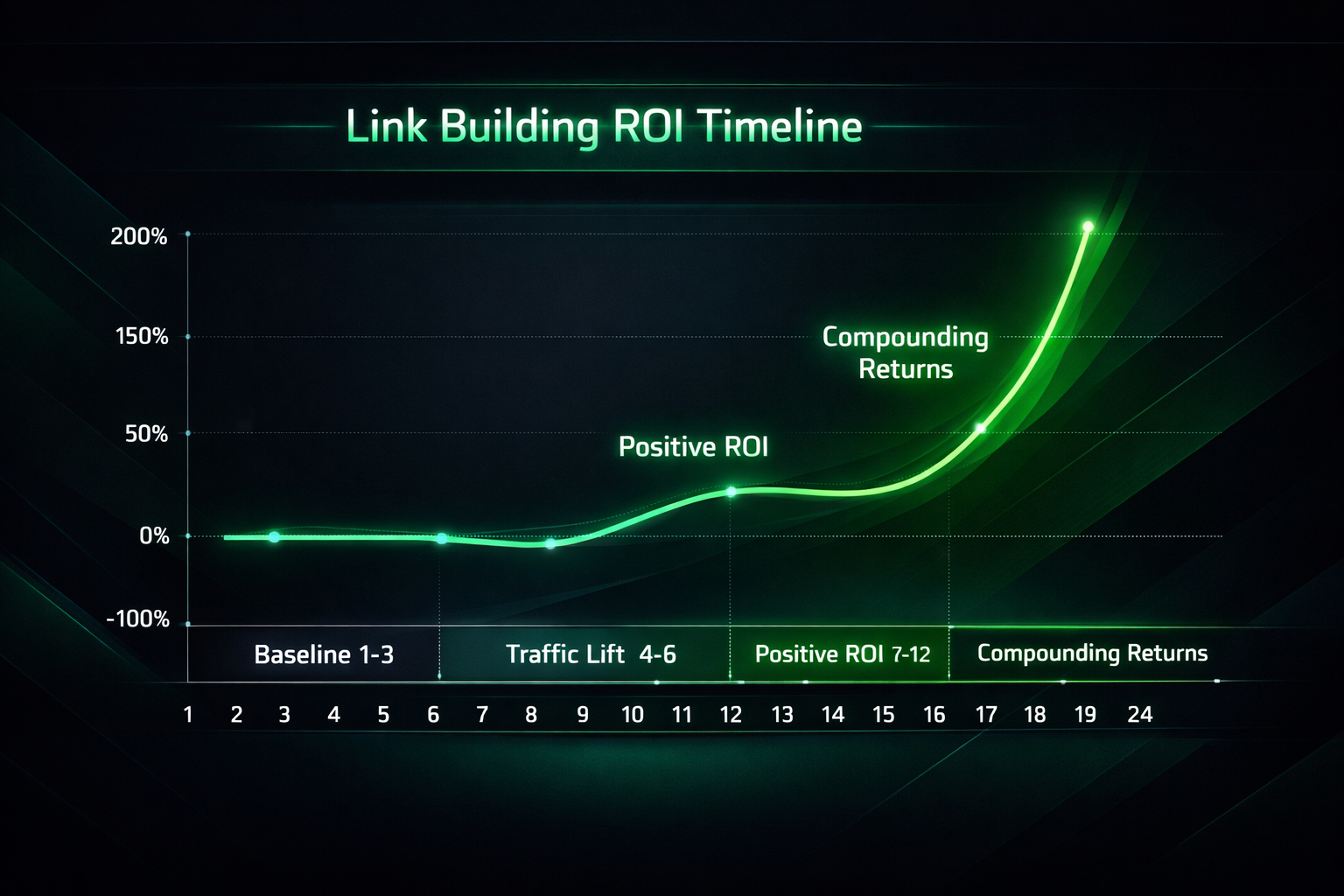
The more important concept for long-term planning is compounding returns. A backlink acquired in month 2 continues to pass authority and support rankings in month 14, 18, and 24 — without additional spend. This means the same campaign that produced 200% ROI in year one may effectively produce 400–600% ROI by year two, as traffic continues to grow on a largely fixed cost base. Payback period — the point at which cumulative revenue exceeds cumulative cost — typically falls between months 8 and 14 for well-executed campaigns in moderately competitive niches.
ROI Forecasting Before You Spend
Most link building ROI discussions focus on measuring results after a campaign. Pre-campaign ROI forecasting — estimating likely return before committing budget — is less commonly covered but arguably more valuable for budget justification and stakeholder reporting.
A simple forecasting framework uses these inputs:
- Link gap analysis — compare your referring domain count for target pages against the top three ranking competitors using Ahrefs or Semrush. The link gap tells you approximately how many additional referring domains may be needed to compete for target positions.
- Search volume and click-through rate (CTR) — estimate the organic sessions available at target ranking positions using Google Search Console data and industry CTR curves (position 1 typically earns 25–35% CTR for branded or navigational queries; lower for informational).
- Conversion rate and AOV — apply your site’s known conversion rate and average order value to the estimated traffic to produce a revenue forecast.
- Estimated campaign cost — use CPAL benchmarks for your link type (editorial links in competitive verticals can range from £150 to £500+ per link depending on quality and niche) multiplied by the number of links needed to close the link gap.
This forecast will not be precise, but it gives stakeholders a reasonable range and a clear logic chain. It also makes ROI reporting more credible when actual results are measured against pre-campaign projections rather than against no target at all.
Industry-Specific ROI Benchmarks
Link building ROI varies substantially by business model and vertical. A single benchmark does not apply across contexts.
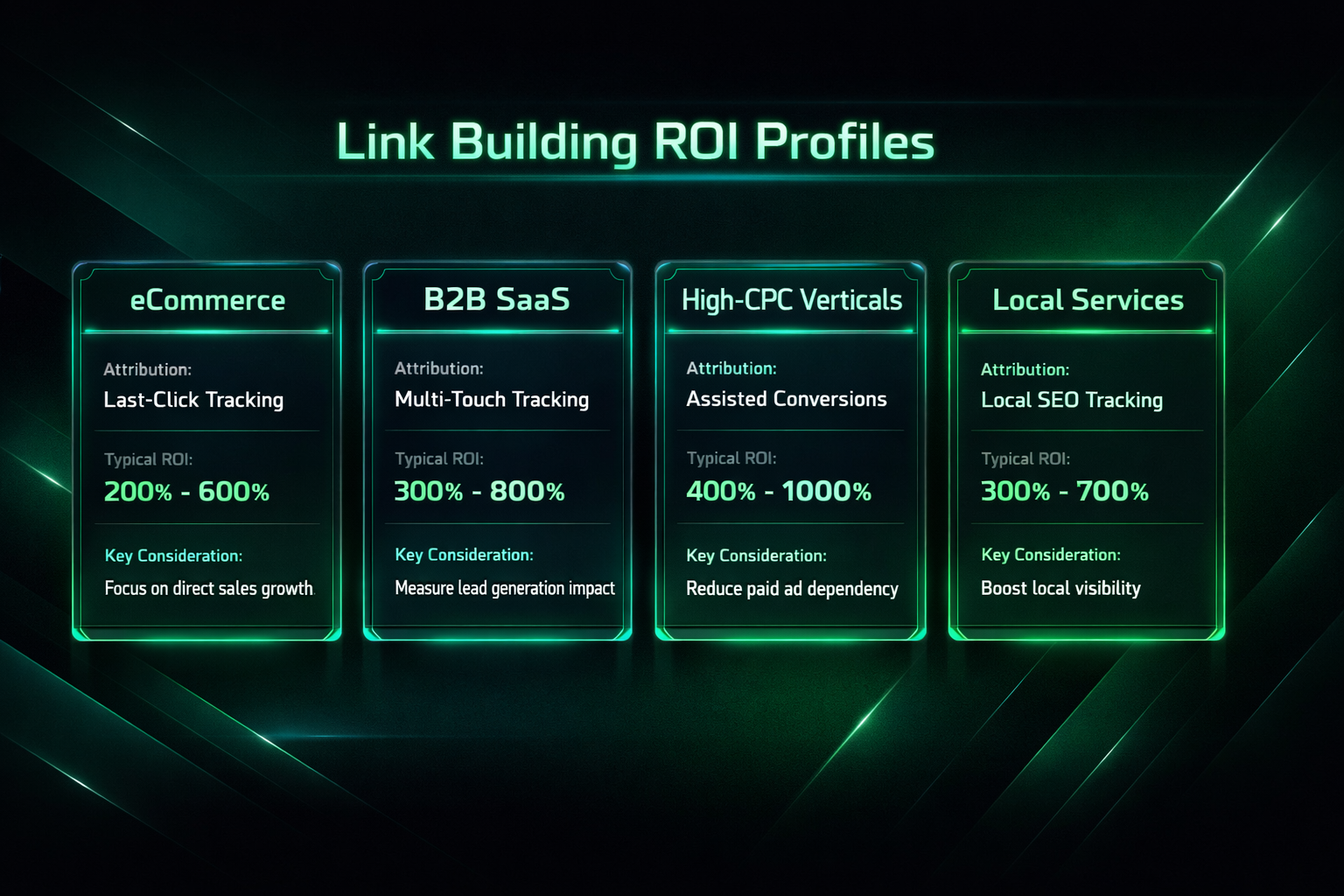
eCommerce: ROI is often calculated on a per-session value basis. With direct revenue tracking available through GA4 and relatively short conversion windows, attribution is cleaner. ROI of 200–500% over 12 months is achievable for established stores targeting mid-competition keywords.
B2B SaaS: Conversion paths are longer and revenue per customer (LTV) is higher, which means the revenue numerator in the ROI formula is larger but takes longer to materialise. LTV-based ROI calculations often show the highest headline returns, but they require more attribution assumptions.
High-CPC verticals (legal, finance, healthcare): Keywords in these niches carry very high traffic value because their CPC equivalents are expensive. Even modest ranking improvements can produce outsized traffic value gains, making the proxy method particularly useful for ROI reporting in these sectors.
Local service businesses: Referral traffic from locally relevant referring domains can drive direct enquiries, but organic traffic attribution requires careful GA4 configuration, particularly if phone calls are a primary conversion channel.
When Link Building ROI Breaks Down
Honest ROI analysis includes recognising the conditions under which the math does not work. Link building investment is unlikely to produce a positive return in the following circumstances:
- Poor content on target pages — links pointing to thin, low-quality, or poorly converting pages cannot compensate for weak on-page fundamentals. Traffic may increase without conversion improvement, keeping revenue low relative to campaign cost.
- Wrong pages targeted — acquiring backlinks to pages with low search volume potential or no clear conversion path wastes link equity. ROI forecasting and keyword research should inform which pages receive link investment.
- Too short a measurement window — evaluating a link building campaign at three months and declaring it a failure is a common and costly error. The timeline section above explains why most campaigns need at least 6–12 months to demonstrate positive ROI.
- Low-quality referring domains — links from irrelevant, low-traffic, or spammy domains contribute little ranking value. CPAL appears low for these links, but the ROI denominator does not shrink if the traffic numerator stays flat.
- No baseline or tracking setup — without a pre-campaign baseline and GA4 goal tracking in place, it becomes impossible to isolate campaign contribution from other organic traffic changes, making the ROI figure unreliable in either direction.
AI Search Visibility as an Emerging ROI Dimension
A growing but largely unmeasured dimension of link building value is AI search visibility. Google’s AI Overviews, along with large language model (LLM) tools that synthesise web content, tend to draw on authoritative, well-linked sources. A site with strong referring domain quality and topical relevance is more likely to be cited in AI-generated responses, which represents a channel of visibility that does not currently appear in standard organic traffic or GA4 conversion reports.
Quantifying this precisely is not yet straightforward. However, monitoring brand mentions in AI search results alongside traditional metrics is becoming part of a complete attribution picture. As AI search visibility becomes more measurable through tools like GA4 traffic source segmentation and third-party AI visibility trackers, it will increasingly be incorporated into ROI reporting frameworks. Campaigns that build topically relevant, high-quality editorial links are better positioned to benefit from this dimension than those focused purely on volume.
Translating Link Building ROI for Stakeholder Reporting
SEO outputs — referring domains, domain rating, keyword rankings — are meaningful to practitioners but often opaque to business decision-makers focused on revenue and cost efficiency. Effective stakeholder reporting translates these outputs into business language.
A practical reporting framework for non-SEO audiences includes: total campaign cost (full accounting, not just agency fees); estimated revenue attributed to organic traffic on target pages; ROI percentage using the core formula; traffic value change as a supporting proxy; and CPAL as an efficiency metric. Where possible, compare the link building campaign’s estimated cost per conversion against paid search CPCs for the same keywords — this demonstrates the long-term cost efficiency of organic investment relative to ongoing paid spend.
Framing compounding returns is also valuable in stakeholder contexts. A chart showing projected ROI at months 6, 12, 18, and 24 — assuming the same links continue to support rankings beyond the initial campaign period — communicates the investment logic more clearly than a single-year figure.
Frequently Asked Questions
What is a good ROI benchmark for link building?
There is no universal benchmark, as ROI depends on campaign cost, niche competitiveness, conversion rate, and business model. For well-executed campaigns in moderately competitive niches, ROI of 200–500% over 12 months is a realistic range. High-CPC verticals or B2B businesses with high LTV can see substantially higher figures, particularly when compounding returns are measured over 24 months.
How long does it take to see a positive ROI from link building?
Most campaigns begin showing meaningful organic traffic growth between months 4–6, with positive ROI typically emerging between months 7–12. Campaigns in highly competitive niches or those targeting keywords with long conversion paths may take longer. Measuring too early and drawing negative conclusions is one of the most common reasons link building investment is cancelled prematurely.
Should I use traffic value or direct revenue for my ROI calculation?
Use direct revenue attribution via GA4 when it is available and reliable. Traffic value is the better choice when revenue attribution is not feasible — for example, in B2B, publishing, or multi-touchpoint service businesses. Both methods can be reported side by side to provide a more complete picture of campaign value.
What is cost per acquired link (CPAL) and how is it useful?
CPAL is calculated as total campaign cost divided by the number of links acquired. It measures link acquisition efficiency rather than business return. CPAL is most useful for comparing different link building methods (guest posts vs. link insertions vs. digital PR) or evaluating in-house vs. agency approaches. A low CPAL is only meaningful if the links acquired are from high-quality, topically relevant referring domains.
Does the ROI formula work the same way for in-house vs. agency link building?
The formula is the same, but in-house calculations are frequently understated because internal staff time is excluded from cost. A genuine in-house vs. agency comparison must include salary allocation, tooling costs, training time, and the opportunity cost of in-house resource. Once full costs are included, the difference in ROI between the two models often narrows considerably, with the better choice depending on campaign scale, expertise, and available internal bandwidth.
How do I track link building ROI in GA4 if my site doesn’t sell products directly?
Configure GA4 Key Events for the conversion actions that matter to your business — contact form submissions, booking requests, phone call clicks, content downloads, or newsletter signups. Assign an estimated monetary value to each event based on your average lead-to-close rate and customer value. This allows GA4 to report estimated revenue from organic sessions even without a direct eCommerce checkout.
Building a Measurement Framework That Grows With Your Campaigns
Calculating link building ROI accurately is less about finding a single number and more about building a consistent measurement framework that improves with each campaign cycle. The pre-campaign baseline documents where you started. Full cost accounting ensures the denominator in the ROI formula reflects real investment. GA4 goal tracking connects organic traffic to business outcomes. Traffic value and CPAL provide supporting metrics when direct attribution is limited. And a 12–24 month measurement window captures the compounding returns that make link building genuinely competitive with paid channels over time.
The businesses that extract the most value from link building ROI analysis are those that treat it as a recurring discipline — not a one-time calculation performed at the end of a campaign to justify a decision already made. If the methodology is in place before the first link is built, the data will tell you not only whether a campaign worked, but why, and where to invest next.


