

Key Takeaways
- A dofollow backlink is simply a standard HTML link with no restrictive attribute — search engine crawlers follow it and pass link equity, also called link juice, to the destination page.
- There is no
rel="dofollow"attribute in HTML; a link is followed by default unless a restrictive attribute such asrel="nofollow",rel="sponsored", orrel="ugc"is added. - Since Google’s 2019 update, nofollow is treated as a hint rather than a strict directive, meaning the dofollow/nofollow distinction is real but not as binary as many guides suggest.
- Quality matters more than the attribute alone — a dofollow link from a low-authority, irrelevant site contributes less than a nofollow link from a major publication with genuine readership.
- White-hat link building tactics such as guest posting, broken link building, original research, and digital PR remain the most sustainable ways to earn dofollow backlinks at scale.
What Is a Dofollow Backlink?
A dofollow backlink is a hyperlink that search engine crawlers are permitted to follow, allowing them to transfer ranking signals — commonly called link juice or link equity — from the linking page to the destination page. When a reputable website links to yours without adding a restrictive HTML attribute, that link is dofollow by default. Search engines such as Google interpret it as a vote of confidence, using it as one of many signals to assess how authoritative, trustworthy, and relevant your page is.
One important technical clarification that many beginner guides miss: there is no actual rel="dofollow" attribute in HTML. The word “dofollow” is an informal industry term, not a real HTML value. A link becomes followed simply by having no restrictive attribute — its default state. If you inspect the source code of a standard editorial link, you will see something like <a href="https://example.com">anchor text</a> with no rel attribute at all. That is a dofollow link.
How Do Dofollow Backlinks Work Technically?
When a search engine crawler discovers a dofollow backlink on a page, it follows the link to the destination URL, indexes the content it finds there, and registers the connection between the two pages. This process is central to how PageRank — Google’s foundational algorithm for measuring page importance — flows through the web. A page that receives many dofollow links from high-authority sources accumulates more PageRank, which can positively influence its position in search results.
Link equity does not pass in equal amounts from every source. The strength of a dofollow backlink depends on the authority of the linking domain, the relevance of the linking page to your topic, where the link appears on the page (an in-body contextual backlink carries more weight than a footer or sidebar link), and the anchor text used. Anchor text — the visible, clickable words in a hyperlink — provides search engines with a contextual signal about what the destination page covers. Diverse, natural anchor text that includes branded terms, generic phrases, and relevant descriptive text tends to produce a healthier backlink profile than a pattern of identical exact-match anchors.
It is also worth understanding link velocity, meaning the rate at which your site acquires new dofollow backlinks over time. A sudden, unnatural spike in link acquisition can appear manipulative to search engines, while steady, gradual growth typically looks organic and is less likely to trigger algorithmic scrutiny.
Dofollow vs. Nofollow Backlinks
The distinction between dofollow and nofollow links is one of the most discussed topics in SEO, but it is also one of the most frequently oversimplified.
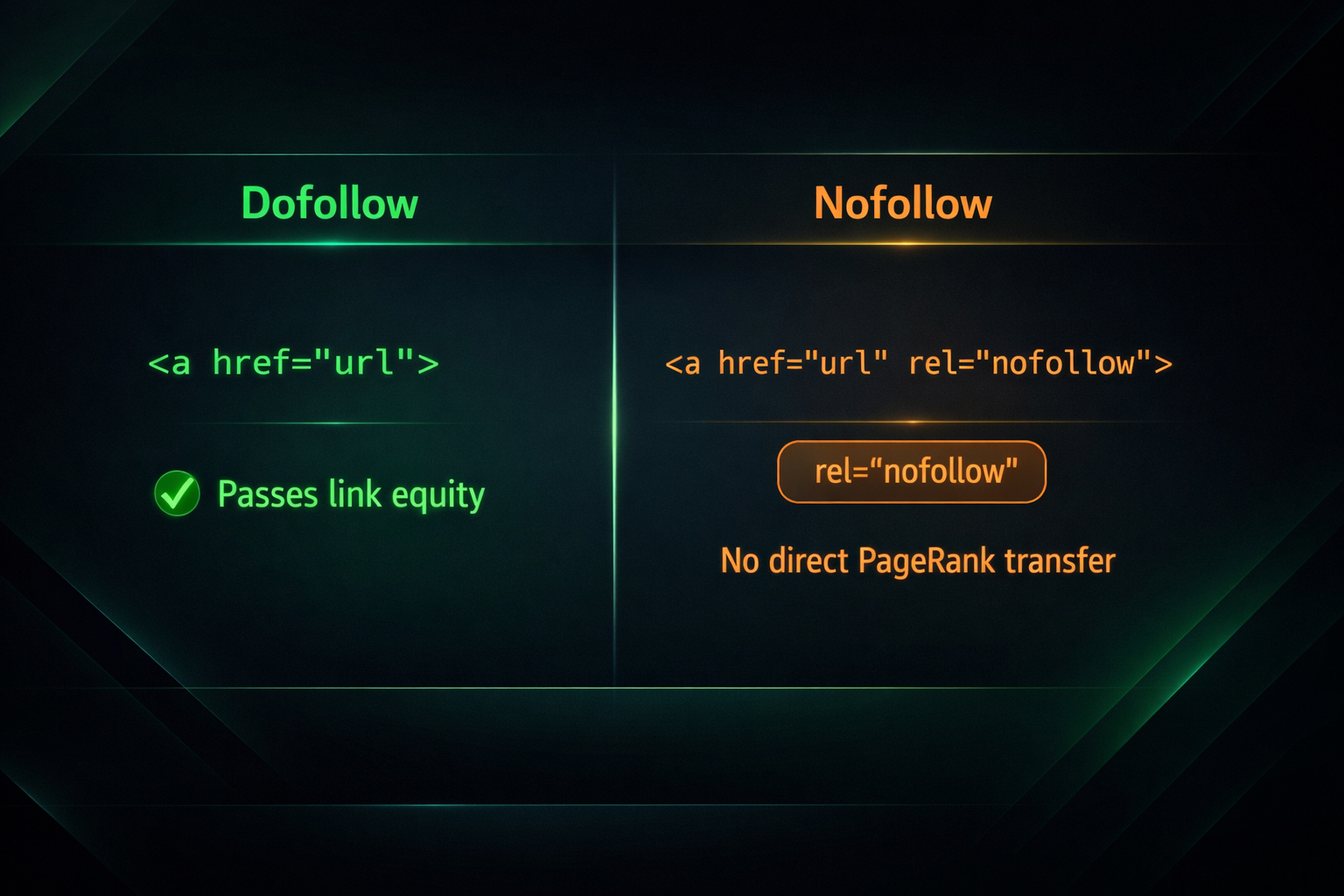
| Characteristic | Dofollow Link | Nofollow Link | Sponsored Link | UGC Link |
|---|---|---|---|---|
| HTML attribute | None (default) | rel="nofollow" |
rel="sponsored" |
rel="ugc" |
| Passes link equity? | Yes | Typically no (see note) | No | No |
| Crawled by Google? | Yes | May be used as a hint | Generally not followed | Generally not followed |
| Typical use case | Editorial, content links | Unvetted or comment links | Paid or affiliate links | Forum posts, comments |
| SEO value | Direct ranking signal | Indirect (traffic, brand) | Minimal for rankings | Minimal for rankings |
Google introduced rel="nofollow" in 2005 primarily to combat comment spam. In September 2019, Google updated its treatment of nofollow links, reclassifying the attribute as a hint rather than a directive. This means Google may choose to follow a nofollowed link and use it for crawling and indexing purposes, even if it does not pass PageRank in the traditional sense. The practical implication is that a nofollow link from a highly authoritative, widely read publication can still contribute to your site’s visibility — through referral traffic, brand recognition, and potential indirect ranking signals — even without direct link equity transfer.
In 2019 Google also introduced two additional attributes: rel="sponsored" for paid and affiliate links, and rel="ugc" for user-generated content such as forum posts and blog comments. These give webmasters finer-grained control over how different link types are communicated to search engines.
A healthy, natural link profile contains a mix of link types. A site with only dofollow backlinks and no nofollow links can actually appear unnatural, since organic online mentions — social media, news sites, forums, comments — frequently produce nofollow links as a matter of course. There is no universally correct dofollow-to-nofollow ratio; the priority should be earning links naturally rather than engineering a specific proportion.
Why Dofollow Backlinks Matter for SEO
Dofollow backlinks remain one of the most influential off-page ranking factors in SEO. Their primary value lies in passing PageRank, which contributes to how search engines evaluate a page’s authority relative to competing pages targeting the same queries. A consistent pattern of earning dofollow links from high-authority websites with strong topical relevance tends to correlate with improvements in domain authority (DA) as measured by Moz, or domain rating (DR) as measured by Ahrefs — though these are third-party metrics, not direct Google signals.
Beyond rankings, dofollow backlinks from reputable sites generate referral traffic — real visitors who click through from the linking page. This traffic has independent value regardless of the SEO benefit, particularly when the linking site serves an audience that overlaps with yours.
There is also an emerging dimension worth noting: as search increasingly intersects with AI-powered answer engines and large language models, earning followed links from authoritative, well-cited sources may contribute to how a brand or website is perceived and referenced in generative search environments. While this area of Generative Engine Optimisation (GEO) is still developing, building a strong base of editorial dofollow backlinks from credible sources appears to be a durable strategy across both traditional and AI-influenced search landscapes.
For internal links — links between pages on your own website — it is generally recommended to leave them as dofollow. Internal dofollow links help search engines crawl your site efficiently and distribute PageRank across your own pages, supporting the visibility of deeper content that might otherwise receive less crawl attention.
What Makes a Dofollow Backlink Valuable?
Not all dofollow backlinks contribute equally to your rankings. A common mistake among beginner SEOs is prioritizing the dofollow attribute itself rather than the quality of the source. A dofollow link from a low-authority directory that nobody visits and that is unrelated to your niche may contribute little — or in extreme cases, could be associated with spammy link patterns that attract algorithmic penalties.
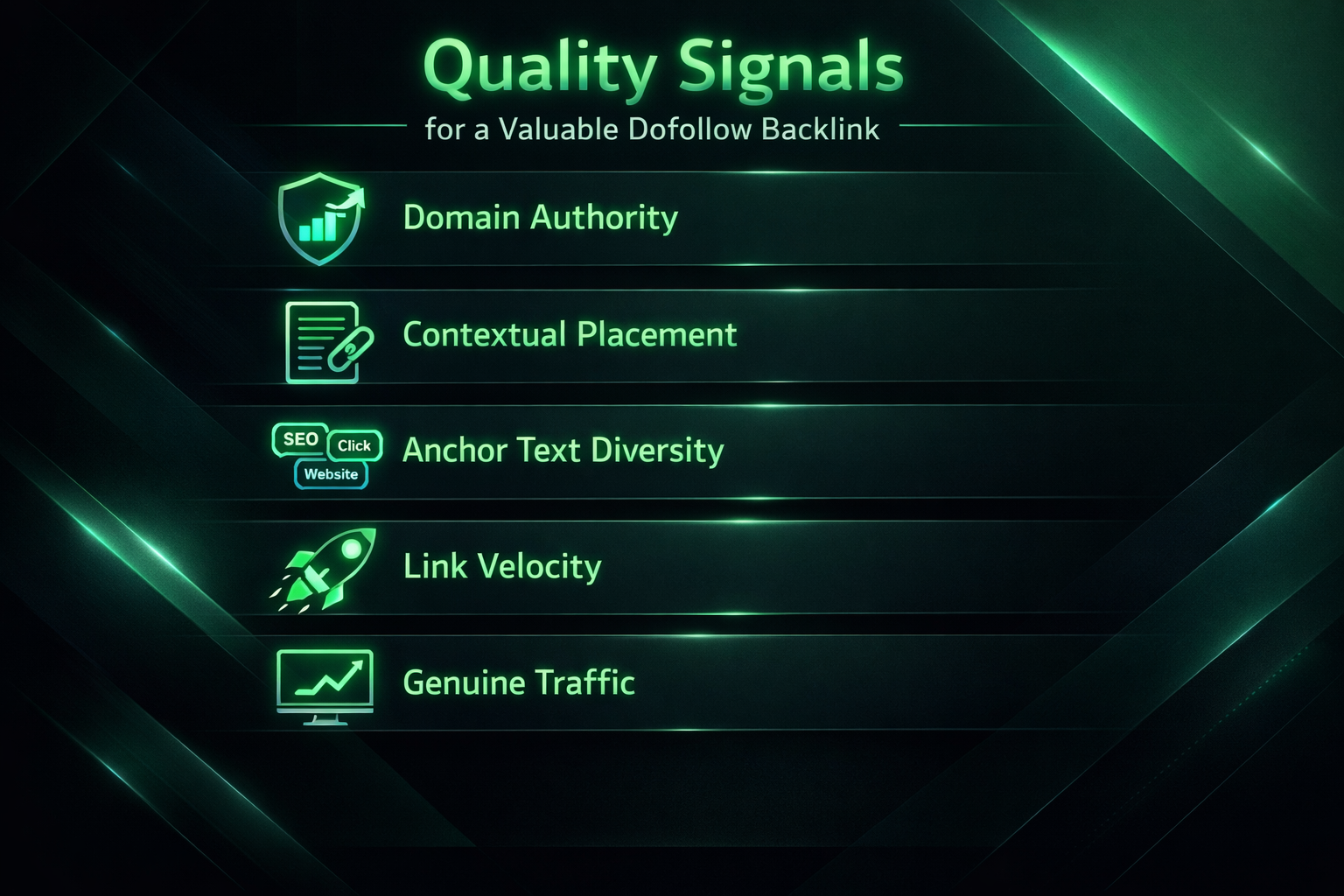
The characteristics that typically make a dofollow backlink valuable include:
- Source domain authority and relevance: A link from a well-established site in your niche carries significantly more weight than one from a general, low-traffic directory.
- Contextual placement: Links embedded naturally within the body text of a relevant article — true editorial backlinks — are generally weighted more strongly than links in footers, sidebars, or link lists.
- Anchor text diversity: A natural mix of branded anchors, generic anchors (such as “click here” or “learn more”), and descriptive anchors reduces the risk of over-optimisation penalties. Heavy use of exact-match keyword anchor text on dofollow links from low-DR sites is a known penalty risk.
- Link velocity: Acquiring links at a consistent, organic pace looks natural. Sudden large spikes in dofollow link acquisition — particularly from low-quality sources — can be a red flag.
- Genuine traffic on the linking page: A link from a page that real people read and engage with tends to carry stronger signals than a link buried on an unvisited page.
How to Check Whether a Link Is Dofollow
Verifying whether a specific backlink is dofollow or carries a restrictive attribute is straightforward. The quickest manual method is to right-click the link on the page and select “Inspect” or “Inspect Element” in your browser. In the HTML panel that appears, look at the anchor tag. If you see no rel attribute, or the rel attribute does not include nofollow, sponsored, or ugc, the link is followed by default.
For auditing your full backlink profile at scale, tools such as Ahrefs, SEMrush, and Moz provide backlink reports that flag each link’s follow status. Browser extensions such as the MozBar and Ahrefs SEO Toolbar can also highlight dofollow and nofollow links directly on the page as you browse, which is useful when evaluating potential link opportunities during outreach research.
10 White-Hat Tactics to Earn Dofollow Backlinks
Building a strong base of dofollow backlinks requires a deliberate, quality-focused link building strategy. The tactics below are all considered white-hat link building approaches — meaning they comply with Google’s guidelines and do not carry the penalty risks associated with link schemes, private blog networks (PBNs), or paid link manipulation.
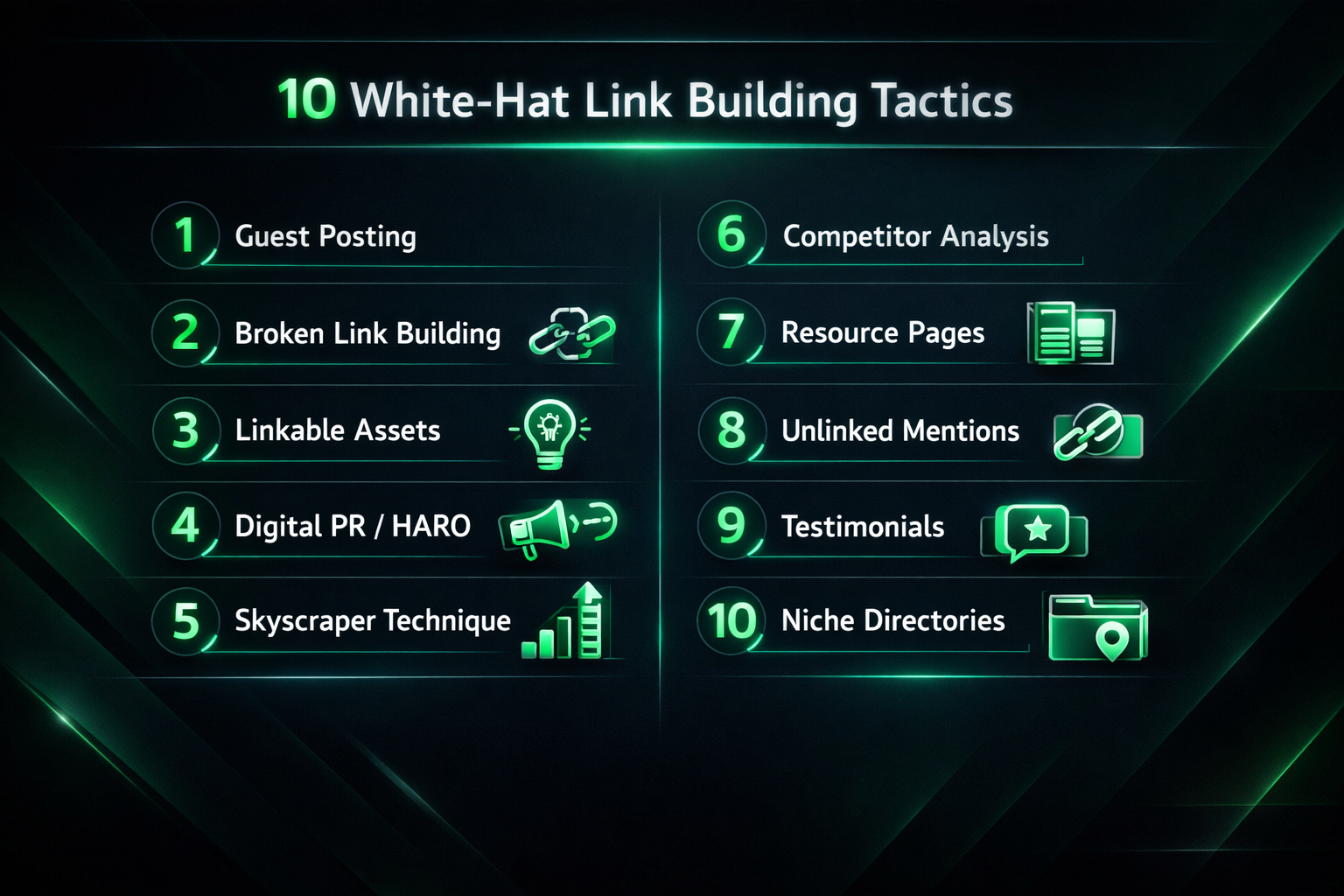
1. Guest Posting on Relevant Websites
Guest posting — contributing original articles to other websites in your niche in exchange for an author bio or in-content link — remains one of the most reliable methods for earning contextual dofollow backlinks. The key is targeting sites with genuine readership and strong topical relevance to your content. Prioritise quality over volume: a single editorial backlink from an authoritative industry publication is worth more than ten links from low-DR guest post farms. When pitching, propose topics that genuinely serve the host site’s audience rather than topics engineered primarily to include your link.
2. Broken Link Building
Broken link building involves finding links on other websites that point to pages that no longer exist (404 errors), then reaching out to the site owner to suggest your relevant content as a replacement. Tools such as Ahrefs and SEMrush can identify broken outbound links on pages within your niche. This tactic is effective because it frames your outreach as genuinely helpful — you are solving a problem for the webmaster — rather than simply requesting a favour.
3. Create Linkable Assets
Original research, comprehensive data studies, free tools, detailed guides, and unique datasets are examples of linkable assets — content that other writers and site owners naturally want to reference. Publishing genuinely useful, well-researched content that fills a gap in your niche is one of the highest-leverage long-term link building approaches available. When your content becomes a recognised reference on a topic, it can continue attracting dofollow backlinks passively over months and years without ongoing outreach.
4. Digital PR and HARO
Platforms such as HARO (Help a Reporter Out) connect journalists and content creators with expert sources. Responding to relevant media queries with useful, well-framed insights can earn editorial backlinks from news sites, industry publications, and high-authority blogs. Digital PR more broadly — proactively pitching newsworthy data, original research, or expert commentary to journalists — can generate dofollow links from major publications that would be difficult to obtain through conventional outreach.
5. The Skyscraper Technique
The skyscraper technique involves identifying content in your niche that has already earned significant backlinks, creating a meaningfully better or more current version, and then reaching out to sites already linking to the original to suggest your improved resource. The outreach succeeds because the target site already values content on this topic — you are offering an upgrade, not a cold pitch.
6. Competitor Backlink Gap Analysis
Competitor backlink analysis using tools such as Ahrefs or SEMrush allows you to identify websites that link to multiple competitors in your space but not to you. These sites have already demonstrated a willingness to link to content like yours, making them warm outreach targets. Filtering for high-DR sources with genuine topical relevance is more efficient than working from an undifferentiated list.
7. Resource Page Link Building
Many websites maintain curated resource pages — lists of useful tools, guides, or services relevant to their audience. Identifying these pages in your niche and requesting inclusion when your content genuinely belongs on the list is a straightforward way to earn contextual dofollow links. The outreach success rate is generally higher when your content is a clear fit rather than a stretch.
8. Reclaim Unlinked Brand Mentions
Websites that mention your brand, product, or content by name without linking to you represent low-friction link opportunities. Search for unlinked mentions using tools such as Ahrefs Content Explorer or Google Alerts, then reach out to the author or editor with a friendly request to convert the mention into a link. Because the site has already chosen to reference you, conversion rates for this tactic tend to be higher than cold outreach.
9. Testimonials and Case Studies
Many businesses and tool providers publish customer testimonials on their websites, often with a link back to the reviewer’s site. If you use software, services, or tools relevant to your niche, offering a genuine, detailed testimonial can earn a dofollow link from the vendor’s testimonials page. The links tend to be contextual and come from legitimate business websites, making them a clean addition to your backlink profile.
10. Niche Directories and Industry Associations
Selective submission to niche directories and industry association member listings can provide dofollow backlinks with genuine topical relevance. The emphasis should be on selectivity — legitimate industry bodies, professional associations, and well-maintained niche directories — rather than bulk submission to general web directories, which offers minimal SEO value and can generate spammy signals.
Common Mistakes to Avoid
Several patterns in dofollow link building carry meaningful risks that beginners often underestimate. Purchasing links from link brokers or link farms — even when those links appear dofollow — violates Google’s guidelines and can result in manual penalties or algorithmic devaluation. Over-optimising anchor text by using the same exact-match keyword phrase across many dofollow links from low-DR sources is a well-documented penalty trigger. And, as noted earlier, treating the dofollow attribute as the primary quality signal is a strategic error: a nofollow link from a major national publication with high genuine traffic can do more for your brand’s authority and indirect SEO signals than dozens of dofollow links from obscure directories.
It is also worth avoiding a common misconception driven by the 2024 Google API documentation leak, which revealed that Google tracks multiple internal PageRank variants and considers a broader set of signals — including engagement, topical authority, and entity associations — than the simplified dofollow/nofollow binary suggests. This reinforces the principle that sustainable link building focuses on earning mentions from genuinely credible, relevant sources, not on gaming a single attribute.
Frequently Asked Questions
Is a dofollow link always better than a nofollow link?
Not necessarily. A dofollow link from a low-authority, irrelevant site contributes little to your rankings. A nofollow link from a high-traffic, authoritative publication can drive significant referral traffic, brand awareness, and indirect trust signals. The source quality and relevance matter more than the attribute alone.
How many dofollow backlinks do I need to rank?
There is no universal number. The quantity of dofollow backlinks required depends heavily on your niche’s competitiveness, the authority of your domain relative to competitors, the quality of the links, and dozens of other on-page and off-page factors. Focusing on earning high-quality, topically relevant dofollow links consistently is more effective than targeting a specific count.
Can I buy dofollow backlinks?
Purchasing links intended to pass PageRank violates Google’s link spam policies and can result in manual penalties or algorithmic ranking drops. Paid links that are disclosed should use rel="sponsored". The risks of buying undisclosed dofollow links generally outweigh any short-term ranking benefit.
Does Google still respect nofollow as an instruction not to follow a link?
Since September 2019, Google treats rel="nofollow" as a hint rather than a strict directive. Google may choose to crawl and index a nofollowed link for discovery purposes, though it typically does not pass PageRank through such links in the same way a dofollow link does.
Should internal links be dofollow?
Yes. It is generally recommended to keep internal links as dofollow. Internal dofollow links help search engine crawlers navigate your site efficiently, distribute link equity across your own pages, and support the indexing of content that might otherwise receive limited crawl attention.
What is a natural backlink profile?
A natural link profile is a diverse mix of followed and nofollowed links from a variety of sources — editorial sites, directories, forums, social platforms, news coverage — acquired at a consistent pace over time. A profile consisting entirely of dofollow links from similar source types can appear engineered rather than organic.
Building Dofollow Backlinks for Long-Term SEO Growth
Dofollow backlinks remain a core component of effective SEO because they directly influence how search engines assess the authority and relevance of your pages. Understanding that the dofollow attribute is simply the default state of an HTML link — not a special designation you apply — is the technical foundation. Understanding that the value of any given link depends on the source’s authority, relevance, and genuine audience is the strategic foundation.
The most durable approach to earning dofollow backlinks combines content worth linking to — original research, genuinely useful resources, and well-argued expert commentary — with targeted outreach through white-hat methods such as guest posting, broken link building, digital PR, and competitor gap analysis. Monitoring your backlink profile regularly using tools such as Ahrefs, SEMrush, or Moz allows you to identify new opportunities, track link velocity, and catch any low-quality links that warrant disavowal before they accumulate into a pattern that could attract scrutiny.
As search evolves — with AI-assisted answer engines placing increasing weight on well-cited, authoritative sources — investing in the kind of content and credibility that earns genuine editorial links from reputable sites is likely to remain a sound long-term strategy, regardless of how the finer mechanics of link attribute interpretation change over time.


