
Resource Page Link Building Value For B2B Websites
Resource page link building still creates value for B2B websites in 2026 when it is managed as selective editorial outreach, not bulk link chasing. For SaaS companies, agencies, affiliate marketers, e-commerce brands, and service firms, this strategy can earn backlinks from curated resources that real buyers, researchers, and industry professionals use.
As a link building agency, we see the strongest results when resource link building supports a broader acquisition mix: guest post backlinks, niche edit links, editorial backlinks, broken link building, and publisher relationship campaigns. The objective is not simply getting a link. The objective is building high-quality backlinks from relevant environments with controlled anchor text, natural link velocity, and transparent performance tracking.
Resource Page Link Building Meaning For B2B SEO
Resource link building is the process of finding relevant resource pages, qualifying each opportunity, and pitching a useful piece of content for inclusion. In B2B SEO, the tactic works best when the asset helps a defined buyer group solve a specific problem.
Our agency manages this as a full workflow, not a one-off email task. A resource page link building campaign requires research, qualification, content matching, outreach email writing, response handling, anchor text planning, indexing checks, and reporting.
Key campaign components include:
- Prospecting around keywords, competitors, industries, and buyer roles
- Manual quality review before any outreach starts
- Outreach email personalization based on the curator’s existing list
- Anchor text distribution that avoids over-optimization
- Link tracking after placement goes live

Mon-Fri: 09:00 AM – 06:00 PM
Resource Page Definition
A resource page is a curated URL that lists helpful links, tools, guides, templates, research, vendors, or educational assets around a topic. A good resource page usually serves a narrow audience, such as HR leaders comparing payroll tools, SaaS founders researching analytics, or marketing teams improving search visibility.
For B2B websites, relevant resource pages may appear on blogs, universities, associations, partner directories, nonprofit sites, media properties, or industry hubs. The strongest curated lists are not random collections. They help users make better decisions.
Resource Page Link Building Definition
Resource page link building means contacting a resource page owner or curator and suggesting a relevant asset that deserves to be added. The pitch must explain why the content improves the resource list, not why the sender wants backlinks.
In managed campaigns, we treat resource page outreach as editorial outreach. We evaluate fit, suggest a specific placement, and avoid inflated claims. Resource page curators respond better when a recommendation makes their work easier.
Resource Page Examples For SaaS Brands
For SaaS brands, resource links often come from tool lists, integration directories, startup hubs, university technology collections, and industry blogs. A CRM platform might earn backlinks from a sales enablement list if the linked guide explains forecasting with practical examples.
The SaaS assets most likely to earn links include:
- Templates for sales, onboarding, reporting, or operations
- Benchmark reports with original data
- Free calculators and workflow tools
- API guides and integration tutorials
- Comparison resources with neutral explanations
These assets work because they educate before they sell.
Resource Page Examples For B2B Service Firms
B2B service firms can get backlinks from association websites, agency partner lists, professional education hubs, vendor comparisons, and niche business directories. A cybersecurity consultancy, for example, may fit a compliance resource list for financial institutions.
Service companies benefit because expertise matters in complex buying decisions. Our team builds backlinks for B2B service companies by matching service expertise with websites where decision-makers already look for trusted references.
Why Resource Page Links Still Matter For B2B Websites
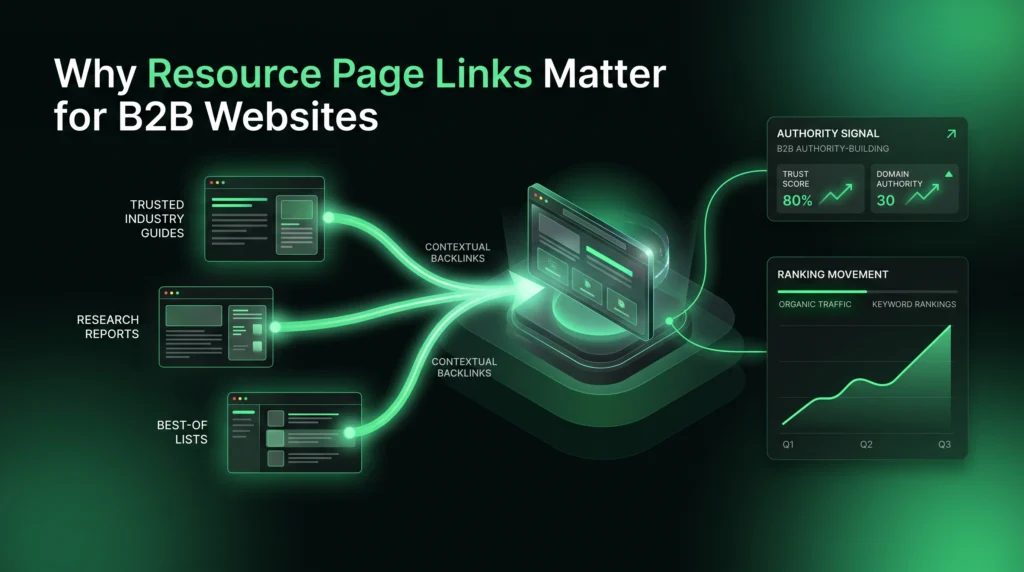
Resource page links matter because B2B rankings are rarely won by content alone. In competitive SERPs, Google and AI search systems evaluate topical relevance, authority, brand mentions, link context, and the usefulness of surrounding content.
Industry link building statistics continue to show a strong relationship between competitive rankings and credible backlink profiles. That does not mean every backlink is valuable; it means building high-quality backlinks from relevant websites remains a practical advantage.
Topical Relevance For Niche Audiences
Topical relevance is the main reason links from resource pages can still support SEO. A curated HR compliance list linking to a payroll software guide sends a cleaner topical signal than a broad lifestyle blog linking to the same asset.
Look for relevance signals such as:
- Same industry or closely related vertical
- Audience overlap with buyers or practitioners
- Existing links to similar tools, guides, or research
- Clear editorial purpose behind the curated list
Authority Signals For Long Sales Cycles
B2B buyers compare vendors across multiple sessions, stakeholders, and decision criteria. Editorial mentions, trusted curated lists, and third-party recommendations help reinforce credibility before prospects contact sales.
High-authority backlinks can support rankings, but they also influence perception. When a SaaS brand appears on respected industry resources, prospects see external validation before they book a demo.
Referral Traffic For Lead Generation
Referral traffic from curated resources is usually smaller than traffic from ranking blog posts, but the visitors can be highly qualified. People who click from a relevant list are often actively researching a solution, tool, or guide.
In our outreach-based link building campaigns, we review more than SEO metrics. We check whether the source has audience value, organic visibility, relevant outbound links, and visible placement potential. A hidden page link in a forgotten section rarely drives meaningful results.
Search Visibility Benefits
Resource page backlinks can support keyword growth when they point to content that already satisfies search intent. A backlink can help strong content compete, but it cannot rescue thin copy, weak UX, or mismatched intent.
That is why we align every link building campaign with content quality, anchor text distribution, and target URL strategy. If the keyword is commercial, the linked asset must naturally support commercial research. If the keyword is informational, the content should provide depth, examples, and clear next steps.
Situations Where This Tactic Loses Value
This tactic loses value when targets are outdated, irrelevant, overloaded with links, or maintained only for paid placements. It also underperforms when companies pitch homepages, sales assets, or generic blog posts with no distinct value.
The warning signs are easy to spot:
- No visible updates for years
- Broken external links across the list
- Irrelevant outbound links
- Obvious paid placement language
- No traffic or indexation signals
Resource page link building works when the target is useful, the content is link-worthy, and the outreach email gives a busy curator a clear reason to act.
Resource Pages, Listicles, Roundups, Resource Hubs
Modern resource link building is broader than old-school “resources” sections. Today, B2B link building opportunities often appear in listicles, roundups, tools directories, partner hubs, comparison articles, and curated industry guides.
Brand inclusion on trusted websites can also influence AI search discovery. ChatGPT, Perplexity, Gemini, and Claude often surface entities that are clearly described across authoritative third-party sources.
Traditional Resource Pages Vs Modern Listicles
Traditional resource pages usually list external links under categories. Modern listicles explain why each resource, tool, company, or page is useful, which makes them more editorial and often more valuable.
Listicles can be strong outreach targets when the content is updated, ranked, and maintained. “Best compliance tools for SaaS finance teams” may deliver stronger business value than a generic resource list with no visibility.
Roundups As Link Targets
Roundups collect expert opinions, tools, examples, or recommended resources around one topic. These articles can help B2B brands earn backlinks when they provide a strong expert quote, data point, or useful asset.
Curated Hubs As Link Opportunities
A curated hub is a structured collection of content around a specific subject. These hubs may include guides, templates, webinars, reports, tools, and third-party references.
Curated hub placements often fit SaaS brands and agencies because the curator wants useful material that keeps the collection valuable. When pitching a resource, we explain where the link should appear and why the content fills a gap.
Pages With Resource Sections
Some pages are not full resource lists but contain smaller curated sections. These sections can appear inside blog posts, guides, documentation, online courses, and association content.
These opportunities are easy to miss if prospecting only searches for “resources.” We often find them by reviewing competitor backlink profiles and URLs that already link to similar tools, guides, or research.
Industry Directories Plus Association Pages
Industry directories and association websites can provide authority, relevance, and referral visibility. For B2B companies, associations often carry trust because members, buyers, and vendors use them for discovery.
Not every directory is worth pursuing. We review:
- Editorial review standards
- Organic traffic and indexation
- Topical fit with the client’s offer
- Outbound link quality
- Whether the listing serves users or only sells links
Customer Support Hubs For Linkable Assets
Customer support hubs can create indirect resource link opportunities. A company that publishes detailed templates, checklists, or troubleshooting guides may earn links from external support content that references helpful material.
Some B2B brands also build resource pages on their own websites to attract natural citations. The best approach is to organize assets around user problems, not internal product categories.
How To Find Resource Pages Worth Pitching
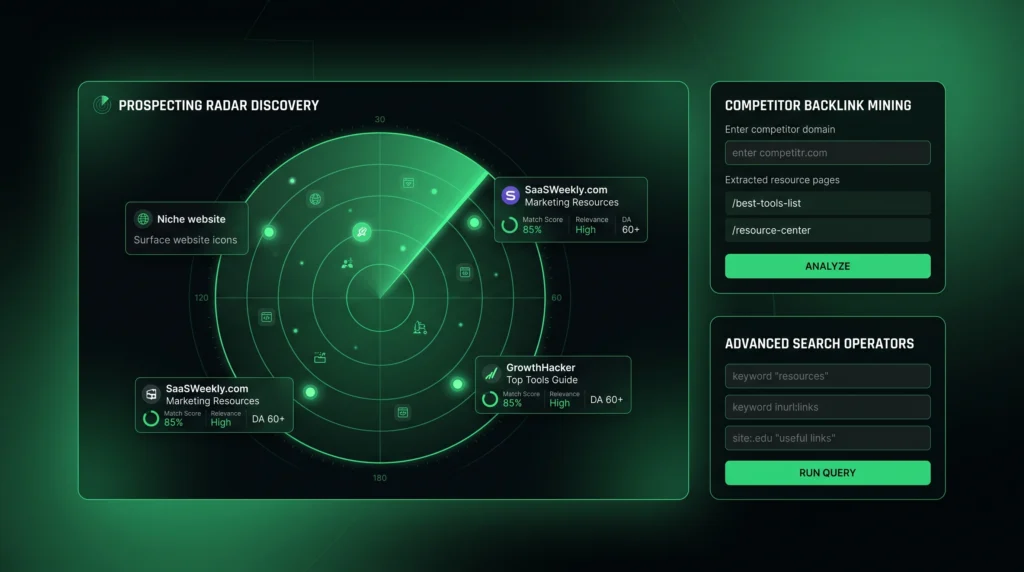
Finding relevant resource pages requires more than typing one search operator into Google. A strong process combines manual search, competitor backlink analysis, prospect databases, tools like ahrefs, and human review.
Our agency uses layered prospecting because each source uncovers different opportunities. Manual search finds obvious targets, backlink mining reveals proven linkers, and content tools help scale without losing topical accuracy.
Google Search Operators Beyond Resources
Search operators can uncover websites that mention “tools,” “guides,” “recommended vendors,” “useful links,” “best resources,” “industry resources,” and “helpful websites.” For B2B campaigns, we combine operators with buyer roles, industries, and use cases.
Examples include:
- keyword + useful tools
- keyword + recommended resources
- keyword + helpful links
- keyword + industry associations
- keyword + vendor directory
The best operators reflect how real page curators label helpful collections. “Resources” is only one signal.
Competitor Backlink Mining
Competitor backlinks often reveal websites that already link to similar companies or content. If a curated list mentions three competing tools, it may be open to adding another useful resource.
We review competitor links carefully before outreach. The presence of a competitor backlink does not automatically make a target good. Relevance, traffic, editorial quality, and business fit still matter.
Ahrefs Content Explorer Workflow
Ahrefs Content Explorer can help find relevant URL types at scale. We use tools like ahrefs to search for targets containing specific phrases, filter by traffic or referring domains, and identify content that mentions related topics without linking to the client.
A practical workflow includes:
- Search by topic, tool category, or buyer problem.
- Filter out low-quality domains and thin content.
- Export potential link building opportunities.
- Review each URL manually.
- Match the strongest targets to the right asset.
Edu Gov Association Opportunities
Edu, gov, and association websites can be valuable when the content fit is genuine. A university entrepreneurship section may link to startup templates, while a nonprofit business support hub may reference compliance guides.
Vendor Partner Resource Pages
Vendor and partner resource pages are strong targets for B2B companies with real ecosystem relationships. Software integrations, implementation partners, resellers, and industry vendors often maintain partner hubs or recommended tool lists.
This is where publisher relationships for link building can create advantages. Real relationships reduce friction, but every placement still needs editorial relevance and a reason to exist.
How To Qualify Resource Page Opportunities
Qualification protects a link building campaign from wasted outreach and risky placements. We would rather pitch 80 strong prospects than email 1,000 weak targets with low relevance.
A high-quality resource page should have topical fit, indexation, organic visibility, editorial standards, and reasonable outbound link behavior. Metrics are useful, but they cannot replace human review.
Topical Fit Before Metrics
Topical fit comes first because an irrelevant backlink sends weak signals and may never drive qualified traffic. A cybersecurity guide should not be pitched to a generic marketing list unless there is a clear security-marketing connection.
Our team reviews site category, audience, surrounding content, existing links, and the reason a curator would add the asset. If the resource list serves the same audience as the client’s content, the opportunity moves forward.
DR DA Traffic As Filters
DR, DA, and organic traffic help filter opportunities, but these numbers are not the final decision. A high-DR site with no relevant audience may deliver less value than a niche website with modest authority and strong topical trust.
We use metrics to identify risk and prioritize effort. A URL with no traffic, poor indexation, and spammy outbound links rarely deserves outreach time.
Indexation Search Value Audience Value
A target should be indexed and accessible to users. If Google does not index the URL, or the content is blocked, hidden, or orphaned, SEO value may be limited.
We also check whether the URL ranks for any relevant keyword or receives meaningful visibility. A relevant source with small but steady traffic can produce better value than an impressive domain with a forgotten list.
Maintenance Signals Plus Freshness
Maintained resources are more likely to accept relevant updates. Fresh timestamps, active links, updated entries, and recent editorial changes indicate that someone still cares about the content.
Abandoned lists waste time. When links are broken, tools are outdated, and contact paths are dead, outreach becomes inefficient unless broken link building creates a strong reason to contact the owner.
Outbound Link Quality Follow Status
Outbound link quality shows whether the curator reviews sources carefully. If the list links to spam, unrelated sites, thin affiliate URLs, or paid-link footprints, we usually remove it from the campaign.
Follow status matters, but it is not the only factor. A nofollow link from a highly relevant industry resource may still support referral traffic and brand discovery, while a followed link from a poor source may create risk.
Existing Link Patterns Plus Content Fit
Existing link patterns reveal what kind of content the curator accepts. Some lists link only to educational guides, while others include tools, vendors, templates, statistics, or case studies.
Before we pitch a resource, we match the content type to the existing pattern. A strong pitch feels like a natural update, not a favor.
Content Worth Adding To Resource Pages
Resource page curators link to content that helps their audience. That content may be a guide, template, report, calculator, checklist, or visual explainer, but it must offer value beyond brand promotion.
In our experience, the strongest assets answer specific problems with depth and clarity. A high-quality resource gives the curator a reason to update the list and gives users a reason to click.
Comprehensive Beginner Guides
Beginner guides work well when they explain complex topics clearly and include practical examples. For B2B SEO, these guides often support top-of-funnel visibility and earn links from educational websites.
A comprehensive page guide should include:
- Clear definitions
- Step-by-step workflows
- Common mistakes
- Industry examples
- Practical next steps
If the guide is thin or generic, it will struggle to earn backlinks from selective curators.
Original Research Statistics Benchmarks
Original research is one of the strongest assets for earning editorial backlinks. Surveys, benchmark reports, industry data, and proprietary analysis give writers and resource page curators something worth citing.
Link building statistics also support AI search visibility because structured findings are easy for answer engines to summarize. When possible, we recommend turning internal customer data or market research into a public report.
Free Tools Calculators Templates
Free tools, calculators, and templates are strong candidates for links from resource pages because they solve immediate problems. A financial calculator, SEO checklist, onboarding template, or ROI worksheet can attract links from curated lists.
For B2B brands, these assets often convert better than broad blog posts. Users arrive with a practical need, and the tool introduces the company’s expertise without forcing a hard sell.
Curated Hubs Visual Explainers Infographics
Curated hubs, visual explainers, and infographics can earn links when they simplify complex information. A visual workflow for SOC 2 preparation or a hub for e-commerce SEO templates may fit several relevant resource pages.
Visual assets need supporting text to perform well in search. We usually pair infographics with indexable explanations, clear headings, and contextual copy so users and search engines can interpret the content.
Outreach Process That Gets Replies
Resource page outreach succeeds when the message is useful, specific, and respectful of the owner’s time. The outreach email should never sound like a mass request for high-authority backlinks.
Our managed outreach process combines prospect research, personalization, deliverability controls, follow-up timing, and response tracking. The goal is to earn links through relevance, not pressure.
Lead With Their Page Not Your Ask
A strong email starts by referencing the exact URL, section, or outdated item. This shows the resource page owner that the message is not automated spam.
Instead of opening with “we want a backlink,” we explain the value gap. For example, we may note that a curated list covers B2B analytics tools but lacks a current benchmark guide for revenue teams.
Specific Placement Suggestion
Specificity improves response rates. We suggest where the link could fit, which section it supports, and why users would benefit from the addition.
A vague pitch creates work for the curator. A clear placement suggestion reduces effort and makes the decision easier. That matters when editors receive dozens of pitches each week.
Short Personalized Email Template
A practical outreach email should be short, human, and focused on the curator’s audience.
Use a simple structure:
- Mention the exact resource list.
- Identify the relevant section or content gap.
- Introduce your piece of content.
- Explain the user benefit.
- Give the curator full editorial control.
Example:
Hi [Name],
I found your resource list on [topic] and noticed it includes several helpful guides for [audience]. We recently published a [piece of content] that covers [specific value], and it may fit the section on [section name].
Here is the URL: [URL]
No pressure either way. I thought it could be useful for readers looking for [specific outcome].
Best,
[Name]
Follow Up Timing
One follow-up is usually enough for resource page outreach. We typically wait several business days, then send a short reminder with the same value proposition.
Aggressive follow-ups damage brand reputation. A controlled cadence protects deliverability and keeps the campaign aligned with professional outreach standards, relevance checks, and long-term publisher trust.
Response Handling After Rejection
Rejection is useful data. If a curator says the content is not a fit, we record the reason and avoid pushing.
Common rejection signals include:
- Only non-commercial resources accepted
- Updates happen quarterly or annually
- Topic is too narrow for the list
- Existing resource already covers the need
- No external additions allowed
Common Mistakes Risks Ethics
Resource page outreach becomes risky when teams prioritize volume over relevance. Poor prospecting, weak content, and aggressive emails can hurt brand perception and waste budget.
As an outsourced link building agency, we focus on sustainable execution. That means manual outreach, real publisher placements, editorial content standards, transparent reporting, and controlled link velocity.
Poor Content Fit
Poor content fit is the most common reason resource page campaigns fail. If the suggested asset does not help the audience, the request feels self-serving.
Before outreach, we ask one direct question: would this list be better for users if the client’s resource were added? If the honest answer is no, we do not pitch.
Abandoned Page Targeting
Abandoned pages often look promising in backlink tools but fail in practice. Contact forms may be broken, editors may have moved on, and old resource lists may no longer be maintained.
Broken link building can create an opportunity on abandoned pages, but only when the owner is reachable. Otherwise, the campaign burns time on prospects that cannot convert.
Identical Email Blasts
Identical email blasts are easy to detect. Curators ignore generic outreach because it creates no trust and shows no knowledge of their content.
Personalization requires the right URL, section, and reason for inclusion.
Broken Link Blind Spots
Ignoring broken links misses a practical angle. If a resource page contains dead links, the owner has a real maintenance problem.
A replacement suggestion should be helpful, not manipulative. The best broken link building pitches identify the dead link, explain the issue, and offer a relevant replacement only when the content truly matches.
Paid Link Requests
Paid resource page placements require careful review, especially when the placement is positioned as editorial. A professional campaign should evaluate disclosure, relevance, source quality, anchor text, and whether the link genuinely improves the resource page for users.
We avoid unclear placement terms, exaggerated claims, and low-value outreach. Our focus is building high-quality backlinks through relevance, editorial value, source review, and transparent processes.
Metrics Over Relevance
Metrics can mislead teams into chasing the wrong websites. A high-DR domain with irrelevant content, poor traffic, or spammy outbound links is not automatically a good target.
Use metrics as filters, not final approval:
- DR and DA for authority context
- Organic traffic for real visibility
- Referring domains for trust signals
- Outbound link review for risk
- Topic match for SEO relevance
Relevance, audience, content fit, and editorial quality must guide the decision.
Scaling Resource Page Link Building For B2B Teams
Scaling resource page outreach requires process discipline. Without qualification rules, anchor text controls, and reporting, a campaign can drift into low-quality placements.
Our agency scales through segmented prospecting, editorial review, publisher communication, content support, and performance tracking. Resource page outreach can also be combined with guest posting services, niche edits, and editorial placements for a balanced acquisition mix.
Batch Prospecting Workflow
Batch prospecting keeps campaigns organized without turning outreach into spam. We group opportunities by topic, URL type, industry, authority level, and content match.
A typical workflow includes:
- Build keyword and topic clusters.
- Find relevant resource pages through search, competitors, and tools.
- Remove irrelevant or risky domains.
- Review quality manually.
- Match each prospect to the best content asset.
- Send personalized outreach in controlled batches.
This structure helps maintain link velocity and keeps outreach aligned with campaign goals.
Qualification Checklist
A practical qualification checklist prevents poor placements from entering the pipeline. Every prospect should pass basic editorial and SEO checks before outreach.
Key criteria include:
- Relevant topic
- Indexed URL
- Real organic visibility
- Clean outbound link profile
- Maintained content
- Clear owner or contact path
- Natural placement opportunity
- Fit with target anchor text
A high-quality resource does not need perfect metrics. It needs a credible audience and a logical reason to link.
Personalization Slots In Templates
Templates save time, but personalization wins replies. We use structured outreach templates with slots for title, section name, content gap, suggested resource, and audience benefit.
This approach keeps campaigns efficient while avoiding robotic email patterns.
CRM Tracking KPIs
Tracking matters because resource page outreach has several moving parts. We monitor prospects contacted, replies, positive responses, live backlinks, anchor text, target URLs, indexing, rankings, referral traffic, and lost links.
A simplified reporting table might look like this:
| KPI | Why It Matters | Healthy Signal |
| Reply rate | Measures outreach relevance | Editors respond with real feedback |
| Placement rate | Shows campaign efficiency | Qualified prospects convert |
| Link relevance | Protects SEO quality | Linking sources match topic |
| Anchor distribution | Reduces over-optimization risk | Anchors look natural |
| Indexing status | Confirms discoverability | Live links appear in search tools |
| Ranking movement | Connects links to SEO goals | Target URLs improve over time |
Transparent reporting shows what was built, where links went live, and how placements support growth.
Resource Page Link Building Service Use Cases
A managed resource page link building service is useful when a B2B team has strong content but lacks outreach capacity. It also helps when internal teams need consistent acquisition across multiple industries, products, or keyword clusters.
Pricing depends on prospect quality, niche difficulty, and placement standards.
| Service Model | Best For | Main Limitation |
| In-house outreach | Teams with existing relationships | Slower scaling |
| Freelancer outreach | Small campaigns | Variable quality control |
| Managed agency campaign | B2B brands needing consistency | Requires clear goals and assets |
| Hybrid support | Agencies and SEO teams | Needs strong coordination |
Outsourced link building services provide the most value when strategy, outreach, content, and reporting work together. A resource page link building campaign should never be treated as a standalone checklist.
FAQ
Resource page link building is the process of earning links from curated resources that list useful tools, guides, vendors, templates, or educational content. The goal is to get backlinks where your content is genuinely useful to the audience, while the nuance is that only maintained, indexed, relevant, and editorially reviewed opportunities deserve outreach.
Yes, resource page link building is still worth it for B2B websites when the campaign targets relevant resource pages and promotes assets that solve specific buyer problems. It works best for SaaS brands, agencies, consultants, e-commerce companies, and affiliate marketers, but loses value when outreach targets abandoned lists, irrelevant sources, or pay-to-play placements.
You can find high quality resource pages using Google search operators, competitor backlink analysis, tools like Ahrefs, association directories, partner ecosystems, and niche industry websites. Software helps discover targets faster, but manual review decides whether each source has topical relevance, organic visibility, clean outbound links, and a real audience.
A resource page is worth pitching when it is relevant, indexed, maintained, trusted, and likely to benefit from your content. A strong opportunity has a logical placement section, clean outbound links, real audience value, and enough editorial quality to support rankings or referral traffic.
Resource page link building earns a link by adding existing content to a curated resource, while guest posting earns a link through a new article placed on a relevant publisher website. Both tactics can build links, but resource page outreach depends on content fit and curator approval, while guest post backlinks require topic pitching, content production, and editorial review.
B2B teams should track qualified prospects, outreach emails sent, reply rate, placement rate, live backlinks, anchor text distribution, indexation, referral traffic, keyword rankings, and target URL performance. Link count alone is not enough because ranking impact depends on content quality, technical SEO, topical relevance, and authority working together.


