

A strong B2B link-building strategy helps service companies earn high-quality backlinks from authoritative websites, improve search rankings, and drive organic traffic from buyers who are already comparing vendors, solutions, and expertise. For a B2B business, backlinks are not just SEO signals. Backlinks support trust, referral traffic, and pipeline growth when link acquisition is planned around relevance, authority, and buyer intent.
As an outsourced link building agency, we manage fully controlled campaigns across guest post backlinks, niche edit links, editorial backlinks, resource page placements, and publisher outreach. Our work reflects real operational SEO execution, not theory.
A fully managed campaign usually includes:
- Manual prospecting for relevant websites
- Outreach to publishers and website owners
- SEO content creation for placements
- Anchor text distribution planning
- Link velocity control across months
- Indexing and placement monitoring
- Ranking, traffic, and backlink reporting
Effective B2B link building is not about collecting random domains. The goal is to acquire high-quality backlinks from reputable publishers that match the client’s industry, service category, and search intent.
B2B Link Building Meaning For Service Companies
B2B link building is the process of earning contextual backlinks from relevant websites that serve business audiences. For service companies, these backlinks often point to service pages, comparison pages, thought leadership content, case studies, original research, and commercial landing pages.
Unlike consumer SEO, B2B link-building strategy must account for longer sales cycles, higher deal values, and smaller but more qualified search audiences. A single authoritative backlink from a trusted industry publication can support organic search visibility, referral traffic, and sales credibility at the same time.

Mon-Fri: 09:00 AM – 06:00 PM
Backlink Role In B2B SEO
Backlinks help search engines evaluate whether a B2B website deserves visibility for competitive commercial queries. When backlinks from authoritative websites point to a service page or supporting content asset, search engines receive signals about topical relevance, credibility, and popularity.
For B2B SEO, link building efforts are strongest when backlinks support pages that already have clear keyword intent, strong on-page optimization, and useful content. A link building agency should not simply build links to any URL. The agency should identify pages where backlinks can realistically boost rankings, generate qualified clicks, and support revenue.
Difference Between B2B Links And General Backlinks
B2B links differ from general backlinks because relevance matters more than volume. A backlink from a niche marketing operations blog, SaaS publication, or industry association usually carries more business value than a generic link from an unrelated lifestyle website.
For B2B clients, link acquisition should prioritize:
- Topical relevance to services, buyers, and industry terminology
- Real organic traffic from search engines
- Editorial standards that reduce spammy placement risk
- Contextual link placement inside useful content
- Natural anchor text variation across branded, partial-match, and URL anchors
- Long-term profile growth instead of sudden unnatural spikes
This is where SaaS link building services become valuable for B2B SaaS companies that need backlinks from reputable websites, not random domains with inflated metrics.
Backlinks As Trust Signals For Long Sales Cycles
B2B buyers rarely convert after one visit. A marketer, founder, or SEO lead may compare several vendors, read case studies, review pricing, and check whether a company appears on authoritative industry websites before booking a call.
Backlinks act as trust signals during that process. When a B2B service provider is mentioned across credible blogs, partner pages, resource pages, and editorial articles, buyers see external validation. Search engines also see backlinks over time as evidence that the brand participates in a real market rather than existing only on its own website.
Backlink Value For B2B Companies Revenue And Pipeline
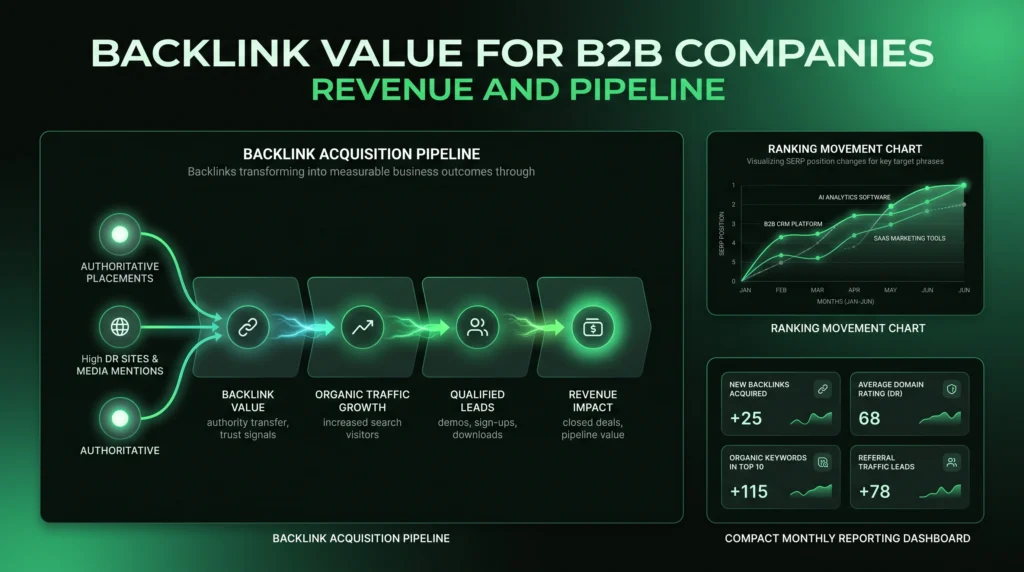
Backlink value for B2B companies comes from the connection between search visibility, authority, and commercial intent. A good backlink can improve search engine rankings, send referral traffic to your website, and support lead generation when the linked page matches the buyer journey.
In real campaigns, we rarely evaluate backlinks in isolation. We measure how link-building strategies affect ranking movement, organic traffic growth, indexed pages, assisted conversions, and the number of target URLs gaining visibility.
Campaign performance is usually reviewed through:
- Ranking changes for target keywords
- Growth in referring domains
- Organic search impressions and clicks
- Referral traffic from placements
- Indexed placement status
- Anchor text distribution
- Movement in page-level authority
- Assisted conversions where tracking is available
Higher Rankings For High Intent Service Pages
High-intent service pages often target keywords that directly relate to revenue. Examples include “B2B SEO agency,” “outsourced link building,” “guest post backlinks,” “technical SEO services,” or “ecommerce link building agency.”
These pages usually need authoritative backlinks because competitors are also investing in SEO strategies. To improve your search engine rankings, a B2B link-building strategy should build links to both commercial pages and supporting informational assets. This creates a stronger topical cluster and gives search engines more evidence that the website is relevant.
Stronger Authority In Competitive Niches
Competitive niches require more than basic content creation. If every competitor has optimized landing pages, comparison content, and internal links, backlinks often become the difference between page two and page one.
Backlinks from authoritative domains help a B2B website compete in crowded search results. The key is controlled growth. A campaign that suddenly sends dozens of low-quality links can look unnatural, while steady link acquisition from relevant websites supports ranking stability.
Referral Traffic With Lead Generation Potential
Referral traffic is not always the main KPI for link building, but it can be valuable when links are placed on websites with real business audiences. A contextual link from an industry guide, expert roundup, or resource page can bring qualified visitors who already care about the topic.
For example, resource page link building for B2B websites can help service companies appear on curated pages that buyers, researchers, and marketers use during vendor discovery. Those backlinks can drive organic traffic indirectly through SEO and directly through referral clicks.
Compounding Growth From Consistent Link Earning
Backlinks over time create compounding value. One high-quality backlink may move a keyword slightly, but a consistent link-building strategy can strengthen domain authority, support new content faster, and make future ranking gains easier.
For B2B teams, the practical advantage is predictability. A managed link acquisition program can plan monthly targets, maintain anchor text diversity, control link velocity, and report progress clearly. That process is far more reliable than occasional one-off outreach.
High-Quality Backlinks For B2B Website Growth
High-quality backlinks for B2B website growth come from relevant websites with real audiences, indexed pages, editorial standards, and natural placement context. A backlink should make sense for readers before it makes sense for an SEO tool.
As a link building agency, we evaluate every opportunity before outreach. We check topical fit, organic traffic, content quality, outbound link patterns, anchor environment, publisher guidelines, and page indexability.
Relevance To Industry Topic And Buyer Intent
A relevant link connects three things: the linking website, the article topic, and the destination page. If a cybersecurity service page earns a backlink from a cybersecurity compliance article, that contextual link is more natural than a backlink from an unrelated food blog.
Before approving a placement, we usually check:
- Whether the publisher covers the same or adjacent industry
- Whether the article topic matches the destination page
- Whether the link helps readers understand the topic
- Whether the page can drive organic traffic or referral interest
- Whether the website has a real audience, not only SEO metrics
Search engines use relevance to interpret why a link exists. For B2B marketing, relevance also affects conversion potential because the reader is closer to the target audience.
Real Traffic Versus Vanity Metrics
Domain authority, domain rating, and similar metrics can help filter prospects, but they are not enough. Some websites have attractive metrics but little organic traffic, weak content, or spammy outbound link patterns.
We prefer traffic-verified websites because organic traffic shows that search engines already trust at least part of the domain. During quality control, we review estimated organic traffic in tools like Ahrefs, ranking keywords by topic, recent content updates, outbound link quality, indexing status, and signs of expired domain abuse.
Domain Authority Role And Limits
Domain authority can be useful for comparing prospects, but it should never be the only decision point. A lower-authority website with strong niche relevance may outperform a higher-authority general site that has no topical connection to the client.
For B2B clients, we usually balance authority with relevance. The strongest campaigns include a mix of niche blogs, industry publications, partner websites, editorial mentions, and resource pages.
Backlink Diversity Across Sources And Formats
Backlink diversity helps create a natural link profile. A healthy B2B website should not rely only on guest posts or only on directories. Search engines expect brands to earn backlinks through different formats and relationships.
Common sources include:
- Guest post backlinks
- Niche edit links
- Editorial backlinks
- Resource page links
- Partner and vendor mentions
- Industry directories
- Digital PR mentions
- Case studies and testimonials
Editorial Placement Versus Paid Placement
Editorial placement is stronger when the link is included because it adds value to the article. Paid placement without standards can become risky if the website accepts any topic, uses thin content, or links heavily to unrelated industries.
A professional outsourced link-building provider should collaborate with real publishers and website owners. Strong publisher relationships in link building help secure placements that meet editorial expectations instead of forcing links into weak content.
Scalable B2B Link-Building Framework
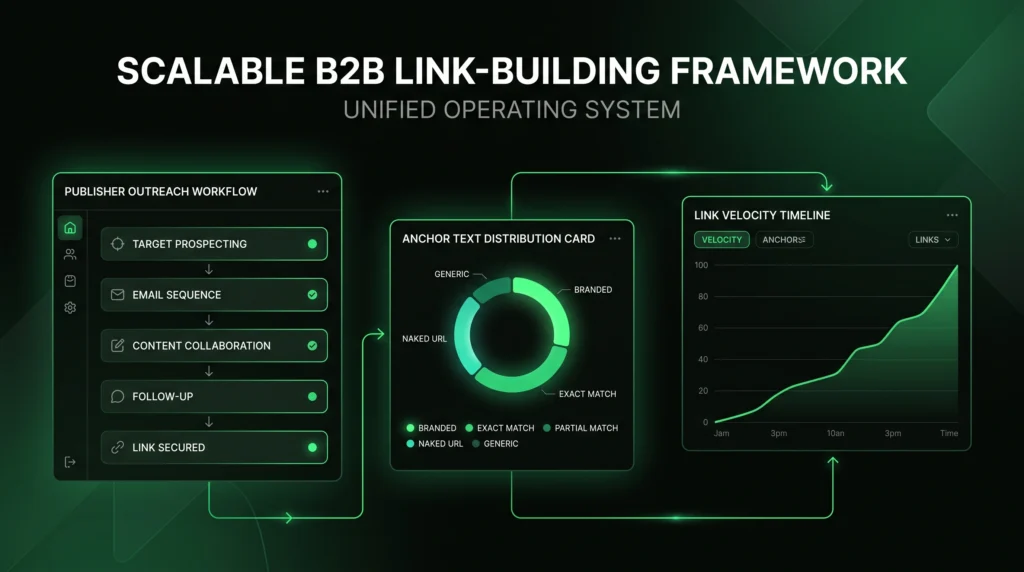
A scalable B2B link-building framework connects SEO goals, content assets, publisher outreach, anchor planning, and reporting. Without a framework, link building becomes reactive. With a framework, B2B teams can build links predictably while protecting long-term search performance.
Our agency workflow usually starts with a backlink audit, competitor gap review, URL prioritization, and anchor text map. From there, we build a monthly acquisition plan that matches budget, difficulty, and ranking opportunity.
SEO And Business Goal Setting
Every campaign should begin with clear goals. Some B2B companies want to boost service page rankings. Others need more authority for a new domain, more organic traffic to your website, or stronger visibility for comparison keywords.
Useful goals include:
- Improve rankings for specific commercial keywords.
- Earn backlinks to high-value service pages.
- Strengthen topical authority around core services.
- Increase qualified referral traffic.
- Support content that attracts links naturally.
- Build authority for new product or service categories.
Goals keep link building efforts aligned with revenue instead of vanity reporting.
KOB Analysis For Keyword Opportunity
KOB analysis, or keyword opposition to benefit analysis, compares ranking difficulty against business value. In practice, this helps decide which pages deserve backlinks first.
A keyword with moderate difficulty and strong buyer intent may be a better target than a massive keyword dominated by enterprise domains. B2B teams should use KOB analysis to avoid wasting link acquisition budget on pages that cannot realistically move within the current authority range.
Funnel Aligned Content Layering
Funnel aligned content layering means building links to pages at different stages of the buyer journey. Commercial pages need backlinks, but informational assets often attract links more naturally.
A balanced structure may include:
- Bottom-funnel service pages
- Middle-funnel comparison content
- Top-funnel guides and research
- Case studies with industry proof
- Content that earns links through data or examples
- Internal links that pass authority to commercial URLs
This approach helps search engines connect the entire topic cluster.
CRM Based Outreach Process
Manual outreach should be managed like sales development. A CRM-based outreach process tracks prospects, contact status, publisher requirements, content topics, placement dates, link status, and follow-ups.
A proper outreach workflow includes:
- Prospect collection and qualification.
- Contact discovery and verification.
- Personalized outreach based on publisher fit.
- Topic approval and content creation.
- Editorial review and placement coordination.
- Link verification, indexing checks, and reporting.
For clients, this creates transparency. For the agency, it prevents duplicate outreach, missed deadlines, and inconsistent communication with publishers.
Content Differentiators For Link Worthy Pages
Content that attracts links naturally usually has something competitors do not offer. That differentiator may be original data, expert commentary, templates, calculators, visual assets, or practical case studies.
Before building backlinks to a page, we ask a simple question: would a publisher have a reason to cite this page? If the answer is weak, content creation should improve the asset before outreach begins.
Revenue Focused Link Prioritization
Revenue focused link prioritization means link targets are chosen based on business impact, not only search volume. A page targeting a smaller but high-converting keyword may deserve more attention than a broad guide with low buyer intent.
For B2B service companies, link acquisition should support pages that influence pipeline. That includes service pages, industry pages, comparison pages, and educational content that moves buyers toward a sales conversation.
Linkable Assets That Help B2B Companies Earn Links
Linkable assets give publishers a reason to reference your website. In B2B SEO, assets that earn backlinks usually provide data, tools, examples, or expert insight that other writers can cite.
A practical link building tool can identify prospects, but the asset itself must justify the pitch. Strong content that earns links reduces outreach friction and improves placement quality.
Original Research And Data Reports
Original research is one of the strongest formats for earning high-quality backlinks. B2B companies can publish survey results, benchmark reports, market studies, or internal trend analysis.
Strong research assets usually include:
- Clear methodology
- Original statistics
- Industry-specific segmentation
- Visual summaries
- Expert commentary
- Downloadable or shareable formats
Publishers often cite data because it strengthens their articles. When a report includes clear statistics, methodology, and visual summaries, link-building outreach becomes more credible.
Industry Benchmarks And Statistics Pages
Benchmark pages and statistics pages attract links because writers frequently need updated numbers. For example, a B2B SaaS company could publish benchmarks about churn, conversion rates, onboarding, or sales cycle length.
These assets work best when they are updated regularly. Search engines and publishers both prefer fresh, accurate data over recycled claims.
Tools Calculators And Interactive Content
Tools, calculators, and templates can attract links from resource pages, blog posts, and software guides. An ROI calculator, cost estimator, or audit checklist can become a useful linkable asset for service companies.
Interactive content also supports buyer engagement. A visitor who uses a calculator may stay longer, explore more pages, and move closer to conversion.
Infographics Visual Assets And Reverse Image Search
Infographics and visual assets can earn backlinks when the topic is data-heavy or process-oriented. Visual explanations of workflows, frameworks, and statistics are easy for publishers to reference.
Reverse image search can also reveal websites using your visuals without attribution. Those mentions create link reclamation opportunities when outreach is handled politely and professionally.
Expert Roundups And Quote Assets
Expert roundups and quote assets help B2B companies earn backlinks by involving credible industry voices. Contributors often share or reference the final article, and publishers may cite expert commentary in future content.
For E-E-A-T, expert quotes also strengthen experience and authority. Search engines increasingly reward content that shows real expertise rather than generic summaries.
Foundational Tactics To Build High-Quality Backlinks
Foundational tactics help B2B companies build high-quality backlinks consistently. These tactics are not shortcuts. They work when outreach is manual, content quality is strong, and placement websites are carefully vetted.
The best link-building strategies combine several methods rather than depending on one channel.
Guest Posting And Niche Edits
Guest post backlinks come from new articles created for relevant websites. Niche edit links, also called link insertions, are added to existing articles where the destination page improves the reader experience.
Both tactics can be effective for different reasons:
- Guest posting gives more control over topic, context, and content quality.
- Niche edits can work faster because existing pages may already be indexed.
- Guest posts are useful for new angles and thought leadership.
- Niche edits are useful when an article already ranks for related queries.
- Both require publisher vetting to avoid spammy placements.
Directory Link Building For Industry Visibility
Industry directories can support local relevance, niche authority, and referral discovery. The best directory placements are selective, indexed, and relevant to the B2B business category.
Low-quality directories should be avoided. If a directory accepts every submission and has no real user value, the backlink may add risk instead of authority.
Broken Link Building And Content Updates
Broken link building identifies dead external links on relevant websites and offers a useful replacement. This tactic works best when the replacement content genuinely matches the original reference.
Content update outreach is similar. A publisher may have an outdated article that can be improved with a newer source, statistic, or tool. The outreach angle should help the publisher, not just ask for a link.
Unlinked Brand Mentions And Link Reclamation
Unlinked brand mentions occur when a website names a company but does not link to the website. These are often easier opportunities because the publisher already recognizes the brand.
Link reclamation also includes fixing lost backlinks, redirect errors, and broken destination URLs. Google Search Console and backlink tools can help identify these issues before ranking value is lost.
Customer Testimonials And Partner Pages
Testimonials and partner pages can produce highly relevant link opportunities. If your company uses B2B software, works with vendors, or participates in partner ecosystems, those relationships may lead to natural backlinks.
These links are especially useful because they reflect real business connections. Search engines can interpret those connections as credibility signals.
Backlink Requests From Vendors And Clients
Backlink requests from vendors and clients should be selective and relationship-based. A generic request can feel transactional, but a request tied to a case study, partnership page, or joint success story feels natural.
For B2B clients, these placements often have strong trust value. They show that the company operates within a real commercial network.
Advanced B2B Link-Building Tactics
Advanced B2B link-building tactics are useful when foundational campaigns are already running and the website needs stronger authority, broader visibility, or competitive differentiation. These tactics require better content, tighter targeting, and stronger publisher relationships.
They also require patience. Advanced link acquisition often produces fewer placements, but each placement can carry more strategic value.
Digital PR Press Mentions And Newsjacking
Digital PR earns editorial backlinks through newsworthy stories, expert commentary, data, and timely industry angles. Newsjacking works when a company responds quickly to a trend with useful insight.
For B2B companies, this may include commentary on regulation, technology adoption, market shifts, or industry benchmarks. The pitch must be credible and timely, not promotional.
Skyscraper Technique With Stronger Differentiators
The skyscraper technique works only when the new content is meaningfully better than existing pages. Making an article longer is not enough.
A stronger version may include:
- Original data competitors do not have
- Expert quotes from credible practitioners
- Better examples and case studies
- Clearer visuals or templates
- Stronger formatting and search intent coverage
- Practical takeaways for marketers and SEO teams
When the asset genuinely improves the topic, outreach has a stronger reason to ask publishers to reference it.
Link Intersect For Competitor Backlink Gaps
Link intersect analysis finds websites linking to competitors but not to your B2B website. This tactic reveals publishers, directories, resource pages, and industry blogs already interested in the topic.
Tools like Ahrefs can speed up this process, but manual review is still necessary. Not every competitor backlink is worth copying, especially if the source is spammy or irrelevant.
Tiered Link Building For Supporting Pages
Tiered link building can support important assets by building links to pages that internally link to commercial URLs. For example, backlinks may point to a research report, and that report links naturally to a service page.
This approach helps avoid overloading money pages with aggressive anchors. It also supports a more natural internal linking structure.
Outreach Partnerships And Relationship Based Link-Building
Relationship based link-building is one of the most durable approaches in B2B SEO. Real publisher relationships improve placement quality, reduce negotiation friction, and create repeat opportunities across campaigns.
An outsourced link building agency should act as a bridge between clients and publishers. That means respecting editorial guidelines, producing useful content, and maintaining communication standards.
Target Prioritization By Relevance Authority And Fit
Target prioritization should score websites by relevance, authority, traffic, editorial quality, and audience fit. A prospect may look strong in a link building tool, but manual review determines whether the placement is actually useful.
A strong target usually has:
- Clear topical relevance
- Indexed pages with organic traffic
- Real editorial content
- A natural outbound link profile
- Audience overlap with the client
- No obvious weak editorial patterns, suspicious source signals, or poor-quality domain history
For B2B teams, the best targets usually serve the same buyer audience or adjacent professional communities. Relevance should always lead the decision.
Value Driven Outreach Angles
Value driven outreach explains why a publisher should care. Strong angles may include a data point, expert quote, content update, broken link replacement, or useful resource.
Weak outreach asks for links without giving a reason. Strong outreach helps editors improve their content while creating a relevant link opportunity for the client.
Follow Up System Without Generic Templates
Follow-ups matter, but generic templates damage response rates. A professional outreach team should personalize the first message and follow up with useful context, not pressure.
In our experience, publishers respond better when outreach is concise, specific, and respectful. The message should show that the sender reviewed the website and understands the audience.
Marketing Strategy Budget Quality Control And Toxic Link Removal
Link building should be part of a broader marketing strategy, not an isolated SEO task. Budget, quality control, anchor planning, and toxic backlink management all affect long-term outcomes.
A managed campaign gives B2B companies structure. The agency handles prospecting, outreach, content creation, placement coordination, reporting, and risk control while the client focuses on growth.
Link Building Costs Timelines And Resource Planning
Costs depend on industry difficulty, publisher standards, content requirements, and monthly volume. Low-cost links require careful review because weak websites, poorly managed networks, irrelevant domains, or unclear sourcing methods can reduce campaign value over time.
Most B2B campaigns fall into one of these categories:
- Starter campaigns: foundational backlinks, safer anchors, and gradual authority building
- Growth campaigns: guest posts, niche edits, and editorial backlinks for competitive service pages
- Scale campaigns: digital PR, linkable assets, and publisher partnerships
- Recovery campaigns: toxic backlink review, disavow support, and quality rebuilding
Most B2B campaigns need several months to show meaningful ranking movement. Search engines must crawl links, evaluate context, and reassess the competitive landscape.
In House Versus Outsourced SEO Link Building
In-house teams know the brand deeply, but they may lack publisher access, outreach systems, and link acquisition capacity. Outsourced SEO link building gives companies access to established processes, content teams, and quality control workflows.
The best model is often collaborative. The client provides positioning, approvals, and subject matter expertise, while the agency manages execution.
Provider Vetting Deliverables And Service Scope
A reliable provider should clearly explain what is included. Vague promises are a warning sign.
Look for these deliverables:
- Prospect quality criteria
- Manual outreach process
- Content creation standards
- Anchor text plan
- Placement approval workflow
- Monthly reporting
- Link status tracking
- Replacement policy when applicable
Transparent reporting helps clients see exactly where backlinks are placed and how those links affect performance.
High-Risk Backlink Review And Cleanup Process
High-risk backlinks can come from hacked pages, automated spam networks, irrelevant directories, scraper sites, or negative SEO patterns. Not every weak-looking link requires action, but suspicious patterns should be reviewed.
A practical process includes backlink audits, source classification, risk scoring, outreach for removals when possible, and disavow support when necessary. Google Search Console helps identify links and manual action issues, while SEO tools provide broader backlink discovery.
Ethical Link-Building Practices For B2B Brands
Professional link-building practices protect ranking stability. For B2B brands, a strong approach combines source evaluation, relevant placements, traffic-verified websites, content standards, anchor text control, and controlled link velocity.
No agency can guarantee rankings. A credible agency can build a system that improves probability, reduces risk, and creates measurable growth through consistent, relevant link acquisition.
FAQ
B2B service companies should start with a backlink audit, competitor gap review, and priority page selection. The first campaign should focus on relevant websites, safe anchor text, and pages with clear ranking potential, while weak content should be improved before outreach begins.
Service pages, comparison pages, industry landing pages, and linkable assets should usually get links first because they connect backlink value to rankings, organic traffic, and pipeline. If a page has thin content or weak search intent alignment, optimization should come before link acquisition.
The right number depends on competition, domain authority, keyword difficulty, and current backlink gaps. A new B2B website may need a slower pace, while an established brand can scale faster, but quality and relevance should always matter more than volume.
Backlinks can take several weeks or months to influence rankings because search engines need time to crawl the linking page, process context, and compare the website against competitors. Strong content, relevant links, and moderate competition usually produce faster movement.
Useful metrics include ranking improvements, organic traffic growth, referring domains, indexed placements, anchor text distribution, referral clicks, and assisted conversions. A strong report should connect link building efforts to business outcomes, not just backlink counts.
The biggest mistakes include approving poorly reviewed links, overusing exact-match anchors, building links from irrelevant websites, scaling too quickly, and ignoring content quality. A stronger B2B link-building strategy uses relevance checks, source quality review, controlled link velocity, and transparent reporting.


