White-Label Link Building Services for SEO Results
White-label link building services give SEO agencies a scalable way to deliver backlink acquisition without hiring, training, and managing a full link building team internally. As an outsourced link building agency, we manage the operational work behind the scenes: prospect research, publisher outreach, content creation, anchor text planning, placement negotiation, quality checks, reporting, and performance tracking.
For SEO professionals, affiliate marketers, SaaS companies, e-commerce brands, and website owners, the goal is not simply to build backlinks. The goal is to earn contextual backlinks from reputable sources that strengthen topical relevance, improve link equity, and support long-term search engine rankings. Done correctly, link building is a smart B2B growth channel because it connects authority signals with commercial SEO goals.
A fully managed campaign usually includes:
- Manual outreach to real publishers and website owners.
- Guest post backlinks placed inside relevant editorial content.
- Niche edit links added to existing indexed pages where context fits naturally.
- Editorial backlinks from publishers with real standards and visible organic traffic.
- Anchor text planning to avoid over-optimization.
- Link velocity management to keep campaign scaling controlled.
- Transparent reporting that connects backlinks to SEO efforts and performance trends.
White label SEO works best when strategy and execution stay aligned. That means every backlink should have a reason: relevance, organic traffic, content fit, authority, indexing potential, and risk profile. Search engines like Google evaluate quality and relevance, not just link volume, so outsourced link-building services should define clear sourcing standards, review every placement method carefully, and separate backlink strategies by quality, transparency, and campaign fit.

Mon-Fri: 09:00 AM – 06:00 PM
What White Label Link Building Means for SEO Agencies
White label link building means an external link building agency fulfills backlink campaigns under another agency’s brand. The client sees the digital marketing agency as the service provider, while the white label partner manages delivery in the background.
In real campaigns, this model works because link acquisition is operationally heavy. Manual outreach, publisher communication, content coordination, placement review, anchor text control, and reporting all require process discipline. Many agencies choose to use white label link building when their SEO efforts are growing faster than their internal fulfillment capacity.
A practical white label partnership usually covers:
- Fulfillment handled by specialized link builders.
- Strategy alignment between the agency and white label partner.
- Publisher screening based on traffic, topical relevance, and editorial quality.
- Content creation for guest posts, niche edits, and editorial placements.
- Client-ready reporting that can be delivered under the agency’s brand.
White label link building definition
White label link building is a managed service where a specialized agency builds backlinks for another company’s clients without taking public credit for the work. The provider may secure guest post backlinks, niche edit links, editorial backlinks, or resource page backlinks depending on campaign strategy.
The main value is controlled execution at scale. A white label partner handles prospecting, outreach, content, placement checks, and reporting, while the agency keeps ownership of client communication and service offerings. This helps agencies save time without lowering delivery standards.
How link-building fits SEO agency delivery
Link-building fits agency delivery after technical SEO, content strategy, and on-page optimization establish a strong foundation. Backlinks help search engines discover authority signals, but those signals work best when the website has clean architecture, relevant landing pages, and valuable content.
For example, a SaaS website may need backlinks to product comparison pages, integration pages, and educational assets. An e-commerce brand may need links to category guides, buying guides, and editorial resources. A professional services company may need authority links that support local visibility and industry credibility.
Difference between reseller model and white label provider
A reseller model usually focuses on selling predefined packages. A white label provider focuses on fulfillment, customization, and reporting under the agency’s brand. The difference matters because SEO campaigns rarely succeed with one-size-fits-all link packages.
A strong white label partner evaluates domain authority, topical relevance, organic traffic, editorial standards, outbound link patterns, and placement context. A basic reseller may only pass through links from inventory. For competitive search engine results, quality control is the difference between useful link equity and wasted budget.
Role of agency branding in client communication
Agency branding keeps the client relationship consistent. Reports, deliverables, status updates, and strategic recommendations should feel like they come from the primary digital marketing agency, not from a third-party vendor.
In our experience, the best white label partnerships work when the agency owns strategy and client expectations while the fulfillment team owns outreach execution. This separation protects transparency inside the agency workflow without confusing the end client.
White Label Link Building Process
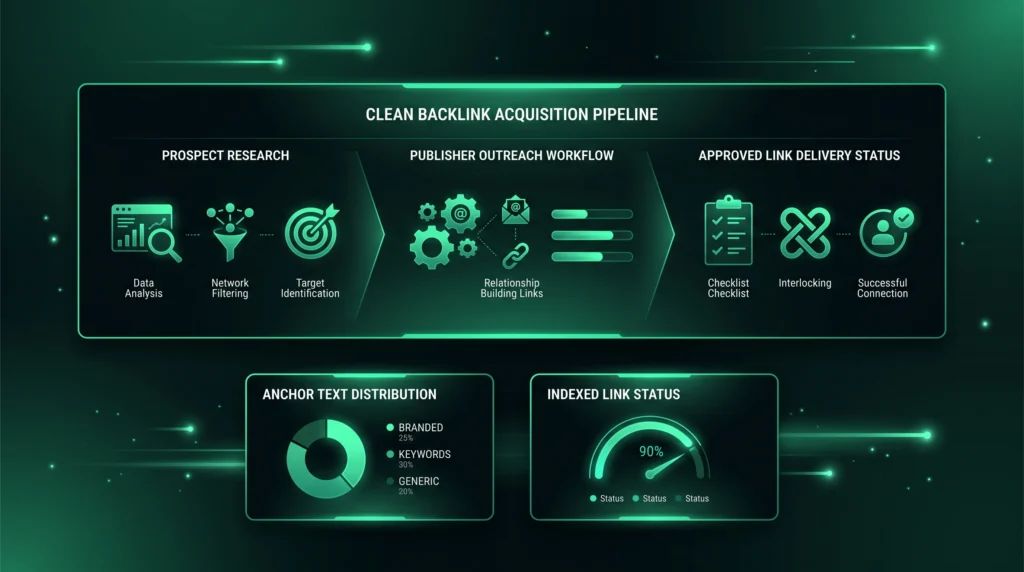
A reliable white label link building process should be documented, repeatable, and flexible enough for different industries. We manage campaigns through clear stages so each backlink supports a measurable SEO goal instead of becoming a random placement.
A practical process usually includes:
- Reviewing client goals, target pages, and current link profile.
- Building a prospect list based on relevance, authority, and organic traffic.
- Planning anchor text distribution to avoid aggressive patterns.
- Managing link velocity around budget, competition, and campaign maturity.
- Running manual outreach to publishers and website owners.
- Creating content that meets editorial standards.
- Reviewing placements before delivery.
- Tracking indexing, rankings, organic traffic, and backlink performance.
This operational structure helps agencies scale link-building services while reducing risk. It also gives clients a clearer connection between backlink acquisition and SEO results.
Client goals and backlink requirements
Every campaign starts with client goals. A website trying to rank a commercial landing page needs a different backlink strategy than a blog trying to build topical authority across an informational cluster.
Before outreach begins, we usually evaluate:
- Target URLs and their current ranking potential.
- Existing backlinks and anchor text ratios.
- Competitor link profiles in search engine results.
- Priority keywords and commercial SEO goals.
- Technical SEO issues that could limit performance.
- Content assets that can naturally earn links.
This audit helps define how many links are needed, what types of backlinks make sense, and which pages can safely absorb more link equity.
Campaign strategy and link target selection
Link target selection determines where authority should flow. Strong campaigns usually balance homepage links, service page links, blog links, comparison content, and supporting assets.
A campaign strategy may prioritize:
- Commercial pages when the client already has authority and needs stronger ranking support.
- Blog assets when the site needs topical relevance before pushing money pages.
- Comparison pages when SaaS or affiliate marketers compete in bottom-funnel SERPs.
- Resource content when the brand needs safer, more editorial link opportunities.
- Homepage authority when the overall domain is weak compared with competitors.
For competitive industries, we often build links to informational content first, then support commercial pages through internal linking. This creates a more natural link profile and reduces over-optimized anchor text patterns.
Prospect research and publisher outreach
Prospect research is where quality begins. We identify publishers by niche relevance, organic traffic, content standards, outbound link behavior, website history, and editorial fit.
A reliable publisher review should check:
- Organic traffic stability.
- Topical relevance to the client’s industry.
- Indexation and crawl visibility.
- Outbound link patterns.
- Editorial quality and content depth.
- Signs of weak editorial control, poor source quality, or low-value placement patterns.
Manual outreach matters because genuine publisher relationships usually produce better placements than automated blasts. For agencies that need fully managed campaigns, outreach link building services provide a structured way to reach real website owners while avoiding low-quality databases.
Content creation and editorial placement
Content creation should serve both the publisher’s audience and the client’s SEO goals. We create content that fits the host website, includes natural anchor text, and supports the surrounding editorial context.
This is where many low-quality providers fail. Thin guest posts, generic introductions, irrelevant topics, and forced anchors reduce SEO value. High-quality placements need useful writing, relevant references where appropriate, clean formatting, and a logical reason for the backlink to exist.
Reporting, approvals, and client handoff
Reporting must make backlink work easy for agencies to review and explain. A useful report includes the live URL, target URL, anchor text, domain metrics, organic traffic indicators, placement type, content title, and indexation status.
Before final delivery, agencies should review:
- Publisher relevance and traffic indicators.
- Target URL and anchor text accuracy.
- Placement context inside the content.
- Indexability and page accessibility.
- Link attributes and outbound link environment.
- Final content quality and brand safety.
We also recommend an approval workflow before final delivery. A structured backlink quality approval process helps agencies confirm publisher quality, topical fit, and placement context before links are reported to clients.
When SEO Agencies Should Use White Label Link Building
SEO agencies should use white label link building when client demand exceeds internal production capacity or when specialized outreach expertise is needed. The decision is usually operational, not philosophical.
Building an in-house team requires hiring link builders, training outreach specialists, building publisher relationships, creating quality control systems, and managing content workflows. That investment can make sense for some companies, but many agencies get better margins and faster delivery by partnering with specialized agencies.
Limited in-house link building resources
Limited in-house link building resources create delivery bottlenecks. An agency may have strong strategists, account managers, and technical SEO specialists but still struggle to produce consistent backlinks.
Outsourcing helps agencies preserve internal focus. Instead of asking a strategist to chase publishers, negotiate placements, and manage writers, the agency can assign that work to a dedicated link building team with established systems.
Need for scalable link acquisition
Scalability becomes important when an agency manages multiple SEO campaigns across different industries. A few links per month may be manageable internally, but 50, 100, or 200 placements require prospect databases, outreach systems, writers, editors, and quality checks.
White label link-building services create predictable capacity. Campaigns can scale up or down based on client budgets, seasonal priorities, and ranking opportunities without forcing the agency to make permanent hiring decisions.
Demand for specialized link-building expertise
Specialized link-building expertise matters in competitive SERPs. Link acquisition for SaaS, finance, legal, healthcare, B2B services, affiliate websites, and e-commerce categories requires different standards.
A strong link building agency knows how to evaluate risk, avoid link schemes, and protect long-term credibility and trustworthiness. This is especially important when clients operate in markets where low-quality backlinks can harm brand perception as much as rankings.
Benefits of White Label Link Building Services for Agencies
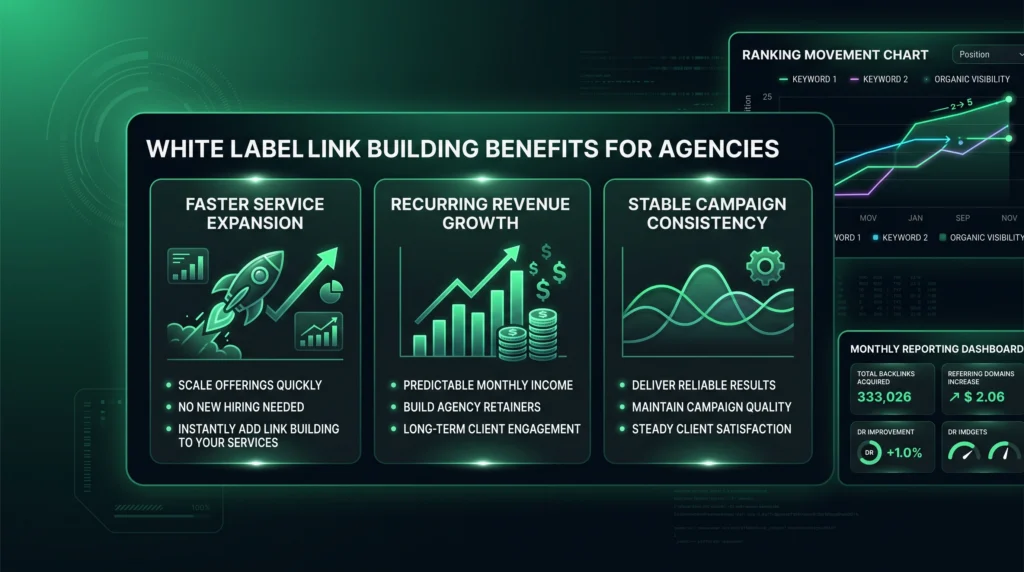
White label link building services help agencies increase delivery capacity, protect margins, and improve client retention. The best partnerships are not just vendor relationships; they are operational extensions of the agency’s SEO department.
For digital marketing agencies, link building is a B2B service that can increase recurring revenue when fulfillment is reliable. The challenge is maintaining quality and transparency while scaling.
Core benefits include:
- Faster service expansion without hiring a full outreach department.
- Higher revenue potential through recurring backlink campaigns.
- Better delivery capacity during client growth periods.
- More strategic focus for account managers and SEO leads.
- Consistent quality control across publishers, anchors, and reports.
- Lower operational risk compared with unmanaged link buying.
That is where a structured white label partner becomes valuable.
Faster service expansion
Agencies can add link-building services quickly without building a department from scratch. This is useful for SEO firms that already provide audits, technical SEO, content strategy, and reporting but lack backlink acquisition infrastructure.
Faster expansion does not mean careless delivery. The agency still needs clear service offerings, defined quality standards, and client expectations. White label fulfillment simply shortens the path from strategy to execution.
Higher revenue potential
Link building can improve agency revenue because backlink campaigns often run monthly. Clients in competitive markets usually need ongoing authority development, not a one-time placement.
A white label model allows agencies to resell link-building services at a margin while avoiding payroll, outreach software, content staffing, and publisher management costs. The result is a more flexible revenue stream tied to clear deliverables.
More time for core white label SEO strategy
When outsourced link building handles fulfillment, agency teams can focus on strategy. That includes keyword research, technical audits, content planning, CRO analysis, analytics, and client communication.
This division of labor improves both quality and efficiency. The agency provides strategic direction, while the white label partner executes link acquisition. For many firms comparing in-house vs link building agency, the deciding factor is whether internal time is better spent managing links or growing client accounts.
Better client retention
Client retention improves when agencies deliver consistent progress. Backlinks from reputable sources can help strengthen authority, support rankings, and increase organic traffic when paired with strong content and technical foundations.
Clients do not stay because they receive a spreadsheet of links. Clients stay because they understand how backlinks support visibility, search engine rankings, and business outcomes. Transparent reporting helps connect those dots.
Access to proven outreach systems
Proven outreach systems reduce guesswork. A professional link building team already has outreach workflows, publisher screening methods, negotiation standards, content templates, and placement review processes.
These systems are difficult to build overnight. In our operational experience, the biggest difference between inconsistent link acquisition and dependable fulfillment is process maturity. A repeatable outreach system creates fewer surprises.
Stronger campaign consistency
Consistency matters because link velocity affects how natural a backlink profile appears. Sudden spikes from low-quality sources can look suspicious, while steady placements from relevant websites tend to support more stable growth.
A white label partner helps manage cadence. Campaigns can be paced by budget, ranking goals, content readiness, and existing link profile strength. That control is essential for long-term SEO results.
Link Types SEO Agencies Can Offer Clients
SEO agencies can offer several types of backlinks depending on client goals, industry, and risk tolerance. The best campaigns rarely rely on only one format. They combine guest post backlinks, niche edit links, editorial backlinks, and resource placements to create a more natural link profile.
| Link Type | Best Use Case | Main SEO Value |
| Guest posting | Building topical authority with fresh content | Contextual relevance and editorial control |
| Niche edits | Strengthening existing pages with aged content | Faster contextual placement on indexed pages |
| Digital PR editorial placements | Brand authority and high-visibility mentions | Trust, referral potential, and credibility |
| Resource page backlinks | Useful assets, guides, and tools | Relevance and evergreen referral value |
| Expert mentions | Authority building through commentary | Brand signals and topical association |
Guest posting
Guest posting involves creating original content for a relevant publisher and placing a contextual backlink inside that content. The best guest post backlinks come from websites with real audiences, editorial review, and organic traffic.
This strategy works well for agencies that need control over topic, surrounding text, and anchor text. It also supports topical relevance because the article can be written around the client’s industry, service, or problem space.
Niche edits and link insertions
Niche edits, also called link insertions, place a backlink into existing content that is already published and often already indexed. This can be efficient when the page is relevant, has traffic, and includes a natural section for the link.
The risk is quality. Niche edit links should not be forced into unrelated content. We evaluate the page topic, existing outbound links, content freshness, indexing status, and editorial fit before recommending this format.
Digital PR editorial placements
Digital PR editorial placements earn backlinks through newsworthy angles, expert commentary, original data, or brand stories. These links can be harder to secure, but they often carry strong credibility because they appear in editorial environments.
For SaaS companies and professional services brands, editorial backlinks can support both SEO and brand authority. They are especially useful when the goal includes visibility, trust, and industry recognition.
Resource page backlinks
Resource page backlinks come from curated pages that list useful guides, tools, studies, or educational assets. These placements work best when the client has content worth referencing.
A strong resource placement should make sense for the page’s audience. If a cybersecurity guide earns a link from a university resource page or industry association, that backlink has clearer quality and relevance than a generic directory link.
HARO-style expert mentions
HARO-style expert mentions involve responding to journalist or publisher requests for expert input. This strategy can produce editorial links and brand mentions when the response is timely, specific, and credible.
Expert mentions are not guaranteed, so they work best as part of a diversified campaign. When successful, they can improve credibility and trustworthiness while adding backlinks from reputable sources.
Pricing, Margins, and Reseller Profitability
Pricing for white label link building depends on placement quality, industry difficulty, content requirements, publisher standards, and delivery speed. Cheaper links usually come with trade-offs: weaker relevance, lower editorial control, less organic traffic, or higher risk.
Professional services should be priced around value and quality, not link volume alone. A backlink from a relevant website with verified traffic can provide more SEO value than several links from low-quality websites with inflated metrics.
| Pricing Model | Best For | Agency Consideration |
| Per-link pricing | Clear deliverables and simple campaigns | Easy to resell, but quality tiers must be clear |
| Monthly retainer | Ongoing SEO campaigns | Better for strategy, pacing, and reporting |
| Custom campaign | Competitive niches or complex goals | Requires deeper planning and flexible execution |
| Hybrid model | Agencies with mixed client types | Balances predictability with customization |
Common pricing models for link building services
Agencies commonly price link-building services through per-link pricing, monthly retainers, or custom campaign packages. Each model has advantages depending on client maturity and campaign complexity.
Per-link pricing gives clients clear deliverables, while retainers give agencies more room to manage strategy, anchor text, and link velocity. Custom campaigns work best when competition, compliance, or content demands require deeper planning.
How agencies mark up outsourced link building
Agencies usually mark up outsourced link building based on management time, client communication, strategy, reporting, and risk ownership. The markup should reflect more than the cost of a backlink.
A healthy margin accounts for campaign planning, account management, revisions, performance analysis, and client education. If an agency sells at cost, it leaves no room for strategy and support. If markup is too high without added value, retention may suffer.
Margin planning for monthly retainers
Monthly retainers work best when backlink acquisition is connected to broader SEO efforts. A client should understand what is included: number of placements, content creation, reporting, strategy calls, and quality controls.
A practical margin plan separates fulfillment cost from agency value. The white label partner handles delivery, while the agency earns margin through strategic direction, client management, and integration with content and technical SEO.
How to Vet White Label Partner for Link-Building Campaigns
Choosing a white label partner is one of the most important decisions an agency can make. A poor provider can damage rankings, waste budget, and create uncomfortable client conversations. A strong provider protects the agency’s reputation.
Before signing with a provider, agencies should verify:
- Manual outreach process instead of automated mass placement.
- Publisher quality standards based on relevance, traffic, and editorial review.
- Transparent reporting with placement proof and anchor text details.
- Clear link policy around sourcing methods, placement standards, network-based opportunities, and campaign risk levels.
- Content quality controls for guest posts and editorial placements.
- Campaign support for scaling, pacing, and issue resolution.
- Real communication standards with defined timelines and accountability.
Do not evaluate a provider only by domain authority or price. Those metrics can be manipulated, and they do not always reflect quality and relevance.
Ethical link building standards
Clear link building standards reduce long-term risk. A partner should explain how placements are sourced, how websites are reviewed, how anchors are managed, and which methods are appropriate for each client’s risk profile.
Manual outreach and real publisher relationships are stronger signals of quality. While no agency can guarantee rankings, a responsible provider can explain how its process aligns with search engine guidelines and protects the client’s link profile.
Transparent reporting and placement proof
Transparent reporting should show exactly what was delivered. Agencies need live URLs, target URLs, anchor text, placement type, publisher metrics, traffic indicators, and content context.
Transparency also includes saying no. If a requested anchor text is too aggressive or a publisher looks risky, a qualified white label partner should explain the issue instead of forcing the placement.
Publisher quality and backlink profile checks
Publisher quality checks should go beyond surface metrics. We review topical relevance, organic traffic patterns, indexed pages, outbound link ratios, content quality, and signs of spammy links.
A website with high domain authority but no real traffic may not provide meaningful SEO value. A smaller niche website with engaged organic traffic and strong relevance can be more useful for search engine rankings.
Social proof, case studies, and client reviews
Social proof helps agencies evaluate whether a provider can deliver consistently. Case studies, sample reports, testimonials, and placement examples reveal how the provider works in real campaigns.
Look for proof of process, not just impressive logos. A credible partner should explain how campaigns are planned, how publishers are vetted, how anchor text is managed, and how performance is tracked.
End-to-end fulfillment capability
End-to-end fulfillment means the white label partner can handle strategy support, prospect research, outreach, negotiation, content creation, editing, placement review, and reporting. This matters because fragmented delivery creates delays.
When a provider controls the full workflow, agencies get fewer handoffs and more consistent results. It also becomes easier to scale campaigns across different industries and client types.
Communication speed and account support
Communication speed affects client satisfaction. Agencies need clear timelines, realistic updates, and fast responses when clients ask about placements or performance.
A reliable white label partner should provide account support, delivery visibility, and proactive issue resolution. Strong communication is not a bonus. It is part of the service.
How to Position White Label SEO for Clients
White label SEO should be positioned as a managed authority-building strategy, not a shortcut. Clients should know that backlinks support rankings when combined with strong content, sound technical SEO, and a healthy website experience.
The best positioning is consultative. Explain what backlinks can do, what they cannot do, and how link acquisition fits the client’s SEO goals. This builds trust and reduces unrealistic expectations.
Framing backlinks as authority growth
Backlinks should be framed as authority signals. Search engines evaluate links as part of a broader system that includes content quality, relevance, user satisfaction, technical accessibility, and brand signals.
A useful explanation is simple: high-quality backlinks from relevant websites help search engines evaluate credibility. They also send referral signals, strengthen topical association, and improve the probability of ranking for competitive queries.
Setting realistic timelines for SEO results
SEO results take time because rankings depend on crawling, indexing, competition, content quality, technical SEO, and the strength of the existing link profile. Some pages move in weeks, while competitive terms may take several months.
Agencies should track timeline expectations through:
- Link delivery and placement approval.
- Indexation and crawl discovery.
- Keyword movement across priority terms.
- Organic traffic trends.
- Assisted conversions and lead quality.
- Link profile growth compared with competitors.
We usually recommend setting expectations around momentum instead of instant wins. This gives clients a clearer view of progress before final ranking gains appear.
Mistakes That Damage White Label Partnerships
White label partnerships fail when expectations, quality standards, or communication break down. Most problems are preventable with clear processes.
The most common issues include:
- Treating backlinks as commodities instead of authority assets.
- Selling links before defining quality standards.
- Using aggressive anchor text without reviewing risk.
- Accepting low-quality publishers because they are cheap.
- Ignoring reporting expectations.
- Hiding campaign risks from clients.
- Scaling too quickly without link velocity control.
The biggest mistake is buying only by price or surface metrics. That approach often leads to low-quality placements that provide little SEO value and may introduce risk.
Selling links without quality control
Selling links without quality control can damage client trust. A report full of irrelevant placements, weak content, or suspicious websites creates more questions than confidence.
Quality control should happen before delivery, not after a client complains. Every placement should be reviewed for topical relevance, traffic, outbound links, indexing status, anchor text, and editorial context.
Hiding risks from clients
Hiding risks creates long-term relationship problems. Link building involves judgment, and not every placement opportunity is equal.
Clients deserve clear explanations about what makes a backlink strong or risky. Agencies should explain that search engine guidelines discourage manipulative link schemes, which is why responsible providers focus on relevance, editorial standards, and real websites.
Choosing cheap providers over reliable partners
Cheap providers often rely on shortcuts. Low-cost packages may include recycled publisher lists, weak editorial review, thin content, overloaded websites, or placements with no organic traffic.
A reliable partner may cost more, but the value is in risk reduction and better execution. In competitive SEO, a few high-quality backlinks can outperform many low-quality links.
Ignoring reporting expectations
Ignoring reporting expectations creates friction. Clients want to know what was built, why it matters, and how it connects to rankings and organic traffic.
A strong report should not be a mystery spreadsheet. It should connect backlink acquisition to SEO goals, target pages, anchor text strategy, and campaign progress.
Frequently Asked Questions
White label link building works by letting an SEO agency outsource backlink acquisition while keeping client-facing ownership of the service. The white label partner manages outreach, publisher communication, content creation, placement review, and reporting, while the agency provides target pages, anchor preferences, quality requirements, and campaign goals.
Agencies should charge based on placement quality, strategy, management time, reporting, and client support. Per-link pricing can work for simple campaigns, but monthly retainers are usually better when link-building services are tied to broader SEO campaigns, content planning, and long-term ranking goals.
White label link building can be stable when campaigns use clear source evaluation, relevant placements, natural anchor text, and quality review. Risk increases when providers skip review, use irrelevant websites, overuse commercial anchors, or scale placements without explaining the sourcing method and campaign logic.
Agencies can resell link building services by partnering with a white label provider, packaging deliverables under their own brand, and presenting reports through their normal client communication process. The agency should define service tiers, timelines, approval rules, and reporting language before selling the offer to clients.
Agencies should offer link types based on client goals, competition, and risk tolerance. Guest post backlinks work well for topical control, niche edit links can strengthen existing indexed content, editorial backlinks support authority, and resource page backlinks work best when the client has genuinely useful assets.
White label link building may show early movement within several weeks, but meaningful SEO results often take several months. Timing depends on competition, website authority, content quality, technical SEO, crawl frequency, indexation, and the strength of the existing link profile.