International link building involves acquiring backlinks from websites in specific target countries or languages to support a brand’s visibility in those markets. It differs from a standard domestic campaign in several meaningful ways: publisher selection, language requirements, editorial standards, and the relationship between link signals and local search rankings all become more complex when you are targeting audiences across multiple regions. This article explains how international link building works, which acquisition methods are commonly used, what realistic outcomes look like, and what to consider before committing to a cross-border campaign.
Key Takeaways
- International link building requires publisher selection, content, and outreach to be aligned with the target country or language, not simply translated from a domestic campaign.
- Topical relevance, editorial quality, and the geographic context of a linking domain all influence how useful a backlink may be for a specific regional market.
- Hreflang implementation, country-code top-level domains, and Google Search Console’s international targeting settings interact with your backlink profile and should be reviewed before a campaign begins.
- Results timelines for international campaigns are often longer than domestic ones due to outreach complexity, language barriers, and the time required for search engines to process new signals in competitive markets.
- A site-specific assessment of your technical SEO setup, existing backlink profile, and target-market competition is important before choosing an international link acquisition strategy.
What International Link Building Actually Involves
International link building is the process of earning or acquiring backlinks from websites that are relevant to a specific country, language, or regional market. The goal is to strengthen a website’s authority and relevance signals within those markets, which may support improved organic visibility in local search results. This is distinct from simply building more links to a website that happens to have international pages; the geographic and linguistic context of the linking domain matters alongside the usual quality factors such as topical relevance, editorial standards, and the placement’s context within the content.
A backlink from a well-regarded German-language publication covering your industry is likely to carry different signals for German search results than a backlink from a generic English-language directory. Search engines use a range of signals to determine which version of a website is most relevant for a given user in a given location, and the origin and language of referring domains form part of that picture. This does not mean that only country-specific domains count, but it does mean that publisher selection for international campaigns requires more deliberate criteria than a purely metric-driven approach.
International link building also intersects with broader international SEO decisions, including whether a website uses country-code top-level domains (ccTLDs such as .de or .fr), subdirectories (example.com/de/), or subdomains (de.example.com). The link building strategy should be consistent with the site’s international architecture, because links pointing to the wrong URL structure may not benefit the intended regional pages.
Why Geographic and Linguistic Context Matters for Backlinks
Search engines assess backlinks as part of a broader set of relevance and authority signals. For international search results, the geographic and linguistic context of a referring domain can influence how that link is interpreted. A link from a website that is clearly associated with a specific country — through its domain extension, hosting location, content language, or audience — may carry stronger regional relevance signals for that market than a link from a globally generic source.
This does not mean that international links are the only factor in regional rankings, or that acquiring them guarantees improved positions. Content quality, technical SEO, on-page relevance, user experience signals, and the competitive landscape in each target market all play a role. However, for websites competing in specific countries or languages, a backlink profile that includes editorially placed links from relevant regional publishers is generally considered a useful component of a broader international SEO strategy.
Language is a separate but related consideration. A link embedded in content written in the target language, on a website whose primary audience speaks that language, tends to be more contextually relevant than a link placed in translated boilerplate on a low-quality multilingual site. This distinction matters when evaluating publisher quality during international outreach campaigns.
Common International Link Building Methods
The acquisition methods used in international campaigns are broadly similar to those used domestically, but each requires adaptation for the target market. The most widely used approaches include the following.
Manual Outreach and Guest Posting
Manual outreach involves identifying relevant publishers in the target country or language, building a contact list, and pitching original content for placement. Guest posting — contributing an article to a third-party website in exchange for an editorial backlink — is one of the most common outputs of this process. For international campaigns, outreach must typically be conducted in the target language, or at minimum with a localised pitch, to achieve meaningful response rates from publishers who receive many generic English-language requests.
Publisher quality assessment for international guest posting should consider topical relevance to the target industry, the site’s organic visibility in the target market, the editorial standards applied to published content, and the language and audience of the site. Third-party metrics such as Domain Rating (Ahrefs), Domain Authority (Moz), or Trust Flow (Majestic) can provide a starting point for evaluation, but these are proprietary estimates rather than Google-provided signals, and they should not be used as the sole quality criterion.
Niche Edits and Link Insertions
Niche edits involve placing a backlink within existing published content on a third-party website, rather than contributing new content. This method can be faster than guest posting because it does not require content creation, but it requires careful vetting of the host page’s relevance, the surrounding content context, and the editorial standards of the publisher. In international markets, niche edits on established local content may carry useful contextual signals, provided the placement is genuinely relevant and the host site meets quality criteria.
Digital PR and Linkable Asset Campaigns
Digital PR involves creating content — such as original research, data studies, interactive tools, or newsworthy stories — that earns backlinks organically through media coverage and editorial citation. For international markets, this typically requires producing assets that are relevant to the target country’s audience, using local data sources, and pitching to regional journalists and publications. Digital PR campaigns can generate high-quality editorial links from authoritative regional publishers, but they require significant content investment and are less predictable in terms of placement volume and timing.
Local Directory and Citation Links
For businesses targeting specific countries or cities, local directory listings and citation links from country-specific business directories can support local search visibility. These are generally lower in individual link value but may contribute to a consistent local presence signal, particularly for businesses with a physical location or a service area in the target market. They are typically used as a supplementary tactic rather than the primary link acquisition method for competitive international campaigns.
Multilingual Content and Hreflang Alignment
International link building is most effective when the target pages are properly configured for the intended market. Hreflang tags tell search engines which language and regional version of a page to serve to users in different locations. If a campaign builds links to a page that lacks correct hreflang implementation, or if the links point to the wrong regional URL, the intended SEO benefit for that market may be reduced. Reviewing the site’s international SEO configuration before a link building campaign begins is a practical step that can prevent wasted effort.
Assessing Publisher Quality in International Markets
Publisher quality assessment is one of the most important and most variable aspects of international link building. Standards differ significantly between markets: a mid-tier industry publication in one country may have stronger editorial standards than a nominally high-metric site in another. Evaluating publishers for international campaigns should involve several considerations beyond a single authority score.
- Topical relevance: Does the site cover topics related to your industry or the content being placed?
- Organic visibility in the target market: Does the site receive meaningful organic traffic from the target country, as estimated by tools such as Ahrefs or Semrush?
- Editorial standards: Does the site publish original, well-written content, or does it appear to accept any submission without review?
- Link profile of the publisher: Does the site have a natural-looking backlink profile, or does it show signs of link scheme participation?
- Language and audience: Is the site’s primary content in the target language, and does its audience match the target market?
- Placement context: Will the link appear within relevant, readable content, or in a sidebar, footer, or unrelated article?
No single metric reliably captures all of these factors. A manual review of the publisher’s recent content, traffic estimates, and link profile is generally more informative than relying on a Domain Rating or Domain Authority threshold alone.

Campaign Planning and Workflow
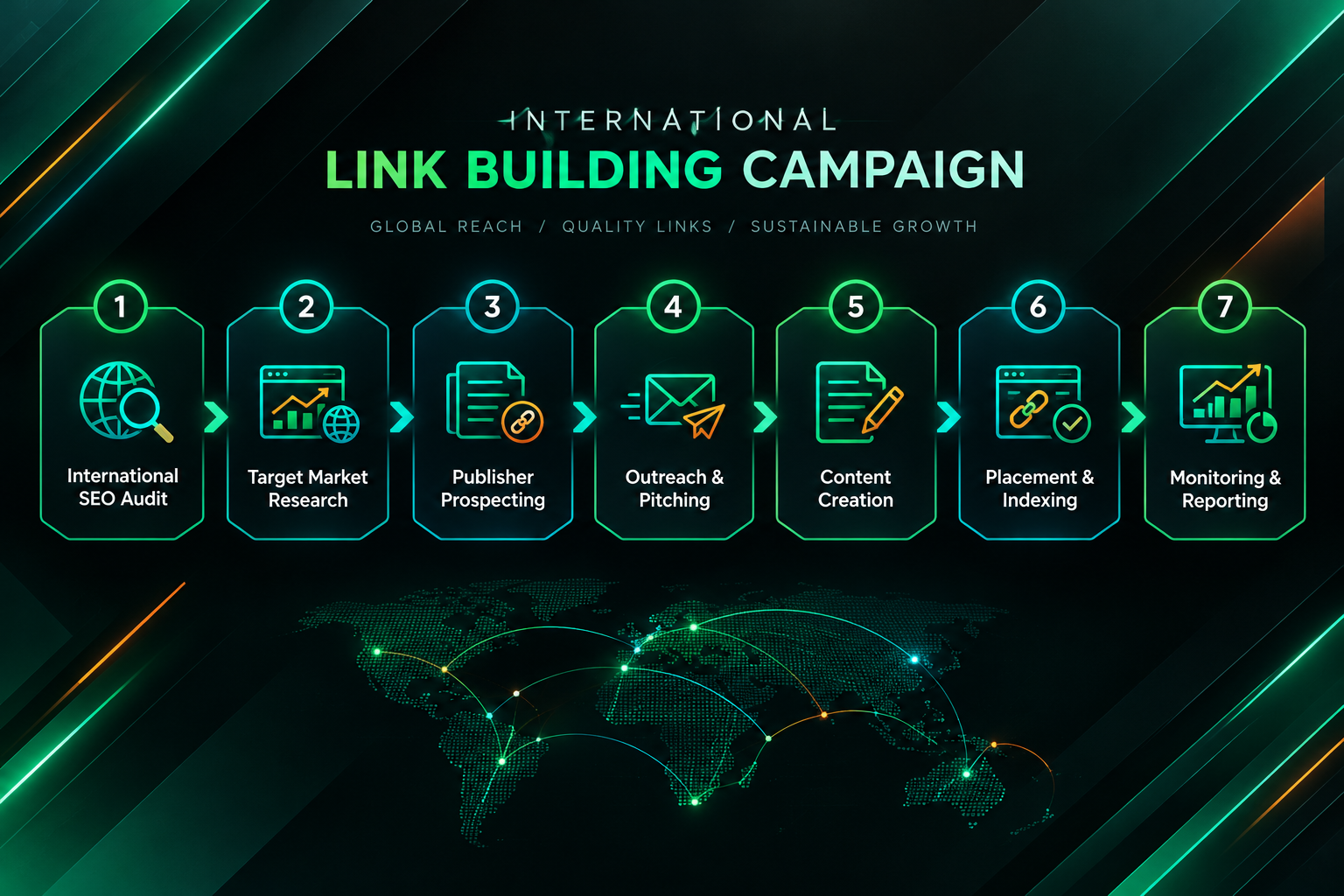
A well-structured international link building campaign typically involves several stages before placements are secured. Understanding this workflow helps set realistic expectations for timelines and internal workload.
- International SEO audit: Before outreach begins, reviewing the site’s technical setup — including hreflang implementation, URL structure, and existing backlink profile by country — helps identify which target pages and markets should be prioritised.
- Target market and keyword research: Identifying which countries and languages represent the highest opportunity, based on search volume, competition, and business goals, informs publisher selection and content strategy.
- Publisher prospecting: Building a list of relevant, quality publishers in the target market requires research into local media, industry blogs, and niche publications. This is more time-intensive in markets where English-language SEO tools have less coverage.
- Outreach and pitching: Contacting publishers in the target language, proposing relevant content, and negotiating placements. Response rates and timelines vary significantly by market and industry.
- Content creation: Producing original, high-quality content in the target language that meets the publisher’s editorial standards and naturally incorporates the intended backlink.
- Placement and indexing: Once content is published, search engines need to crawl and index the new page before the link can be processed. This can take days to weeks depending on the publisher’s crawl frequency.
- Monitoring and reporting: Tracking new referring domains, monitoring for link removals, and assessing any changes in organic visibility in the target market over time.
Realistic Timelines and What Influences Them
International link building campaigns generally take longer to produce measurable results than domestic campaigns, for several reasons. Outreach in a second language requires either native-speaking outreach specialists or careful localisation, both of which add time. Publisher response rates in some markets are lower, and editorial review processes vary. Content production in the target language adds a further step. Once placements are live, search engines may take additional time to process new link signals in markets where crawl budgets are allocated differently.
As a general orientation, most link building campaigns — domestic or international — require several months before any ranking or traffic changes become measurable, and the relationship between new backlinks and ranking changes is rarely direct or immediate. International campaigns may require a longer observation period, particularly in competitive markets or for websites that are new to a specific region. Results depend on the existing backlink profile, the quality and relevance of new placements, the technical SEO condition of the site, the competitiveness of target keywords, and other factors that vary by website and market.
It is not accurate to attribute ranking changes solely to link building activity, as other SEO factors, algorithm updates, and competitor behaviour all influence search positions simultaneously.
Risks and Quality Considerations
International link building carries the same fundamental risks as any link acquisition campaign, with some additional complexity introduced by operating across multiple markets and languages.
Low-quality publisher networks: Some link vendors operate networks of low-quality multilingual sites that accept paid placements without editorial review. Links from these sources may provide little SEO value and, in some cases, may attract negative attention from search engine spam detection systems. Google’s spam policies apply globally, and paid links that pass PageRank without appropriate disclosure are against those policies regardless of the language or country of the host site.
Irrelevant placements: A link placed on a site that has no topical or geographic relevance to the target market is unlikely to contribute meaningful regional authority signals. In international campaigns, it is possible to accumulate a large number of referring domains that do not meaningfully support the intended market, particularly if publisher selection is driven primarily by metric thresholds rather than genuine relevance.
Link loss: Published content can be removed, URLs can change, and websites can go offline. International publishers may be less responsive to link replacement requests, and monitoring link retention across multiple markets adds operational complexity.
Translation quality: Content produced in the target language by non-native speakers or low-quality translation tools may be rejected by quality publishers or may reflect poorly on the brand if published. Editorial standards in some markets are high, and poorly localised content can damage outreach relationships.
Compliance with local regulations: Some markets have specific regulations around sponsored content disclosure that go beyond search engine policies. Understanding local editorial and advertising standards in each target market is a practical consideration for international campaigns.
Who May Benefit from International Link Building
International link building may be worth considering for businesses and websites in the following situations, though a site-specific assessment is always advisable before committing to a campaign.
- Businesses that already have localised content and correctly configured international SEO architecture, and want to strengthen their authority signals in specific target markets.
- E-commerce websites expanding into new countries, where building regional backlink profiles may support visibility for product and category pages in local search results.
- SaaS companies targeting specific language markets, where acquiring links from relevant regional publications and review sites may support brand awareness and organic discovery.
- Agencies managing international SEO campaigns on behalf of clients, who need a scalable and quality-controlled link acquisition process across multiple markets.
- Websites that have strong domestic backlink profiles but limited referring domains from target international markets, and where competitive analysis suggests that regional link signals may be a meaningful gap.
International link building is less likely to be the right priority for websites with significant technical SEO issues, thin or poorly localised content, or no clear international SEO strategy in place. Addressing those foundations first is generally a more efficient use of resources.
Alternatives and Complementary Approaches
Link building is one component of international SEO, not the whole strategy. Several complementary approaches may support or, in some cases, partially substitute for a link acquisition campaign depending on the website’s situation and goals.
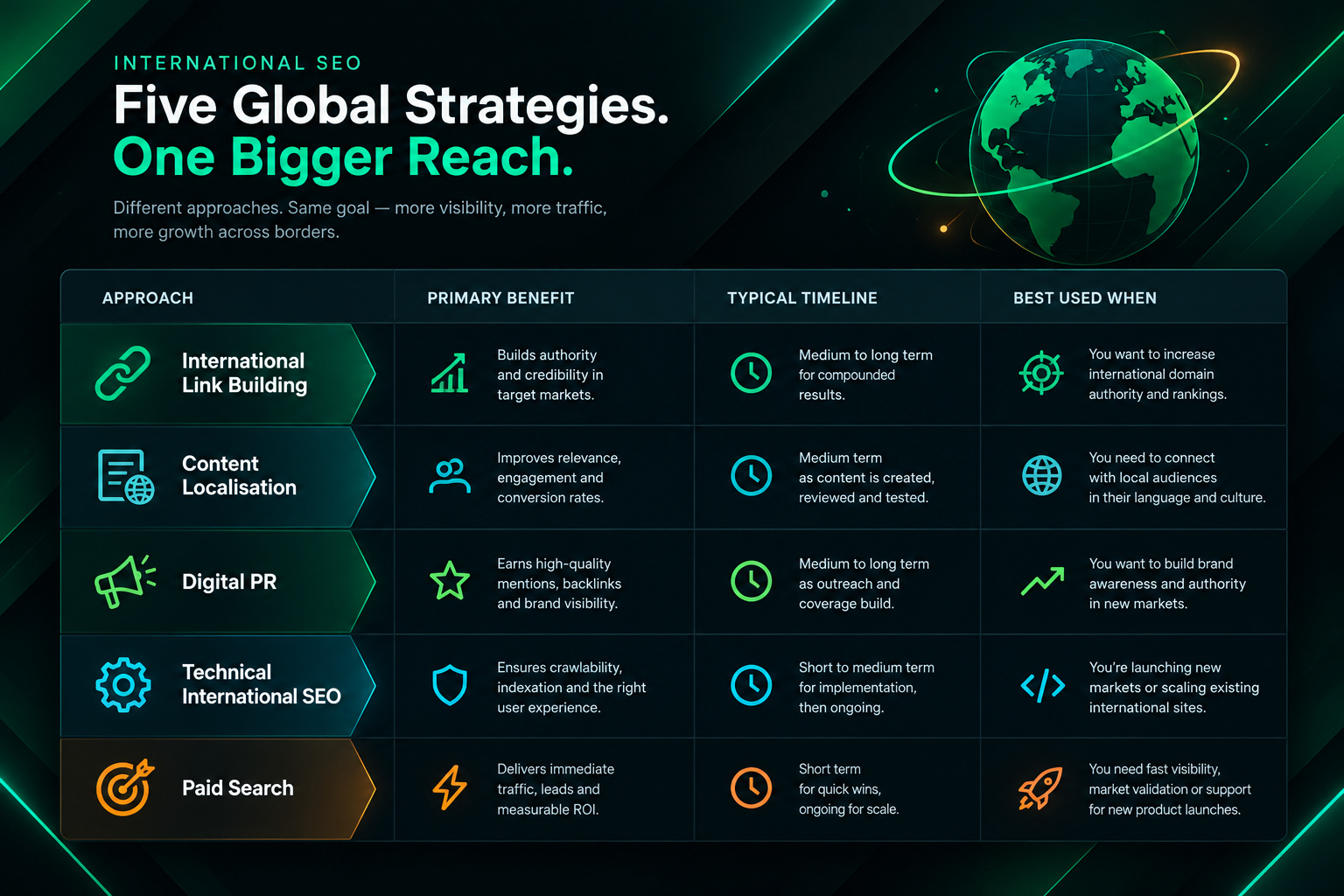
Content localisation: Producing genuinely localised content — not just translated pages, but content that addresses the specific questions, terminology, and context of the target market — can improve organic visibility independently of link building and makes any link acquisition more effective by giving publishers and journalists something worth linking to.
Digital PR in target markets: Investing in original research or data-driven content designed for regional media can generate editorial links from authoritative local publishers without a traditional outreach campaign. This approach tends to produce fewer but higher-quality placements.
Partnerships and co-marketing: Collaborating with complementary businesses or organisations in the target market can generate natural backlinks through joint content, events, or resource sharing, alongside other business benefits.
Technical international SEO: Ensuring that hreflang tags, URL structures, and international targeting settings are correctly implemented may improve how search engines serve regional pages to the intended audience, sometimes producing measurable visibility improvements without additional link building.
Paid search in new markets: For businesses entering a new international market, paid search advertising can generate traffic and conversion data while organic authority is being built, providing a useful complement to a longer-term link building investment.
Frequently Asked Questions
Do links from foreign-language websites help with rankings in those countries?
Links from websites that are associated with a specific country or language — through their domain extension, content, and audience — may carry regional relevance signals that support visibility in that market. However, the impact depends on the quality and topical relevance of the linking site, the overall backlink profile, and many other SEO factors. There is no guarantee that acquiring regional links will produce specific ranking improvements.
Should links point to the localised page or the main domain?
Links should generally point to the specific regional page that is intended to rank in the target market — for example, the German-language subdirectory or ccTLD page — rather than the main domain homepage, unless the homepage is the intended ranking page. This ensures that link equity is directed to the correct URL within the site’s international architecture.
How many links are needed to rank in a new international market?
There is no reliable universal answer to this question. The number of referring domains that may be needed depends on the competitiveness of the target keywords in that market, the quality of existing backlinks to competing pages, the site’s overall authority, and many other factors. A competitive analysis of the top-ranking pages in the target market can provide a rough orientation, but prescribing a fixed link count as a guarantee of rankings is not supported by evidence.
Is it better to use a local agency or an international link building service?
Both approaches have trade-offs. A local agency in the target market may have stronger publisher relationships and native-language outreach capability, but may lack the broader SEO campaign management experience of a specialist link building provider. An international link building service with multilingual outreach capability and established regional publisher networks may offer more consistent quality control and reporting. The right choice depends on the target markets, campaign scale, and internal resources available.
How long should an international link building campaign run?
Link building for competitive international markets is generally an ongoing investment rather than a one-time project. Initial campaigns may run for three to six months to establish a baseline of regional referring domains, with ongoing activity to maintain and grow that profile as competitors also build links. The appropriate duration depends on the target market’s competitiveness and the website’s starting position.
Can I use the same content for multiple international markets?
Repurposing the same content across multiple markets is possible but requires genuine localisation for each target audience, not just translation. Publishers in different markets have different editorial standards and audience expectations, and content that performs well in one market may not be accepted or resonate in another. Investing in market-specific content generally produces better outreach results and higher-quality placements.
Planning an International Link Building Campaign That Fits Your Goals
International link building can be a meaningful part of a broader international SEO strategy for businesses that have the right foundations in place: localised content, a correctly configured site architecture, and a clear understanding of which markets represent genuine opportunity. The methods — manual outreach, guest posting, niche edits, digital PR — are broadly the same as in domestic campaigns, but the execution requires language capability, regional publisher knowledge, and a more careful approach to quality assessment.
Realistic expectations matter. Results in new international markets typically take longer to materialise than domestic campaigns, and the relationship between new backlinks and ranking changes is influenced by many factors beyond link acquisition alone. A campaign that prioritises publisher quality, topical relevance, and genuine editorial placement is more likely to produce durable results than one focused primarily on volume or metric thresholds.
Before committing to an international link building campaign, it is worth reviewing the site’s technical international SEO setup, assessing the existing backlink profile by target market, and identifying which pages and keywords represent the clearest opportunity. If you are considering outsourcing this work, discussing your target markets, site architecture, and campaign goals with a provider who has demonstrable experience in multilingual outreach and regional publisher networks is a practical starting point.