A guest post content brief is the document that sits between your link building strategy and the finished article a publisher actually accepts. When a brief is vague, writers produce generic content that editors reject or heavily rewrite, placements are delayed, and the links you planned for may never materialise. When a brief is clear and well-structured, writers can produce relevant, on-topic content efficiently, editors are more likely to approve it with minimal changes, and the placement serves its intended SEO purpose. This guide explains what a guest post content brief should contain, how to build one, and what to watch for when quality matters.
Key Takeaways
- A guest post content brief defines the topic, target audience, structure, tone, and linking requirements before a writer begins work, reducing revision cycles and rejection risk.
- The brief must reflect the publisher’s editorial guidelines, not just the client’s preferences, because the editor’s standards ultimately determine whether the placement succeeds.
- Topical relevance between the guest post content, the target page, and the anchor text is an important quality signal; a brief that ignores this alignment weakens the placement’s SEO value.
- A well-written brief reduces the internal workload for agencies and in-house teams managing multiple placements simultaneously, making campaigns easier to scale without sacrificing quality.
- Content briefs are living documents; updating them based on editor feedback and placement outcomes improves the quality of future briefs across a campaign.
What Is a Guest Post Content Brief?
A guest post content brief is a structured set of instructions given to a writer before they produce an article intended for publication on a third-party website. In the context of link building, the brief serves two purposes simultaneously: it guides the writer toward content the target publisher will accept, and it ensures the finished article supports the SEO goal behind the placement, typically a contextual backlink to a specific target page.
The brief is distinct from a general content brief used for a client’s own blog. A standard content brief focuses on the client’s brand voice, internal SEO targets, and audience. A guest post content brief must also account for the publisher’s editorial standards, their existing content style, their audience’s expectations, and any topic restrictions the site has communicated during outreach. Ignoring this distinction is one of the most common reasons guest post pitches and drafts are rejected.
For agencies managing outsourced link building campaigns, the content brief is also a quality control tool. It creates a shared reference point between the outreach team, the writer, and the reviewer, reducing the chance that a finished article misses the mark after significant time has already been invested.
Why the Brief Matters for Link Building Quality
Search engines assess the context surrounding a backlink, not just its existence. A link embedded in a well-written, topically relevant article on a credible publisher’s site carries different signals than a link dropped into thin or off-topic content. The content brief is the mechanism that controls this context before the article is written.
When a brief specifies the topic angle, the intended reader, the required depth, and the natural placement of the target link, the writer can produce content where the link genuinely fits the surrounding text. This matters because editors on quality sites will remove or refuse links that appear forced, irrelevant, or promotional. A brief that treats the link as an afterthought, rather than as something that needs to be earned by the surrounding content, tends to produce exactly that kind of placement.
Topical relevance between the guest post subject, the publisher’s site category, and the target page being linked to is a meaningful quality factor. A brief that carefully aligns these three elements gives the placement a stronger editorial foundation and reduces the risk that the link will be removed after publication or that the content will be rejected before it reaches that stage.
Core Elements of an Effective Guest Post Content Brief
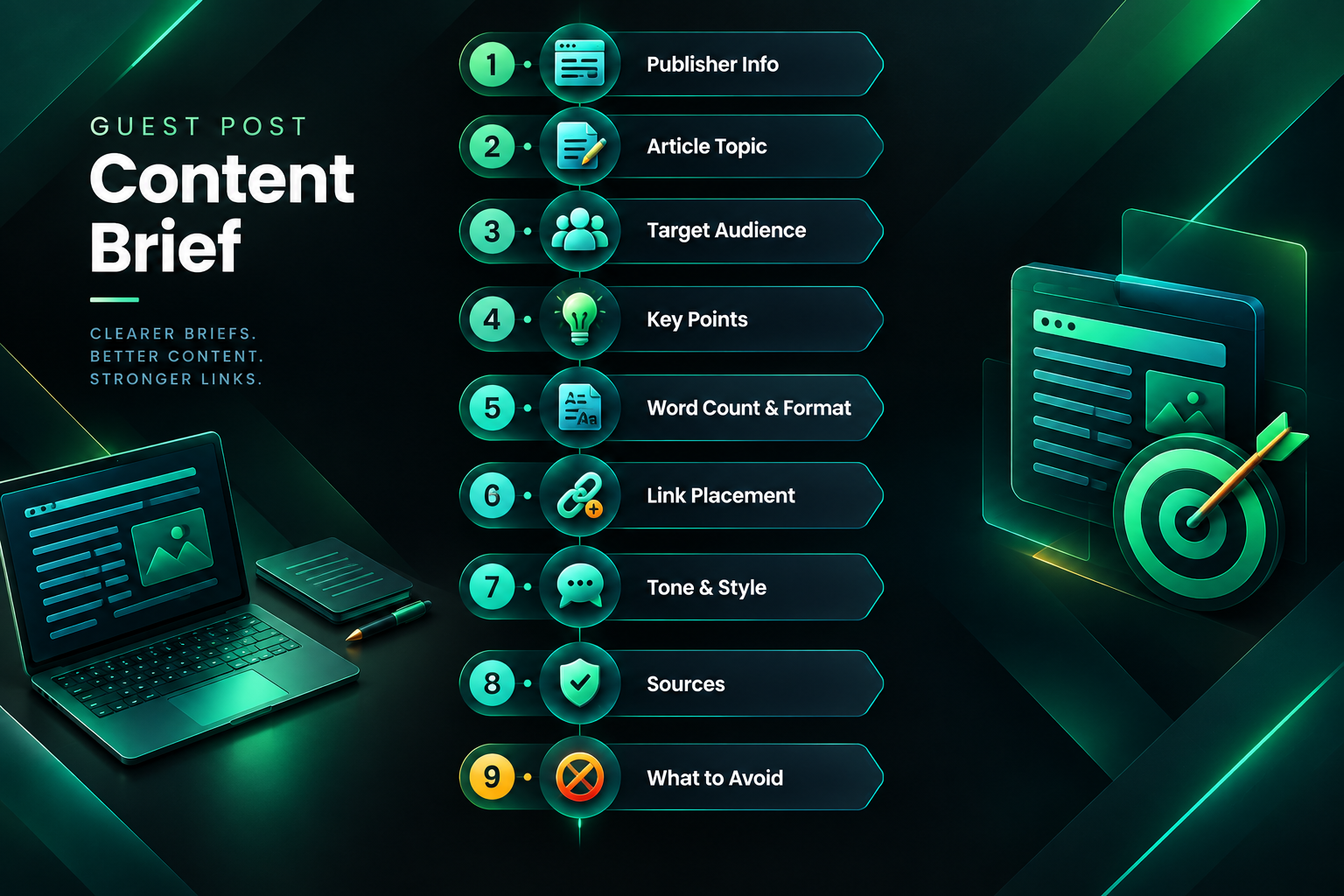
A practical guest post content brief does not need to be long, but it does need to be complete. The following elements are typically necessary for a writer to produce a publishable draft without requiring significant back-and-forth.
Target Publisher Information
The brief should include the name and URL of the target publication, a short description of the site’s audience and content focus, and any editorial guidelines the publisher has shared. If the publisher has a style guide, a preferred word count range, or specific formatting requirements such as avoiding certain heading structures or preferring a particular citation style, these should be included. Writers who understand the publication they are writing for produce more appropriate content than those working from a topic alone.
Article Topic and Working Title
The topic should be specific enough to prevent the writer from drifting into adjacent areas that the publisher has not agreed to cover. A working title helps anchor the scope. For example, “how small e-commerce businesses can reduce cart abandonment” is more useful than “e-commerce tips” because it defines the audience, the problem, and the implied content structure. The working title does not need to be the final headline, but it should reflect what the editor agreed to during the pitch stage.
Target Audience Description
Describe who the article is written for in terms of their knowledge level, role, and likely intent. A guest post written for a site aimed at early-stage startup founders requires a different tone and assumed knowledge base than one written for experienced digital marketers. Without this information, writers default to a generic middle ground that often satisfies neither the publisher’s audience nor the editor’s expectations.
Content Angle and Key Points
The angle is the specific perspective or argument the article will take on the topic. It differentiates the piece from existing content on the publisher’s site and from broadly similar articles elsewhere. The brief should outline three to six key points or sections the article should cover, in a logical order where possible. This is not a rigid outline the writer must follow exactly, but it prevents significant structural omissions and keeps the article focused on what was agreed with the editor.
Word Count and Format
Specify a target word count range rather than an exact number. Most quality publishers expect guest posts to fall between 800 and 2,000 words, though this varies considerably by niche and publication type. The brief should also note any formatting preferences: whether subheadings are expected, whether bullet lists are appropriate for the site’s style, and whether the publisher prefers a conversational or formal register. Matching the format to the publication’s existing content reduces the editing burden on both the writer and the publisher.
Link Placement Instructions
This section is specific to guest posts written for link building purposes. The brief should state the target URL, the preferred anchor text or a short list of acceptable anchor text variations, and the context in which the link should appear. The anchor text should read naturally within the surrounding sentence; briefs that specify exact-match commercial anchor text without considering how it will fit into the prose often result in awkward placements that editors remove.
It is also worth noting in the brief whether the link should appear in the body of the article or whether a bio link is acceptable to the client. Many quality publishers restrict body links or limit them to one per article, so the brief should reflect what was agreed during outreach rather than assuming unlimited link placement is available.
Tone and Style Guidance
Tone guidance helps writers match the publication’s voice without needing to read extensively through the site’s archive. A short description such as “practical and direct, written for busy professionals, avoids jargon” is more useful than a vague instruction to “write well.” If the client has a specific brand voice that should be reflected even in third-party content, note this, but also flag where the publisher’s style should take precedence.
Sources and Research Requirements
Some publishers require cited sources, original data references, or links to authoritative external resources. If the publisher has communicated this requirement, the brief should specify it. Where original research or statistics are needed, the brief should either supply them or direct the writer to appropriate sources. Asking writers to find their own statistics without guidance increases the risk of inaccurate or low-quality citations appearing in the final draft.
What to Avoid
A brief that only describes what the article should include is incomplete. Adding a short list of what to avoid is equally useful. Common restrictions include: do not mention competitor brands by name, do not make claims that require regulatory approval, do not use a promotional tone when describing the client’s products or services, and do not include more than one outbound link to the client’s site unless the editor has agreed otherwise. These instructions prevent avoidable rejections and protect the client’s relationship with the publisher.
Aligning the Brief With the Publisher’s Editorial Standards
One of the most common mistakes in guest post brief writing is treating the publisher as a passive recipient rather than an active editorial partner. Quality publishers have standards, and those standards exist independently of what the link building campaign requires. A brief that ignores the publisher’s audience, contradicts their stated topic restrictions, or produces content that duplicates what they have already published is likely to result in rejection regardless of how well the writer follows the brief.
Before writing the brief, review the publisher’s existing content to understand the depth and style they expect. Check whether they have published similar articles recently, because pitching a topic that overlaps heavily with recent content reduces the chance of acceptance. If the outreach team has already communicated with the editor, any feedback or preferences the editor expressed should be incorporated into the brief before it reaches the writer.
For agencies running outsourced link building campaigns at scale, maintaining a publisher-specific notes file alongside the brief template can help. This file captures editor preferences, past feedback, topic restrictions, and formatting quirks that apply to that specific site. Over time, this institutional knowledge improves placement rates and reduces the revision cycles that slow campaigns down.
Structuring the Brief for Different Campaign Types
The level of detail required in a guest post content brief varies depending on the campaign type, the writer’s familiarity with the niche, and the publisher’s requirements.
SaaS and Technology Niches
Guest posts for SaaS or technology publishers often require a higher level of technical accuracy than general business content. Briefs for these placements should specify the technical depth expected, flag any claims that require verification, and note whether the writer should assume the reader has prior knowledge of the software category or product type being discussed. Inaccurate technical content is a common reason for rejection on specialist sites, and a brief that does not address this creates unnecessary risk.
E-commerce and Retail Niches
E-commerce guest posts frequently target informational or comparison-stage readers. Briefs for these placements should clarify whether the article is intended to be purely informational or whether it can include product category references. Publishers in this space are often sensitive to content that reads as thinly veiled advertising, so the brief should explicitly instruct the writer to maintain an editorial rather than promotional tone throughout.
Finance, Health, and Regulated Niches
Publishers in finance, health, legal, and similarly regulated categories typically apply stricter editorial standards. Briefs for these niches should include clear instructions about claim accuracy, the need for qualified sources, and any statements the writer must avoid for compliance reasons. These are also categories where search engines apply heightened quality assessment, so the content standard required is generally higher than in less regulated niches.
Common Brief-Writing Mistakes and How to Avoid Them
Understanding what makes a brief fail is as useful as knowing what makes one succeed. The following mistakes appear frequently in guest post campaigns and are largely preventable at the brief-writing stage.
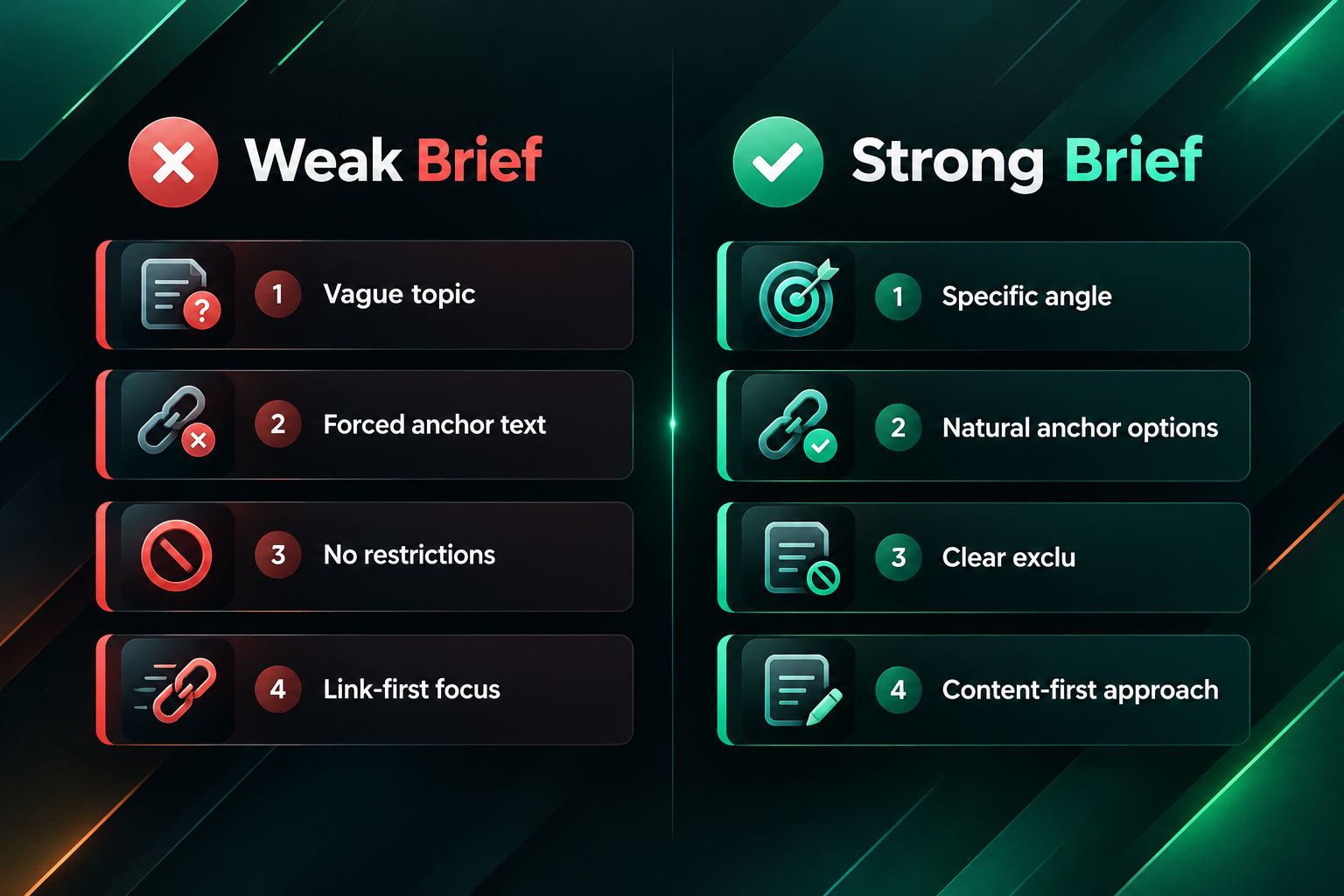
- Vague topic descriptions: A topic like “digital marketing tips” gives the writer almost no useful direction. The brief should define the specific angle, the intended reader, and the key points to cover.
- Anchor text that cannot fit naturally into prose: Exact-match commercial anchor text such as “buy cheap running shoes online” is difficult to place naturally in an editorial article. The brief should offer anchor text options that read as natural language within a sentence.
- Ignoring the publisher’s existing content: Briefs written without reviewing the target site often produce articles that duplicate recent posts or contradict the publisher’s editorial position, both of which lead to rejection.
- Omitting what to avoid: Writers who are not told what to exclude may include competitor mentions, promotional language, or unsupported claims that the editor will flag or remove.
- Treating the link as the primary goal rather than the content: A brief that is clearly structured around inserting a link rather than producing useful content for the publisher’s audience tends to produce exactly that kind of article. Editors recognise this pattern and reject it.
- No revision or feedback loop: A brief that is never updated based on editor feedback or writer questions becomes progressively less useful as a campaign continues. Building in a feedback mechanism improves brief quality over time.
Using the Brief as a Quality Control Tool in Outsourced Campaigns
For businesses and agencies that outsource guest post writing as part of a broader link building campaign, the content brief is the primary quality control mechanism available before a draft is submitted to a publisher. A thorough brief reduces the number of revision rounds required, shortens the time between outreach approval and live placement, and makes it easier to maintain consistent quality across multiple writers working on the same campaign.
When multiple writers are involved, a standardised brief template ensures that each placement receives the same level of structural guidance, even if the specific topic, publisher, and target page differ. The template should cover all the core elements described above, with blank fields that are completed for each individual placement. This approach is more efficient than writing each brief from scratch and reduces the risk of important elements being omitted under time pressure.
Reviewing finished drafts against the brief before submission is also worthwhile. A simple checklist confirming that the article covers the agreed key points, uses the specified anchor text naturally, matches the target word count, and avoids the listed restrictions takes only a few minutes but catches the most common quality issues before they reach the editor.
Frequently Asked Questions
How long should a guest post content brief be?
Most effective guest post briefs are between one and three pages. The goal is completeness, not length. A brief that covers the publisher’s requirements, the article topic and angle, the key points, the link placement instructions, and the tone guidance in a clear format is more useful than a longer document that buries important details in unnecessary text.
Should the brief be shared with the publisher?
Generally, no. The brief is an internal document for the writer and the campaign team. Sharing it with the publisher may raise questions about the commercial nature of the placement. What the publisher should receive is the agreed pitch summary and, eventually, the finished draft that reflects the brief’s instructions.
How specific should the anchor text instructions be?
The brief should provide a preferred anchor text and one or two acceptable alternatives. Anchor text that reads naturally within a sentence is more likely to survive editorial review than exact-match commercial phrases. If the publisher has communicated restrictions on anchor text type, those restrictions should be reflected in the brief.
What happens if the writer deviates significantly from the brief?
A draft that deviates significantly from the brief should be returned for revision before it is submitted to the publisher. Submitting an off-brief draft risks rejection, damages the relationship with the editor, and wastes the time invested in outreach. A clear brief reduces the frequency of significant deviations, but a review step before submission catches the cases that do occur.
Can the same brief template be used across different niches?
A template can provide the structural framework, but the specific content of each brief must reflect the individual publisher, niche, and target page. A finance publisher and a lifestyle publisher have different editorial standards, audience expectations, and topic sensitivities. Applying an identical brief to both without adjustment is likely to produce content that fits neither well.
How does the brief change when targeting high-authority publishers?
Higher-authority publishers typically apply stricter editorial standards, expect greater content depth, and are more likely to reject content that appears commercially motivated. Briefs for these placements should specify a higher standard of research and accuracy, provide more detailed guidance on tone and structure, and be particularly clear about how the link should be integrated naturally into the content.
Putting a Guest Post Brief Into Practice
A guest post content brief is not a bureaucratic formality; it is the practical document that determines whether a link building placement succeeds or fails at the content stage. The time invested in writing a thorough brief is recovered many times over in reduced revision cycles, fewer editorial rejections, and placements that hold their value because the surrounding content genuinely serves the publisher’s audience.
For teams managing guest post campaigns at scale, standardising the brief format and updating it based on editor feedback creates a compounding quality improvement across the campaign. Each placement that generates useful feedback makes the next brief more accurate, and more accurate briefs produce better content with less effort over time.
If your team is managing outreach, brief writing, and content production simultaneously, the workload can become difficult to sustain without a clear process. Working with an experienced link building partner who manages the brief, writer, and editorial relationship as part of a coordinated campaign can reduce that burden while maintaining the content quality that quality publishers require. A site-specific assessment of your target pages, niche, and publisher options is a useful starting point before committing to a campaign approach.