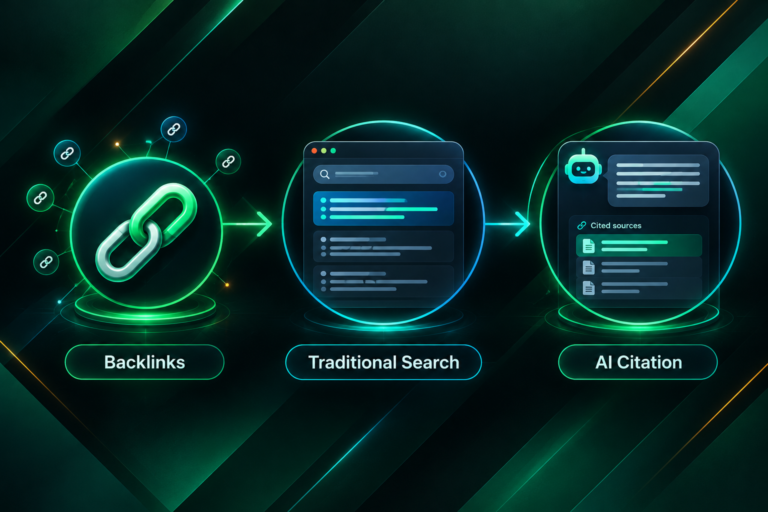
When a product is discontinued, the page is often deleted or left to return a 404 error without much thought about the backlinks pointing to it. Those links may represent months or years of link acquisition effort, and losing their value quietly can affect the organic visibility of the wider site. Understanding your options before making changes to discontinued product pages can help you preserve link equity, maintain a cleaner backlink profile, and avoid creating unnecessary crawl problems.
Key Takeaways
- Backlinks pointing to a 404 page pass no link equity to the rest of your site; the value of those links is effectively lost until you take action.
- A properly implemented 301 redirect to a relevant destination is usually the most practical way to recover link equity from a discontinued product URL.
- Redirecting to an irrelevant page may not fully preserve link equity and can create a poor user experience; destination relevance matters.
- Link reclamation outreach — contacting publishers to update the destination URL — is worth considering when the linking pages are editorially strong and a redirect is not ideal.
- Leaving high-value URLs as 404s without a plan is rarely the right choice, but the best approach depends on the number of referring domains, the quality of those links, and what replacement content or pages are available.
Why Backlinks to Discontinued Pages Are Worth Addressing
A backlink pointing to a live, relevant page contributes to the authority and topical signals of a website. When that page is removed and returns a 404 status code, the link still exists on the referring website, but it no longer passes any meaningful equity to the destination domain. From a crawling perspective, Googlebot will follow the link, encounter the error, and move on. The referring page’s link value is not redistributed to other pages on your site automatically.
The practical consequence is that a site with a history of product launches and discontinuations can accumulate a significant number of referring domains pointing to dead URLs. Over time, this erodes the effective backlink profile — the portion of your link acquisition work that is actually contributing to rankings and organic visibility. For e-commerce websites and SaaS platforms that regularly update their product catalogue, this is a recurring issue rather than a one-time problem.
It is also worth noting that a large number of 404 errors from external links is not itself a direct ranking penalty. Google has stated that 404 pages are a normal part of the web. The concern is not the error status itself but the lost opportunity: link equity that could be recovered and redistributed is instead sitting idle.
Auditing Backlinks Before Making Any Changes
Before deciding how to handle a discontinued product URL, it is worth understanding what is actually pointing to it. Not every backlink carries the same weight, and the effort required to recover link equity should be proportionate to the value of the links involved.
A backlink audit using tools such as Ahrefs, Semrush, or Majestic can show you the referring domains pointing to a specific URL, along with metrics such as domain rating, trust flow, and the number of referring pages. These are third-party proprietary metrics rather than Google-provided signals, so they should be used as relative indicators of link quality rather than absolute measures. What you are looking for is a sense of whether the links pointing to the discontinued URL come from editorially relevant, well-established websites or from low-quality sources that are unlikely to contribute meaningfully to your site’s authority.
Key questions to answer during an audit include:
- How many unique referring domains point to the discontinued URL?
- Are those domains topically relevant to your site’s niche?
- Are the linking pages themselves indexed and receiving organic traffic?
- Is the anchor text used in those links descriptive and relevant, or generic?
- Are there any existing pages on your site that could serve as a logical redirect destination?
This audit step is important because it determines which recovery method is worth pursuing. A URL with two or three low-quality referring domains may not justify significant outreach effort. A URL with twenty referring domains from authoritative industry publications is a different situation entirely.
Option 1: 301 Redirects to a Relevant Destination
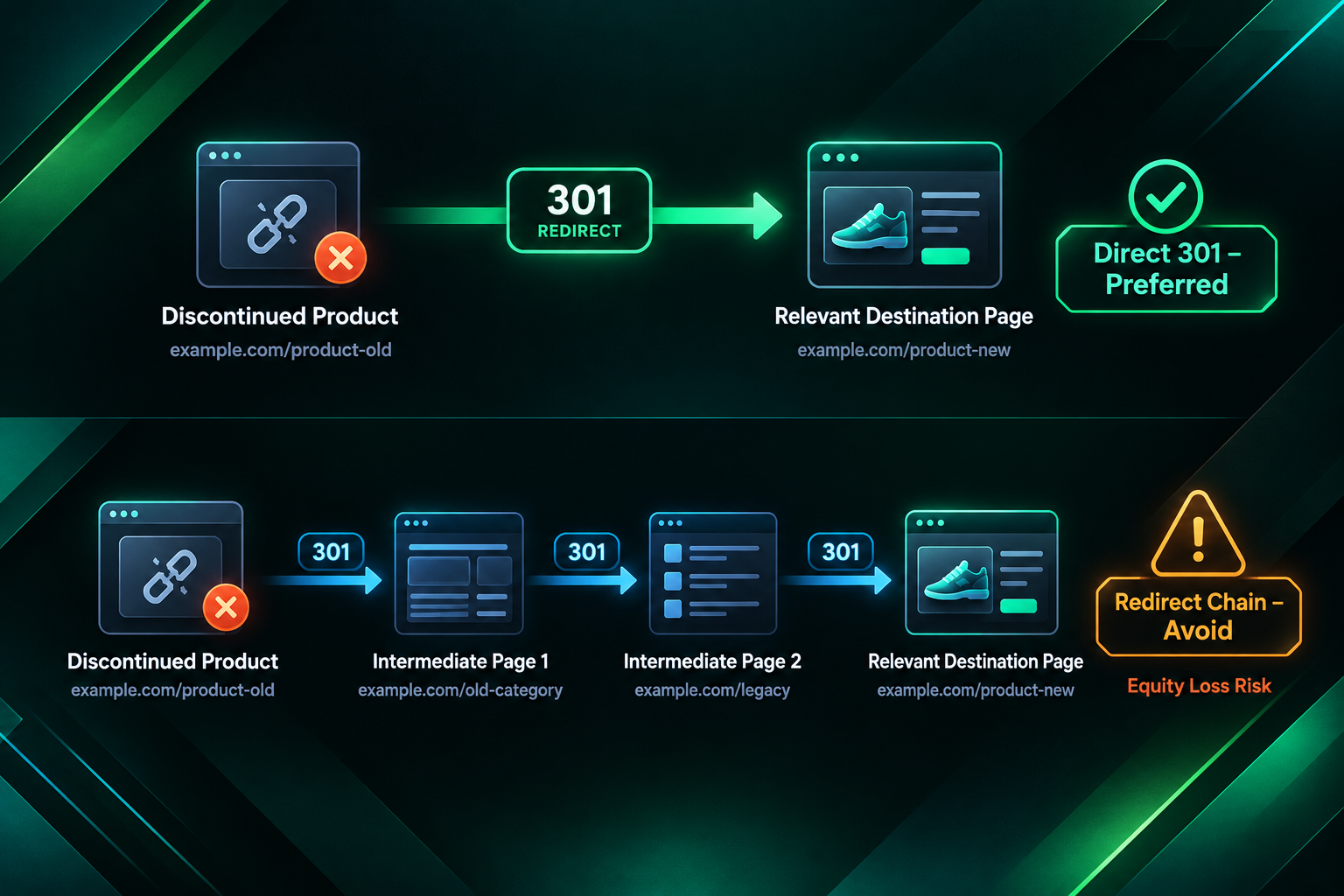
A 301 redirect tells both users and search engines that a URL has permanently moved to a new location. When implemented correctly, a 301 redirect passes the majority of the link equity from the old URL to the new destination. This makes it the most commonly recommended approach for handling discontinued product pages that have meaningful backlinks.
The critical factor is destination relevance. Redirecting a discontinued product page to your homepage is technically straightforward, but it may not fully preserve the link equity or the user experience. Search engines assess the relationship between the old URL and the redirect destination; a redirect to a closely related product, a product category page, or a well-developed alternative page is generally more appropriate than a blanket redirect to the homepage.
Practical redirect destinations to consider include:
- A successor or replacement product page — the most relevant option when a newer version of the discontinued product exists.
- A product category or collection page — appropriate when no direct replacement exists but the category remains active.
- A comparison or buying guide page — useful when the discontinued product was frequently compared to alternatives that you still sell.
- A relevant informational resource — suitable when the discontinued product attracted links because of its educational context rather than its commercial function.
Avoid redirect chains, where a URL redirects to another URL that itself redirects again. Each additional hop in a redirect chain can reduce the equity passed and slow down crawling. If you are consolidating multiple discontinued product URLs, aim to redirect each one directly to its final destination rather than routing through intermediate pages.
Once redirects are in place, it is worth monitoring them in Google Search Console to confirm that the new destination URLs are being indexed and that the old URLs are no longer appearing in coverage reports as errors.
Option 2: Replacing the Page with Relevant Content
In some cases, the best response to a discontinued product page is not to redirect it but to replace it with content that serves the same audience. This approach is particularly relevant when the discontinued product URL has accumulated a meaningful number of backlinks from editorially strong sources, and when there is a genuine informational need that the page can continue to address.
For example, a discontinued software product that attracted links from technology publications may have done so because reviewers and bloggers found it useful to reference. If the product is gone but the underlying topic — the problem it solved, the category it belonged to, the audience it served — remains relevant, a well-developed resource page at the same URL can continue to attract and retain those links.
Content replacement works best when:
- The original URL has a strong referring domain profile that justifies the investment in new content.
- The topic associated with the discontinued product is still actively searched.
- You have the editorial capacity to produce content that genuinely serves the audience who linked to the original page.
- A redirect to an existing page would feel forced or irrelevant to users arriving from the linking context.
This approach requires more upfront effort than a redirect but can deliver longer-term value by creating a page that continues to attract new links organically, rather than simply inheriting the equity from old ones.
Option 3: Link Reclamation Outreach
Link reclamation involves contacting the publishers of pages that link to your discontinued URL and asking them to update the link to point to a more relevant destination. This is a form of manual outreach and is most effective when the linking pages are editorially maintained, topically relevant, and likely to be updated by an active webmaster or content team.
The case for link reclamation is strongest when a 301 redirect is not available or not ideal — for instance, when the discontinued product URL has been completely removed from the site architecture and no suitable redirect destination exists, or when the linking context is specific enough that a redirect would feel misleading to users who follow the link.
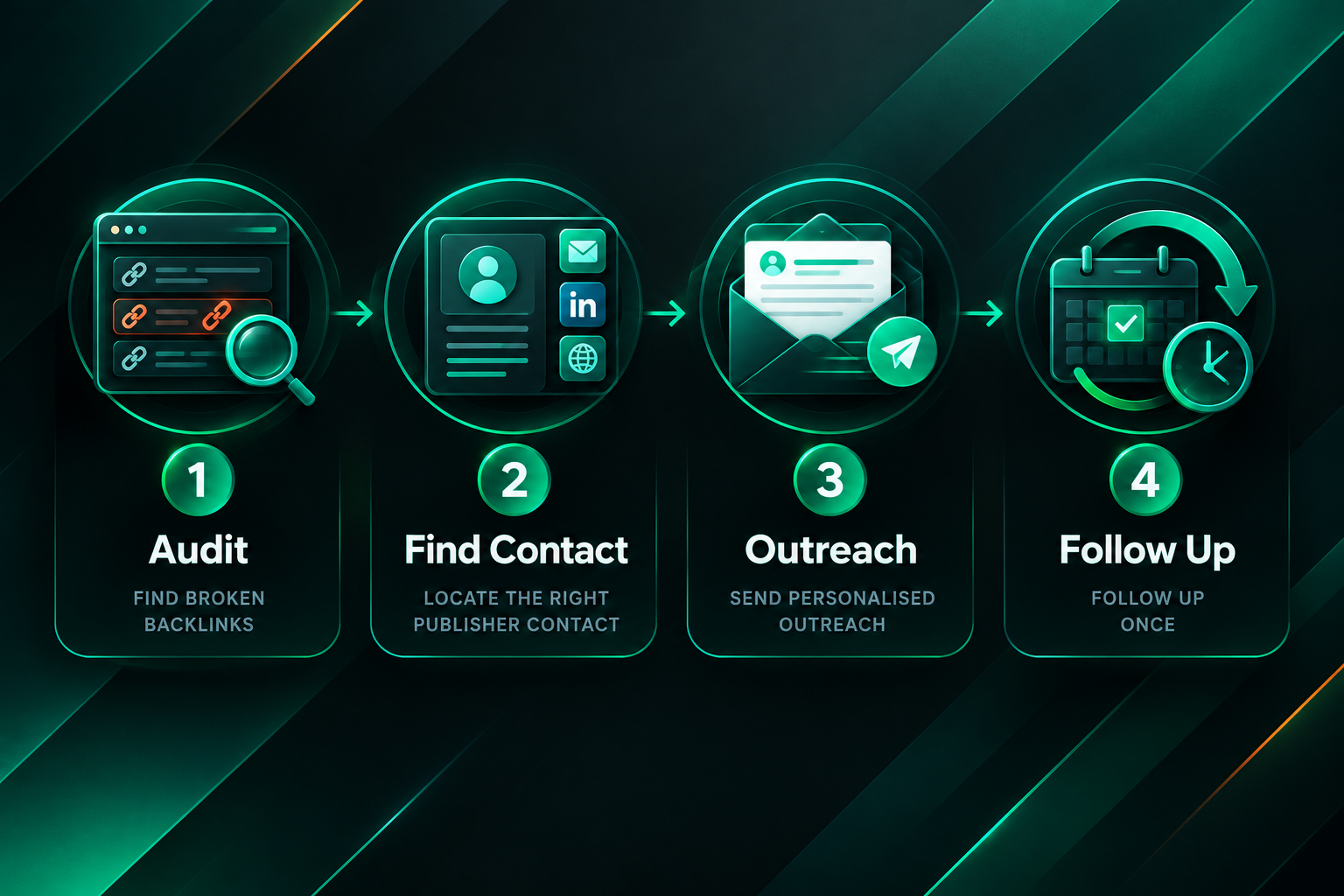
Effective link reclamation outreach typically involves:
- Identifying the specific pages linking to the discontinued URL and confirming they are still live and indexed.
- Finding the appropriate contact — usually the site owner, editor, or content manager — rather than sending a generic contact form submission.
- Writing a brief, clear message that explains the situation, acknowledges the broken link, and suggests a specific replacement URL with a reason why it is relevant to their content.
- Following up once if there is no response, without being persistent to the point of being unwelcome.
Response rates for link reclamation outreach vary considerably depending on the niche, the quality of the linking site, and how recently the content was published. Older pages on sites that are no longer actively maintained are unlikely to be updated regardless of how well the outreach is written. Prioritising recently published pages on active, editorially managed websites will generally produce better results.
Link reclamation is often more cost-effective than acquiring new backlinks from scratch, because the referring domain has already demonstrated a willingness to link to your site. However, it should be treated as a complementary activity rather than a replacement for ongoing link acquisition.
Option 4: Disavowing Low-Quality Links to Discontinued Pages
Not every backlink pointing to a discontinued product page is worth recovering. Some links may come from sources that are low-quality, irrelevant, or potentially harmful to your site’s backlink profile. In these cases, the appropriate response is not to redirect or reclaim but to consider whether those links should be disavowed.
Google’s disavow tool allows site owners to request that certain links be ignored when assessing the site’s backlink profile. This is generally recommended only when there is reason to believe that specific links are causing or contributing to a manual action, or when a site has a history of manipulative link building that needs to be addressed. Disavowing links speculatively — removing links that are simply low-quality but not actively harmful — is not generally advised and can be counterproductive.
For most discontinued product pages, the relevant question is not whether to disavow but whether the links pointing to the page are worth the effort of recovery. If an audit reveals that the referring domains are low-authority, irrelevant, or appear to be part of link networks, the practical decision is often to leave those links as they are rather than investing in outreach or redirect infrastructure for minimal return.
Handling Multiple Discontinued Pages at Scale
For e-commerce websites and SaaS platforms with large product catalogues, discontinued product pages are not an occasional problem but an ongoing operational reality. Managing backlinks to discontinued pages at scale requires a systematic approach rather than case-by-case decisions.
A practical framework for ongoing management might include:
- A pre-discontinuation review — before removing a product page, check its referring domain count and quality. If the page has meaningful backlinks, plan the redirect destination before the page goes offline rather than after.
- A redirect mapping document — maintain a record of all discontinued URLs and their redirect destinations, updated whenever a product is removed. This prevents redirect chains from accumulating over time and makes it easier to audit the redirect structure periodically.
- Scheduled backlink audits — run a crawl of your backlink profile at regular intervals to identify new 404 errors from external links. Tools such as Google Search Console’s coverage report and third-party crawlers can surface these issues before they compound.
- A triage process for link reclamation — not every broken backlink justifies outreach. Establish a minimum threshold — for example, referring domains above a certain domain rating or trust flow score — before committing outreach resources to a reclamation campaign.
Outsourcing the outreach component of link reclamation campaigns can be a practical option for teams that lack the internal bandwidth to manage ongoing manual outreach at scale. A specialist link building provider can handle prospecting, personalised outreach, and follow-up while the internal team focuses on redirect mapping and content decisions.
Common Mistakes to Avoid
Several recurring errors can reduce the effectiveness of backlink management for discontinued product pages or create new problems in the process.
Redirecting everything to the homepage. A homepage redirect is better than a 404, but it is rarely the best option. Search engines may treat a mass redirect to the homepage as a soft 404 if the destination is not contextually related to the original URL. Where possible, redirect to the most relevant available page.
Deleting pages without checking backlinks first. Removing a product page without auditing its backlink profile means losing link equity that could have been preserved with a redirect. Building a pre-deletion backlink check into the product management workflow prevents this from happening repeatedly.
Creating redirect chains. If a discontinued product URL was previously redirected to another page that has since been redirected again, the chain reduces the equity passed and complicates crawling. Audit your redirect structure periodically and update chains to point directly to the final destination.
Assuming all backlinks are worth recovering. Investing significant outreach effort in recovering links from low-quality or irrelevant sources is unlikely to produce meaningful SEO benefit. Prioritise based on the quality and relevance of the referring domains, not simply the number of links.
Ignoring the user experience dimension. Backlink management is often discussed purely in terms of link equity, but users who follow links from external sites also matter. A redirect to a genuinely useful page serves both the SEO goal and the user’s intent; a redirect to an unrelated page may increase bounce rates and reduce the commercial value of the traffic even if some equity is preserved.
Frequently Asked Questions
Does a 301 redirect pass 100% of the link equity from the discontinued page?
Google has indicated that 301 redirects pass the majority of link equity, and in most practical contexts the difference between a redirect and a direct link is considered negligible. However, the relevance of the redirect destination still matters. A redirect to a closely related page is likely to be treated more favourably than a redirect to an unrelated one.
How long does it take for Google to recognise a new redirect?
The time it takes for Googlebot to crawl the old URL, follow the redirect, and update its index varies depending on the crawl frequency of the site and the authority of the pages involved. For well-established sites, this can happen within days; for smaller or less frequently crawled sites, it may take several weeks. Submitting the redirect destination URL through Google Search Console can help prompt recrawling.
Is it worth doing link reclamation outreach for older discontinued pages?
It depends on the quality of the referring domains and whether the linking pages are still actively maintained. A high-quality link from an active industry publication is worth pursuing even if the original product was discontinued some time ago. A link from a page that has not been updated in several years and receives no organic traffic is unlikely to be worth the outreach effort.
Should I create a custom 404 page instead of redirecting?
A well-designed 404 page improves the user experience for visitors who arrive at a dead URL, but it does not recover link equity. A custom 404 page is a useful fallback for URLs that have no suitable redirect destination and no meaningful backlinks, but it should not replace a redirect where one is appropriate.
Can I use a 302 redirect instead of a 301 for discontinued product pages?
A 302 redirect signals a temporary move rather than a permanent one. For discontinued product pages, a 301 is almost always more appropriate because the product is not returning. Search engines may not pass link equity through a 302 redirect in the same way as a 301, and the old URL may continue to be indexed rather than the destination.
What if the discontinued product page has no backlinks worth recovering?
If an audit confirms that the discontinued URL has no meaningful referring domains, the practical options are to leave it as a 404, implement a redirect to the most relevant available page for user experience purposes, or simply remove it from the sitemap and allow it to be deindexed naturally. In this case, the decision is primarily about site hygiene rather than link equity recovery.
Choosing the Right Approach for Your Discontinued Product Pages
There is no single correct way to handle backlinks to discontinued product pages. The right approach depends on the quality and quantity of the referring domains, the availability of a relevant redirect destination, the editorial capacity to produce replacement content, and the operational scale at which product discontinuations occur on your site.
For most websites, a combination of approaches will be appropriate: 301 redirects to relevant destinations for the majority of discontinued URLs, targeted link reclamation outreach for pages with strong referring domain profiles and no suitable redirect, and content replacement for URLs where the topic remains commercially or editorially relevant. Low-quality links pointing to discontinued pages generally do not justify recovery effort and can be left as they are.
The most important habit to develop is checking backlinks before removing a product page rather than after. Recovering link equity from a URL that has been returning a 404 for months is possible but requires more effort than planning the redirect at the point of discontinuation. Building this check into your product management or content workflow reduces the ongoing cost of backlink maintenance considerably.
If your site has a large number of discontinued product URLs with unresolved backlinks, or if you are managing link reclamation campaigns alongside ongoing link acquisition, working with a specialist link building provider can help you prioritise effectively and execute outreach at a scale that internal teams may not have the bandwidth to sustain. A qualified provider can audit the referring domain landscape, identify the highest-value reclamation opportunities, and manage the outreach process while your team focuses on the technical and content decisions that only you can make.