Financial education content is one of the more credible link acquisition approaches available to fintech brands. Publishers covering personal finance, investing, and consumer banking actively seek accurate, well-sourced material to reference, and fintech companies are well-positioned to produce it. This article explains how that dynamic works in practice, which content formats tend to attract editorial links, what the realistic limitations are, and how to assess whether a financial education strategy is appropriate for a specific website and campaign goal.
Key Takeaways
- Financial education content can attract editorial backlinks from publishers in personal finance, consumer media, and professional financial services when the content is genuinely useful and credibly sourced.
- The strongest link-earning formats for fintech brands tend to be original data, interactive tools, and clearly explained regulatory or product guides that journalists and bloggers need to reference.
- Link acquisition through financial education is a medium-to-long-term strategy; measurable SEO effects typically take several months to become visible and depend on many factors beyond backlink count alone.
- Publisher quality, topical relevance, and link placement context matter more than volume; a small number of editorially placed links from authoritative financial publishers may carry more weight than many links from low-quality directories.
- Fintech brands operating in regulated categories face additional content accuracy requirements that, while demanding, can also differentiate their educational material from lower-quality competitors.
Why Financial Education Works as a Link Acquisition Strategy for Fintech
Fintech companies occupy an unusual position in the link building landscape. They operate in a sector where trust signals matter enormously to both users and search engines, yet many fintech brands struggle to earn backlinks because their core product pages offer little that a journalist or blogger would naturally want to cite. Financial education content changes that equation by giving external publishers something genuinely useful to reference: clear explanations of complex topics, original research, or tools that help readers make better financial decisions.
Publishers in the personal finance space, including major consumer media outlets, independent financial blogs, and professional advisory websites, regularly link to external sources when those sources provide data, definitions, or explanations that support their own editorial content. A fintech brand that publishes a well-researched guide to open banking regulations, a calculator that estimates savings account returns under different interest rate scenarios, or an original survey on consumer debt behaviour gives those publishers a credible reason to link. The link is earned because the content serves the publisher’s audience, not because a placement was purchased.
This distinction matters for search engine policy compliance. Google’s published guidance on link schemes identifies paid links that pass PageRank without appropriate disclosure as a violation of its spam policies. Editorially placed links, where a publisher chooses to reference content because it is useful, are not treated the same way. Financial education content, when it genuinely earns citations rather than being placed through paid arrangements, aligns with this editorial model. That said, the line between editorial outreach and paid placement can blur in practice, and fintech brands working with link building partners should clarify how placements are acquired and disclosed.
Content Formats That Tend to Attract Editorial Links in Finance
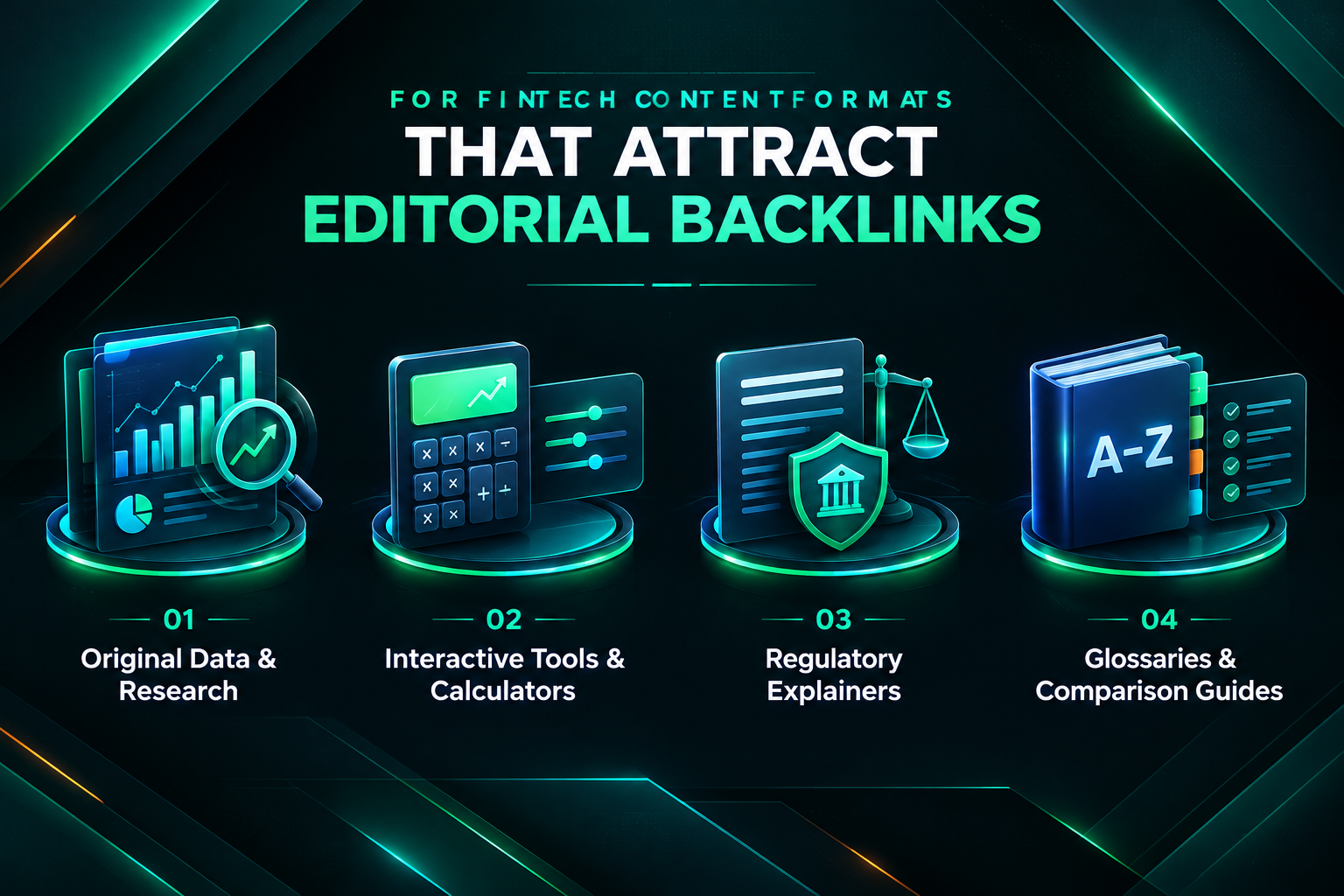
Not all financial education content earns backlinks at the same rate. The formats that tend to generate the most editorial citations share a common characteristic: they give a publisher something they cannot easily produce themselves or find elsewhere.
Original Data and Research
Original surveys, proprietary transaction data analysis, and consumer behaviour research are among the most linkable assets a fintech brand can produce. When a payments company publishes anonymised data showing how spending patterns shift around major economic events, or a lending platform releases research on borrowing behaviour across different age groups, financial journalists have a primary source to cite. This type of content earns links because it is genuinely new information. The investment required to produce credible original research is significant, but the link acquisition potential is correspondingly higher than for explanatory content that largely restates publicly available information.
Interactive Financial Tools and Calculators
Mortgage calculators, compound interest tools, debt repayment planners, and retirement projection tools attract links from personal finance bloggers and consumer advice websites that want to direct their readers to a useful resource rather than build the tool themselves. For fintech brands, these tools also serve a product awareness function, which can make the investment easier to justify internally. The key quality requirement is accuracy: a calculator that produces incorrect outputs will damage credibility rather than build it, and in a regulated sector, errors can carry additional reputational risk.
Regulatory and Product Explainers
Financial regulation changes frequently, and many consumers and small business owners struggle to understand what regulatory updates mean for them. Fintech brands that publish clear, accurate, and timely explanations of regulatory changes, such as updates to open banking frameworks, changes to payment processing rules, or new consumer credit regulations, give publishers a reliable reference point. These explainers tend to attract links from professional services websites, accountancy blogs, and small business media that need to inform their audiences without becoming regulatory experts themselves. Accuracy is non-negotiable in this format; errors in regulatory content can mislead readers and expose the publishing brand to reputational and potentially legal risk.
Glossaries, Definitions, and Comparison Guides
Well-structured financial glossaries and comparison guides earn links more slowly than original research but can accumulate citations steadily over time as publishers look for authoritative definitions to reference. A fintech brand that publishes a comprehensive, clearly written glossary of open banking terms, cryptocurrency concepts, or embedded finance terminology gives writers in adjacent sectors a convenient reference. These assets tend to perform better when they are kept current and when the definitions reflect genuine expertise rather than generic descriptions that could be found anywhere.
Outreach and Publisher Quality in Financial Link Building
Producing strong financial education content is necessary but not sufficient for earning backlinks. Most content, regardless of quality, does not attract links passively without some form of outreach or promotion. Manual outreach to relevant publishers is typically required to make potential linkers aware that the content exists and to explain why it would be useful to their audience.
In the financial sector, publisher quality assessment is particularly important. A backlink from a well-established personal finance publication, a major consumer news outlet, or a respected professional services website carries different weight than a link from a low-traffic financial blog with thin content and no editorial standards. Third-party metrics such as Ahrefs’ Domain Rating, Moz’s Domain Authority, or Majestic’s Trust Flow can provide a rough initial filter for publisher quality, but these are proprietary estimates rather than Google-provided signals, and they should not be treated as guarantees of ranking impact. Topical relevance, the quality of the publisher’s existing content, the editorial context of the placement, and the publisher’s organic visibility in relevant search results are all meaningful factors that metrics alone do not capture.
For fintech brands, publisher relevance extends beyond domain-level authority. A link from a publisher whose audience actively uses financial products, reads about personal finance decisions, or works in financial services is likely to be more contextually appropriate than a link from a high-authority general news site where the financial content is peripheral. Outreach targeting should reflect this distinction.
How a Financial Education Link Building Campaign Typically Works
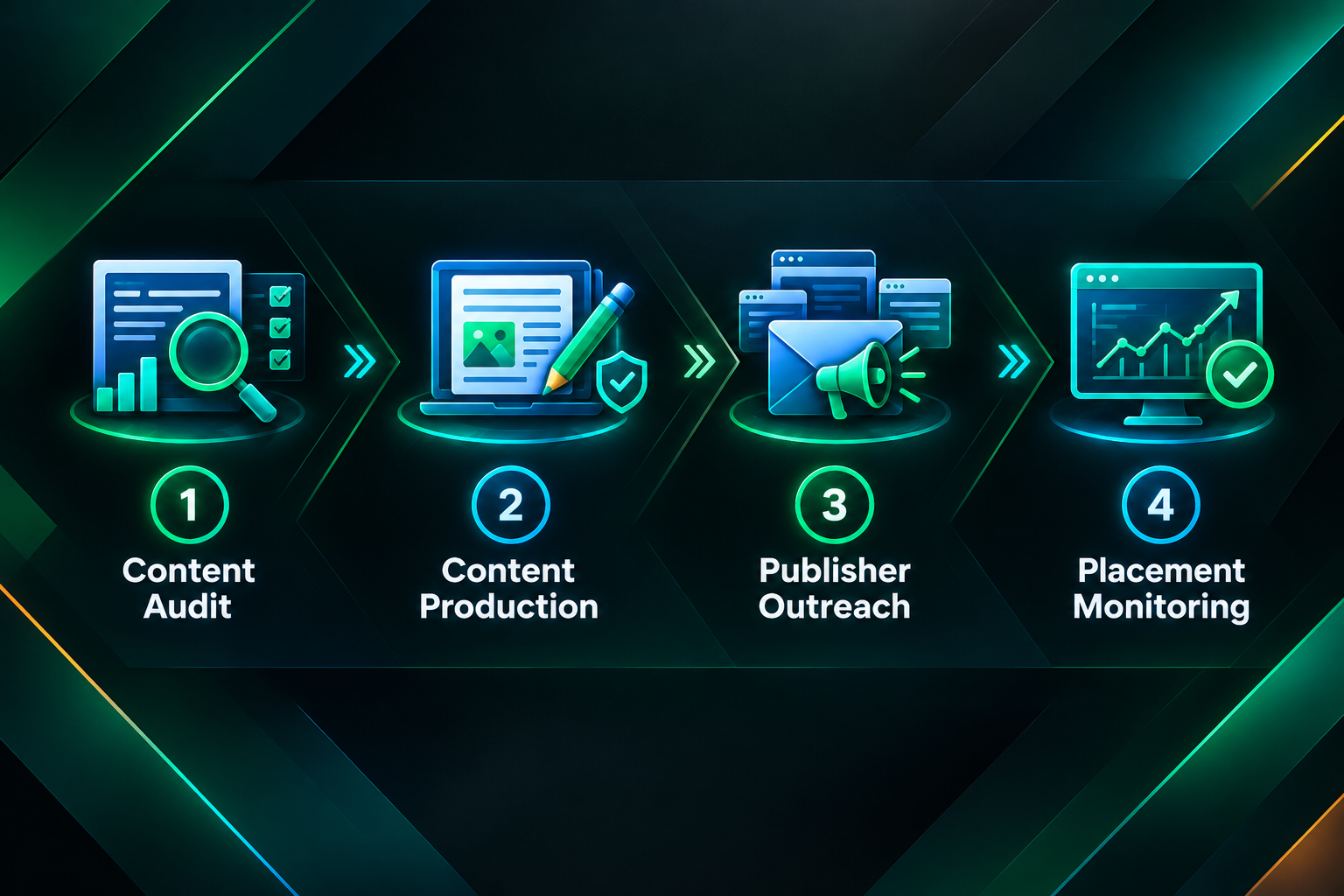
A structured campaign combining financial education content with manual outreach generally involves several sequential phases, each with its own timeline and resource requirements.
Content Audit and Gap Analysis
Before producing new content, it is worth assessing what educational material the brand already has, which pages are attracting organic traffic and backlinks, and where gaps exist relative to competitor content and publisher demand. This audit helps prioritise content investment and identifies whether existing assets could be updated or promoted more effectively before new production begins.
Content Production and Accuracy Review
Financial education content for link acquisition purposes needs to meet a higher accuracy standard than general marketing copy. In regulated sectors, content that makes misleading claims about financial products, misrepresents regulatory requirements, or provides inaccurate data can create compliance problems. Many fintech brands involve compliance or legal review in the content production process, which adds time but reduces risk. This review stage should be factored into campaign timelines.
Publisher Identification and Outreach
Manual outreach involves identifying publishers whose audiences would benefit from the educational content, personalising the outreach message to explain the specific value of the content for that publisher’s readers, and following up appropriately. Response rates in financial publishing vary considerably depending on the quality of the content, the relevance of the pitch, and the publisher’s editorial policies. Some financial publishers do not accept external contributions or links at all; others have formal contributor programmes with their own requirements. Outreach at scale in the financial sector typically requires a dedicated process and realistic expectations about conversion rates.
Placement, Indexing, and Monitoring
Once a link is placed, it needs to be crawled and indexed by search engines before it can contribute to a website’s backlink profile. Crawling and indexing timelines vary and are not directly controllable. After indexing, any ranking or organic traffic effects may take additional weeks or months to become measurable, and those effects depend on many factors beyond the backlink itself, including the target page’s content quality, the website’s overall authority, the competitiveness of the target keywords, and technical SEO factors. Monitoring placements over time is also important; links can be removed when publishers update or delete content, and a replacement process may be needed to maintain campaign momentum.
Realistic Timelines and Expected Outcomes
Financial education link building is not a short-term tactic. Producing credible content, conducting manual outreach, securing placements, and waiting for indexing and ranking effects to accumulate typically means that measurable organic search improvements, where they occur, are more likely to become visible over a period of several months rather than weeks. The exact timeline depends on the website’s starting position, the competitiveness of the target keywords, the quality and relevance of the links acquired, and whether other SEO factors such as technical health and on-page content are already in good condition.
It is also important to distinguish between different types of outcomes. An increase in the number of referring domains pointing to a fintech website is a measurable campaign output, but it is not the same as an improvement in search rankings, and an improvement in search rankings is not the same as an increase in qualified organic traffic or leads. Each step in that chain involves additional variables. Campaigns that focus exclusively on link volume without considering topical relevance, target page alignment, and content quality may produce referring domain growth without corresponding business impact.
Referral traffic from editorial placements in high-traffic financial publications can also be a meaningful outcome in its own right, independent of any ranking effect. A link from a widely read personal finance article may send qualified readers directly to a fintech product page, and that referral traffic may convert at a useful rate depending on the audience match. This outcome is worth tracking separately from organic search metrics.
Risks and Limitations Specific to Fintech Financial Education
Several risks are worth understanding before committing to a financial education link building strategy.
- Content accuracy and compliance risk: Inaccurate financial education content can mislead consumers and, in regulated markets, may attract regulatory scrutiny. The accuracy review process adds production time and cost but is not optional for responsible fintech brands.
- Publisher gatekeeping: Many high-authority financial publishers have strict editorial standards and do not accept unsolicited contributions or external links. Outreach to these publishers may have low conversion rates, and some placements may only be achievable through digital PR approaches rather than standard guest posting outreach.
- Link loss: Editorial links can be removed when publishers update, restructure, or delete content. A campaign that does not include ongoing monitoring and replacement processes may see its backlink profile erode over time.
- Attribution complexity: Isolating the ranking or traffic impact of a specific link building campaign is methodologically difficult. Other SEO changes, algorithm updates, and competitive shifts all affect organic performance simultaneously, making it hard to attribute outcomes to link acquisition alone.
- Paid placement disclosure: If any placements involve payment to publishers, those links should be disclosed appropriately in line with search engine guidelines and, where applicable, advertising standards regulations. Undisclosed paid links in financial content carry both SEO and regulatory risk.
Suitability: Which Fintech Brands May Benefit Most
Financial education link building is not equally suitable for every fintech brand or campaign situation. Brands that are likely to find this approach most productive tend to share certain characteristics.
Fintech companies with access to proprietary data, whether from transaction volumes, user behaviour, or platform analytics, are well-positioned to produce original research that journalists will cite. Brands without proprietary data can still produce useful educational content, but the linkability of that content may be lower unless it offers a genuinely distinctive perspective or format.
Brands targeting competitive keywords in personal finance, lending, payments, or investment management may find that financial education content helps build the topical authority and referring domain profile needed to compete, though this should be assessed alongside technical SEO and content quality factors rather than treated as a standalone solution. Brands in very early stages of website development, or those with significant technical SEO issues, may find that addressing those foundational factors first produces more immediate impact than link acquisition.
Fintech brands operating in niche B2B categories, such as embedded finance infrastructure, regulatory technology, or treasury management software, may find that the pool of relevant high-quality publishers is smaller, which affects both outreach volume and realistic link acquisition rates. A realistic assessment of publisher availability in a specific niche is an important part of campaign planning.
Alternatives and Complementary Approaches
Financial education content is one link acquisition approach among several that fintech brands may consider. Digital PR, which involves pitching original research or data-driven stories to financial journalists rather than seeking guest post placements, can produce links from major publications that do not accept contributor content. This approach tends to require strong story angles and media relations skills, and outcomes are less predictable than structured outreach campaigns, but the placements it generates can be among the most authoritative available.
Niche edits, where a link is inserted into existing published content on a relevant website, offer a faster placement timeline than producing new content and waiting for publication. The quality of niche edit placements varies considerably depending on how they are acquired, and the distinction between editorially motivated updates and paid insertions is an important one from a search engine policy perspective.
Partnerships with complementary financial services brands, such as co-authored research reports or jointly produced educational resources, can generate links from partner websites and from third-party publishers who cover the collaboration. These arrangements require relationship development but can produce mutually beneficial outcomes for both parties.
For fintech brands that lack the internal resources to manage content production, outreach, and publisher relationships simultaneously, working with a specialist link building partner that understands the financial sector’s content accuracy requirements and publisher landscape may be worth considering. The key questions to ask any prospective partner include how placements are acquired, how publisher quality is assessed, what the process is for replacing lost links, and how campaign performance is reported.
Frequently Asked Questions
How long does it take for financial education backlinks to affect search rankings?
There is no fixed timeline. After a link is placed and indexed, ranking effects may begin to become measurable within a few months, but this depends on the competitiveness of the target keywords, the quality and relevance of the links, the website’s existing authority, and whether other SEO factors are in good condition. Some campaigns show measurable movement within three to six months; others take longer or show effects primarily in organic traffic rather than specific keyword rankings.
Do financial education links need to be from finance-specific publishers to be valuable?
Topical relevance is an important quality factor, but it is not the only one. A link from a high-authority general publisher that covers personal finance topics in depth may be more valuable than a link from a low-quality finance-specific site with thin content and minimal organic visibility. The most useful assessment considers both the publisher’s relevance to the target audience and the overall quality of the publication.
Can fintech brands use guest posting as part of a financial education strategy?
Guest posting on relevant financial publications can be an effective way to place educational content and earn backlinks, provided the content meets the publisher’s editorial standards and the placement is genuinely editorial rather than paid without disclosure. Many high-authority financial publishers have formal contributor guidelines, and outreach should be tailored to those requirements. The quality of the host publication and the relevance of the content to the target audience are more important than the volume of placements.
What makes financial education content more linkable than standard fintech marketing content?
Educational content gives external publishers something to reference: data, explanations, tools, or analysis that helps their own readers. Standard marketing content, such as product feature pages or promotional landing pages, typically does not serve that function. Publishers link to content that adds value for their audience, not to content that primarily promotes a product. Financial education content bridges that gap by providing genuine utility while remaining associated with the fintech brand.
How should fintech brands handle compliance review for link-building content?
The appropriate compliance process depends on the brand’s regulatory environment, the nature of the content, and the markets it operates in. Content that touches on regulated financial products, investment advice, or consumer credit typically requires review by a compliance or legal team before publication. This adds time to the production process but reduces the risk of publishing inaccurate or misleading information. Factoring compliance review into campaign timelines from the outset avoids delays later.
Is it possible to measure the ROI of a financial education link building campaign?
Measuring return on investment in link building is genuinely difficult because the causal chain between a specific link and a business outcome involves many intermediate variables. Campaigns can track referring domain growth, changes in organic search visibility for target keywords, referral traffic from specific placements, and changes in lead or conversion volume over the campaign period. However, isolating the contribution of link acquisition from other SEO and marketing activity requires careful baseline measurement and realistic expectations about attribution precision.
Is Financial Education Link Building the Right Approach for Your Fintech Brand?
Financial education content offers fintech brands a credible, editorially grounded route to earning backlinks from publishers that matter in the personal finance and professional services space. The approach works best when the content is genuinely useful, accurately produced, and actively promoted through structured outreach rather than left to attract links passively. It is a medium-to-long-term investment, and the outcomes depend on content quality, publisher relevance, campaign consistency, and the broader SEO condition of the website.
Brands with access to proprietary data, a compliance-aware content production process, and realistic expectations about timelines are likely to find this strategy productive. Brands that are looking for rapid link volume or that have significant technical SEO issues to resolve first may benefit from a different sequencing of priorities. A site-specific assessment that considers the existing backlink profile, target keyword competitiveness, content quality, and available resources is the most reliable basis for deciding whether and how to invest in financial education link building.
If you are evaluating this approach for a fintech website and want to understand how it might fit within a broader link acquisition strategy, speaking with a specialist who understands both the financial sector’s content requirements and the practical realities of manual outreach is a reasonable next step.