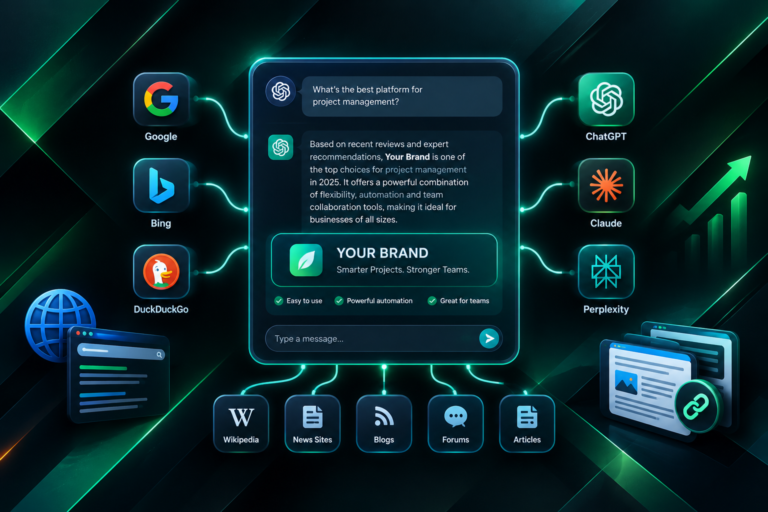
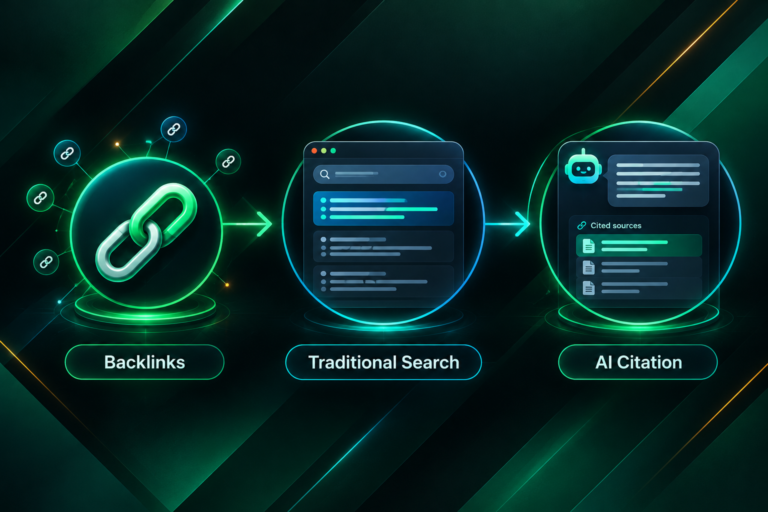
AI-powered answer engines such as Google’s AI Overviews, ChatGPT, Perplexity, and Bing Copilot increasingly surface content directly within search results, often citing specific publishers as sources. For SEO professionals and link builders, understanding which publishers earn those citations — and why — has become a meaningful research task. This article explains practical methods for discovering cited publishers, what their citation patterns may reveal about content authority, and how this intelligence can inform a more targeted outreach and link acquisition strategy.
Key Takeaways
- AI answer engines regularly cite a relatively small set of publishers per topic; identifying these publishers gives you a prioritised outreach target list grounded in demonstrated topical authority.
- Citation discovery requires a combination of manual query testing, prompt engineering, and cross-referencing with traditional backlink and traffic analysis tools.
- Being cited by an AI answer engine does not automatically improve search rankings, but earning links from frequently cited publishers may contribute to a stronger backlink profile over time.
- Publisher citation patterns vary by query type, geography, and the specific AI platform, so research should cover multiple tools and query formulations.
- This research method complements — rather than replaces — conventional publisher prospecting based on topical relevance, domain authority metrics, and editorial standards.
Why AI Citation Research Matters for Link Building
When an AI answer engine responds to a user query, it typically draws on a curated set of sources it considers authoritative, relevant, and trustworthy for that topic. These sources are not selected randomly. Platforms such as Perplexity and Google’s AI Overviews tend to favour publishers with strong editorial standards, consistent topical coverage, and established backlink profiles. Identifying which publishers consistently appear as cited sources for your target topics gives you a data-informed shortlist of websites that search engines and AI systems already treat as credible voices in your niche.
From a link building perspective, this matters for two connected reasons. First, earning a link from a publisher that AI systems regularly cite may carry meaningful authority signals, because those publishers tend to have the editorial quality and topical depth that both traditional search algorithms and AI retrieval systems reward. Second, understanding the citation landscape helps you assess whether your own content is positioned to compete for similar recognition — and where gaps in your publisher relationships may exist. This is not a guarantee of AI citation or ranking improvement, but it is a more targeted starting point than generic domain authority filtering alone.
How AI Answer Engines Select Their Sources
Understanding the selection mechanism helps you interpret citation data more accurately. AI answer engines generally retrieve sources through a combination of retrieval-augmented generation (RAG) — where the model queries a live or indexed web corpus — and pre-training data that reflects historical web authority signals. Google’s AI Overviews, for example, appear to draw heavily on the same quality signals that influence organic search rankings, including content depth, E-E-A-T indicators (experience, expertise, authoritativeness, and trustworthiness), and the strength of a publisher’s inbound link profile.
Perplexity operates as a real-time search-and-summarise tool, citing sources it retrieves during the query session. This means its citations can shift more frequently than those of a model with a fixed training cutoff. Bing Copilot integrates with Bing’s search index, so its cited publishers tend to reflect Bing’s own ranking signals. ChatGPT with browsing enabled behaves similarly to Perplexity for live queries, while the base model without browsing reflects training data that may not represent the current web. Recognising these differences is important: a publisher cited consistently across multiple AI platforms is likely to have broader and more durable authority signals than one that appears only in a single tool’s output.
Step-by-Step Methods for Discovering Cited Publishers
1. Direct Query Testing Across Multiple AI Platforms
The most straightforward starting point is to run your target queries directly in each major AI answer tool and record which publishers are cited. Use the same query formulations you would target in an SEO campaign — informational questions, comparison queries, and definition-style prompts tend to generate the most explicit source citations. In Perplexity, citations appear as numbered footnotes linked to the original URLs. In Google’s AI Overviews, cited sources appear as expandable cards beneath the generated answer. In Bing Copilot, sources are listed alongside the response. Record the domain, the specific page cited, and the position of the citation within the answer.
Run each query in at least three to five different formulations to account for variation. AI systems do not always cite the same sources for semantically similar queries, so testing multiple phrasings gives you a more representative picture of which publishers hold consistent authority for a topic cluster rather than a single keyword. Document your findings in a spreadsheet, noting the platform, query, cited domain, cited URL, and citation position for each result.
2. Prompt Engineering to Surface Source Lists
Some AI platforms respond to direct prompts asking them to identify their preferred sources. In ChatGPT with browsing enabled or in Perplexity, you can ask: “Which websites do you consider most authoritative on [topic]?” or “Which publishers do you typically cite when answering questions about [niche]?” The responses are not always consistent or complete, but they can surface publisher names that do not always appear in standard query testing, particularly for niche or technical topics where citation frequency is lower.
Treat these responses as supplementary intelligence rather than definitive lists. AI models can hallucinate publisher names or describe authority patterns that do not reflect their actual retrieval behaviour. Cross-reference any publisher names generated this way against your direct query testing results and against conventional SEO tools before treating them as outreach targets.
3. Cross-Referencing with Backlink and Traffic Analysis Tools
Once you have a list of frequently cited publishers from direct testing, validate and enrich that list using tools such as Ahrefs, Semrush, or Majestic. Look at each cited publisher’s referring domain count, topical authority within your niche, and organic traffic estimates. A publisher that appears frequently in AI citations and also has a strong, editorially earned backlink profile is a higher-confidence outreach target than one with AI citations but weak conventional authority signals.
Within Ahrefs or Semrush, you can also use the “Top Pages” or “Organic Keywords” reports for each cited publisher to understand which of their specific articles are driving the most visibility. This helps you identify the content formats, depth levels, and topic angles that AI systems appear to favour from that publisher — useful intelligence when planning guest content or link placement proposals. Domain Rating (DR) in Ahrefs, Domain Authority (DA) in Moz, and Authority Score in Semrush are proprietary metrics and should not be treated as direct Google ranking signals, but they can serve as relative quality indicators when comparing publishers within the same niche.
4. Monitoring AI Citation Patterns Over Time
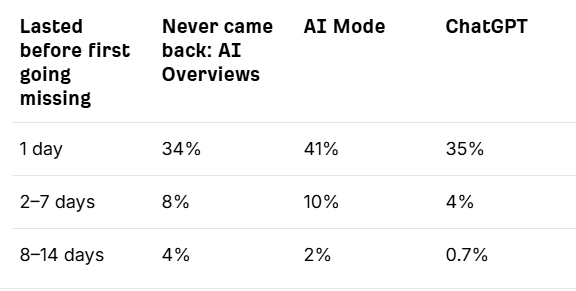
AI citation patterns are not static. Publishers can gain or lose citation frequency as their content is updated, as their backlink profiles change, or as AI platforms adjust their retrieval and ranking logic. Building a repeatable monitoring process — running the same set of test queries monthly or quarterly and recording citation changes — allows you to track which publishers are gaining authority in your topic area and which are declining. This longitudinal view is more actionable than a single snapshot, particularly for competitive niches where publisher authority shifts more frequently.
Some SEO teams use structured tracking sheets or simple automation scripts to run queries via API access (where available) and log citation data systematically. Perplexity offers API access that can support this kind of programmatic monitoring. For most teams without developer resources, a consistent manual testing schedule with a standardised recording template is a practical alternative.
5. Analysing Competitor Backlink Profiles for Cited Publishers
A complementary approach is to identify which publishers are already linking to your competitors’ most visible pages, then cross-reference those publishers against your AI citation research. If a publisher appears both as a frequent AI citation source and as a referring domain for multiple competitors in your niche, it is a strong candidate for outreach. This overlap suggests the publisher has established topical relevance, editorial credibility, and a demonstrated willingness to link to content in your space.
In Ahrefs or Semrush, the “Link Intersect” or “Backlink Gap” features allow you to identify referring domains that link to several competitors but not yet to your site. Filtering this list against your AI citation research produces a prioritised outreach shortlist that combines traditional link gap analysis with AI-era authority signals — a more robust basis for campaign planning than either method alone.
Evaluating Publisher Quality Beyond Citation Frequency
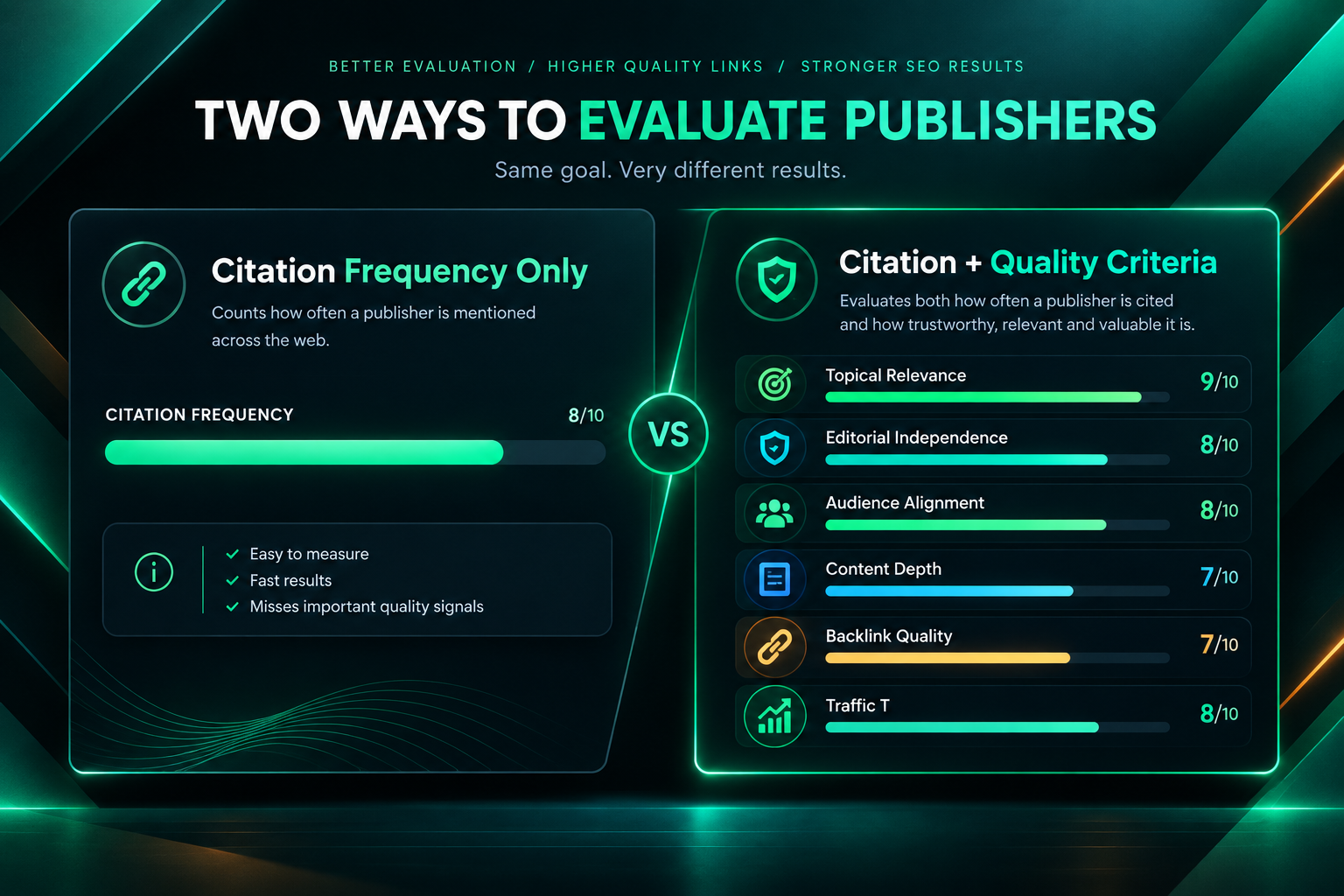
Citation frequency in AI answers is a useful signal, but it should not be the only criterion for evaluating a publisher as an outreach target. A publisher cited frequently by AI tools may still be unsuitable for link acquisition if its editorial standards are low, if it accepts paid placements without disclosure, or if its audience does not overlap with your target market. Conversely, a publisher cited less frequently may be highly valuable if it has a loyal, engaged readership in your specific niche and a strong record of editorially independent content.
When assessing a cited publisher for outreach suitability, consider the following factors alongside citation frequency:
- Topical relevance: Does the publisher consistently cover topics closely related to your target pages and business niche?
- Editorial independence: Does the publisher maintain clear editorial standards, or does it routinely publish sponsored content without adequate disclosure?
- Audience alignment: Does the publisher’s readership match the demographic or professional profile of your target customers?
- Content depth and update frequency: Does the publisher produce substantive, regularly updated content, or does it rely on thin or outdated material?
- Backlink profile quality: Does the publisher’s own inbound link profile reflect genuine editorial recognition, or does it show signs of manipulative link acquisition?
- Traffic trends: Is the publisher’s organic traffic stable or growing, or has it declined significantly in recent algorithm updates?
Applying these criteria alongside AI citation data produces a more reliable publisher shortlist than citation frequency alone. A link from a publisher that meets all of these criteria is likely to carry more durable value than one from a frequently cited but editorially weak source.
Using Citation Research to Inform Content Strategy
Publisher discovery is not only useful for outreach planning. Analysing the specific pages that AI systems cite — not just the domains — reveals patterns in the content formats, depth levels, and structural features that AI retrieval systems appear to favour. If the majority of cited pages for your target topic are long-form guides with clear subheadings, structured data, and original research, that is meaningful input for your own content development. If cited pages tend to be concise, definition-focused articles, that suggests a different content approach may be more appropriate for that query type.
This content intelligence is particularly useful for teams planning to build linkable assets — pieces of content specifically designed to attract editorial links from high-quality publishers. Understanding what cited publishers themselves link to, and what formats AI systems retrieve from those publishers, helps you design linkable assets that are more likely to earn genuine editorial recognition rather than requiring purely outreach-driven placement.
Limitations and Realistic Expectations
AI citation research is a relatively new practice, and its relationship to measurable SEO outcomes is not yet well established. Being cited by an AI answer engine does not directly improve a page’s organic search ranking in the traditional sense, and earning a link from a frequently cited publisher does not guarantee AI citation for your own content. The causal relationships between AI citations, backlink profiles, and search rankings remain an active area of observation and debate among SEO practitioners, and definitive conclusions are not yet supported by large-scale, independently verified research.
There are also practical limitations to the discovery methods described above. AI citation patterns can vary significantly between query sessions, geographic locations, and platform versions. A publisher cited in one session may not appear in the next, particularly on platforms with real-time retrieval. This variability means that citation data should be treated as directional intelligence rather than a precise ranking of publisher authority. Additionally, some AI platforms do not consistently surface citations in a format that allows systematic recording, which limits the completeness of any manual research effort.
Finally, publisher outreach based on AI citation research is subject to the same practical constraints as any manual link acquisition campaign: publishers may decline outreach, editorial standards may make certain placements difficult to earn, and the time from initial contact to live placement can range from several weeks to several months depending on the publisher’s editorial calendar and responsiveness.
How This Research Fits Into a Broader Link Building Campaign
AI citation research is most effective when integrated into a broader link acquisition strategy rather than treated as a standalone tactic. The publisher shortlists it generates are most valuable when combined with conventional prospecting methods — topical relevance filtering, backlink gap analysis, domain quality assessment, and audience alignment checks — to produce a prioritised outreach list that reflects multiple dimensions of publisher authority.
For agencies managing link building campaigns on behalf of clients, this research layer adds a forward-looking dimension to publisher prospecting. As AI answer engines become a more significant source of search traffic and brand visibility, the publishers that AI systems treat as authoritative are likely to become increasingly important outreach targets. Building relationships with these publishers now — through guest posting, digital PR, or editorial link placement — may position a client’s backlink profile more favourably as the search landscape continues to evolve.
For in-house SEO teams with limited outreach capacity, the prioritisation value of this research is particularly significant. Rather than working through a broad list of potential publishers, AI citation research helps concentrate outreach effort on the subset of publishers most likely to carry meaningful authority signals in both traditional and AI-mediated search environments. This focus can improve the efficiency of a link acquisition campaign without requiring a larger outreach volume.
Frequently Asked Questions
Does being cited in an AI answer directly improve my search rankings?
There is no documented evidence that AI citation directly causes an improvement in traditional organic search rankings. AI citations and search rankings are influenced by overlapping but distinct signals. However, the publishers that AI systems frequently cite tend to have strong editorial authority and backlink profiles, so earning links from those publishers may contribute positively to your own authority signals over time.
Which AI platforms are most useful for citation research?
Perplexity is currently one of the most useful platforms for citation research because it consistently displays numbered source citations linked to specific URLs. Google’s AI Overviews and Bing Copilot also surface citations, though in different formats. Running research across multiple platforms gives a more representative picture of publisher authority than relying on a single tool.
How often do AI citation patterns change?
Citation patterns can shift with each query session, particularly on platforms with real-time retrieval like Perplexity. Broader shifts in which publishers are consistently cited tend to occur more gradually, often reflecting changes in publisher content quality, backlink profiles, or AI platform updates. Monthly or quarterly monitoring is a practical approach for most teams.
Can I use this research to get my own content cited by AI tools?
Understanding what types of content AI systems cite can inform your content strategy, but there is no reliable method for guaranteeing AI citation. Producing high-quality, well-structured, topically authoritative content and earning editorial links from credible publishers are the factors most commonly associated with AI citation, based on current practitioner observation. Outcomes vary significantly by topic, query type, and platform.
Is AI citation research suitable for all niches?
The usefulness of this research varies by niche. For topics where AI answer engines are frequently used — health, finance, technology, marketing — citation patterns tend to be more consistent and easier to analyse. For highly specialised or local topics, AI citation frequency may be lower and patterns less reliable. A niche-specific assessment is advisable before investing significant research time.
How does this differ from traditional publisher prospecting?
Traditional publisher prospecting typically relies on topical relevance, domain authority metrics, traffic estimates, and backlink gap analysis. AI citation research adds a layer of intelligence about which publishers search and AI systems actively treat as authoritative sources for specific query types. The two approaches are complementary: AI citation data helps prioritise the publisher list that conventional prospecting generates.
Turning Publisher Discovery Into a Practical Outreach Advantage
Discovering which publishers are cited in AI answers is a research task with genuine practical value, but its usefulness depends on how the findings are applied. A list of frequently cited publishers is only as useful as the outreach strategy built around it. The publishers that AI systems favour tend to have high editorial standards, which means earning placements from them typically requires well-researched, genuinely useful content proposals rather than generic outreach templates. Treating citation research as the starting point for a more targeted and editorially credible outreach effort is likely to produce better results than using it simply to generate a larger prospecting list.
For businesses and agencies considering how to integrate this approach into their link acquisition campaigns, the most practical next step is to run a structured citation audit for your primary topic cluster, cross-reference the results against your existing backlink profile and competitor gap analysis, and use the combined findings to prioritise your outreach calendar. If your team lacks the capacity to conduct this research systematically alongside active outreach, working with an experienced link building partner who can incorporate publisher intelligence into campaign planning may be worth exploring. The goal in either case is the same: building relationships with publishers whose editorial authority is recognised by both traditional search systems and the AI tools that are increasingly shaping how users discover content.