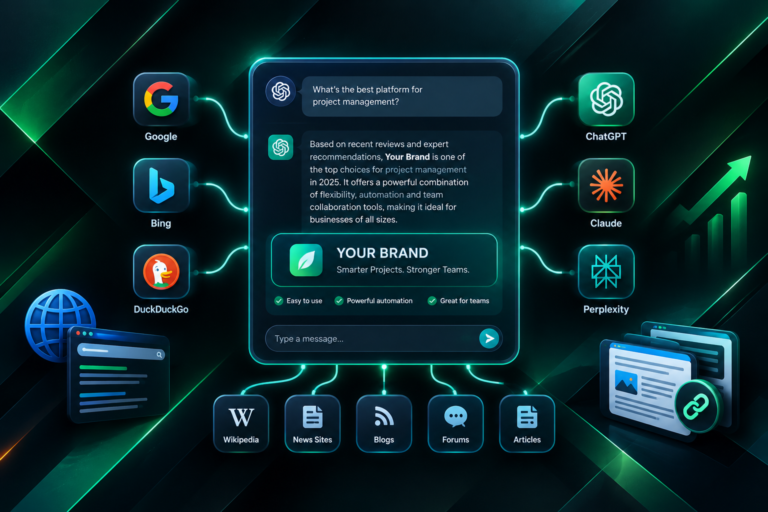
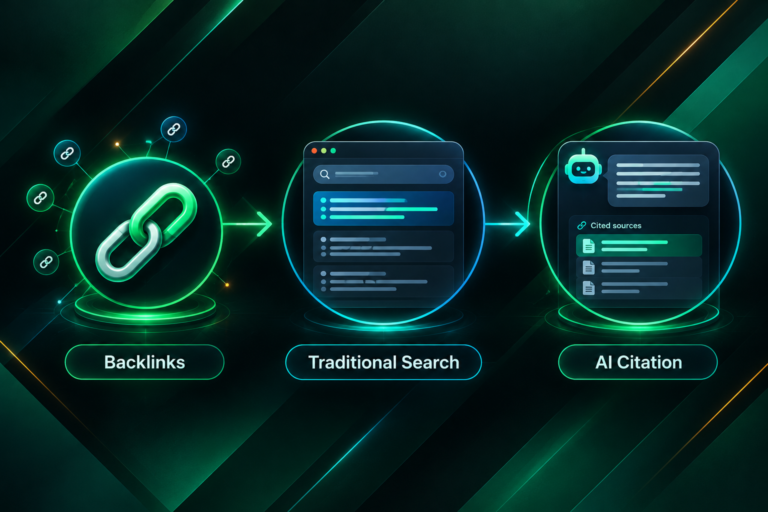
Backlinks are widely regarded as one of the more durable SEO assets a website can acquire, but that durability is not unconditional. A link that contributes meaningfully to a page’s authority today may deliver less value in a year, or none at all, depending on what happens to the linking page, the linking domain, and the broader competitive landscape around your target content. Understanding how and why backlink value changes over time helps businesses and SEO teams make better decisions about acquisition, monitoring, and long-term campaign planning.
Key Takeaways
- Backlinks do not automatically lose value simply because time passes, but several real-world factors can reduce or eliminate the link equity a placement delivers.
- The most common causes of backlink decay include page removal, domain decline, link attribute changes, and shifts in topical relevance between the linking and target pages.
- Third-party metrics such as Domain Rating (Ahrefs), Domain Authority (Moz), and Trust Flow (Majestic) can change independently of actual Google ranking signals, so metric movement alone does not confirm that a link has gained or lost value.
- Active backlink monitoring and periodic profile audits are practical steps that help identify lost or degraded links before they affect campaign performance.
- Link building is most effective as an ongoing investment rather than a one-time activity, partly because the competitive landscape and the linking ecosystem both change continuously.
What Does “Backlink Value” Actually Mean?
Before examining whether backlinks lose value over time, it is worth being precise about what backlink value means in practice. A backlink’s contribution to a target page’s search visibility depends on several interconnected factors: the authority and trustworthiness of the linking domain, the relevance of the linking page’s content to the target page, the placement context within the page, the link attributes applied (such as rel=”nofollow” or rel=”sponsored”), and whether the link is still live and crawlable. Google’s documented guidance describes links as one signal among many that help its systems understand a page’s credibility and relevance, though the precise weighting of individual link signals is not publicly disclosed.
Third-party tools assign proxy metrics to domains and pages — Domain Rating from Ahrefs, Domain Authority from Moz, Authority Score from Semrush, and Trust Flow from Majestic are common examples. These metrics estimate link-based authority using each tool’s own methodology and data. They are useful for comparative assessment and campaign planning, but they are not Google ranking signals and should not be treated as direct measures of how much ranking benefit a specific link delivers. A link from a domain with a high Domain Rating may still contribute little if the linking page is buried, irrelevant, or carries a restrictive link attribute.
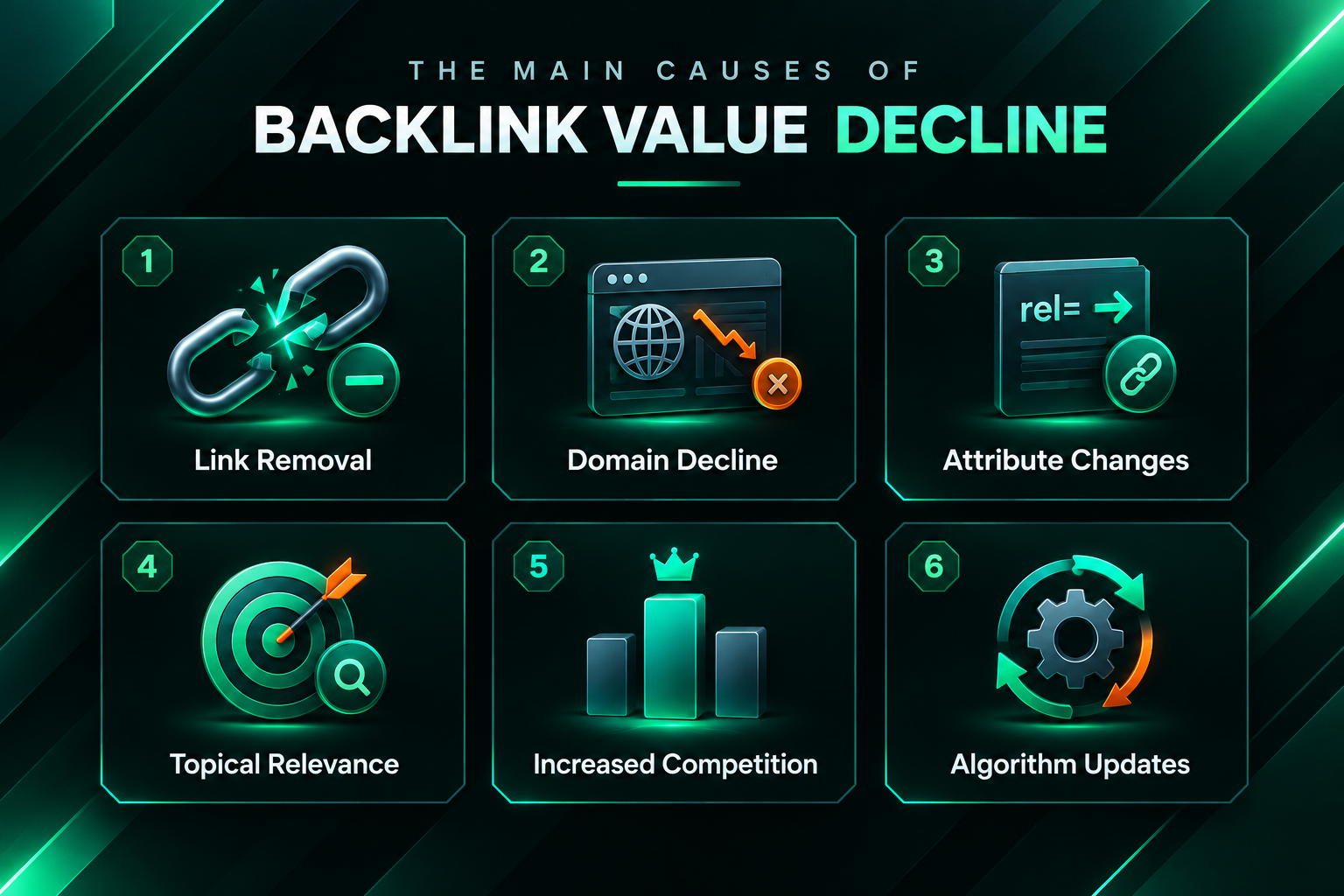
The Main Reasons Backlink Value Can Decline
Backlink value does not erode on a fixed schedule, but several documented mechanisms can reduce what a link contributes over time. Recognising these mechanisms helps SEO teams prioritise monitoring and replacement activity.
Link Removal or Page Deletion
The most straightforward cause of backlink value loss is the removal of the link itself. Publishers update, restructure, or delete content regularly. A guest post that was live for two years may be removed during a site redesign. A resource page that linked to your tool may be pruned when the publisher audits their outbound links. When a linking page is deleted or the link is removed from the page, the placement no longer passes any equity to the target page. Google’s crawlers will eventually discover the change and update their index accordingly, though the timing of that update varies.
Domain Decline or Abandonment
A linking domain’s authority is not static. If a previously strong domain loses significant organic traffic, accumulates thin or low-quality content, receives a manual action from Google, or is eventually abandoned and allowed to expire, the links it hosts may contribute less over time. In some cases, expired domains are re-registered and repurposed for spam, which can make links from those domains actively harmful rather than merely neutral. Monitoring the health of referring domains — not just the presence of individual links — is a meaningful part of backlink profile maintenance.
Changes to Link Attributes
Publishers sometimes retroactively change link attributes. A link that was originally followed (passing equity) may be changed to rel=”nofollow” or rel=”sponsored” during a site audit or policy update. Google’s documentation indicates that nofollow is treated as a hint rather than a directive for crawling and indexing purposes, but the practical effect on link equity is generally considered to be reduced compared to a followed editorial link. If a significant portion of a site’s backlink profile shifts from followed to nofollowed links, the aggregate equity contribution of those links may decrease.
Declining Topical Relevance
Topical relevance between a linking page and a target page is a factor in how useful a link is considered to be. If the content of a linking page is substantially updated and moves away from the subject matter of the original placement, the contextual relevance of the link may diminish. Similarly, if the target page’s content becomes outdated relative to current search intent, the page itself may rank less well regardless of its backlink profile, making the question of individual link value somewhat secondary to the content problem.
Increased Competition in the Linking Ecosystem
Backlink value is partly relative. If your competitors are consistently acquiring high-quality links to their pages while your backlink profile remains static, the competitive gap widens even if your existing links remain live and unchanged. This is not the same as your links losing intrinsic value, but the practical effect on relative ranking position can be similar. Ongoing link acquisition is partly a response to this competitive dynamic rather than solely a response to link decay.
Algorithm Updates and Changing Signal Weighting
Google updates its ranking systems regularly, and the relative weighting of different signals — including link signals — can shift. Some links that were highly valued under older algorithmic approaches may contribute less under updated systems, particularly if those links were acquired through methods that later became associated with manipulative practices. Google’s spam policies have evolved over time, and links that were once considered acceptable may be treated differently following a policy or algorithm update. This is one reason why the quality and editorial context of link placements matters for long-term value, not just the metrics at the time of acquisition.
How Quickly Can Backlink Value Change?
There is no universal timeline for backlink value change. A link from a stable, editorially maintained publication on a high-traffic page may remain valuable for many years. A link from a lower-quality site with irregular publishing activity may lose relevance or disappear within months. The rate of change depends on the stability of the linking domain, the editorial practices of the publisher, the competitiveness of the target niche, and the frequency of algorithm updates that affect link signal weighting.
Research into link attrition — the rate at which backlinks disappear over time — has been conducted by several SEO tool providers, though methodologies and findings vary. Observational data from tools like Ahrefs has suggested that a meaningful proportion of links acquired in any given period may be lost within one to two years, though the exact figures depend heavily on the types of sites and link acquisition methods studied. These findings are observational rather than controlled experiments, and they should be interpreted as indicative rather than definitive. The practical implication is that some level of ongoing link acquisition is generally needed to maintain a stable or growing backlink profile, even without accounting for competitive pressure.
Does Link Age Itself Affect Value?
A common question is whether older links are inherently more or less valuable than newer ones. The answer is nuanced. Link age is not a direct ranking factor in the way that link relevance or domain authority are understood to be. However, a link that has remained live for several years on a stable, well-maintained domain may be an indirect signal of editorial quality — publishers who maintain their content tend to be more selective about what they link to. Conversely, a very new link from a high-quality domain may take some time to be fully crawled, indexed, and reflected in ranking signals, which is a timing issue rather than a value issue.
Some SEO practitioners have observed that links from pages with established crawl history and consistent traffic may be processed more reliably by search engine crawlers than links from newly published or infrequently crawled pages. This is a plausible hypothesis based on how crawl prioritisation is understood to work, but it is not a documented Google ranking factor. The more reliable principle is that link quality — assessed through domain relevance, editorial context, and placement authenticity — is a stronger predictor of long-term value than link age alone.
Monitoring Backlink Health Over Time
Active monitoring is the practical response to backlink decay. Several tools support this, including Google Search Console, Ahrefs, Semrush, and Majestic. Each provides data on referring domains, individual backlinks, link attributes, and changes over time, though their crawl coverage and update frequencies differ. Using more than one tool can help identify discrepancies and provide a more complete picture of a site’s backlink profile.
Key monitoring activities include tracking lost links (links that were previously detected but are no longer live), monitoring changes in the authority metrics of referring domains, checking for attribute changes on important placements, and reviewing whether high-value linking pages are still indexed and receiving traffic. Google Search Console’s Links report provides data on links Google has detected, which is useful for cross-referencing with third-party tool data, though it does not show link attributes or domain-level metrics directly.
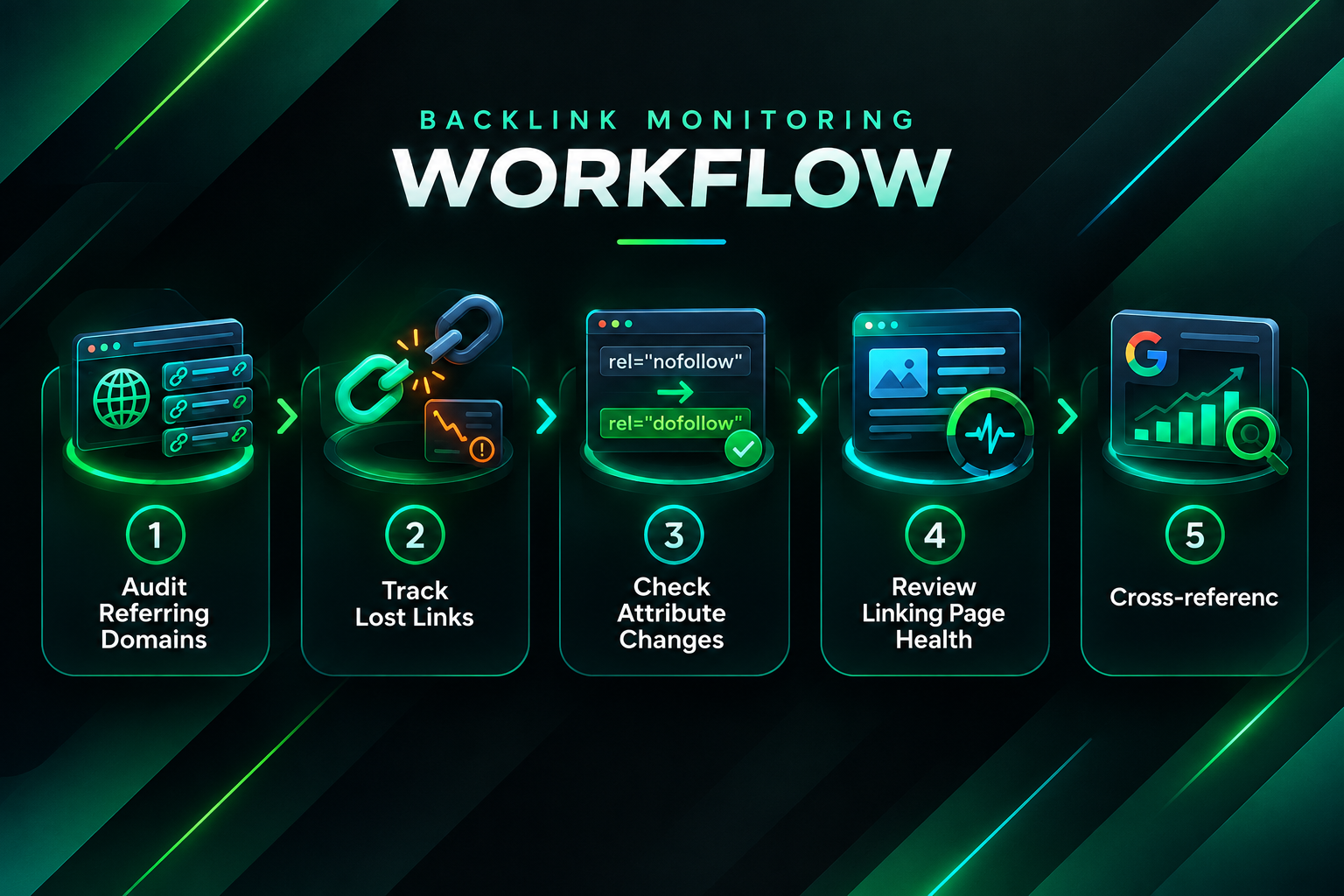
For businesses running outsourced link building campaigns, understanding what monitoring and replacement terms a provider offers is a practical due diligence question. Some providers offer link replacement guarantees for placements that are removed within a defined period after delivery. The scope and duration of such guarantees vary between providers and should be clarified before a campaign begins.
The Role of Link Diversity in Long-Term Profile Stability
A backlink profile that depends heavily on a small number of referring domains or a single link acquisition method is more vulnerable to value loss than a diverse profile. If a significant portion of a site’s link equity comes from one domain or one type of placement, and that domain declines or those placements are removed, the impact on the overall profile can be disproportionate. Diversity across referring domains, content types, and acquisition methods — such as editorial mentions, guest posts, resource page links, and digital PR placements — can reduce this concentration risk.
Diversity also matters from a search engine policy perspective. A backlink profile that shows an unnatural pattern — for example, a sudden spike in links from a narrow range of domains, or a high proportion of exact-match anchor text — may attract algorithmic scrutiny. Building a profile that reflects genuine editorial interest across a range of relevant publishers is generally considered more sustainable than concentrating acquisition in a single channel or using a formulaic anchor text approach.
Protecting Long-Term Link Value Through Acquisition Quality
The most reliable way to protect the long-term value of a backlink is to acquire it from a source that is likely to remain editorially stable and relevant. This means prioritising placements on domains with consistent publishing activity, genuine organic traffic, and editorial standards that reflect real audience intent. A link from a well-maintained industry publication is more likely to remain live and valuable over several years than a link from a site that publishes content primarily to sell link placements.
Manual outreach — where a link building team identifies relevant publishers, builds a relationship, and secures a placement through genuine editorial engagement — tends to produce links with stronger long-term stability than automated or marketplace-based approaches. This is partly because editorially earned links are more likely to be maintained by publishers who value the content they link to, and partly because they are less likely to be caught in algorithmic updates targeting manipulative link patterns. The acquisition process itself is a quality signal, even if it is not directly visible to search engines.
Guest posting on relevant, well-trafficked publications can produce durable placements when the content is genuinely useful to the publisher’s audience. Niche edits — where a link is inserted into existing published content — can also provide stable placements if the host page has established traffic and the link is contextually relevant. The risk with both methods increases when placements are sourced from sites that exist primarily to sell links rather than to serve a genuine readership.
When Backlink Value Loss Affects Rankings
Not every lost link will produce a measurable ranking change. If a site has a large and diverse backlink profile, the loss of a single placement may have no detectable effect on rankings or organic traffic. The impact of link loss is more likely to be noticeable when the lost link was from a particularly authoritative or relevant domain, when the target page has a thin backlink profile overall, or when multiple links are lost in a short period — for example, following a publisher’s site restructure or domain expiry.
Ranking changes attributed to backlink loss can be difficult to isolate because many other factors affect rankings simultaneously, including content updates, competitor activity, and algorithm changes. If a page’s rankings decline, a backlink audit is a reasonable diagnostic step, but it should be considered alongside a review of content quality, technical SEO health, and changes in the competitive landscape. Assuming that link loss is the sole cause of a ranking decline without examining other factors can lead to misallocated remediation effort.
Frequently Asked Questions
Do backlinks from old, low-traffic pages still pass value?
A link from a page with low or declining traffic may still pass some equity if the domain remains authoritative and the link is followed and contextually relevant. However, links from pages that have lost significant traffic or are no longer indexed may contribute less than they once did. Regular monitoring of referring page health — not just domain-level metrics — helps identify placements that may have degraded in value.
How long does it typically take for a new backlink to affect rankings?
The time between a link going live and any measurable ranking effect varies considerably. Google needs to crawl and index the linking page, process the link signal, and incorporate it into ranking calculations. For pages that are crawled frequently, this may happen within days or weeks. For less frequently crawled pages, it may take longer. Ranking changes, if they occur, may not be clearly attributable to a single link, particularly in competitive niches where many signals are changing simultaneously.
Should I disavow links from domains that have declined in quality?
Google’s disavow tool is intended for situations where a site has a significant number of spammy or manipulative links that may be contributing to a manual action or algorithmic penalty. Disavowing links from domains that have simply declined in authority is generally not recommended as a routine practice, as it can remove links that still contribute some equity. A site-specific assessment by an experienced SEO professional is advisable before using the disavow tool, as incorrect use can remove beneficial links.
Is it worth replacing lost backlinks?
Replacing lost links from high-quality, relevant domains is generally worthwhile, particularly for target pages where the backlink profile is relatively thin or where the lost link was a significant contributor. The priority for replacement should be based on the quality and relevance of the original placement rather than the volume of lost links. Not every lost link warrants replacement effort, especially if the linking domain has itself declined significantly since the original placement.
Can a backlink become harmful over time?
A link that was neutral or beneficial at the time of acquisition can become potentially problematic if the linking domain is later repurposed for spam, if the linking page accumulates a large number of outbound links to low-quality sites, or if the link was acquired through a method that later becomes associated with manipulative practices under updated search engine policies. Regular backlink audits help identify placements that may have shifted from neutral to potentially risky, though the threshold for action should be assessed carefully to avoid unnecessary disavow activity.
Does the anchor text of a backlink affect its long-term value?
Anchor text is a factor in how search engines understand the relevance of a link to the target page. Over time, if a site’s backlink profile accumulates an unnaturally high proportion of exact-match commercial anchor text, this pattern may attract algorithmic scrutiny regardless of when the individual links were acquired. A varied anchor text profile that reflects natural editorial linking behaviour — including branded, generic, and partial-match anchors — is generally considered more sustainable than a profile optimised around a narrow set of commercial phrases.
Planning for Backlink Value Over the Long Term
Backlinks are not a set-and-forget asset. The evidence available — from tool-provider research, documented algorithm updates, and observed link attrition patterns — consistently points toward ongoing investment as the more reliable approach compared to a single acquisition campaign. This does not mean that every business needs to run continuous high-volume link building activity, but it does mean that treating a backlink profile as something that requires periodic review, monitoring, and selective reinforcement is more realistic than assuming that links acquired today will deliver the same contribution indefinitely.
For businesses considering outsourced link building, the long-term value question is relevant to how campaigns are structured. A provider that focuses on placement quality, editorial relevance, and publisher stability is more likely to deliver links that retain their value over time than one that prioritises volume or speed at the expense of those factors. Asking a prospective provider about their publisher vetting process, their approach to link attribute verification, and any monitoring or replacement terms they offer are practical steps toward understanding the likely durability of the placements they deliver. A site-specific assessment of your existing backlink profile, target pages, and competitive landscape remains the most reliable starting point for planning a link building strategy that is appropriate for your goals and resources.