When planning a link building campaign, one of the most practical decisions you will face is where acquired backlinks should point: to your homepage or to specific internal pages deeper in your site structure. This choice affects how link equity is distributed, which pages become competitive in search, and whether your campaign aligns with your actual business goals. This article explains the differences between homepage backlinks and deep links, the situations where each type is most useful, and the factors that should guide your targeting decisions.
Quick Comparison
| Characteristic | Homepage Backlinks | Deep Links |
|---|---|---|
| Target page | Root domain or homepage (example.com or example.com/) | Internal pages such as product, service, blog, or landing pages |
| Primary SEO effect | Builds domain-level authority signals | Passes link equity directly to specific target pages |
| Ranking benefit | Indirect; benefits flow through internal linking | More direct; supports ranking for the linked page’s target keywords |
| Anchor text flexibility | Often branded or navigational | Can be topically relevant, keyword-informed, or branded |
| Typical use case | Brand building, domain authority, new site establishment | Ranking specific pages, supporting commercial or informational content |
| Internal link dependency | High; equity must flow through site architecture | Lower; equity reaches the target page more directly |
| Naturalness in outreach | Common for brand mentions, press, and directory citations | Common for contextual editorial placements and guest posts |
| Campaign suitability | Early-stage sites, brand awareness campaigns, local SEO | Established sites with specific ranking targets |
| Risk considerations | Over-concentration on homepage can appear unnatural | Thin or low-quality target pages reduce the value of deep links |
What Are Homepage Backlinks?
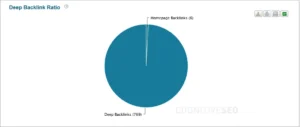
A homepage backlink is any external link that points to the root URL of a website, typically the main domain address such as example.com or www.example.com. These links are common in brand mentions, press coverage, directory listings, sponsorship acknowledgements, and general citations where a publisher references a company rather than a specific piece of content. Because the homepage is usually the most authoritative page on a domain, links pointing to it contribute to the overall domain-level authority signals that search engines use when evaluating a site’s credibility within its niche.
Homepage backlinks are particularly useful for newer websites that need to establish a baseline level of domain authority before individual internal pages can compete effectively. They are also a natural outcome of brand-building activity: when a journalist covers your company, they are more likely to link to your homepage than to a specific product page. This naturalness is one reason why a healthy backlink profile typically includes a proportion of homepage links alongside links to internal pages.
The limitation of homepage backlinks is that their SEO benefit reaches specific internal pages only indirectly, through your site’s internal linking structure. If your internal linking is weak or poorly organised, link equity acquired through homepage backlinks may not flow efficiently to the pages you most want to rank. This makes internal link architecture an important companion consideration whenever homepage link building is a significant part of your strategy.
What Are Deep Links?
Deep links, sometimes called inner page links or internal page backlinks, are external backlinks that point to a specific page within a website rather than the homepage. These target pages might include service or product pages, category pages, blog posts, resource guides, comparison pages, or landing pages built around particular keywords or topics. The defining characteristic of a deep link is that it delivers link equity directly to the page that needs it, without relying on internal linking to redistribute that equity from the homepage.
Deep links are the standard output of most contextual link building methods, including manual guest post outreach, niche edits, and digital PR campaigns targeting specific content assets. When a publisher includes a link within an article that references a relevant resource on your site, that link will typically point to the specific page being referenced rather than your homepage. This editorial context makes deep links feel natural to both readers and search engines, provided the linking page is topically relevant and the placement is genuinely useful to the audience.
From a ranking perspective, deep links can have a more direct and measurable effect on the performance of specific target pages. If you want a particular service page or product category to rank for a competitive keyword, acquiring backlinks that point directly to that page is generally more efficient than relying on homepage links and internal link equity flow. However, the quality of the target page itself matters considerably: a deep link pointing to thin, poorly structured, or low-relevance content is unlikely to produce meaningful ranking improvements regardless of the linking domain’s authority.
How Link Equity Distribution Differs
Link equity, sometimes described as link juice or PageRank flow, refers to the ranking value that passes from one page to another through a hyperlink. Understanding how this value distributes differently between homepage backlinks and deep links helps explain why the choice of target page matters strategically.
When a backlink points to your homepage, the equity it carries enters your site at the root level. From there, it distributes across your site through internal links. Pages that receive many internal links from the homepage, or from other well-linked pages, will accumulate more of this equity. Pages that are buried deep in your site architecture, or that receive few internal links, may receive very little of the equity that arrived through a homepage backlink. This means that the SEO benefit of homepage links is partly dependent on how well your internal linking is structured and maintained.
When a backlink points directly to an internal page, the equity arrives at that specific page without passing through the homepage first. This more direct delivery can be particularly valuable for pages that are not prominently featured in your internal linking structure, or for pages targeting competitive keywords where every increment of link equity may influence ranking position. Deep links also allow for more topically relevant anchor text, since the linking context is usually specific to the content of the target page rather than a general brand reference.
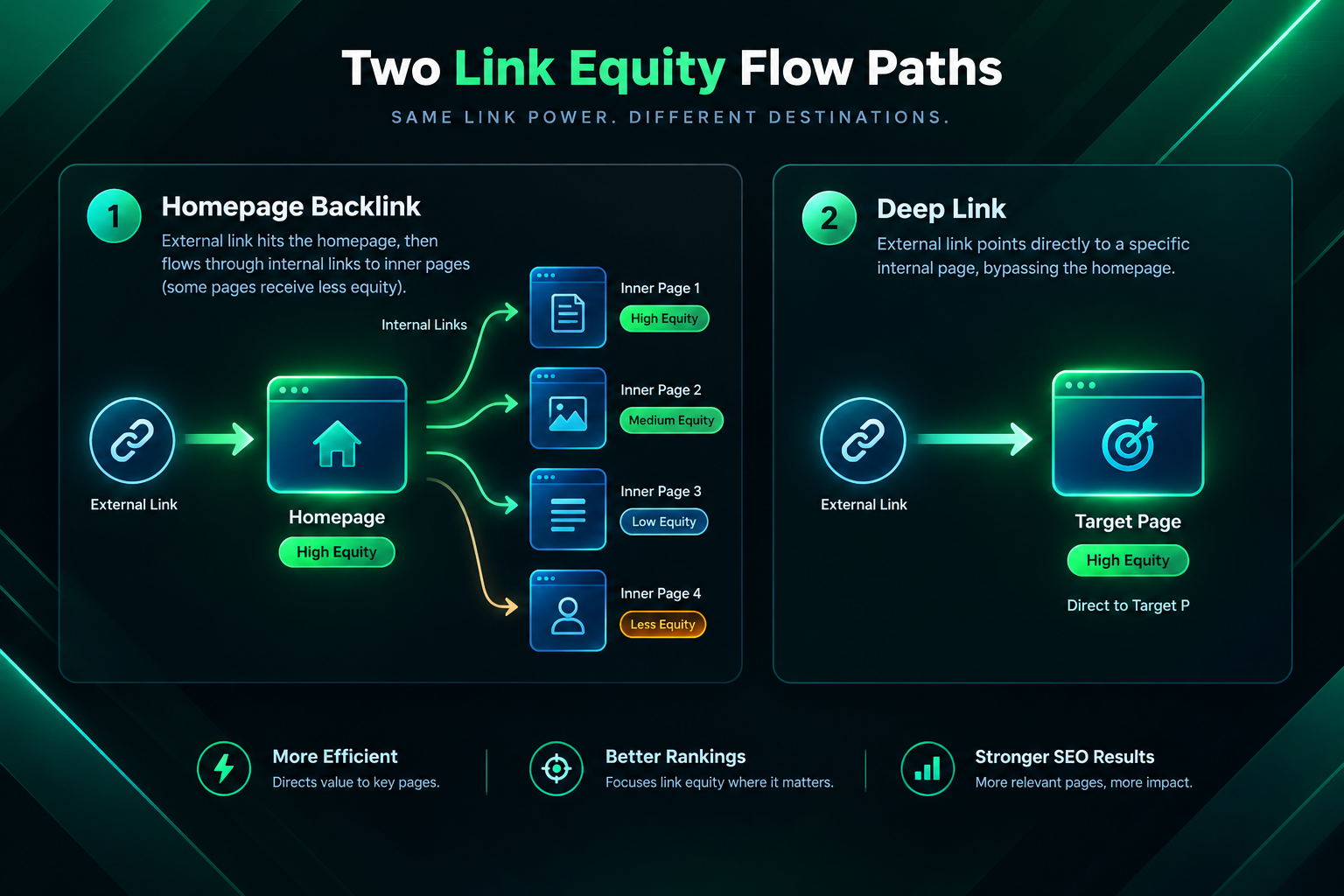
Neither approach is inherently superior in all situations. A well-structured site with strong internal linking can distribute homepage link equity effectively. Conversely, deep links pointing to pages with weak content or poor technical SEO may not produce the ranking improvements you expect. The relationship between link equity, page quality, and ranking outcomes is complex, and results will vary depending on your site’s existing authority, the competitiveness of your target keywords, and the quality of both the linking and linked pages.
When Homepage Backlinks May Be the Right Choice
Homepage backlinks tend to be most appropriate in specific situations where domain-level authority building or brand visibility is the primary goal. Understanding these situations helps you allocate your link building budget and outreach effort more effectively.
- New or low-authority websites: Sites with limited existing backlink profiles often benefit from homepage links that help establish a baseline of domain authority before targeting competitive keywords with deep links.
- Brand awareness and press campaigns: When the goal is to increase brand recognition rather than rank a specific page, homepage links from relevant publications, industry directories, or news outlets are a natural and appropriate outcome.
- Local SEO and citation building: Local business directories and citation sources typically link to a business’s homepage. These links contribute to local search visibility and are a standard part of local SEO campaigns.
- Sponsorships and partnerships: When your brand sponsors an event, publication, or organisation, the resulting link is almost always a homepage link. These are natural and editorially appropriate placements.
- Balancing an over-concentrated deep link profile: If your existing backlink profile shows an unusually high proportion of links pointing to specific internal pages with few homepage links, acquiring some homepage backlinks may help create a more natural-looking profile distribution.
When Deep Links May Be the Right Choice
Deep links are generally the preferred choice when you have specific pages that need to rank for particular keywords, and when those pages have sufficient content quality to justify and benefit from external link equity.
- Ranking specific service or product pages: If a commercial page is not ranking competitively despite good content and technical SEO, acquiring deep links pointing directly to that page may help improve its position for target keywords.
- Supporting content marketing assets: Blog posts, resource guides, comparison articles, and data-driven content pieces often benefit from deep links that reinforce their topical authority and help them rank for informational queries.
- Targeting long-tail or niche keywords: Specific keyword targets are usually associated with specific pages. Deep links with contextually relevant anchor text can help signal topical relevance to search engines for those pages.
- Established sites with strong domain authority: Sites that already have reasonable domain-level authority often see more measurable ranking improvements from deep links to specific pages than from additional homepage links.
- E-commerce category and product pages: Category and product pages in e-commerce sites rarely receive natural external links without deliberate outreach. Deep link campaigns targeting these pages can help them compete for transactional keywords.
- SaaS feature and comparison pages: SaaS websites often have feature pages, pricing pages, and comparison pages that are critical for conversion but difficult to rank without direct link support.
Anchor Text Considerations for Each Link Type
Anchor text, the visible clickable text of a hyperlink, plays a role in communicating topical relevance to search engines. The appropriate anchor text strategy differs between homepage backlinks and deep links, and understanding this distinction can help you plan outreach and placement approvals more effectively.
Homepage backlinks typically carry branded or navigational anchor text. A link that says your company name, your domain, or a generic phrase such as “visit their website” pointing to your homepage is natural and expected. Attempting to use keyword-rich anchor text for homepage links can appear manipulative, particularly if done at scale, and may attract scrutiny from search engine spam detection systems. Branded anchor text for homepage links is generally the safest and most natural approach.
Deep links offer more flexibility for topically relevant anchor text because the linking context is usually specific to the content of the target page. A guest post about project management software might naturally include a link with anchor text referencing a specific feature or use case. However, it is important to avoid over-optimising anchor text across a deep link campaign. A backlink profile where a high proportion of deep links use identical exact-match keyword anchor text can appear unnatural and may carry risks under search engine link spam policies. Varying anchor text across placements, using partial match, branded, and descriptive variations alongside occasional exact-match anchors, is generally considered a more sustainable approach, though no specific ratio can be prescribed without assessing your existing profile.
Balancing Homepage Backlinks and Deep Links in a Campaign
Most effective link building campaigns include a mix of homepage backlinks and deep links rather than relying exclusively on one type. The appropriate balance depends on your site’s current authority, the distribution of your existing backlink profile, your specific ranking targets, and the nature of your link acquisition methods.
A useful starting point is to audit your existing backlink profile using a tool such as Ahrefs, Semrush, or Majestic to understand how your current links are distributed across pages. If the vast majority of your existing backlinks point to your homepage, your internal pages may be underserved and deep link campaigns targeting specific pages could be a priority. If your homepage has relatively few backlinks compared to industry benchmarks, some homepage link building may help establish the domain-level foundation that benefits all pages.
When running outreach campaigns, the natural editorial context of each placement will often determine the appropriate target page. A guest post on a relevant industry publication is a natural opportunity for a deep link to a specific resource or service page. A brand mention in a news article or a listing in an industry directory is a natural opportunity for a homepage link. Forcing keyword-rich deep links into contexts where a homepage link would be more natural can reduce the editorial quality of placements and may attract publisher pushback or search engine scrutiny.
For sites with multiple priority pages, a phased approach can be effective: establish domain authority through a combination of homepage and deep links in an initial phase, then focus subsequent campaign phases on specific high-priority pages that need direct link support. This approach allows link equity to build at the domain level before being supplemented by targeted deep link campaigns.
Quality Factors That Affect Both Link Types
Regardless of whether a backlink points to your homepage or a deep page, the quality of the linking page and the broader linking domain significantly influences the value of the placement. A homepage backlink from a high-quality, topically relevant publication in your industry is likely to be more valuable than a deep link from a low-quality or unrelated site, and vice versa.
Key quality factors to assess when evaluating potential placements include the topical relevance of the linking site to your industry or niche, the organic traffic and search visibility of the linking page, the editorial standards of the publication, whether the link is placed within the main body content or in a footer or sidebar, and whether the link carries a dofollow or nofollow attribute. Third-party metrics such as Domain Rating from Ahrefs, Domain Authority from Moz, or Trust Flow from Majestic can provide useful reference points during publisher assessment, but these are proprietary tool metrics rather than Google-provided signals, and they should not be treated as guarantees of ranking impact.
The quality of your own target page also matters. A deep link pointing to a page with thin content, poor user experience, or a mismatch between the page’s content and the anchor text used in the placement is unlikely to produce strong ranking improvements. Before investing in deep link campaigns for specific pages, it is worth ensuring those pages have well-structured, substantive content that genuinely serves the search intent of the keywords you are targeting.
Common Mistakes to Avoid
Several recurring mistakes can reduce the effectiveness of homepage and deep link campaigns or introduce unnecessary risk.
-
- Pointing all links to the homepage: A backlink profile where nearly every external link points to the homepage can appear unnatural for an established site with substantial content. Real websites accumulate links to a variety of pages organically.

- Targeting deep pages with weak content: Acquiring deep links for pages that have not been properly developed is unlikely to produce meaningful ranking improvements and may waste campaign budget.
- Using exact-match anchor text at scale for deep links: Repeating the same keyword-rich anchor text across many deep link placements can appear manipulative and may carry risks under search engine link spam policies.
- Ignoring internal linking when building homepage links: If you are relying on homepage backlinks to benefit internal pages, your internal linking structure needs to be well-organised so that equity flows efficiently to priority pages.
- Neglecting topical relevance: Both homepage and deep links are more valuable when they come from sites and pages that are topically relevant to your industry. Links from unrelated sites may carry less contextual value.
- Treating link building as the only solution: If a specific page is underperforming, the cause may be content quality, technical SEO issues, search intent mismatch, or strong competition rather than a lack of backlinks. A site-specific assessment is advisable before committing to a link building campaign for underperforming pages.
Frequently Asked Questions
Is it better to build links to my homepage or to specific pages?
The answer depends on your goals and your site’s current situation. Homepage backlinks help build domain-level authority and are natural for brand mentions and directory citations. Deep links are generally more effective when you want to improve the ranking of specific pages for particular keywords. Most campaigns benefit from a mix of both, with the balance informed by your existing backlink profile and ranking priorities.
Do deep links pass more SEO value than homepage links?
Not necessarily. The value of any backlink depends primarily on the quality and relevance of the linking page, not on whether it points to your homepage or an internal page. A high-quality homepage backlink from a relevant, authoritative publication can be very valuable. A deep link from a low-quality or irrelevant site may provide little benefit regardless of the target page.
How many deep links does a page need to rank?
There is no fixed number. The links needed to rank a specific page depend on the competitiveness of the target keywords, the quality and relevance of the linking pages, your domain’s existing authority, the quality of the target page’s content, and many other factors. Prescribing a specific link count without a site-specific assessment would not be reliable.
Can I use keyword-rich anchor text for deep links?
Topically relevant anchor text for deep links is natural and appropriate in editorial contexts where the anchor text accurately describes the linked content. However, using identical exact-match keyword anchor text across many placements can appear manipulative. Varying anchor text across placements is generally a more sustainable approach, though the right balance depends on your existing anchor text profile.
Should I build homepage links before deep links?
For newer or lower-authority sites, establishing some domain-level authority through homepage links before focusing heavily on deep links can be a reasonable approach. For established sites with existing authority, deep link campaigns targeting specific priority pages may be more immediately impactful. The appropriate sequencing depends on your site’s current state and goals.
What is the risk of building too many homepage links?
An unusually high concentration of links pointing exclusively to the homepage, particularly with keyword-rich anchor text, can appear unnatural for an established site. Natural backlink profiles for content-rich sites typically show links distributed across multiple pages. However, homepage link concentration alone is not necessarily a risk indicator; context, quality, and anchor text distribution all matter.
How do I know which pages to target with deep links?
Start by identifying the pages that are most important to your business goals, such as high-value service pages, product categories, or content assets targeting competitive keywords. Then assess which of those pages are underperforming relative to their potential, and whether the underperformance is likely related to a lack of external link support rather than content or technical issues. A backlink profile audit and keyword ranking analysis can help prioritise targets.
Choosing the Right Link Target for Your Campaign Goals
Homepage backlinks and deep links serve different but complementary roles in a link building strategy. Homepage backlinks contribute to domain-level authority signals and are a natural outcome of brand visibility, press coverage, and directory citations. Deep links deliver link equity more directly to specific pages and are generally more effective when the goal is to improve the ranking of particular content or commercial pages for target keywords.
The most effective campaigns typically use both types in proportions that reflect the site’s current authority, the distribution of its existing backlink profile, and the specific pages that need support. Neither type is universally superior, and the value of any backlink, whether it points to a homepage or a deep page, depends heavily on the quality and relevance of the linking source and the quality of the target page itself.
If you are unsure how to balance homepage and deep link targeting for your site, a review of your existing backlink profile and ranking data is a useful starting point. A qualified link building provider can help assess your current profile distribution, identify priority target pages, and design a campaign structure that aligns with your specific SEO and business goals rather than applying a one-size-fits-all approach.