AI writing tools have become a routine part of many content workflows, and it is natural to ask whether they can play a useful role in guest post production for link building. The short answer is that AI can assist with certain parts of the process, but the quality, editorial acceptance, and SEO value of a guest post depend on factors that go well beyond what any current AI tool reliably delivers on its own. Understanding where AI genuinely helps, where it introduces risk, and what publishers and search engines actually expect is essential before building it into a link acquisition strategy.
Key Takeaways
- AI writing tools can support guest post production through research assistance, outlining, and drafting, but human editorial oversight remains necessary for accuracy, originality, and publisher acceptance.
- Many high-quality publishers now screen for AI-generated content and may reject submissions that lack genuine expertise, original perspective, or editorial polish.
- Google’s published guidance focuses on content quality and helpfulness rather than the production method, but thin or generic AI output that adds little value may perform poorly in search regardless of how it was created.
- AI-assisted guest posts can be a cost-efficient part of a link building workflow when used carefully, but they are not a shortcut to high-authority placements or guaranteed editorial acceptance.
- The most effective approach typically combines AI efficiency with human subject-matter knowledge, editorial judgment, and outreach expertise.
What AI-Assisted Guest Post Writing Actually Means
AI-assisted guest post writing refers to using large language model tools — such as those built on GPT-4, Claude, or similar architectures — to support some or all stages of producing a guest article intended for publication on a third-party website. The degree of AI involvement varies considerably. At one end, a writer might use an AI tool only to generate an initial outline or suggest headings. At the other end, a team might prompt an AI to produce a full draft and publish it with minimal human editing. These two approaches carry very different implications for content quality, editorial acceptance, and link building outcomes.
It is worth distinguishing AI-assisted writing from fully automated content generation. AI assistance, when applied thoughtfully, means a human writer or editor remains in control of the final output — checking facts, adding genuine insight, adjusting tone for the target publication, and ensuring the content serves the reader rather than just filling a word count. Fully automated generation, where drafts go from prompt to submission with little human review, tends to produce content that is generic, factually unreliable, and increasingly recognisable to experienced editors.
Where AI Can Genuinely Help in the Guest Post Process
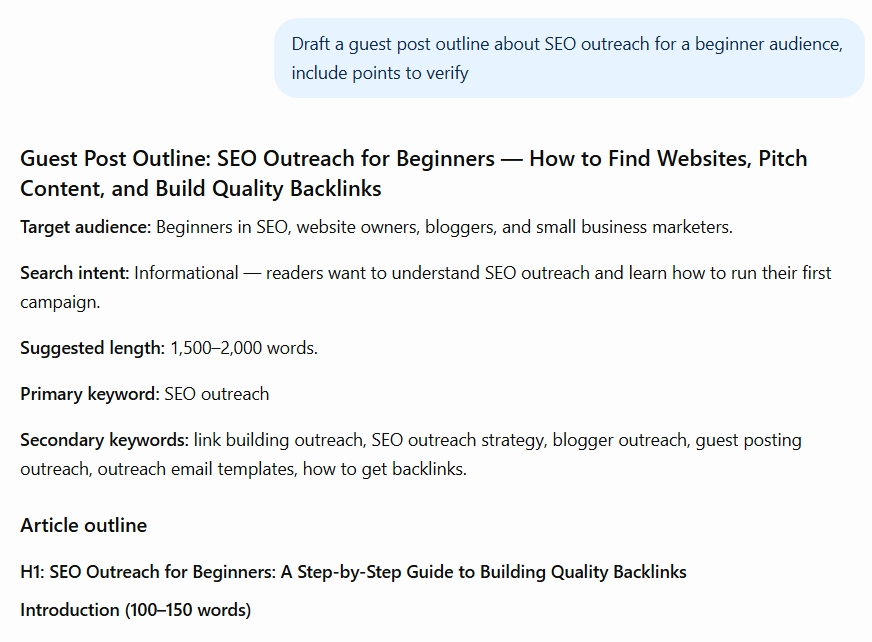
Several stages of guest post production can benefit from AI assistance without compromising the final quality of the placement.
Research and Topic Ideation
AI tools can help identify relevant angles for a target publication, suggest related subtopics, and surface questions that a target audience is likely to ask. This can accelerate the ideation phase, particularly when a link building team is producing content across multiple niches simultaneously. The output at this stage is a starting point for human judgment, not a finished brief.
Outline and Structure Development
Producing a logical, well-structured outline is one of the more reliable uses of AI in content workflows. A clear structure helps writers stay focused, ensures the article addresses the reader’s intent, and makes it easier for an editor to review the piece before it is submitted to a publisher. AI-generated outlines still need to be reviewed against the specific editorial guidelines of the target site and the topical requirements of the placement.
First-Draft Production
AI can produce a serviceable first draft faster than most human writers, which may reduce production costs when volume is a priority. However, first drafts from AI tools frequently contain generic statements, vague claims, and occasional factual errors. They also tend to lack the specific examples, data references, and original perspective that distinguish a genuinely useful article from filler content. A human editor needs to substantially revise an AI draft before it is ready for submission to a quality publisher.
Editing and Refinement
AI tools can assist with grammar checking, sentence clarity, and readability improvements. Some tools can also help adapt tone and style to match a publication’s voice. These are lower-risk uses of AI because a human writer has already produced the substantive content and the AI is acting as a copy-editing assistant rather than a primary author.
Where AI Falls Short for Guest Post Link Building
Understanding the limitations of AI in this context is as important as recognising its potential uses. Several factors make fully AI-generated guest posts a poor fit for serious link building campaigns.
Lack of Original Expertise and Perspective
High-quality publishers — the kind that provide genuinely valuable backlinks — typically expect guest contributors to bring real expertise, original analysis, or first-hand experience to their articles. AI tools generate text by predicting likely word sequences based on training data. They do not have professional experience, proprietary data, or genuine opinions. Content that lacks a credible expert perspective is increasingly easy for experienced editors to identify, and many will reject it outright or request significant revisions.
Factual Reliability
AI language models can produce plausible-sounding but inaccurate statements, particularly when writing about specific statistics, recent events, technical processes, or niche industry topics. A guest post that contains factual errors damages the credibility of the linking website, the target site, and the brand being promoted. Human fact-checking is not optional when AI is involved in drafting.
Publisher Detection and Rejection
A growing number of publishers use AI detection tools as part of their editorial review process. While no detection tool is perfectly accurate, content that scores highly on AI detection metrics — particularly content that is generic, repetitive, or stylistically flat — is increasingly likely to be rejected by quality sites. Some publishers have introduced explicit policies against AI-generated submissions. This is a practical risk for any link building workflow that relies heavily on unedited AI output.
Thin Content and Search Engine Performance
Google’s published guidance on helpful content emphasises that content should demonstrate experience, expertise, authoritativeness, and trustworthiness — often referred to as E-E-A-T. While Google has stated that the production method alone does not determine content quality, content that is generic, adds little original value, or fails to satisfy the reader’s intent may perform poorly in search regardless of how it was produced. A guest post that earns a backlink but sits on a page that receives no organic traffic provides limited SEO benefit to the linked site.
What Publishers and Editors Actually Expect
Editorial standards vary significantly across the publishing landscape. A niche industry blog with a small but engaged readership may have different expectations from a high-traffic general business publication. Understanding what a specific publisher values is a prerequisite for any guest post submission, AI-assisted or otherwise.
Most quality publishers share a set of common expectations: the article should be original and not published elsewhere, it should be relevant to their audience, it should be accurate and well-sourced where claims are made, and it should read as though a knowledgeable person wrote it with the reader’s benefit in mind. An article that reads as though it was generated by a prompt and lightly edited is unlikely to meet these standards at publications that take their editorial reputation seriously.
Publishers that accept guest posts as part of a link building arrangement — sometimes called sponsored content or paid placements — may have different thresholds. However, it is worth noting that placements on sites with low editorial standards tend to provide weaker link equity and may carry greater risk if search engine algorithms or manual reviewers assess the quality of the linking domain. The value of a backlink is closely tied to the quality and relevance of the page it appears on.
AI-Assisted Guest Posts and Google’s Content Policies
Google has published guidance clarifying that using AI to assist with content creation is not inherently against its policies. The relevant question, according to Google’s documentation, is whether the content is helpful, reliable, and created primarily to benefit people rather than to manipulate search rankings. Content that is produced at scale with little human oversight, that is generic and adds no original value, or that is designed primarily to generate links rather than serve readers, may be assessed negatively regardless of whether a human or an AI produced it.
The distinction between AI-assisted content and AI-generated spam is meaningful. A well-researched article that uses AI tools to improve efficiency but is reviewed, fact-checked, and enriched by a human expert is a different product from a bulk-generated article that exists solely to host a backlink. Search engine policies and algorithmic signals are increasingly capable of distinguishing between these categories, though the precise mechanisms are not publicly documented in detail.
It is also worth noting that guest posts containing followed backlinks are subject to Google’s link spam policies. The method used to write the article does not change the policy status of the link itself. Links in guest posts that are primarily intended to pass PageRank rather than serve the reader may be treated as manipulative regardless of content quality. This is a separate consideration from the writing process but is relevant to any guest post link building strategy.
Practical Workflow: Combining AI Efficiency with Human Quality
A realistic and responsible approach to AI-assisted guest post writing for link building typically involves a structured workflow rather than end-to-end automation. The following stages reflect how experienced content and outreach teams tend to integrate AI tools without sacrificing placement quality.
-
- Publisher research and qualification: Identify target publications based on topical relevance, audience quality, domain authority metrics, and editorial standards. This stage is human-led and determines whether a placement is worth pursuing.
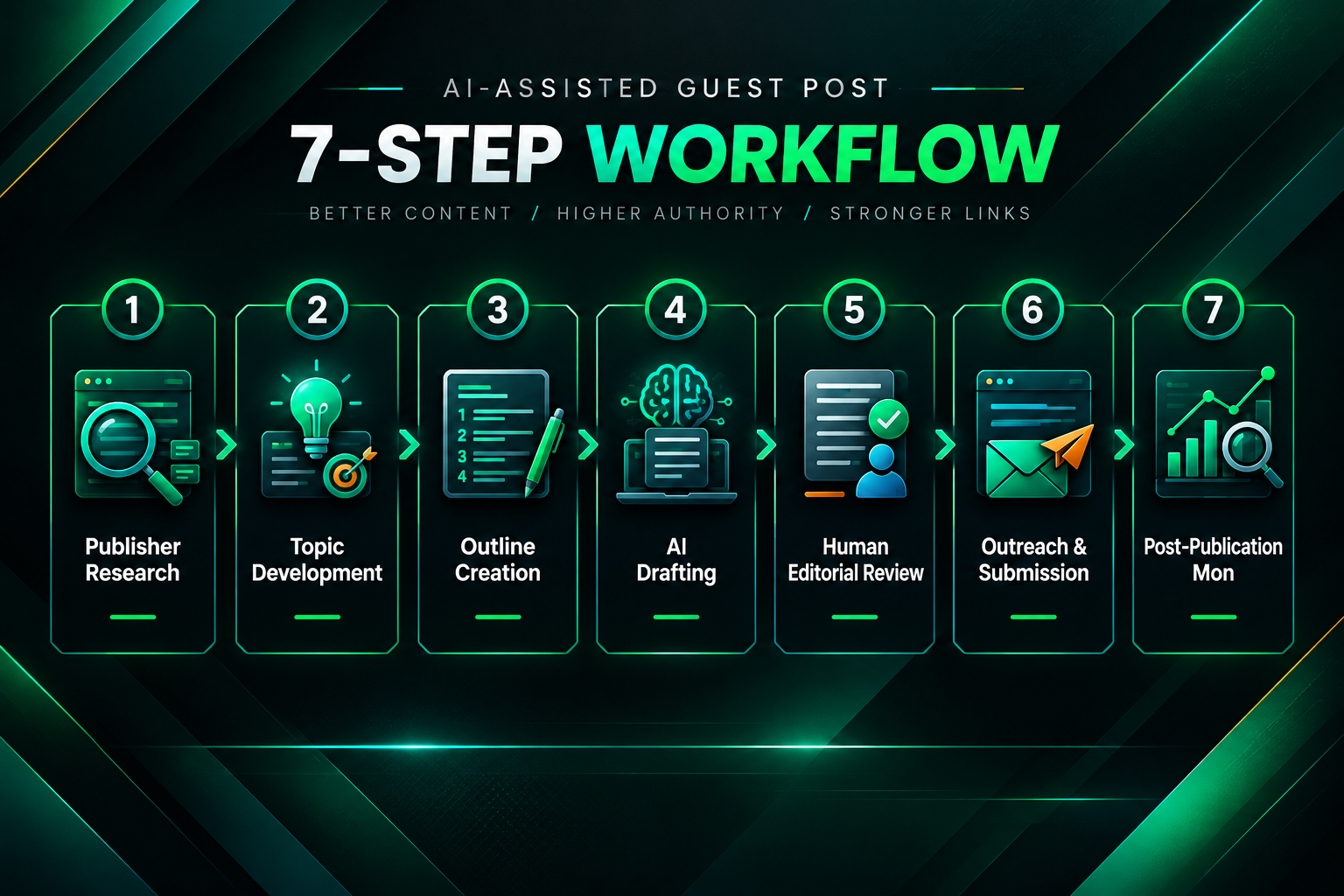
- Topic and angle development: Use AI tools to generate topic ideas and identify content gaps, then apply human judgment to select angles that align with the publisher’s audience and the linking site’s goals.
- Outline creation: Produce a structured outline using AI assistance, then review and refine it against the publisher’s editorial guidelines and the specific search intent the article should address.
- Drafting: Use AI to produce an initial draft, then assign a human writer or subject-matter expert to revise it substantially — adding original insight, accurate data references, specific examples, and a credible authorial voice.
- Editorial review: A senior editor reviews the revised draft for accuracy, originality, tone, and compliance with the publisher’s requirements before submission.
- Outreach and submission: The article is pitched or submitted through the appropriate editorial channel. Outreach quality and relationship management at this stage are human-dependent and significantly affect acceptance rates.
- Post-publication monitoring: Track whether the placement is indexed, whether the link is live and correctly attributed, and whether the page gains any organic visibility over time.
This kind of workflow uses AI to reduce time spent on lower-value tasks while preserving the human judgment that determines whether a placement is accepted and whether it provides lasting SEO value.
Suitability: When AI Assistance May or May Not Be Appropriate
AI-assisted guest post writing is not equally suitable for every link building campaign or every target publication. Several factors affect whether it is a reasonable approach for a given situation.
Situations Where AI Assistance May Be Appropriate
- Campaigns targeting mid-tier publications with moderate editorial standards where volume and efficiency are priorities alongside quality.
- Niches where content is relatively evergreen and factual accuracy can be verified without deep specialist knowledge.
- Teams with experienced human editors who can substantially revise AI drafts before submission.
- Outreach campaigns where AI is used only for research, ideation, and outlining rather than full draft production.
Situations Where AI Assistance Carries Greater Risk
- Campaigns targeting high-authority publications with strict editorial policies and explicit AI content restrictions.
- Highly technical or regulated niches — such as medical, legal, or financial topics — where factual accuracy is critical and errors carry reputational or compliance risk.
- Campaigns where the brand being promoted has a strong public profile and where low-quality content could cause reputational damage.
- Situations where the link building strategy depends on a small number of high-value placements rather than volume, making each submission too important to risk with unpolished AI output.
Alternatives to AI-Assisted Guest Post Writing
For campaigns where AI assistance introduces more risk than benefit, several alternatives are worth considering.
Human-written guest posts by subject-matter experts remain the most reliable approach for high-authority placements. A writer with genuine expertise in the target niche can produce content that passes editorial review, satisfies reader intent, and reflects well on the linking brand. The trade-off is higher production cost and longer turnaround times.
Niche edits — also called link insertions — involve placing a backlink within existing, already-published content on a relevant site rather than producing a new article. This approach bypasses the content production challenge entirely, though it depends on finding suitable existing pages and negotiating placement with the publisher.
Digital PR involves earning editorial backlinks through newsworthy content, original research, or data-driven assets that journalists and publishers want to reference. This approach tends to produce high-authority, editorially earned links, but it requires significant investment in content creation and media outreach.
Outsourced link building services that manage the full guest post workflow — from publisher identification and outreach to content production and placement — can provide a practical alternative for businesses that lack the internal resources to manage quality control across a high-volume campaign. The quality of the output depends heavily on the provider’s editorial standards and publisher relationships.
Frequently Asked Questions
Does Google penalise AI-written guest posts?
Google’s published guidance states that the production method alone does not determine whether content is penalised. Content that is thin, generic, or primarily designed to manipulate rankings may be assessed negatively regardless of whether it was written by a human or an AI. The relevant factors are content quality, helpfulness, and whether the links within the post comply with Google’s link spam policies.
Can publishers detect AI-written content?
Many publishers now use AI detection tools as part of their editorial process, and experienced editors can often identify AI-generated content by its generic tone, repetitive phrasing, and lack of original perspective. Detection tools are not perfectly accurate, but content that scores highly on AI detection metrics is at greater risk of rejection at quality publications.
How much human editing is needed to make an AI draft acceptable?
This depends on the quality of the initial prompt, the AI tool used, and the editorial standards of the target publication. In most cases, a first draft from an AI tool requires substantial revision — adding original insight, correcting factual claims, adjusting tone, and ensuring the article genuinely serves the reader. Light editing is rarely sufficient for placements at quality publishers.
Will AI-assisted guest posts provide the same link value as human-written ones?
The SEO value of a backlink is primarily determined by the quality, relevance, and authority of the linking page, not by how the surrounding content was written. An AI-assisted article that is well-edited, factually accurate, and published on a relevant, high-quality site may provide similar link value to a fully human-written piece. The risk is that lower-quality AI output leads to placement on lower-quality sites, which reduces link value.
Is it ethical to use AI for guest post writing without disclosing it?
Disclosure norms for AI-assisted content are still evolving and vary by publication. Some publishers require disclosure; others do not address it explicitly. The more important practical consideration is whether the content meets the publisher’s quality standards and genuinely serves their audience, regardless of the production method.
How does AI assistance affect the outreach stage of guest posting?
AI tools can assist with drafting outreach emails and personalising pitches at scale, but outreach quality depends heavily on genuine relationship-building, accurate targeting, and a compelling pitch that reflects real knowledge of the publisher’s audience. Fully automated outreach tends to produce low response rates and can damage sender reputation if it appears spammy.
Deciding Whether AI-Assisted Guest Posts Fit Your Link Building Strategy
AI writing tools are a practical reality in content production, and dismissing them entirely is as unhelpful as treating them as a complete solution. The more useful question is where in the guest post workflow AI assistance adds genuine efficiency without compromising the quality that determines whether a placement is accepted and whether it provides lasting SEO value.
For most link building campaigns, the answer involves a careful division of labour: AI tools handling research, ideation, outlining, and first-draft production, with experienced human writers and editors responsible for the substantive revision, fact-checking, and final quality control that publishers and search engines expect. Campaigns that skip the human layer to reduce costs tend to produce content that is rejected by quality publishers, placed on lower-authority sites, or generates links with limited long-term value.
The suitability of AI assistance also depends on the specific goals of the campaign, the authority level of the target publications, the niche, and the brand’s tolerance for reputational risk. A campaign targeting a handful of high-authority placements in a regulated industry requires a different approach from one targeting a broader set of mid-tier sites in a general business niche. Neither approach is universally right, and a site-specific assessment of goals, resources, and publisher targets is a reasonable starting point before committing to a production model.
If you are considering how AI-assisted content fits into a broader guest post or link building strategy, discussing the specifics with an experienced link building provider can help clarify which approach is likely to produce the most reliable results for your particular situation.