Whether outreach emails should use a subdomain is a question that comes up regularly among SEO teams and agencies running manual link building campaigns. The short answer is that subdomains can offer meaningful protection for your primary domain’s sending reputation, but they introduce their own technical requirements and are not automatically the right choice for every team or campaign. This guide explains how subdomain-based outreach works, when it may be worth the setup effort, and what to consider before making a decision.
Key Takeaways
- Sending outreach emails from a subdomain can help protect your main domain’s deliverability if a campaign generates spam complaints or bounces.
- A subdomain alone does not guarantee inbox placement; proper authentication records, a warmed-up sending history, and a quality contact list are all required.
- For low-volume, carefully managed outreach, the added complexity of a subdomain setup may not be necessary.
- High-volume campaigns, agency white-label outreach, and situations where multiple clients share infrastructure are the scenarios where subdomain isolation tends to offer the clearest benefit.
- Whichever sending domain you choose, the quality of the email content and the relevance of the outreach target remain the most important factors in response rates.
What Is a Subdomain in the Context of Email Outreach?
A subdomain is a prefix added to your primary domain name. If your main website is example.com, a subdomain might be outreach.example.com or mail.example.com. When used for email sending, the subdomain functions as a distinct identity in the eyes of email service providers and receiving mail servers. Reputation signals — including spam complaint rates, bounce rates, and engagement history — are tracked separately for the subdomain rather than being attributed directly to the root domain.
In link building outreach, this separation matters because large-scale prospecting campaigns carry an inherent risk of triggering spam filters or generating complaints, particularly when contact lists include unverified addresses or when recipients are not expecting unsolicited email. If those negative signals accumulate on a subdomain rather than on your primary domain, the deliverability of your transactional emails, client communications, and marketing newsletters sent from the root domain is less likely to be affected.
How Subdomain Email Sending Works Technically
Setting up a subdomain for outreach email involves several technical steps that go beyond simply creating a DNS record. Each step contributes to whether your emails reach the inbox or are filtered as spam.
DNS and Authentication Records
For a subdomain to send email credibly, it needs its own set of authentication records. These include an SPF record (Sender Policy Framework), which specifies which mail servers are authorised to send on behalf of the subdomain; a DKIM record (DomainKeys Identified Mail), which adds a cryptographic signature to outgoing messages so receiving servers can verify they have not been tampered with; and ideally a DMARC policy (Domain-based Message Authentication, Reporting and Conformance), which tells receiving servers what to do when authentication checks fail. Without these records correctly configured, even a well-written outreach email is likely to be filtered or rejected regardless of which domain or subdomain it comes from.
Inbox Warming
A newly created subdomain has no sending history, which means email providers treat it with caution. Inbox warming is the process of gradually increasing sending volume over several weeks, starting with small batches of emails to engaged recipients, to build a positive reputation before scaling up. Skipping this step and immediately sending hundreds of outreach emails from a fresh subdomain is likely to result in poor deliverability and may cause the subdomain’s reputation to deteriorate before the campaign has properly started. Most email outreach platforms and deliverability tools include warming features or guidance, but the process still requires time — typically two to six weeks depending on the target sending volume.
Dedicated IP Addresses
Some high-volume senders pair a subdomain with a dedicated IP address rather than sharing an IP pool with other senders. A dedicated IP gives you full control over the sending reputation associated with that address, but it also means you are solely responsible for maintaining it. For most link building outreach operations, a shared IP through a reputable email service provider is sufficient, provided the subdomain is properly authenticated and warmed.
Why Outreach Campaigns Create Deliverability Risk
Manual link building outreach involves contacting website owners, editors, and content managers who have not opted in to receive your emails. Even when the outreach is relevant, personalised, and genuinely useful to the recipient, a proportion of contacts will mark the message as spam, ignore it, or have addresses that are no longer active. These outcomes — spam complaints, hard bounces, and low engagement — are signals that email providers use to assess sender reputation.
If these signals accumulate on your primary domain, they can affect the deliverability of every email sent from that domain, including internal communications, client reports, and sales emails that have nothing to do with link building. Isolating outreach activity on a subdomain limits this risk. It does not eliminate the underlying deliverability challenges of cold outreach, but it contains the potential damage to a separate sending identity that can be managed, adjusted, or retired without affecting the root domain.
The risk is proportional to volume and list quality. A team sending twenty carefully researched outreach emails per week to verified contacts faces a different risk profile than an agency running automated sequences to thousands of addresses. The higher the volume and the lower the list quality, the stronger the case for subdomain isolation.
When Using a Subdomain for Outreach Makes Sense
There is no universal rule that all outreach must use a subdomain. The decision depends on several practical factors.
High-Volume Campaigns
When a campaign involves sending hundreds or thousands of outreach emails per month, the statistical likelihood of spam complaints and bounces increases simply because of scale. At this volume, subdomain isolation is a reasonable precaution. Agencies running outreach on behalf of multiple clients, or in-house teams targeting large publisher lists across several niches, typically benefit from the separation a subdomain provides.
Agency and White-Label Outreach
Agencies that manage link building campaigns for multiple clients sometimes use subdomains to keep outreach identities distinct. A white-label outreach setup might use client-branded subdomains or agency-managed subdomains to separate campaign activity. This approach also makes it easier to track deliverability metrics and reputation signals per campaign rather than mixing them together on a single sending domain.
Protecting a Well-Established Primary Domain
If your primary domain has a strong sending reputation built up over years of legitimate email activity, introducing high-volume cold outreach from that same domain carries a meaningful risk of degrading that reputation. A subdomain allows you to run outreach campaigns without putting the root domain’s deliverability at stake.
Testing New Outreach Strategies
When experimenting with new outreach templates, sequences, or targeting approaches, a subdomain provides a contained environment. If a new approach generates an unexpectedly high complaint rate, the damage is limited to the subdomain rather than affecting your entire email infrastructure.
When a Subdomain May Not Be Necessary
For smaller operations, the overhead of setting up and maintaining a subdomain may outweigh the benefit. If your team sends a modest number of highly personalised outreach emails each week to a carefully verified list of relevant contacts, and your primary domain’s sending reputation is not at significant risk, the additional complexity of a subdomain setup may not be justified.
Similarly, if you are using a dedicated outreach email address on a separate root domain — a common alternative approach — you may already have sufficient isolation without needing a subdomain structure. Some link builders register a separate domain specifically for outreach, which achieves a similar protective effect. This approach has its own considerations, including the need to warm the new domain and the fact that some recipients may be more cautious about emails from unfamiliar domains.
The key question is whether the volume and risk profile of your outreach activity genuinely threaten your primary domain’s deliverability. If the answer is no, a simpler setup may serve you equally well.
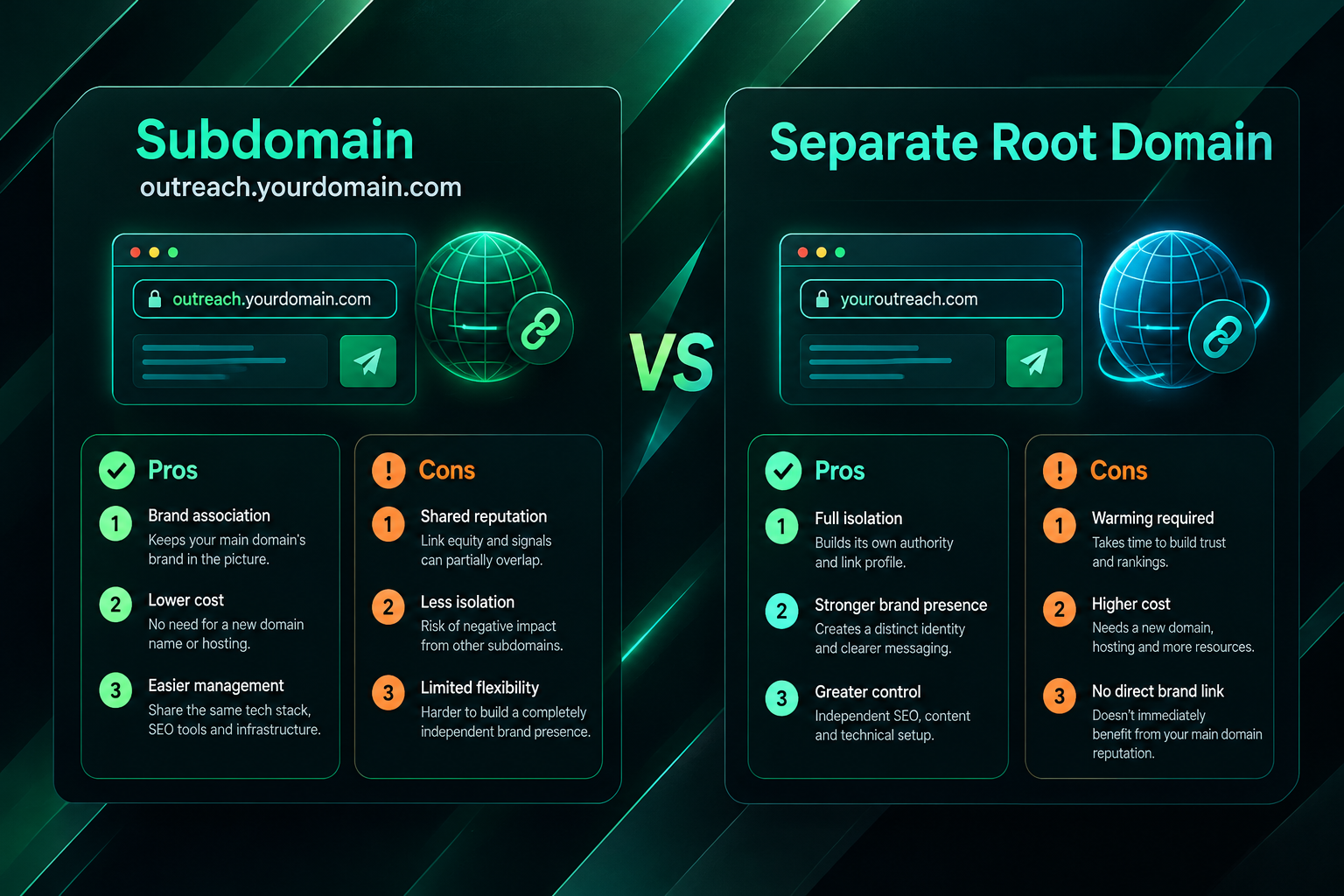
Subdomain vs Separate Root Domain for Outreach
Choosing between a subdomain and a completely separate root domain for outreach email is a practical decision with trade-offs on both sides.
| Factor | Subdomain (e.g. outreach.yourdomain.com) | Separate Root Domain (e.g. yourdomain-outreach.com) |
|---|---|---|
| Setup complexity | Moderate; requires DNS records on existing domain | Moderate; requires new domain registration and full DNS setup |
| Brand association | Visible connection to primary brand | Can be branded separately or kept neutral |
| Reputation isolation | Partial; subdomain reputation is separate but root domain may still be associated | Full isolation from primary domain |
| Recipient trust | May benefit from primary domain recognition | Unknown domain may reduce initial trust |
| Warming requirement | Yes; new subdomain needs warming | Yes; new domain needs warming |
| Cost | No additional domain cost | Domain registration and renewal cost |
| Management overhead | Lower; managed within existing domain | Higher; separate domain to maintain |
Neither option is universally superior. A subdomain keeps a visible connection to your brand, which can help with recipient trust when your primary domain is well-known. A separate root domain offers more complete isolation but requires managing an additional asset. The right choice depends on your sending volume, brand considerations, and how much separation you need between outreach activity and your primary domain’s reputation.
The Role of Email Content and List Quality
It is worth being direct about a common misconception: using a subdomain does not compensate for poor outreach practices. Deliverability infrastructure — whether a subdomain, a separate domain, or a carefully configured primary domain — creates the conditions for emails to reach the inbox. What happens after delivery depends almost entirely on the quality of the email content and the relevance of the contact list.
Outreach emails that are generic, poorly personalised, or sent to irrelevant contacts will generate complaints and low engagement regardless of the sending domain. Over time, this degrades the subdomain’s reputation just as it would degrade any other sending identity. The protective benefit of a subdomain is that it limits the blast radius of a poorly performing campaign; it does not make a poorly performing campaign succeed.
For link building outreach specifically, the most effective emails tend to be those that demonstrate genuine familiarity with the recipient’s website, offer something of clear value — whether a well-researched article, a relevant resource, or a mutually beneficial placement — and are sent to contacts who are genuinely likely to be interested. These factors influence response rates far more than the technical configuration of the sending domain.
Monitoring and Maintaining Subdomain Reputation
Once a subdomain is set up and warmed, ongoing monitoring is important. Key metrics to track include bounce rates, spam complaint rates, open rates, and reply rates. Most email outreach platforms provide these metrics, and some deliverability tools offer additional visibility into how your sending domain is being treated by major email providers.
If complaint rates rise above acceptable thresholds — typically around 0.1% or lower for sustained campaigns, though thresholds vary by provider — it is worth pausing the campaign to review list quality and email content before continuing. Continuing to send at high complaint rates will erode the subdomain’s reputation and may eventually affect the root domain as well, depending on how email providers assess the relationship between the two.
DMARC reporting is a useful tool for monitoring authentication failures and identifying whether any unauthorised parties are attempting to send email using your subdomain. Setting up DMARC with at least a reporting policy (rather than a reject or quarantine policy) gives you visibility into these issues without immediately blocking legitimate email.
Practical Setup Checklist for Outreach Subdomains
If you decide a subdomain is the right approach for your outreach campaigns, the following steps cover the essential setup requirements. This is not a universal prescription — specific configurations depend on your email service provider, DNS host, and sending volume — but it reflects the core elements that need to be in place before a campaign begins.
-
- Create the subdomain in your DNS management interface and point it to your chosen email service provider.
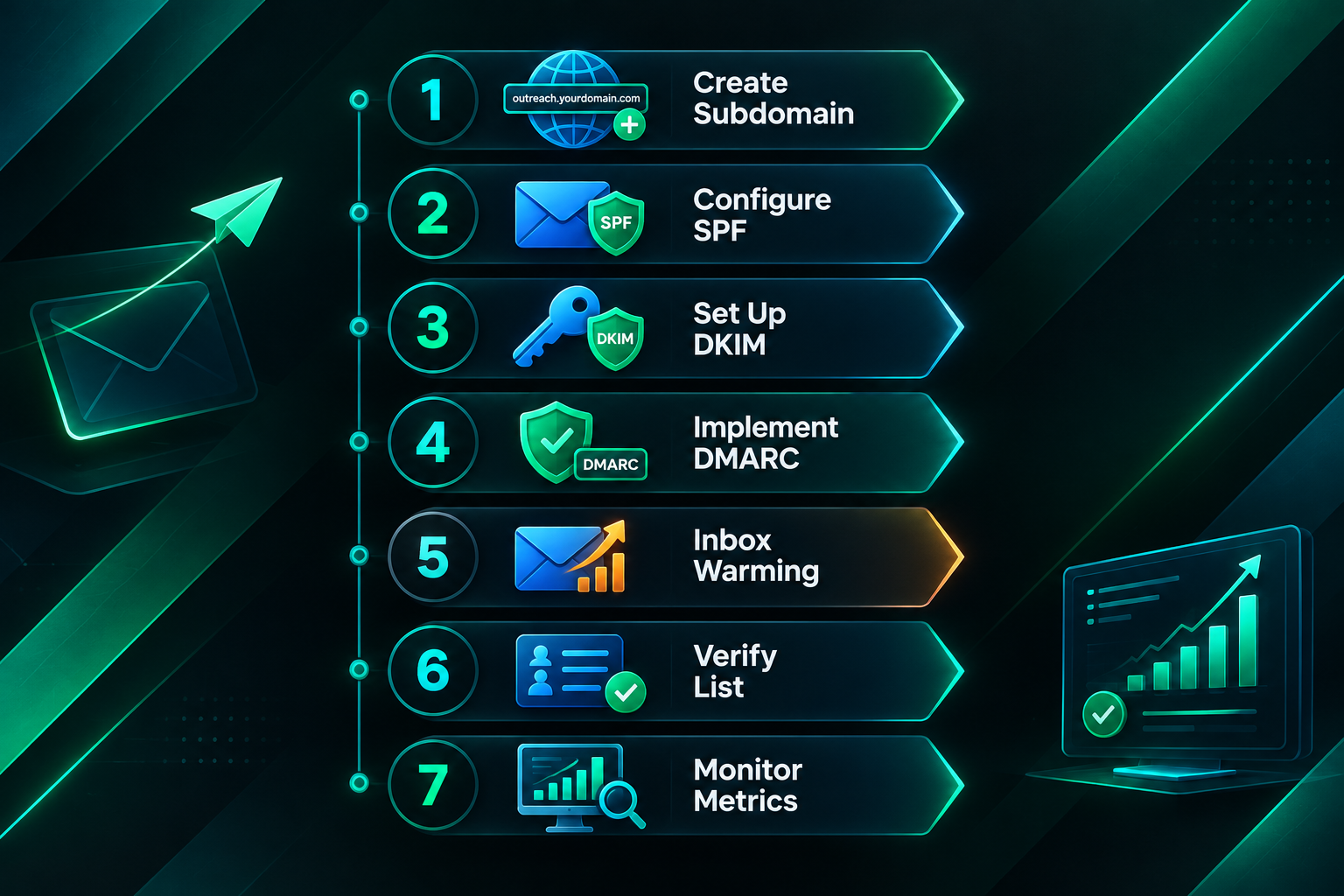
- Configure SPF to authorise the mail servers that will send on behalf of the subdomain.
- Set up DKIM by adding the public key provided by your email service provider as a DNS TXT record.
- Implement a DMARC policy starting with a monitoring-only setting to collect data before enforcing stricter rules.
- Begin inbox warming with low daily sending volumes, gradually increasing over two to six weeks.
- Verify your contact list before sending to reduce hard bounces from invalid addresses.
- Monitor deliverability metrics throughout the campaign and adjust sending volume or content if complaint rates rise.
- Review DMARC reports regularly to identify authentication issues or unauthorised use of the subdomain.
Implications for Link Building Campaign Management
For teams managing outsourced link building campaigns or running outreach at scale, the subdomain question sits within a broader set of campaign infrastructure decisions. Deliverability is one component of outreach effectiveness, alongside prospecting quality, personalisation, follow-up sequencing, and the strength of the content or resource being pitched.
Agencies and in-house SEO teams that invest in proper email infrastructure — including subdomain setup, authentication, and warming — tend to experience more consistent inbox placement over time. This does not guarantee higher response rates or more placements, because those outcomes depend on the quality of the outreach itself, but it removes a technical barrier that can otherwise undermine an otherwise well-planned campaign.
When evaluating a link building provider or deciding how to structure an in-house outreach operation, it is reasonable to ask about the email infrastructure being used. A provider that sends high-volume outreach from a single unprotected domain without proper authentication or warming practices may be creating deliverability problems that affect campaign performance without the client being aware of it.
Frequently Asked Questions
Does using a subdomain improve my outreach response rates?
Not directly. A subdomain improves the likelihood that your emails reach the inbox by protecting your sending reputation, but response rates depend primarily on the quality and relevance of your email content and the accuracy of your contact list. Better deliverability creates the opportunity for a response; it does not generate one on its own.
Will a subdomain protect my primary domain from being blacklisted?
A subdomain provides meaningful separation, but it is not a complete guarantee. Some email providers and blacklist operators assess the relationship between a subdomain and its root domain. If a subdomain generates severe spam signals, there is a possibility that the root domain could be affected depending on the provider’s policies. Proper list hygiene and responsible sending practices remain important regardless of the domain structure you use.
How long does it take to warm up a subdomain for outreach?
Warming timelines vary depending on the target sending volume and the email service provider being used. A typical warming process for moderate outreach volumes takes between two and six weeks, starting with small daily batches and gradually increasing. Rushing this process increases the risk of poor deliverability from the outset.
Can I use the same subdomain for multiple link building campaigns?
Yes, but the reputation of the subdomain will reflect the combined performance of all campaigns sent through it. If one campaign generates high complaint rates, it affects the deliverability of all subsequent campaigns using the same subdomain. Some agencies use separate subdomains or separate root domains for different clients or campaign types to avoid this cross-contamination.
Do I need a dedicated IP address for my outreach subdomain?
For most link building outreach operations, a shared IP through a reputable email service provider is sufficient. Dedicated IPs are generally more relevant for very high-volume senders who need complete control over their IP reputation. If you are using a shared IP pool, the quality of the other senders on that pool can affect your deliverability, which is one reason why choosing a reputable email service provider matters.
Is it better to use a subdomain or a completely separate domain for outreach?
Both approaches can work. A subdomain is simpler to manage and may benefit from the recognition of your primary domain. A separate root domain offers more complete isolation. The right choice depends on your sending volume, how much brand association you want in your outreach emails, and how much separation you need between outreach activity and your primary domain’s reputation.
Making the Right Infrastructure Decision for Your Outreach Campaigns
The decision about whether to use a subdomain for outreach emails is ultimately a risk management and operational efficiency question rather than a purely technical one. For teams running low-volume, highly targeted outreach with a carefully maintained contact list, the added complexity of a subdomain setup may not be necessary. For agencies, high-volume campaigns, or situations where protecting a well-established primary domain’s sending reputation is a priority, subdomain isolation is a sensible precaution that is worth the setup investment.
What matters most in either case is that the underlying outreach is genuinely relevant, properly authenticated, and sent to contacts who are likely to find it useful. Technical infrastructure supports good outreach; it cannot substitute for it. If you are reviewing how your link building campaigns are structured — including the email infrastructure behind them — speaking with an experienced outreach team can help you identify whether your current setup is creating avoidable deliverability problems or whether your resources are better directed elsewhere in the campaign.