When email campaigns fail to reach the inbox, the cause is often traced back to one of two sender signals: domain reputation or IP reputation. These two factors are assessed separately by receiving mail servers and inbox providers, and confusing them can lead to misdiagnosed deliverability problems and ineffective fixes. Understanding how each works, what influences it, and how the two interact is essential for anyone managing email outreach, marketing campaigns, or transactional messaging at scale.
Quick Comparison
| Factor | Domain Reputation | IP Reputation |
|---|---|---|
| What is assessed | The sending domain (e.g. yourbrand.com) and its historical behaviour | The IP address used to send email and its sending history |
| Tied to | Your brand identity and domain ownership | Your mail server or email service provider infrastructure |
| Portability | Travels with the domain regardless of sending infrastructure | Stays with the IP address; changes when you switch providers |
| Primary signals | Spam complaints, engagement rates, authentication records, sending consistency | Spam complaints, blacklist status, sending volume patterns, IP age |
| Recovery difficulty | Moderate to high; domain history persists over time | Moderate; switching IPs or warming a new IP can help |
| Shared risk | Low on dedicated domains; higher on shared subdomains | High on shared IPs; low on dedicated IPs |
| Authentication dependency | Strongly linked to SPF, DKIM, and DMARC alignment | Less directly dependent on authentication records |
| Inbox provider weighting | Increasingly prioritised by major providers such as Gmail and Outlook | Still relevant but weighted less heavily than domain reputation at major providers |
| Warm-up requirement | New domains require gradual volume increases | New or changed IPs require a structured warm-up period |
| Suitable for | Long-term brand sender identity and deliverability strategy | Infrastructure management, shared hosting decisions, and provider selection |
What Is Domain Reputation for Email?
Domain reputation refers to the trustworthiness score that inbox providers and spam filtering systems assign to the domain used in the sending address, the return-path, and the DKIM signature of an email. When a recipient’s mail server evaluates an incoming message, it checks the domain’s historical behaviour: how often messages from that domain have been marked as spam, whether recipients engage with the content, whether authentication records are correctly configured, and whether the domain has appeared on blocklists. This assessment is tied to the domain itself, not to the server or IP address that physically delivered the message.
Because domain reputation travels with the brand, it is considered a more stable and persistent signal than IP reputation. A domain that has accumulated a strong sending history over months or years carries that standing even if the sender migrates to a different email service provider or changes their sending infrastructure. Conversely, a domain with a damaged reputation carries that damage forward regardless of infrastructure changes, which makes domain-level problems more difficult to resolve quickly.
Major inbox providers, including Google’s Gmail and Microsoft’s Outlook, have publicly indicated that domain-based signals play a central role in their filtering decisions. Google’s Postmaster Tools, for example, provides a domain reputation dashboard that categorises sender domains as High, Medium, Low, or Bad based on observed complaint rates and engagement patterns from Gmail users. This tool gives senders direct visibility into how their domain is perceived at one of the largest inbox providers globally.
What Is IP Reputation for Email?
IP reputation is the trust score assigned to the specific IP address from which email is transmitted. Every email is delivered from a server with an assigned IP address, and receiving mail systems log the behaviour associated with that address over time. High complaint rates, sudden volume spikes, connections to known spam networks, or appearances on real-time blacklists (RBLs) all reduce an IP’s reputation score. A low IP reputation can cause messages to be filtered to spam or rejected outright before the receiving server even evaluates the content or the sending domain.
IP reputation is particularly relevant for senders using shared infrastructure. When multiple businesses send email from the same IP address — as is common with many email service providers on lower-tier plans — the behaviour of one sender can affect the deliverability of all others sharing that IP. This shared-risk dynamic is one reason why high-volume senders and businesses with strict deliverability requirements often invest in dedicated IP addresses, where the reputation is determined solely by their own sending behaviour.
Unlike domain reputation, IP reputation is not portable. If a sender moves to a new IP address — whether by switching providers or upgrading to a dedicated IP — the new address starts with a neutral or unknown reputation. This requires a structured IP warm-up process, during which sending volume is gradually increased to allow inbox providers to build a positive assessment of the new address before high-volume campaigns are sent.
How Domain and IP Reputation Are Assessed Together
Receiving mail servers and spam filters do not evaluate domain reputation and IP reputation in isolation. Most modern filtering systems, including those used by Gmail, Outlook, Yahoo Mail, and enterprise spam gateways, assess both signals simultaneously as part of a broader sender reputation score. The relative weight given to each signal can vary between providers and filtering systems, but the general principle is that a strong signal in one area cannot fully compensate for a severely damaged signal in the other.
Authentication protocols play a connecting role between the two reputation types. SPF (Sender Policy Framework) authorises specific IP addresses to send email on behalf of a domain, creating a verifiable link between the sending IP and the domain. DKIM (DomainKeys Identified Mail) attaches a cryptographic signature tied to the sending domain, allowing the receiving server to verify that the message was not altered in transit and that it genuinely originates from the claimed domain. DMARC (Domain-based Message Authentication, Reporting and Conformance) builds on both SPF and DKIM to specify how receiving servers should handle messages that fail authentication checks. When all three protocols are correctly configured and aligned, they strengthen domain reputation signals and make it easier for inbox providers to attribute sending behaviour accurately to the correct domain.
A practical consequence of this interaction is that a sender with a strong domain reputation but a poor IP reputation may still experience deliverability problems, particularly at providers that weight IP signals heavily or use aggressive real-time blacklist checks. Similarly, a sender on a reputable shared IP pool but with a damaged domain reputation will likely see filtering problems that cannot be resolved simply by changing infrastructure.
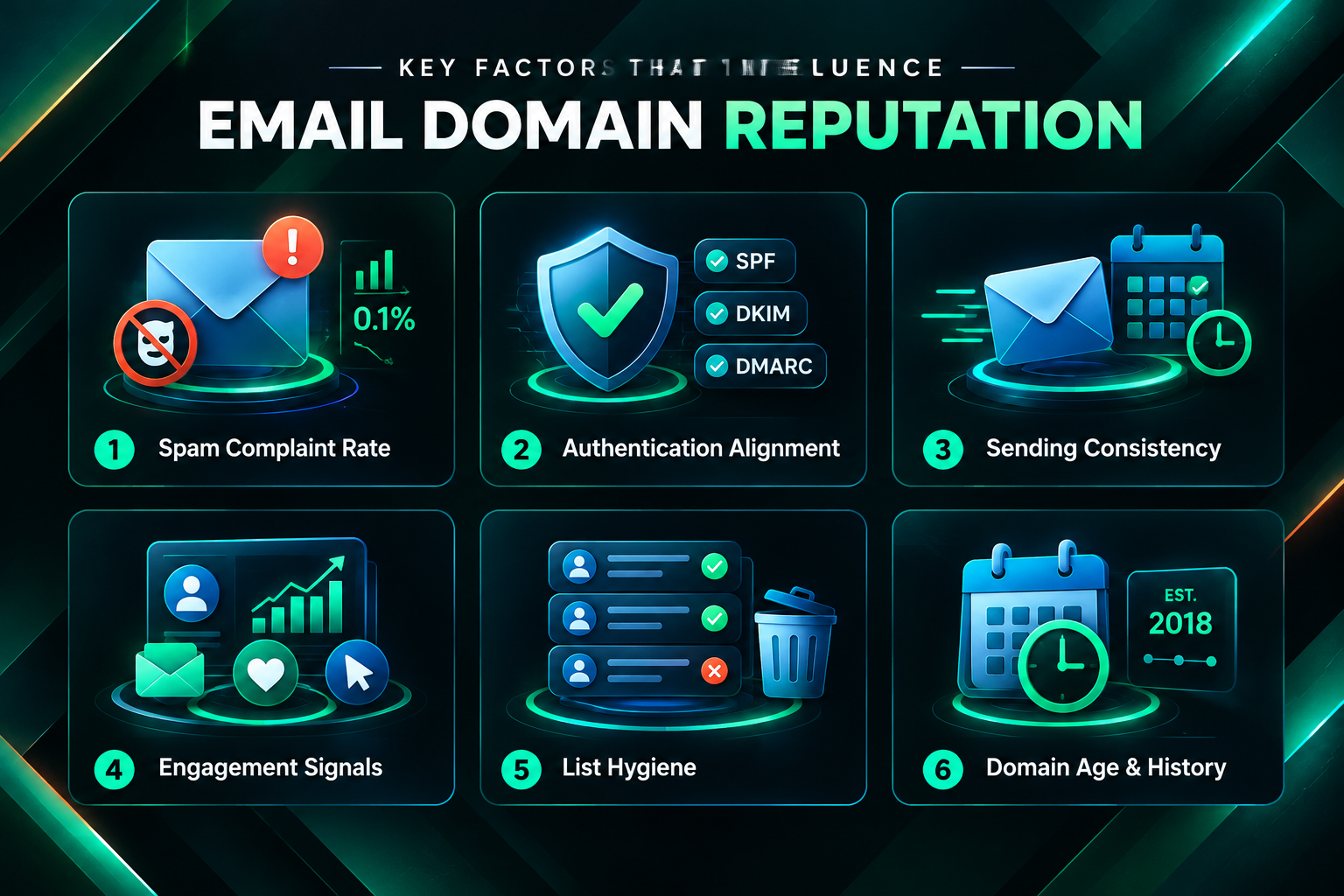
Key Factors That Influence Domain Reputation
Several measurable behaviours and technical configurations affect how inbox providers assess a sending domain over time.
- Spam complaint rate: The proportion of recipients who mark messages as spam is one of the most direct negative signals. Google’s published guidance for bulk senders recommends keeping complaint rates below 0.10% and treating rates above 0.30% as a serious threshold requiring immediate action.
- Authentication alignment: Correctly configured SPF, DKIM, and DMARC records that align with the sending domain strengthen the domain’s credibility with filtering systems.
- Sending consistency: Irregular sending patterns — such as long periods of inactivity followed by sudden high-volume sends — can trigger spam filters, as this behaviour is associated with compromised accounts and spam campaigns.
- Engagement signals: Opens, clicks, replies, and the absence of deletions without reading are positive engagement signals that some inbox providers use to infer that recipients find the messages valuable.
- List hygiene: Sending to invalid addresses, spam traps, or unsubscribed contacts generates hard bounces and complaints that damage domain reputation over time.
- Domain age and history: Newly registered domains have no established reputation and are treated with greater suspicion by filtering systems. Domains with a history of spam or blocklist appearances carry that negative history forward.
- Subdomain usage: Some senders use separate subdomains for different email types (e.g. marketing.yourbrand.com versus transactional.yourbrand.com) to isolate reputation signals. A spam complaint spike from a marketing campaign does not then affect the reputation of the transactional subdomain.
Key Factors That Influence IP Reputation
IP reputation is shaped by a partially overlapping but distinct set of signals, most of which relate to the behaviour of the sending server rather than the brand identity of the sender.
- Blacklist appearances: Real-time blacklists (RBLs) such as Spamhaus, Barracuda, and SORBS track IP addresses associated with spam, phishing, and malware distribution. An IP listed on a major RBL will face rejection or aggressive filtering at any receiving server that queries that list.
- Sending volume patterns: Sudden large increases in sending volume from an IP address are a common spam indicator. Gradual, consistent volume growth is associated with legitimate senders.
- Bounce rates: High rates of undeliverable messages from an IP suggest poor list quality or spam-like behaviour and reduce IP reputation scores.
- Spam trap hits: Sending to honeypot addresses maintained by anti-spam organisations is a strong negative signal for IP reputation and can result in blacklisting.
- IP age and history: Newly allocated IP addresses have no reputation history and are sometimes treated with caution. IP addresses with a long, clean sending history carry positive standing.
- Shared versus dedicated IP: On shared IPs, the behaviour of all co-senders contributes to the IP’s reputation. On dedicated IPs, the sender has full control over the signals that shape the IP’s standing.
- Reverse DNS (rDNS) configuration: A correctly configured reverse DNS record that resolves the IP address to a legitimate hostname is a basic technical requirement that some filtering systems check as a signal of sender legitimacy.
Which Matters More: Domain or IP Reputation?
The relative importance of domain reputation versus IP reputation has shifted over time as inbox providers have developed more sophisticated filtering systems. Major providers such as Gmail have publicly indicated a move toward domain-based reputation as the primary signal, partly because domain reputation is harder to manipulate through infrastructure changes alone. A spammer who switches IP addresses to escape a poor IP reputation still carries their damaged domain reputation to the new infrastructure.
That said, IP reputation remains a meaningful factor, particularly at smaller inbox providers, enterprise mail gateways, and in markets where filtering infrastructure is less sophisticated. For senders using shared IP pools, IP reputation can be the more immediate and unpredictable variable, since it is influenced by the behaviour of other senders on the same infrastructure. For senders on dedicated IPs with well-maintained lists and consistent sending patterns, domain reputation typically becomes the dominant long-term factor.
A practical way to think about the relationship is that IP reputation often functions as a first-pass filter — a message from a blacklisted IP may be rejected before domain reputation is even evaluated — while domain reputation functions as a longer-term assessment of sender trustworthiness that accumulates over many sending cycles. Both need to be managed, and neither can be safely ignored.
Diagnosing Deliverability Problems: Domain vs IP
When email deliverability declines, identifying whether the root cause is a domain reputation issue, an IP reputation issue, or a combination of both is an important first step before attempting a fix. Several diagnostic tools and methods can help narrow down the source.
Google Postmaster Tools provides direct visibility into domain reputation for Gmail traffic, showing complaint rates, authentication pass rates, and domain reputation category over time. If domain reputation is rated Low or Bad in Postmaster Tools, the problem is domain-level and cannot be resolved by changing IP addresses. MXToolbox, Spamhaus, and similar blacklist lookup tools allow senders to check whether a specific IP address appears on major RBLs. If the sending IP is listed, that is a clear IP-level problem that requires either delisting the IP or migrating to a clean IP address.
Sending a test message from the same domain using a different IP address — for example, through a different email service provider — can help isolate whether the deliverability problem follows the domain or the IP. If the test message from the new IP also lands in spam, the domain is the more likely source of the problem. If the test message reaches the inbox, the original IP is the more likely culprit. This kind of structured testing is more reliable than guessing, and it prevents senders from making infrastructure changes that do not address the actual cause of the problem.
Practical Implications for Email Outreach and Link Building Campaigns
For businesses and SEO agencies running email outreach campaigns — whether for link acquisition, digital PR, or guest post prospecting — domain and IP reputation have direct practical consequences. Outreach emails that land in spam folders are never seen by the publishers, editors, or webmasters they are intended to reach, which means the entire campaign effort is wasted regardless of the quality of the pitch or the relevance of the target.
Outreach campaigns typically involve sending personalised emails to a large number of individual recipients over a relatively short period. This sending pattern can trigger spam filters if the sending domain or IP does not have an established reputation for this type of volume. Using a dedicated outreach domain — separate from the main business domain — is a common practice that protects the primary domain’s reputation from the higher complaint rates and bounce rates that outreach campaigns can generate. The outreach domain should be properly aged, authenticated with SPF, DKIM, and DMARC, and warmed up gradually before high-volume sending begins.

Shared IP infrastructure from lower-tier email service provider plans can introduce unpredictable deliverability problems for outreach campaigns, particularly if other users on the same IP are sending low-quality or high-complaint messages. Agencies and businesses running consistent outreach at meaningful volume may find that a dedicated IP or a reputable outreach-focused sending platform provides more stable and predictable deliverability. The investment in better infrastructure is often justified by the improvement in response rates and the reduction in wasted outreach effort.
Monitoring both domain reputation and IP reputation throughout an outreach campaign — rather than only at the start — allows teams to identify problems early and adjust sending behaviour before significant damage accumulates. Tools such as Google Postmaster Tools, MXToolbox, and the reporting dashboards of reputable email service providers can provide ongoing visibility into the signals that matter most for deliverability.
Frequently Asked Questions
Can a strong IP reputation compensate for a damaged domain reputation?
Generally, no. At major inbox providers such as Gmail and Outlook, domain reputation is weighted heavily enough that a damaged domain will cause deliverability problems regardless of the IP address used to send. Switching to a clean IP may help at some smaller providers or enterprise gateways, but it does not resolve the underlying domain-level issue.
How long does it take to rebuild a damaged domain reputation?
Recovery timelines vary depending on the severity of the damage, the inbox provider, and the corrective actions taken. Minor reputation issues may improve within a few weeks of reducing complaint rates and improving list hygiene. Severely damaged domains may take several months to recover, and in some cases a new sending domain may be a more practical option than attempting to rehabilitate a heavily penalised one.
What is IP warm-up and why is it necessary?
IP warm-up is the process of gradually increasing sending volume from a new or previously unused IP address over a period of days or weeks. Inbox providers treat sudden high-volume sending from an unknown IP as a potential spam signal. By starting with low volumes and increasing gradually while maintaining good list hygiene and low complaint rates, senders allow providers to build a positive reputation assessment for the new IP before full-volume campaigns are sent.
Does using a subdomain protect the main domain’s reputation?
Using a subdomain for a specific email type — such as newsletters or outreach — can isolate reputation signals so that problems with one sending stream do not directly affect others. However, subdomain reputation is not entirely independent of the root domain’s reputation at all inbox providers, and a severely damaged subdomain may still reflect negatively on the parent domain over time.
What authentication records are most important for domain reputation?
SPF, DKIM, and DMARC are the three foundational authentication protocols. All three should be correctly configured and aligned with the sending domain. DMARC in particular provides a policy layer that tells receiving servers how to handle messages that fail SPF or DKIM checks, and it enables reporting that gives senders visibility into authentication failures and potential abuse of their domain.
Is it possible to check my domain’s reputation directly?
Google Postmaster Tools provides a domain reputation dashboard for Gmail traffic, which is one of the most direct and actionable sources of domain reputation data available to senders. Some email service providers also offer reputation monitoring within their platforms. Third-party tools such as Sender Score (from Validity) provide IP reputation assessments, and blacklist lookup tools such as MXToolbox allow senders to check IP addresses against major RBLs.
Should outreach campaigns use the main business domain or a separate domain?
Using a separate domain dedicated to outreach is a widely recommended practice for protecting the main business domain’s reputation. Outreach campaigns tend to generate higher bounce rates and occasional spam complaints, which can damage a domain’s standing over time. A dedicated outreach domain, properly authenticated and warmed up, allows the main domain to maintain a clean reputation for transactional and marketing emails.
Domain and IP Reputation: Managing Both for Reliable Email Deliverability
Domain reputation and IP reputation are distinct but interconnected signals that together determine whether your emails reach the inbox or disappear into spam folders. Domain reputation is the more persistent and portable of the two — it travels with your brand and accumulates over time based on authentication, complaint rates, engagement, and sending consistency. IP reputation is more infrastructure-dependent and can be more immediately affected by blacklist appearances or shared-sender behaviour, but it is also more recoverable through IP changes and warm-up processes.
For most senders at major inbox providers, domain reputation has become the more strategically important factor to manage over the long term. However, IP reputation cannot be ignored, particularly for senders on shared infrastructure or those running high-volume outreach campaigns where sudden volume spikes and variable list quality can create IP-level problems quickly. The most reliable deliverability outcomes come from managing both signals deliberately: maintaining clean lists, configuring authentication correctly, monitoring complaint rates, choosing appropriate sending infrastructure, and warming up new domains or IPs before scaling volume.
For businesses running email outreach as part of a link building or digital PR strategy, these considerations are directly relevant to campaign effectiveness. If your outreach emails are not reaching inboxes, the effort invested in prospecting, personalisation, and pitch quality is unlikely to produce the response rates you need. Assessing both domain and IP reputation before launching a campaign — and monitoring both throughout — is a practical step that can meaningfully improve the return on outreach investment. If deliverability problems persist despite technical fixes, a review of the overall outreach strategy and sending infrastructure by an experienced practitioner may help identify the root cause more efficiently than trial-and-error adjustments alone.