

Keyword cannibalization occurs when two or more pages on the same website compete for the same or very similar search queries, causing search engines to split signals between them rather than concentrating ranking strength on a single, authoritative page. Internal linking is one of the most practical and underused tools for addressing this problem, because it allows you to signal clearly to search engines which page should be treated as the primary resource for a given topic, while guiding users toward the most relevant content. This article explains how cannibalization develops, how internal links can help manage it, and what additional steps may be needed when internal linking alone is not sufficient.
Key Takeaways
- Keyword cannibalization splits ranking signals across competing pages, which can reduce the overall visibility of your most important content.
- A deliberate internal linking structure helps search engines identify your preferred page for a query by concentrating link equity and contextual signals toward it.
- Anchor text choice, link placement, and the authority of the linking page all influence how effectively internal links consolidate topical signals.
- Internal linking is a supporting fix, not a universal cure; severe cannibalization may also require content consolidation, canonical tags, or redirects.
- Resolving cannibalization can improve crawl efficiency, reduce ranking instability, and make it easier for external link building to deliver measurable results.
What Is Keyword Cannibalization and Why Does It Matter?
Keyword cannibalization describes a situation where multiple pages on a single domain target the same primary keyword or a closely related set of search terms. This is not simply a matter of having overlapping topics; the problem arises when search engines cannot confidently determine which page best satisfies a given query and begin alternating between them in search results, or settle on a page that is not the one you intended to rank. The result is ranking instability, diluted link equity, and wasted crawl budget.
Cannibalization often develops gradually. A blog post written to support a product page may eventually accumulate enough backlinks to outrank the page it was meant to support. A category page and an individual product page may both target the same transactional phrase. A pillar page and a supporting cluster article may drift toward the same keyword as the site grows. None of these situations is necessarily the result of poor planning at the outset; they frequently emerge as websites expand over time without a consistent content architecture review.
The practical consequences vary by site and competitive landscape. In some cases, cannibalization causes a measurable drop in organic traffic to the intended page. In others, it creates ranking volatility where a page fluctuates between positions without a clear upward trend despite receiving new backlinks. For websites investing in external link acquisition, cannibalization can reduce the return on that investment because link equity is distributed across competing pages rather than concentrated where it is most needed.
How Internal Links Signal Page Priority to Search Engines

Internal links serve two related functions relevant to cannibalization management. First, they pass link equity, sometimes called PageRank or link juice in SEO discussions, from one page to another within the same domain. A page that receives many internal links from authoritative sections of a website accumulates more internal authority than a page that is rarely linked to. Second, the anchor text and surrounding context of an internal link provide a relevance signal that helps search engines understand what a destination page is about and for which queries it should be considered.
When you consistently link to a single target page using descriptive, keyword-relevant anchor text from multiple high-authority pages across your site, you are effectively casting votes for that page as the primary resource for the associated topic. This does not override all other ranking signals, but it contributes meaningfully to the overall picture search engines build about your site’s topical structure. Conversely, if you link to several competing pages using similar anchor text without a clear hierarchy, you may reinforce the cannibalization problem rather than resolve it.
It is worth distinguishing internal link equity from external link equity here. External backlinks from third-party domains carry significant weight in most competitive search environments, but they are harder to control and slower to acquire. Internal links are entirely within your control, can be adjusted immediately, and can be used to direct both crawlers and users toward your preferred page without waiting for outreach campaigns to deliver results. This makes internal linking one of the fastest levers available for signaling page priority.
Identifying Cannibalization Before Adjusting Internal Links
Adjusting your internal link structure without first identifying which pages are competing and which should be treated as the primary page is likely to produce inconsistent results. A structured audit is the appropriate starting point.
A basic cannibalization audit involves the following steps:
- Export your ranking data. Use Google Search Console to identify queries where multiple URLs appear in the Performance report for the same keyword. A query showing impressions or clicks distributed across two or more URLs from your domain is a candidate for investigation.
- Check for competing pages in your crawl data. Tools such as Screaming Frog, Ahrefs, or Semrush can help you identify pages with overlapping title tags, meta descriptions, or heading structures that suggest they are targeting the same terms.
- Review your internal link map. Identify which of the competing pages currently receives more internal links, which receives more external links, and which has stronger engagement metrics. This helps you determine which page is the stronger candidate to serve as the primary resource.
- Assess content intent alignment. Determine whether the competing pages serve genuinely different search intents, such as informational versus transactional, or whether they are targeting the same intent with similar content. Pages serving different intents may not need consolidation; pages serving the same intent are stronger candidates for a structural fix.
Once you have a clear picture of which pages are competing and which should be prioritized, you can make deliberate decisions about how to adjust your internal linking structure.
Practical Internal Linking Strategies to Reduce Cannibalization
The following approaches can help you use internal links to consolidate topical signals and reduce the impact of keyword cannibalization. These are not universal prescriptions; the appropriate combination depends on your site architecture, the severity of the cannibalization, and the content involved.
Designate a Primary Page and Link to It Consistently
Choose one page as the definitive resource for the target keyword and ensure that all other pages on your site that reference the topic link to this primary page rather than to competing alternatives. If a supporting blog post, FAQ page, or category page currently links to a secondary page using the target keyword as anchor text, update those links to point to the primary page instead. Consistency matters here: mixed signals from internal links pointing to different pages for the same query can perpetuate the confusion you are trying to resolve.
Use Descriptive, Contextually Relevant Anchor Text
The anchor text of an internal link contributes to the relevance signal that search engines associate with the destination page. When linking to your primary page, use anchor text that reflects the keyword or topic the page is intended to rank for, embedded naturally within a sentence that provides useful context. Avoid generic anchors such as “click here” or “read more” for links that are intended to carry topical signals. At the same time, avoid forcing exact-match anchor text into every internal link pointing to the same page, as this can appear unnatural and may not reflect the way users actually navigate your content.
Reduce or Reframe Internal Links to Competing Pages
If a secondary page is receiving internal links that use the same anchor text as your primary page, consider whether those links can be removed, redirected to the primary page, or reframed with different anchor text that reflects the secondary page’s distinct angle. For example, if a blog post about a topic is competing with a product page for the same keyword, you might update the blog post’s internal links to use informational anchor text while reserving transactional anchor text for links pointing to the product page. This helps differentiate the two pages in terms of the signals they send, even if their content overlaps.
Build a Topic Cluster Structure Around the Primary Page
A topic cluster model organizes content so that a central pillar page covers a broad topic comprehensively, while supporting cluster pages address specific subtopics and link back to the pillar. This structure naturally concentrates internal link equity on the pillar page and reduces the likelihood that cluster pages will compete with it for the same broad keyword. If your site does not currently follow this model, restructuring your internal links to reflect a hub-and-spoke architecture can help resolve cannibalization while also improving the overall coherence of your content for both users and search engines.
Link From High-Authority Pages to the Primary Page
Not all internal links carry equal weight. A link from your homepage, a high-traffic category page, or a well-established evergreen article passes more internal authority than a link from a thin or recently published page. When trying to consolidate signals toward a primary page, prioritize adding or updating internal links from the pages on your site that already carry the most authority. This is particularly relevant when the primary page has historically received fewer internal links than a competing page that has grown organically over time.
When Internal Linking Is Not Enough
Internal linking adjustments can meaningfully reduce cannibalization signals, but they are not always sufficient on their own. Several situations may require additional technical or content-level interventions.
Canonical tags allow you to specify the preferred version of a page when duplicate or near-duplicate content exists across multiple URLs. If two pages are substantially similar in content and both target the same keyword, adding a canonical tag on the secondary page pointing to the primary page tells search engines which version should be indexed and credited with any link equity. Canonical tags work alongside internal linking adjustments rather than replacing them.
Content consolidation involves merging two competing pages into a single, more comprehensive resource and redirecting the secondary URL to the primary one using a 301 redirect. This is often the most effective long-term solution when two pages are genuinely targeting the same intent with similar content, because it eliminates the competing URL entirely rather than managing the signals around it. The trade-off is that consolidation requires editorial work and carries a short-term risk of ranking disruption during the transition period.
Noindex directives can be used to remove a secondary page from search engine indexes entirely, which prevents it from competing for rankings. This is appropriate when the page serves a useful internal purpose, such as a filtered category page or a printer-friendly version, but should not appear in search results. It is generally not the right approach for pages that have accumulated backlinks or organic traffic, as removing them from the index also removes any ranking benefit they currently provide.
Content differentiation is relevant when two pages target overlapping keywords but serve genuinely different intents or audiences. Rather than consolidating or suppressing one page, you can rewrite or restructure it to serve a clearly distinct purpose, reducing the overlap in keyword targeting while preserving both pages’ value. This approach requires honest assessment of whether the differentiation is meaningful enough to be recognized by search engines and users, or whether it is superficial.
The Relationship Between Internal Linking and External Link Building
For websites that invest in external link acquisition, resolving keyword cannibalization through internal linking has a direct practical benefit. When external backlinks point to a domain where multiple pages compete for the same keyword, the authority those links contribute is effectively split. A well-structured internal link architecture ensures that the authority flowing in from external sources is directed efficiently toward the pages that matter most for your ranking goals.
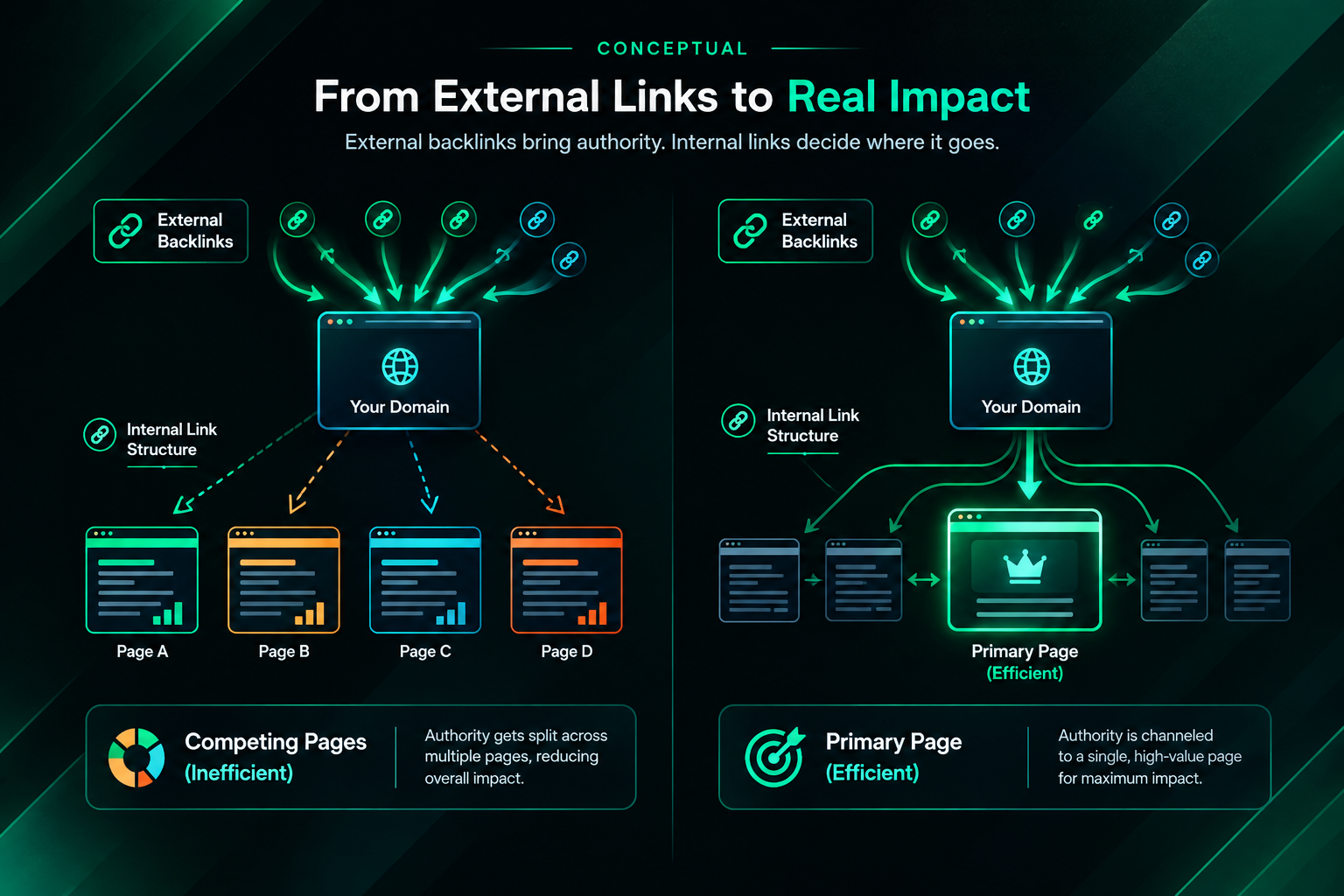
This relationship works in both directions. If you are planning an external link building campaign targeting a specific page, auditing and correcting your internal link structure before or alongside that campaign can improve the efficiency of the investment. Links pointing to a page that is clearly designated as the primary resource for its topic, supported by a coherent internal linking structure, are more likely to contribute to measurable ranking improvements than links pointing to a page that is competing with several others on the same domain.
Conversely, if a secondary page has accumulated a significant number of external backlinks over time, consolidating it into the primary page via a 301 redirect allows those external link signals to transfer to the primary URL, further strengthening it. This is one reason why content consolidation, combined with internal linking adjustments, is often more effective than simply suppressing a competing page.
Monitoring Progress After Internal Link Adjustments
Changes to internal link structure do not produce immediate results. Search engines need to recrawl and reindex the affected pages before updated signals are reflected in rankings, and this process can take days to several weeks depending on crawl frequency and site size. Ranking changes, if they occur, may take additional time to stabilize.
After making internal link adjustments, monitor the following in Google Search Console and your preferred SEO tool:
- Whether the primary page is now consistently appearing for the target keyword rather than alternating with competing pages.
- Whether the primary page’s average position for the target keyword has improved or stabilized.
- Whether the secondary pages are now ranking for distinct, differentiated queries rather than the same core keyword.
- Whether crawl coverage of the primary page has increased, which may indicate that search engines are following the updated internal link signals.
If rankings remain unstable after several weeks, it may indicate that the cannibalization has deeper causes, such as substantially similar content that internal links alone cannot differentiate, or that additional interventions such as content consolidation or canonical tags are needed. A site-specific assessment is appropriate before drawing conclusions about what is or is not working.
Common Mistakes to Avoid
Several internal linking practices can inadvertently worsen cannibalization rather than resolve it.
- Linking to multiple competing pages with identical anchor text. If your navigation, footer, or body content links to several pages using the same keyword phrase, you are reinforcing the ambiguity rather than resolving it.
- Ignoring the authority of the linking page. Adding internal links from low-authority or thin pages to the primary page provides minimal benefit. Focus on links from established, well-trafficked pages.
- Treating internal linking as a one-time fix. As new content is published, new cannibalization risks can emerge. Periodic internal link audits are a useful part of ongoing site maintenance.
- Confusing cannibalization with healthy topical coverage. Not every instance of keyword overlap is problematic. Pages that target the same broad topic but serve clearly different intents, such as a how-to guide and a product comparison, may coexist without competing in a way that harms rankings. The goal is to resolve genuine competition, not to eliminate all topical overlap.
- Relying solely on internal links when content consolidation is the more appropriate fix. If two pages are substantially duplicative, adjusting internal links may reduce but not eliminate the cannibalization signal. In these cases, consolidation is likely to produce a more durable result.
Frequently Asked Questions
Can internal links alone fix keyword cannibalization?
Internal links can significantly reduce cannibalization signals by concentrating topical authority on a primary page, but they are not always sufficient on their own. When competing pages have substantially similar content or when one of them has accumulated significant external backlinks, additional measures such as canonical tags, content consolidation, or 301 redirects may be needed to fully resolve the issue.
How many internal links should point to the primary page?
There is no fixed number that guarantees a result. The goal is to ensure that the primary page receives more internal links than competing pages, that those links use relevant anchor text, and that they come from authoritative sections of your site. Quality and consistency of internal linking matter more than reaching a specific count.
Does anchor text in internal links affect rankings?
Anchor text in internal links contributes to the relevance signals search engines associate with a destination page. Using descriptive, keyword-relevant anchor text for links pointing to your primary page can help reinforce its topical focus. However, this should be done naturally within useful content rather than forcing exact-match phrases into every link.
How long does it take to see results after adjusting internal links?
Results depend on how quickly search engines recrawl and reindex the affected pages, which varies by site size, crawl frequency, and the extent of the changes. Ranking changes may become visible within a few weeks, but stabilization can take longer. Monitoring Google Search Console over a period of four to eight weeks after making changes provides a reasonable initial picture.
Should I use noindex to stop a competing page from ranking?
Noindex is appropriate for pages that should not appear in search results for functional reasons, such as filtered category pages or duplicate utility pages. It is generally not the right approach for pages that have accumulated backlinks or organic traffic, because removing them from the index also removes any ranking benefit they currently provide. Content consolidation with a 301 redirect is usually a better option in those cases.
How does keyword cannibalization affect external link building campaigns?
Cannibalization can reduce the efficiency of external link building by splitting the authority that incoming links contribute across competing pages. Resolving cannibalization before or alongside a link building campaign helps ensure that external link equity is concentrated on the intended target page, which may improve the measurable impact of the campaign.
Deciding When to Prioritize Internal Linking as a Cannibalization Fix
Internal linking adjustments are most appropriate as a first response when cannibalization is identified early, when the competing pages serve meaningfully different purposes, or when the site’s content architecture simply lacks a clear hierarchy. In these situations, restructuring internal links to designate a primary page and direct supporting pages toward it is a low-risk, relatively fast intervention that can produce measurable improvements in ranking stability without requiring significant content changes.
When cannibalization is more severe, involving pages with substantially overlapping content, similar external backlink profiles, or a long history of ranking instability, internal linking adjustments are best treated as one component of a broader remediation plan that may include content consolidation, canonical tags, or redirects. A site-specific audit is the appropriate starting point for determining which combination of interventions is most likely to be effective for a given situation.
For websites that are also investing in external link acquisition, addressing cannibalization through internal linking is a practical step that can improve the return on that investment by ensuring that link equity flows efficiently to the pages that matter most. If you are unsure whether your current internal link structure is supporting or undermining your ranking goals, discussing your site architecture with an experienced SEO professional before scaling an external link building campaign is a reasonable precaution.


