Site reputation abuse is one of the more consequential developments in Google’s spam policies in recent years, and it has direct implications for anyone using guest posting as a link building strategy. Understanding what it means, how it is identified, and what separates compliant guest posting from policy-violating behaviour can help businesses and SEO teams make better decisions about how they acquire backlinks and where they publish content.
Key Takeaways
- Site reputation abuse occurs when a third party publishes content on an established website primarily to exploit that site’s authority, rather than to serve its existing audience.
- Google’s spam policies explicitly address this practice, and sites found to be hosting such content may receive manual actions or algorithmic demotions.
- Not all guest posting constitutes site reputation abuse; editorial relevance, audience fit, and the nature of the arrangement are meaningful distinctions.
- Publishers and link builders both carry risk when placements prioritise link equity over genuine editorial value.
- Assessing publisher quality, topical relevance, and content standards before placement remains the most practical way to reduce exposure to this risk.
What Site Reputation Abuse Means
Site reputation abuse, as defined in Google’s spam policies, refers to the practice of hosting third-party content on an established website with the primary purpose of passing that site’s ranking signals to the hosted content or to external destinations. The concern is not guest content itself, but rather arrangements where the host site’s credibility is being exploited rather than genuinely shared. Google’s documentation describes this as a situation where a site with strong organic visibility allows content that would not rank on its own merits to benefit from the host’s established reputation.
In practical terms, this often involves a well-known or high-traffic website publishing content in a separate section — sometimes labelled as a blog, partner content, or sponsored hub — where the editorial standards, topical relevance, and audience alignment are substantially weaker than the rest of the site. The content may be written by external parties, optimised for keywords unrelated to the host site’s core subject matter, and designed primarily to generate backlinks or rankings rather than to inform the host’s readership.
Google’s framing is important here: the policy targets arrangements where the third-party content would be unlikely to rank independently, and where the host site’s involvement is essentially a mechanism for transferring authority rather than providing genuine editorial value. This is distinct from a site that occasionally publishes contributed content that happens to include a link; the distinction lies in intent, editorial oversight, and the degree to which the content serves the host’s audience.
How This Applies to Guest Posting
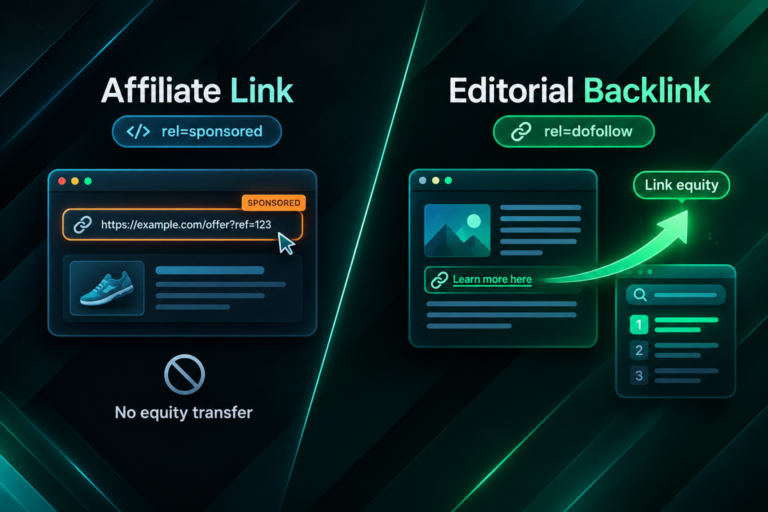
Guest posting has been a mainstream link acquisition method for many years. At its best, it involves a subject-matter expert contributing a useful, relevant article to a publication whose readership would benefit from it. The link included in that article is a natural consequence of attribution and further reading, not the sole reason the content exists. This kind of arrangement has generally been considered editorially legitimate, even if Google has long maintained that links in guest posts should carry a rel=”sponsored” or rel=”nofollow” attribute when the placement involves any form of compensation.
Site reputation abuse becomes relevant when guest posting moves away from this model. The specific patterns that attract scrutiny include: content published on a host site with no meaningful editorial review; articles covering topics entirely unrelated to the host site’s subject area; bulk placements across a network of sites that share ownership or management; and arrangements where the host site’s primary motivation is revenue from content fees rather than audience value. In these cases, the guest post is functioning as a paid link placement dressed in editorial clothing, and the host site is effectively renting out its domain authority.
It is worth noting that Google has acknowledged the difficulty of drawing a precise line between legitimate contributed content and abusive arrangements. The policy guidance emphasises that the key question is whether the content would be considered valuable by the host site’s existing audience, and whether the host site exercises genuine editorial control over what is published. A guest post that passes both tests is on considerably stronger ground than one that fails either.
Signals That May Indicate Site Reputation Abuse
Neither publishers nor link builders can know with certainty how Google’s systems evaluate any individual placement, but several observable characteristics are associated with the kind of arrangements the policy targets. Understanding these signals is useful both for assessing publisher quality before outreach and for evaluating an existing backlink profile.
Topical Disconnection
When a guest post covers a subject that has no logical relationship to the host site’s established content, this is a meaningful warning sign. A financial news website publishing detailed articles about dietary supplements, or a regional lifestyle magazine hosting technical software tutorials, suggests that the content was placed for link value rather than audience relevance. Topical relevance between the linking page and the target page has long been considered a quality signal in link building; site reputation abuse concerns add a further dimension by focusing on the relevance between the guest content and the host site’s overall editorial identity.
Absence of Editorial Standards
Publishers that accept guest content with minimal or no editorial review, that publish articles regardless of quality or accuracy, or that operate dedicated sections where any paying contributor can place content, are exhibiting characteristics associated with site reputation abuse. The presence of a clearly labelled “write for us” page is not itself a problem, but when the acceptance criteria are purely commercial rather than editorial, the arrangement begins to resemble a link marketplace rather than a genuine publication.
Disproportionate Volume of Third-Party Content
A site where the majority of published content originates from external contributors, particularly when those contributors have no visible connection to the site’s subject area, may be operating primarily as a link host. This is different from a publication that actively commissions expert contributors in its field; the distinction is whether the contributors are selected for their expertise and relevance or simply for their willingness to pay a placement fee.
Mismatch Between Site Traffic and Content Quality
Some sites maintain strong domain-level metrics — such as high scores in tools like Ahrefs, Semrush, or Moz — while publishing content of noticeably lower quality than their traffic history would suggest. This can occur when a site built its reputation through legitimate content over many years but has since shifted to monetising that reputation through paid placements. The domain-level authority metric may not yet reflect the change in editorial direction, but the content itself signals the shift.
The Risk to Publishers and Link Builders
Site reputation abuse carries risk for both parties in a guest posting arrangement, though the nature of that risk differs.
Risk to the Publishing Site
A website found to be hosting content that violates Google’s site reputation abuse policy may receive a manual action, which is a human-reviewed penalty applied by Google’s spam team. Manual actions targeting specific sections of a site can result in those sections being excluded from search results, reducing the organic visibility of the affected pages. In more serious cases, a manual action may affect the site more broadly. Google has indicated that it may also address site reputation abuse algorithmically, meaning that some sites may experience ranking changes without receiving a formal manual action notification in Google Search Console.
For publishers, the commercial logic of accepting paid guest content can appear attractive in the short term, but the long-term risk to organic traffic — which is often the asset that makes the site valuable to advertisers and contributors in the first place — is a meaningful consideration. A site that loses significant organic visibility as a result of a manual action may find that the revenue from guest placements does not compensate for the loss of search-driven traffic.
Risk to the Link Builder or SEO Campaign
From the perspective of a business or agency acquiring links through guest posting, placements on sites that are subsequently penalised or algorithmically demoted may lose their value. A backlink from a page that no longer ranks or receives organic traffic contributes less to a link profile than one from a page with active visibility. More significantly, if a site receives a manual action and its pages are removed from search results, the links pointing from those pages may cease to pass meaningful signals.
There is also a reputational consideration for agencies and in-house teams. A link building campaign that relies heavily on publishers operating in ways that conflict with Google’s policies creates ongoing uncertainty, even if the immediate impact is not visible. Disavowing links from penalised sites is possible through Google Search Console, but it is a reactive measure rather than a preventive one, and it does not guarantee that any negative association has been fully addressed.
What Separates Compliant Guest Posting from Site Reputation Abuse
The distinction between a legitimate guest post and a placement that risks being classified as site reputation abuse is not always immediately obvious, but several practical criteria help clarify the difference.
Editorial intent: Compliant guest posting involves content that the host site’s editorial team has assessed for relevance, accuracy, and audience value. The host site publishes the content because it serves its readers, not solely because a fee has been paid. Where a fee is involved, Google’s guidance is that the link should carry an appropriate attribute such as rel=”sponsored” to signal its commercial nature.
Topical alignment: The guest post should address a subject that is genuinely relevant to the host site’s established subject area and to the interests of its existing audience. A link from a topically aligned page on a relevant site is more likely to be considered editorially meaningful than a link from an unrelated section of a high-traffic domain.
Content quality: The article should meet the same quality standards as the host site’s own content. It should be accurate, well-structured, and useful to a reader who arrived at the site for its primary subject matter. Content that would not pass editorial review on its own merits, but is published because of a commercial arrangement, is closer to the behaviour the policy targets.
Link attributes: Where a placement involves any form of payment or reciprocal arrangement, using rel=”sponsored” or rel=”nofollow” on the included links is consistent with Google’s webmaster guidelines. Dofollow links in paid placements are not automatically penalised, but they represent a higher-risk approach, particularly when the placement itself lacks strong editorial justification.
Publisher transparency: Sites that clearly distinguish between editorial content and contributed or sponsored content, and that apply consistent standards to both, are operating more transparently than those that present paid placements as organic editorial output.
Assessing Publisher Quality Before Placement
Practical publisher assessment before outreach or placement approval is one of the most effective ways to reduce exposure to site reputation abuse risk. This assessment should go beyond domain-level authority metrics, which are proprietary scores calculated by third-party tools and do not directly reflect Google’s evaluation of a site.
Useful assessment criteria include: the proportion of content on the site that originates from external contributors versus the site’s own editorial team; whether the site’s content is topically consistent or covers an unusually wide range of unrelated subjects; the quality and depth of existing articles in the section where the guest post would appear; whether the site has visible editorial standards or contributor guidelines that go beyond commercial terms; and whether the site’s organic traffic history shows signs of previous algorithmic or manual penalties, which tools like Ahrefs or Semrush can sometimes indicate through traffic trend data.
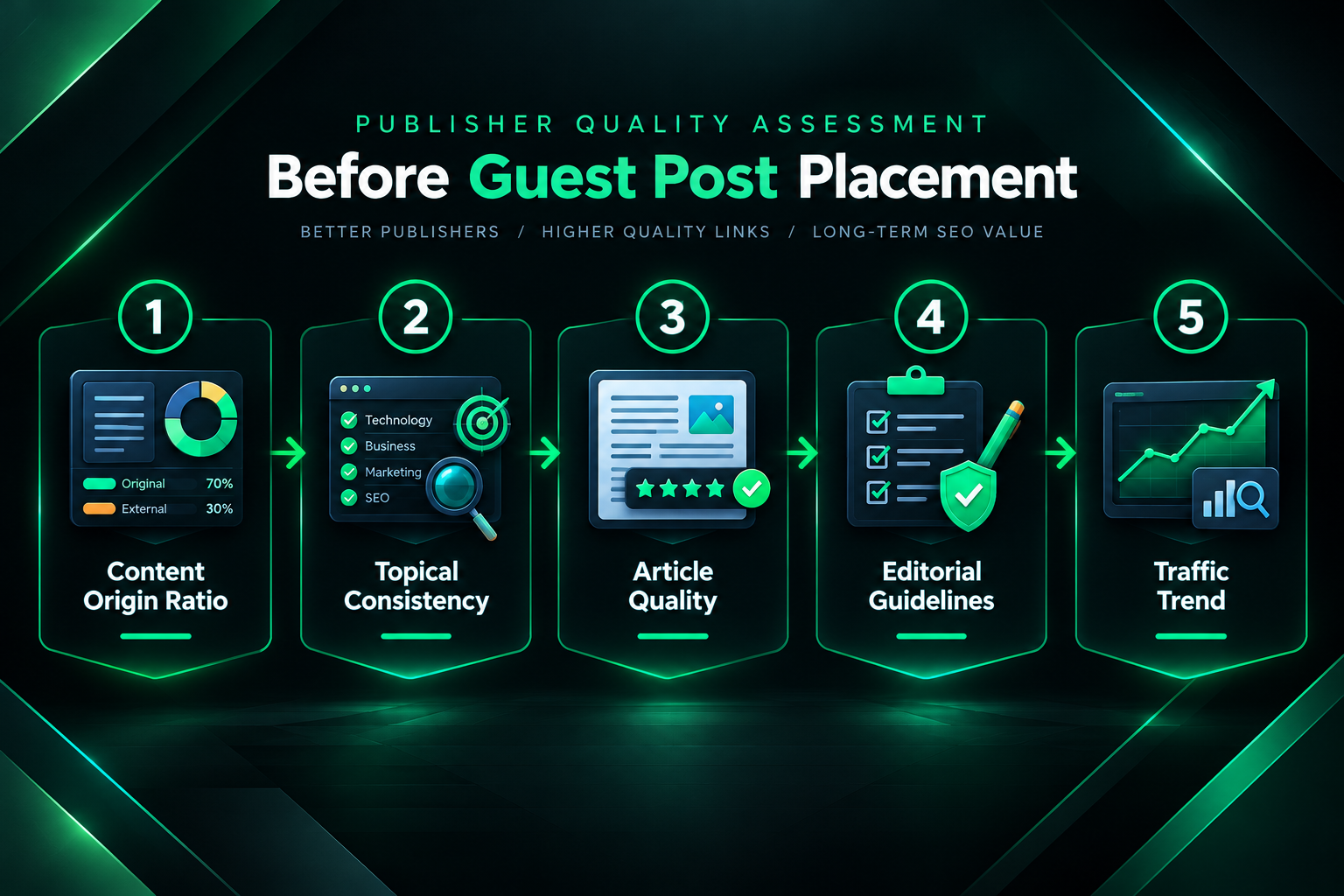
It is also worth reviewing whether the site discloses sponsored or contributed content clearly, and whether the section where guest posts appear is indexed and receiving organic traffic. A placement on a page that search engines do not index, or that receives no organic visitors, is unlikely to contribute meaningfully to a link building campaign regardless of the host site’s overall domain metrics.
Implications for Link Building Strategy
Site reputation abuse policy has practical implications for how guest posting campaigns are planned and executed. Campaigns that prioritise placement volume over publisher quality, or that rely on networks of sites known to accept content without meaningful editorial review, carry a higher risk of including placements that conflict with this policy. This does not mean that guest posting as a strategy is inherently problematic; it means that the quality bar for publisher selection needs to be applied consistently.
For businesses working with an outsourced link building provider, it is reasonable to ask how publishers are assessed before outreach, what criteria are used to approve or reject a potential placement, and whether the provider’s process includes a review of editorial standards rather than relying solely on domain authority scores. A provider that can explain its publisher vetting process in concrete terms is better positioned to deliver placements that remain valuable over time.
Diversifying link acquisition beyond guest posting is also worth considering. Niche edits — where a link is added to an existing, already-indexed article on a relevant site — digital PR campaigns that earn editorial coverage through newsworthy content, and unlinked brand mention outreach are all methods that can complement a guest posting programme and reduce dependence on any single acquisition channel. Each method carries its own quality considerations and risk profile, and the appropriate mix depends on the website’s existing backlink profile, its industry, and its campaign goals.
Frequently Asked Questions
Does site reputation abuse only apply to guest posting?
No. Google’s site reputation abuse policy applies to any arrangement where third-party content is hosted on an established site primarily to exploit its ranking signals. This can include parasite SEO tactics, sponsored content hubs, and other forms of third-party publishing. Guest posting is one of the more common contexts in which the policy is relevant, but it is not the only one.
Will a guest post on a penalised site harm my own website?
A link from a site that has received a manual action or experienced a significant algorithmic demotion is unlikely to contribute positively to your backlink profile, and in some cases may be worth disavowing through Google Search Console. However, a small number of low-quality links in an otherwise healthy backlink profile is generally considered a manageable issue rather than a cause for alarm. The risk increases when a significant proportion of a site’s backlinks come from publishers operating in ways that conflict with Google’s policies.
Should all guest post links use rel=”nofollow” or rel=”sponsored”?
Google’s guidelines indicate that links in paid or compensated placements should carry an appropriate attribute. For purely editorial placements where no compensation is involved, a dofollow link is not inherently against policy. In practice, many guest posting arrangements involve some form of compensation, and using the appropriate link attribute reduces the risk of the placement being treated as a manipulative link. This is a nuanced area, and the appropriate approach may depend on the specific arrangement and the publisher’s own policies.
How can I tell if a site I’m targeting for outreach is at risk of a site reputation abuse penalty?
No external tool can predict with certainty whether a site will receive a manual action. However, reviewing the proportion of third-party content on the site, assessing topical consistency, checking organic traffic trends in tools like Ahrefs or Semrush for signs of previous penalties, and evaluating the editorial standards applied to existing guest content can all provide useful signals. Sites that appear to operate primarily as link hosts, with minimal editorial oversight and a wide range of unrelated content, carry a higher risk profile.
Is it possible to do guest posting safely under Google’s current policies?
Guest posting that involves genuine editorial contribution to a relevant, quality publication, with appropriate link attributes where compensation is involved, remains a viable link acquisition approach. The policy targets arrangements that exploit site reputation rather than those that contribute genuine value. Applying consistent publisher quality standards and prioritising topical relevance over domain authority scores are the most practical ways to reduce policy-related risk.
What should I do if I discover my backlink profile includes links from sites that may be violating this policy?
A site-specific backlink audit is the appropriate starting point. Identifying which links come from publishers that appear to be operating as link hosts, assessing whether those links are likely to be contributing positively or negatively to the profile, and using Google Search Console’s disavow tool for links that appear genuinely harmful are reasonable steps. An SEO professional with experience in backlink profile assessment can help prioritise which links warrant action and which represent a manageable level of risk.
Evaluating Your Guest Posting Approach in Light of Site Reputation Abuse Policy
Site reputation abuse policy does not make guest posting obsolete, but it does raise the standard for what constitutes a defensible placement. The practical implication is that publisher selection needs to be driven by editorial relevance and audience fit, not solely by domain authority metrics or the willingness of a site to accept content for a fee. Placements that would not survive scrutiny on those grounds carry a higher risk of losing their value if the host site is affected by a manual action or algorithmic change.
For businesses and agencies reviewing their link building approach, the most useful question is whether each placement would be considered genuinely valuable by the host site’s existing audience, independent of its link-building function. If the honest answer is no, the placement is closer to the behaviour the policy targets than to the editorial contribution it is meant to resemble. Applying that standard consistently — across publisher selection, content quality, and link attribute decisions — is the most practical way to build a backlink profile that remains useful over time, regardless of how Google’s enforcement of this policy evolves.
If you are uncertain whether your current guest posting programme meets these standards, discussing your publisher vetting process and content criteria with an experienced link building provider is a reasonable starting point for a more informed assessment.