Daily outreach email volume is one of the most practical—and most frequently underestimated—factors in any link building campaign. Send too few emails and your campaign stalls; send too many from a single domain and you risk deliverability problems, spam-filter flags, or permanent damage to your sending reputation. Understanding realistic sending limits, the factors that influence them, and how to scale safely can make the difference between a productive outreach campaign and one that quietly fails before a single reply arrives.
Key Takeaways
- There is no single universal daily sending limit for outreach emails; safe volume depends on domain age, warm-up history, sending infrastructure, and the receiving mail servers you are targeting.
- A freshly registered domain should typically begin with no more than 10–20 outreach emails per day and increase volume gradually over several weeks before reaching higher thresholds.
- Established domains with a healthy sending history can often sustain higher daily volumes, but exceeding the tolerance of your email service provider or triggering spam filters at scale can still damage deliverability.
- Outreach email volume is only one variable; reply rates, bounce rates, spam complaint rates, and the quality of your prospect list have a greater influence on campaign outcomes than raw send counts.
- Spreading outreach across multiple domains or dedicated sending accounts is a common approach for high-volume link building campaigns, but each domain still requires its own warm-up and reputation management.
Why Daily Sending Limits Matter for Link Building Outreach
Email outreach is the engine behind most manual link building methods, including guest post prospecting, niche edit requests, digital PR pitches, and resource page link requests. The volume of emails a domain can send each day directly affects how many publishers a campaign can reach within a given time frame. However, email service providers, internet service providers, and receiving mail servers all apply filters and rate limits that are designed to detect and block unsolicited bulk email. Outreach campaigns that ignore these constraints often see their messages land in spam folders or get blocked entirely, meaning the effort invested in writing personalised pitches produces no measurable result.
The practical consequence for link building is straightforward: a domain that has been flagged as a spam source will struggle to reach editorial inboxes, regardless of how well-crafted the outreach message is. Protecting the sending reputation of your outreach domain is therefore not a technical detail—it is a prerequisite for campaign effectiveness.
What Determines How Many Emails a Domain Can Send Per Day
Several interconnected factors influence the safe daily sending volume for any outreach domain. Understanding each one helps you set realistic expectations and avoid common mistakes.
Domain Age and Sending History
A newly registered domain has no established sending reputation. Mail servers at major providers such as Google Workspace and Microsoft 365 use reputation signals to decide whether incoming messages are legitimate. A domain that suddenly sends hundreds of emails on its first day of use is a strong signal of spam behaviour, and receiving servers may block or filter those messages immediately. Older domains with a consistent, low-volume sending history are generally treated more favourably, though a poor historical reputation can be equally damaging.
Email Service Provider Limits
Every email service provider imposes its own sending limits, which vary by plan and account type. Google Workspace accounts, for example, have documented daily sending limits that differ between standard and legacy plans. Microsoft 365 applies its own recipient-per-day thresholds. Dedicated outreach tools such as Lemlist, Instantly, Mailshake, and Woodpecker operate within these underlying provider limits while adding their own rate controls. Exceeding a provider’s threshold can result in temporary account suspension or permanent termination, so it is important to understand the specific limits of whichever infrastructure you are using before scaling volume.
Domain Warm-Up Status
Domain warm-up is the process of gradually increasing sending volume over a period of weeks to build a positive sending reputation before running a full-scale outreach campaign. A domain that has been properly warmed up can typically sustain meaningfully higher daily volumes than one that has not. Many outreach tools include automated warm-up features that simulate natural email exchanges to help establish reputation signals. However, automated warm-up is not a guarantee of deliverability; it reduces risk but does not eliminate it, and the quality of the warm-up process matters as much as its duration.
Bounce Rate and Spam Complaint Rate
Receiving servers and email providers monitor the proportion of your outgoing messages that bounce or generate spam complaints. A high hard-bounce rate—caused by sending to invalid or non-existent email addresses—signals poor list hygiene and can trigger deliverability penalties quickly. Similarly, if recipients mark your messages as spam at a rate above roughly 0.1–0.3%, major providers may begin filtering your future messages more aggressively. These thresholds are not fixed and vary by provider, but they illustrate why list quality and personalisation matter as much as raw volume.
Sending Patterns and Timing
Sending a large batch of identical or near-identical emails in a short burst is a pattern associated with spam campaigns. Spreading sends across the working day, introducing small random delays between messages, and varying subject lines and message content all help outreach emails appear more consistent with normal human communication. Most dedicated outreach platforms include throttling and randomisation features for this reason.
Practical Sending Volume Ranges for Outreach Domains
While no universally correct number exists, the following ranges reflect commonly observed practices in professional outreach campaigns. These are general guidance figures, not guarantees, and actual safe volumes will depend on the specific factors described above.
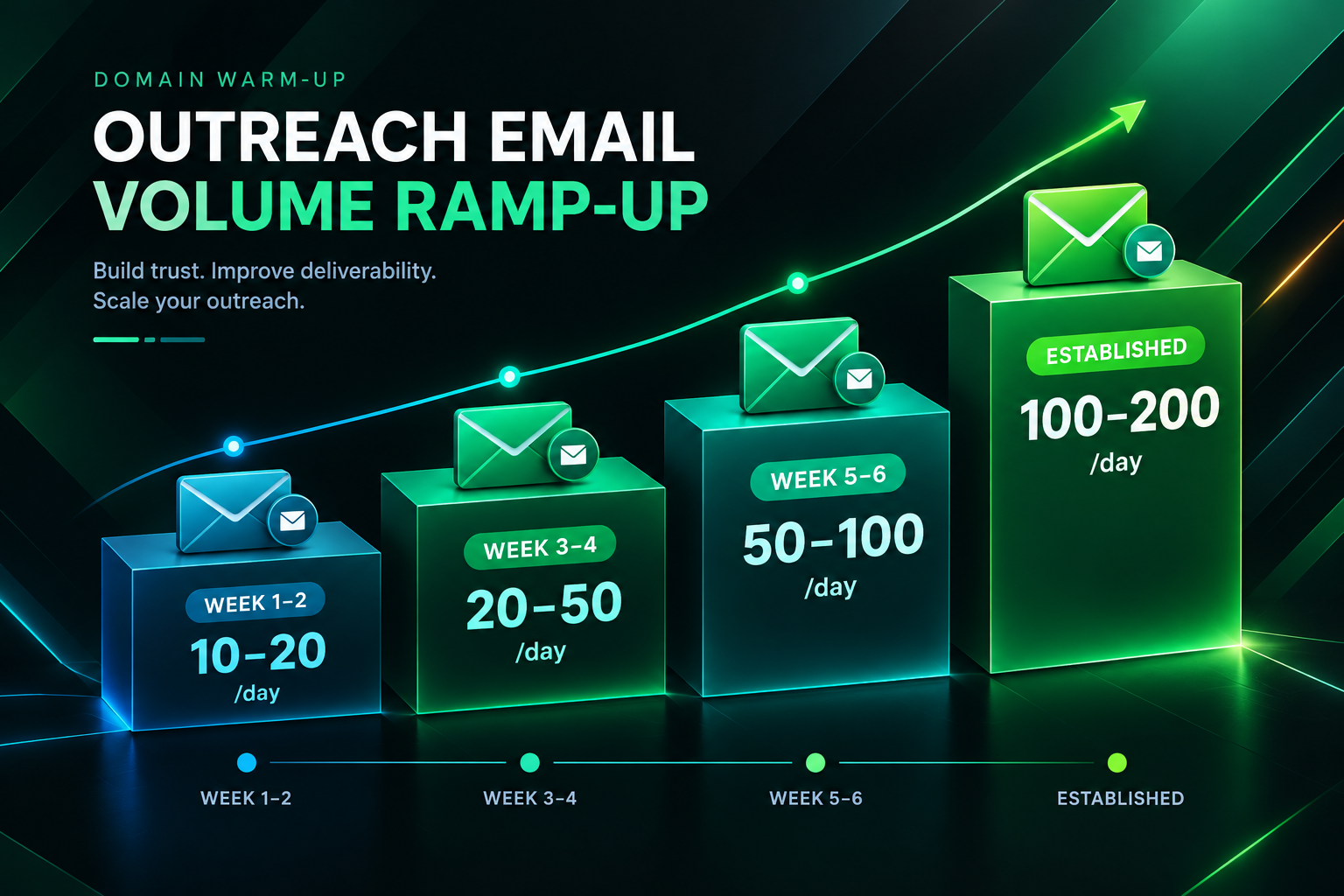
- New or unwarmed domain (weeks 1–2): 10–20 emails per day is a widely recommended starting point. Some practitioners begin even lower, at 5–10 per day, particularly for domains registered specifically for outreach.
- Warming domain (weeks 3–6): Volume can typically be increased incrementally, often doubling every one to two weeks if bounce rates and complaint rates remain low. Reaching 50–100 emails per day by the end of a structured warm-up period is a realistic target for many setups.
- Established warmed domain with clean history: Daily volumes of 100–200 outreach emails are achievable for well-maintained domains using reputable sending infrastructure. Some high-volume campaigns push beyond this, but doing so increases the risk of triggering filters and requires more active monitoring.
- Multiple dedicated sending domains: Agencies and in-house teams running large-scale campaigns often distribute outreach across several domains, each managed separately, to achieve higher aggregate daily volumes while keeping per-domain risk manageable.
It is worth noting that these figures refer to outreach emails—personalised prospecting messages sent to individual publishers or website owners—rather than bulk marketing emails, which are governed by different infrastructure and compliance requirements.
The Relationship Between Volume and Link Building Campaign Quality
Higher daily sending volume does not automatically produce more links. The quality of the prospect list, the relevance of the outreach pitch, the authority and topical alignment of the target publishers, and the strength of the content or value proposition being offered all influence reply rates and placement outcomes more directly than the number of emails sent.
A campaign sending 50 highly personalised emails per day to carefully vetted, topically relevant publishers will typically generate more useful responses—and ultimately more editorially placed links—than one sending 500 generic messages to a poorly filtered list. In link building specifically, the editorial quality of the placements matters for SEO purposes; a link from a relevant, well-maintained publisher is generally more valuable than one from a low-quality site, regardless of how efficiently it was acquired.
This means that optimising daily outreach volume should be considered alongside prospect list quality, personalisation depth, follow-up sequencing, and publisher vetting. Treating volume as the primary lever is a common mistake that can simultaneously damage deliverability and reduce the quality of the links acquired.
Risks of Exceeding Safe Sending Thresholds
Pushing daily outreach volume beyond what a domain’s reputation and infrastructure can support carries several practical risks that are worth understanding before scaling a campaign.
Deliverability Degradation
When a domain’s sending reputation deteriorates, messages are increasingly likely to be routed to spam or junk folders rather than primary inboxes. This can happen gradually and may not be immediately obvious from within your outreach tool. A campaign that appears to be running normally—with emails being sent and no error messages returned—may in practice be reaching almost no one. Monitoring inbox placement rates using tools designed for deliverability testing can help identify this problem before it becomes severe.
Domain Blacklisting
Sustained high-volume sending that generates complaints or bounces can result in a domain being added to one or more email blacklists. Blacklisted domains face significant deliverability problems across multiple receiving servers, and removal from blacklists can be a slow and uncertain process. In some cases, a domain used for outreach may need to be retired and replaced, which means rebuilding sending reputation from scratch.
Account Suspension by Email Providers
Google Workspace, Microsoft 365, and other providers can suspend accounts that violate their terms of service or sending limits. Account suspension interrupts active campaigns and may result in loss of access to historical email data. Providers’ terms of service generally prohibit using their platforms for bulk unsolicited email, so outreach campaigns should be structured to comply with those terms, including ensuring that recipients have a reasonable basis for receiving the message.
Reputational Risk with Publishers
Beyond technical deliverability, sending excessive or poorly targeted outreach can damage relationships with publishers and editors in your niche. Website owners who receive repeated or irrelevant pitches from the same domain or sender are less likely to respond positively to future outreach, even when the pitch is relevant and well-crafted. In competitive niches where the pool of high-quality publishers is limited, this reputational cost can have a lasting effect on campaign effectiveness.
Managing Multiple Outreach Domains
For link building campaigns that require reaching a large number of publishers within a defined time frame, distributing outreach across multiple dedicated sending domains is a practical approach. Each domain is registered, warmed up, and managed independently, allowing the aggregate daily volume to scale while keeping per-domain risk within manageable bounds.
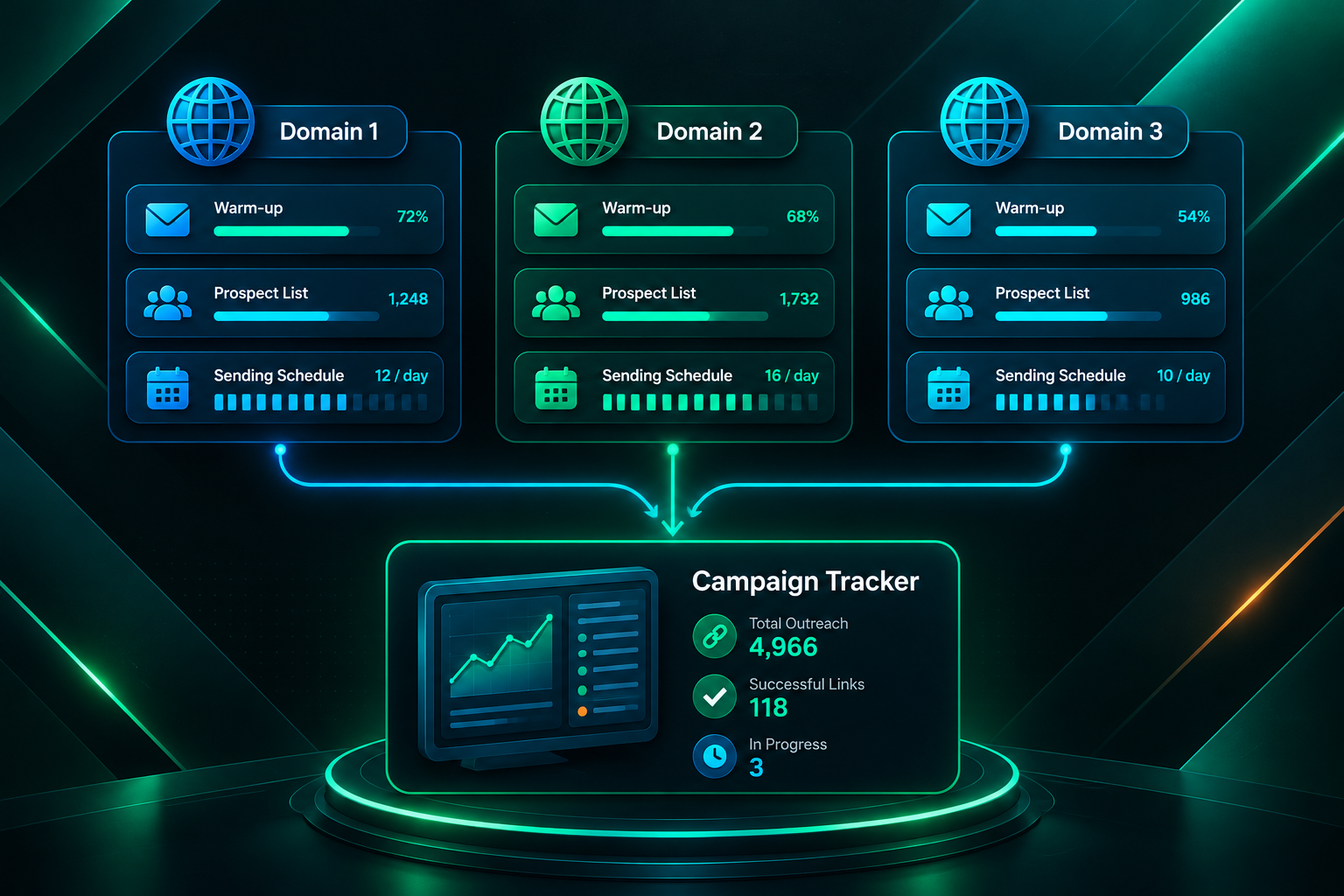
This approach requires more infrastructure management and a clear system for tracking which prospects have been contacted from which domain, to avoid sending duplicate messages to the same publisher. It also means that the warm-up investment must be repeated for each new domain, which adds lead time before a new domain can contribute meaningfully to campaign volume. Agencies running outreach at scale typically build and maintain a portfolio of sending domains as part of their standard operating infrastructure.
When using multiple domains, it is important to ensure that each domain has a complete and credible online presence—including a professional website, consistent branding, and verifiable contact information—since publishers who receive outreach will often check the sender’s domain before deciding whether to respond. A domain that appears to exist solely for sending emails is less likely to generate trust or positive replies.
Compliance and Legal Considerations
Email outreach for link building operates in a legal and regulatory environment that varies by geography. In the United States, the CAN-SPAM Act sets requirements for commercial email, including the need for a clear opt-out mechanism and accurate sender identification. In the European Union and United Kingdom, the General Data Protection Regulation and related legislation impose stricter requirements around consent and the processing of personal data, including email addresses. Canada’s Anti-Spam Legislation applies similar principles.
Whether link building outreach constitutes commercial email under these frameworks depends on the specific message content and context, and legal interpretations vary. Campaigns targeting publishers in multiple jurisdictions should be reviewed against the applicable regulations, and outreach messages should include accurate sender information and a clear way for recipients to request that they not be contacted again. This is not only a legal consideration but also a practical one: outreach that respects recipients’ preferences is less likely to generate spam complaints that damage deliverability.
How Outreach Volume Fits Into a Broader Link Building Campaign
Daily outreach email volume is one operational variable within a larger campaign structure. A well-managed link building campaign typically involves several stages before and after the outreach phase itself, each of which influences how volume decisions should be made.
Prospect Research and List Building
Before any emails are sent, identifying and vetting suitable publishers is essential. This involves assessing the topical relevance of potential linking domains, evaluating their content quality and editorial standards, checking third-party metrics such as Domain Rating from Ahrefs or Domain Authority from Moz as one signal among several, and verifying that the site has genuine organic traffic rather than inflated or artificial visitor counts. A smaller list of well-qualified prospects will typically produce better results than a large list of poorly filtered contacts, and it reduces the bounce rate that can damage sending reputation.
Outreach Sequencing and Follow-Up
Most outreach campaigns include an initial email and one or two follow-up messages sent to non-responders after a defined interval. The daily volume calculation needs to account for follow-up messages as well as initial contacts, since both draw on the same sending capacity. Poorly timed or overly aggressive follow-up sequences can increase complaint rates, so the number of follow-ups and the intervals between them should be set conservatively, particularly for new or recently warmed domains.
Placement, Publication, and Indexing
Once a publisher agrees to a placement—whether a guest post, niche edit, or another format—the link acquisition process moves into content creation, editorial review, and publication. These stages take time and are largely independent of outreach volume. A campaign that generates a high volume of positive responses can create a backlog if content production capacity is limited. Aligning outreach volume with content production capacity helps avoid situations where agreed placements are delayed, which can damage relationships with publishers and reduce the likelihood of future collaboration.
Frequently Asked Questions
Is there a specific number of outreach emails per day that Google recommends or penalises?
Google does not publish specific guidance on outreach email volume, and email sending limits are governed by email service providers and receiving mail servers rather than by search engines. Google’s documented link spam policies relate to the nature of the links acquired rather than the method used to request them. However, acquiring links through outreach does not automatically make those links compliant with Google’s guidelines; the editorial context and nature of the placement remain relevant.
How long does domain warm-up take before I can send meaningful outreach volume?
A structured warm-up period typically runs for four to eight weeks before a domain can reliably support daily outreach volumes in the range of 50–100 emails. The exact duration depends on the starting volume, the rate of increase, bounce and complaint rates during the warm-up period, and the email service provider being used. Rushing the warm-up process increases the risk of deliverability problems.
Can I use my main business domain for link building outreach?
Using your primary business domain for high-volume outreach carries risk, because deliverability problems or blacklisting would affect all email communication from that domain, including transactional and customer-facing messages. Many practitioners use a separate subdomain or a dedicated outreach domain to isolate this risk, while ensuring the sending domain still has a credible and professional online presence.
What reply rate should I expect from link building outreach?
Reply rates vary considerably depending on the niche, the quality of the prospect list, the personalisation of the message, and the value proposition being offered. Across the industry, reply rates for cold outreach campaigns are often reported in the range of 5–15%, though this figure varies widely and should not be treated as a benchmark for any specific campaign. Campaigns targeting highly competitive niches or using generic templates tend to see lower rates.
Does sending more outreach emails always produce more links?
Not necessarily. Beyond a certain volume threshold, additional emails may produce diminishing returns if the prospect list quality declines, if deliverability is affected, or if the outreach becomes less personalised. The relationship between outreach volume and link acquisition is not linear, and campaigns that prioritise prospect quality and message relevance over raw volume often achieve better placement rates per email sent.
How do I know if my outreach emails are landing in spam?
Deliverability testing tools such as Mail-Tester, GlockApps, and similar platforms can help assess whether outreach messages are likely to reach the primary inbox. Monitoring open rates within your outreach platform can also provide an indirect signal, though open tracking has become less reliable following changes to email client behaviour. Sending test messages to accounts across different providers—Gmail, Outlook, and others—before launching a campaign is a practical way to check inbox placement.
Setting Realistic Outreach Volume Expectations for Your Campaign
The question of how many outreach emails a domain can send per day does not have a single correct answer, but it does have a practical framework. Start conservatively with any new or unwarmed domain, increase volume gradually based on deliverability signals rather than arbitrary targets, and treat the prospect list and message quality as at least as important as the number of emails sent each day.
For businesses and agencies running link building campaigns at scale, the infrastructure decisions around outreach domains, sending tools, warm-up processes, and list hygiene are worth investing time in before the first email is sent. A campaign built on a solid deliverability foundation will reach more publishers, generate more replies, and ultimately acquire more editorially placed links than one that prioritises speed over sustainability.
If you are planning a link building campaign and are uncertain about the right outreach infrastructure or volume strategy for your specific situation, discussing your goals with an experienced link building provider can help you avoid common mistakes and set realistic expectations for what the campaign can achieve within your time frame and budget.