

Sending the same outreach email to the same contact twice — or reaching the same editor through three different email addresses — is one of the most avoidable mistakes in a link building campaign. Publisher contact deduplication is the process of identifying and removing duplicate or overlapping contact records before your outreach sequence begins. Done carefully, it protects your sender reputation, reduces wasted effort, and helps your team focus on genuine relationship-building rather than accidental spam. This guide explains why deduplication matters, how to approach it systematically, and what practical steps you can take whether you manage outreach in-house or work with an outsourced link building partner.
Key Takeaways
- Duplicate publisher contacts can trigger spam filters, damage sender reputation, and cause editors to ignore or blacklist your domain before a campaign gains traction.
- Deduplication should happen at multiple stages: during list building, before import into your outreach tool, and again before each new campaign wave.
- Matching on email address alone is insufficient; effective deduplication also checks domain, contact name, and role to catch near-duplicates and alias addresses.
- A clean, deduplicated contact list is a reusable asset that improves over time when teams maintain suppression lists and document outreach history consistently.
- Outsourced link building teams that manage publisher relationships at scale typically maintain proprietary contact databases with deduplication built into their workflow, reducing this burden for clients.
Why Publisher Contact Deduplication Matters for Outreach
In link building outreach, your contact list is the foundation of every campaign. A list that contains duplicate records — whether exact copies of the same email address or near-duplicates such as the same editor listed under a personal address and a generic editorial inbox — creates several compounding problems. The most immediate is deliverability: email service providers and outreach platforms flag accounts that send repeated messages to the same recipient in a short window. Even a handful of duplicate sends can push your domain toward spam classification, reducing the deliverability of every subsequent email you send, including to contacts you have never reached before.
Beyond deliverability, duplicate outreach damages professional relationships. Editors and site owners who receive two or three versions of the same pitch within days of each other are unlikely to respond positively, and some will mark the sender as spam or add the domain to a blocklist. In competitive niches where the pool of high-quality publishers is limited, burning a contact through careless duplication can close a placement opportunity permanently. The reputational cost is disproportionate to the administrative effort required to prevent it.
There is also a resource efficiency argument. Outreach campaigns involve copywriting, personalisation, follow-up sequencing, and response management. Every duplicate contact that receives an email consumes capacity that could have been directed toward a genuinely new publisher. At scale — campaigns targeting hundreds or thousands of contacts — the cumulative waste becomes significant.
Where Duplicate Publisher Contacts Come From
Understanding the sources of duplication helps you address the problem at its root rather than simply cleaning lists after the fact. The most common sources include:
- Multiple prospecting tools: Teams that use Ahrefs, Semrush, Hunter.io, and manual research simultaneously often pull overlapping results. The same publisher may appear in a backlink analysis export, a content explorer search, and a manual Google search, each time with slightly different contact details.
- Shared or inherited databases: Agencies and in-house teams that inherit contact lists from previous campaigns, freelancers, or acquired businesses frequently receive records that overlap with their existing data without obvious flags.
- Role-based and personal email addresses: A single editor may be reachable at [email protected], [email protected], and [email protected]. Without cross-referencing, all three can appear as separate contacts for the same person at the same publication.
- Publisher rebranding or domain changes: A site that has changed its domain or merged with another publication may appear in your list under both its old and new identity, with different contact details pointing to the same editorial team.
- Repeated prospecting cycles: Teams that run multiple outreach waves without maintaining a persistent suppression list will re-add contacts from previous campaigns, sometimes with updated or slightly different details that prevent simple exact-match deduplication from catching them.
Building a Deduplication Workflow Before Outreach Begins
Effective deduplication is not a single action; it is a workflow with several distinct stages. The following sequence reflects how organised outreach teams typically approach the problem, though the specific tools and steps will vary depending on campaign size, team structure, and the outreach platform in use.
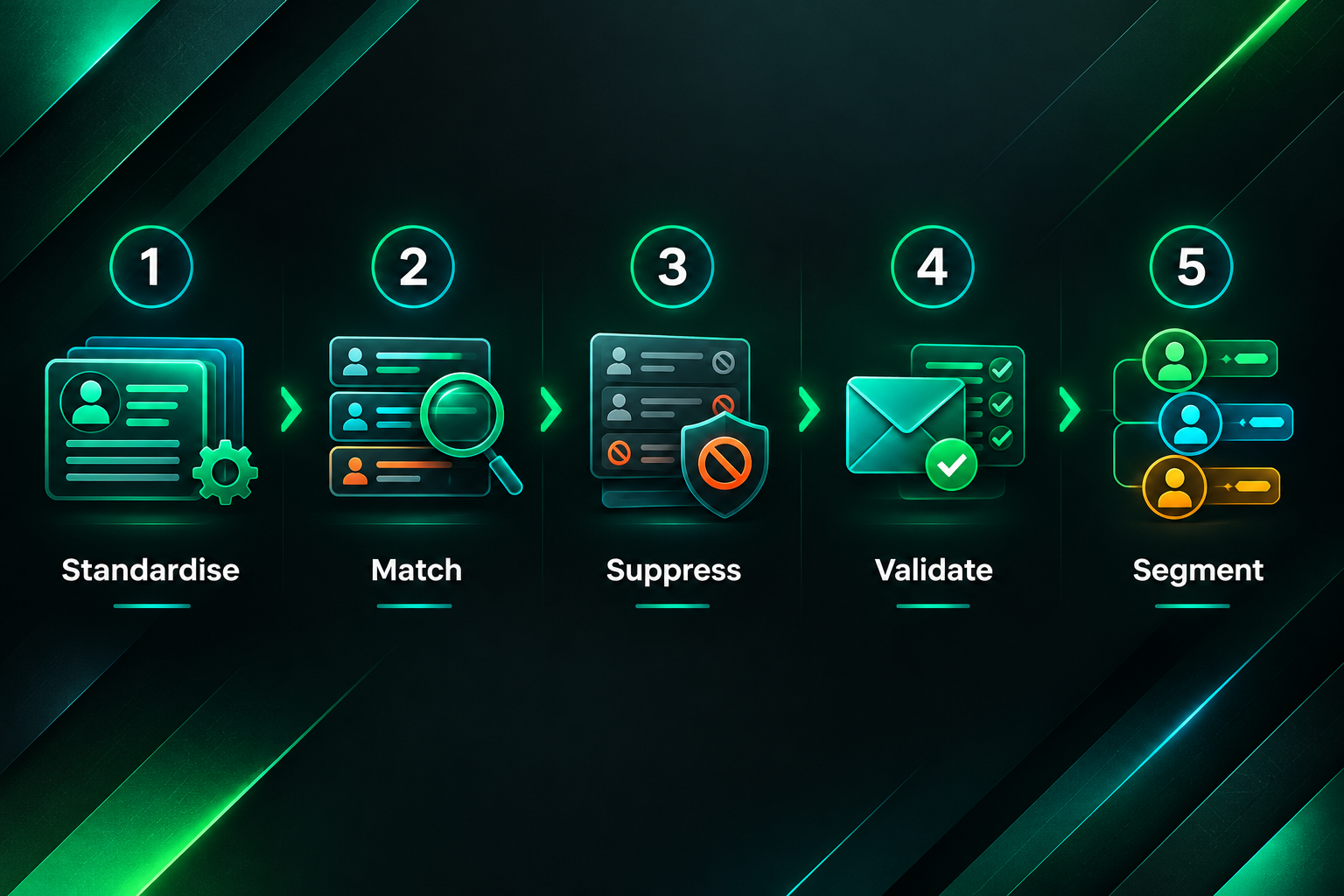
Stage 1: Standardise Your Data Before Merging Sources
Before you can identify duplicates, your contact records need to be in a consistent format. This means standardising email address casing (all lowercase), trimming whitespace, normalising domain formats (removing www prefixes and trailing slashes), and applying consistent naming conventions for contact fields. Inconsistent formatting is the primary reason that exact-match deduplication fails to catch obvious duplicates: [email protected] and [email protected] are the same address, but a case-sensitive comparison will treat them as different records.
Standardisation should happen before you merge data from multiple sources into a single working list. If you are combining exports from Ahrefs, a manual prospecting spreadsheet, and a previous campaign archive, standardise each source independently first, then merge. This reduces the complexity of the deduplication step that follows.
Stage 2: Apply Multi-Field Matching, Not Just Email Matching
Matching on email address alone catches exact duplicates but misses the near-duplicates that cause the most damage in practice. A robust deduplication pass should check multiple fields in combination:
- Email address: Exact match after standardisation catches the most obvious duplicates.
- Root domain: Matching on the publisher’s root domain (stripping subdomains) identifies cases where the same publication appears under different contact addresses or slightly different URL formats.
- Contact name and role: Fuzzy matching on first name, last name, and job title can surface cases where the same editor appears under a nickname or a slightly misspelled name.
- Phone number or social profile: Where available, these provide additional matching signals that can confirm whether two records with different email addresses represent the same individual.
Spreadsheet-based deduplication using tools like Excel or Google Sheets can handle exact-match email deduplication through built-in duplicate removal functions. For fuzzy matching across multiple fields, teams often use dedicated data cleaning tools, CRM deduplication features, or outreach platforms with built-in contact management. The right approach depends on list size and the resources available.
Stage 3: Cross-Reference Against Your Suppression List
A suppression list is a record of contacts who should not receive outreach, either because they have already been contacted in a previous campaign, because they have opted out, or because they have responded negatively. Cross-referencing your deduplicated prospect list against your suppression list before any email is sent is a non-negotiable step in responsible outreach management.
Suppression lists should include: contacts who have previously replied asking not to be contacted again, domains where a previous outreach attempt resulted in a spam complaint, contacts who have already received a placement offer or accepted a link, and any domains that your team has identified as low-quality or policy-violating since the last campaign. Maintaining this list as a living document — updated after every campaign — is what transforms deduplication from a one-time task into a durable operational asset.
Stage 4: Validate Email Addresses Before Sending
Deduplication removes redundant records; email validation removes records that are likely to bounce. These are related but distinct steps. Sending to invalid addresses increases your bounce rate, which damages sender reputation independently of the duplicate problem. Email validation tools check whether an address is formatted correctly, whether the domain’s mail server exists, and in some cases whether the specific mailbox is active. Running validation after deduplication and before import into your outreach platform reduces bounce risk and keeps your sending metrics within acceptable ranges.
It is worth noting that email validation tools vary in accuracy and that some addresses — particularly role-based inboxes at larger publications — may return uncertain results. Treat validation output as a risk signal rather than a definitive verdict, and use judgement when deciding whether to include borderline addresses.
Stage 5: Segment and Tag Remaining Contacts
Once your list is clean, segmenting contacts by publisher type, niche relevance, domain authority tier, previous outreach history, and geographic market makes campaign management more precise. Segmentation is not strictly part of deduplication, but it is the natural next step: a clean list is only useful if you can work with it intelligently. Tagging contacts with their source, the date they were added, and any previous interaction history also makes future deduplication faster, because you have a clear record of what has already been processed.
Tools and Approaches for Publisher Contact Deduplication
The right tooling depends on the scale of your outreach operation and the complexity of your contact data. The following options represent a range of approaches rather than a prescriptive recommendation, since the best fit will depend on your specific workflow.
Spreadsheet-Based Deduplication
For smaller campaigns — typically under a few hundred contacts — spreadsheet tools such as Google Sheets or Microsoft Excel provide sufficient functionality. Built-in duplicate removal features handle exact-match email deduplication, and conditional formatting can highlight potential near-duplicates for manual review. The limitation is that spreadsheet-based approaches require significant manual effort for fuzzy matching and do not integrate natively with outreach platforms, meaning that suppression list cross-referencing must also be done manually.
CRM and Outreach Platform Features
Outreach platforms designed for link building or sales outreach — such as Pitchbox, BuzzStream, or Mailshake — typically include contact management features that prevent duplicate sends within a campaign. Some platforms also maintain global suppression lists across campaigns, which reduces the risk of re-contacting a publisher who responded negatively in a previous wave. The deduplication logic built into these platforms varies, and it is worth understanding exactly what matching criteria a platform uses before relying on it as your sole deduplication mechanism.
Dedicated Data Cleaning Tools
For larger operations managing thousands of contacts across multiple campaigns, dedicated data cleaning and enrichment tools offer more sophisticated matching capabilities, including fuzzy name matching, domain normalisation, and bulk email validation. These tools are typically used as a preprocessing step before data is imported into an outreach platform. The trade-off is additional cost and the need to manage data transfers between systems securely, particularly when contact records include personal information subject to data protection regulations.
Manual Review for High-Value Contacts
Automated deduplication is efficient but imperfect. For high-value publisher contacts — editors at authoritative publications in your niche, journalists with strong domain relevance, or site owners with whom you have an existing relationship — a manual review step before outreach is worthwhile. This means checking that the contact details are current, that the publication is still active and relevant, and that no previous outreach has occurred under a different contact record. The investment in manual review for a small number of high-priority contacts is usually justified by the placement value those contacts represent.
Deduplication in the Context of Ongoing Link Building Campaigns
Publisher contact deduplication is not a task you complete once and then set aside. Link building campaigns that run over multiple months, or that involve repeated outreach waves to expand a backlink profile, require ongoing deduplication discipline. New contacts added mid-campaign need to be checked against the existing list and suppression records. Contacts who respond during a campaign need to be flagged so they are not re-entered into the outreach sequence. Publishers who provide a placement need to be moved to a relationship management record rather than remaining in the active outreach pool.
Teams that treat their contact database as a living asset — updating it consistently after each campaign, maintaining clear records of outreach history, and applying deduplication checks before each new wave — find that the process becomes faster and more reliable over time. The initial investment in building a clean, well-structured contact database pays dividends across multiple campaigns, particularly in niches where the publisher pool is relatively stable.
How Outsourced Link Building Teams Handle Contact Deduplication
For businesses and agencies that outsource their link building campaigns, publisher contact deduplication is typically handled as part of the provider’s internal workflow rather than as a client-facing task. Established outsourced link building providers maintain proprietary publisher databases that have been built and refined over many campaigns. These databases generally include deduplication logic, outreach history records, and relationship management data that prevent the same contact from being approached inappropriately across different client campaigns.
This is one of the practical advantages of working with an experienced outsourced provider: the operational infrastructure for contact management, deduplication, and suppression list maintenance already exists and does not need to be built from scratch by the client. However, it is reasonable to ask a prospective provider how they manage contact deduplication, how they handle suppression across campaigns, and whether their publisher database is segmented by niche and geographic market. Understanding these processes helps you assess whether a provider’s outreach operation is likely to protect your domain’s sender reputation and publisher relationships.
It is also worth clarifying how a provider handles contacts that you supply directly — for example, if you have existing publisher relationships you want to include in a campaign. Your own contacts should be cross-referenced against the provider’s database before outreach begins to avoid duplicate approaches from both sides.
Common Deduplication Mistakes and How to Avoid Them
Even teams that understand the importance of deduplication make avoidable errors. The most common include:
- Relying on a single matching field: Email-only deduplication misses alias addresses, role-based inboxes, and contacts who have changed email providers since they were first added to your list.
- Skipping suppression list cross-referencing: Deduplicating within a new list but failing to check it against previous campaign records means you will re-contact publishers who have already responded, opted out, or received a placement.
- Deduplicating once and not maintaining the list: A list that was clean at the start of a campaign becomes progressively less reliable as new contacts are added without consistent deduplication checks.
- Treating all duplicates as identical: Sometimes two records for the same email address contain different and useful information — one may have a more current job title or a more specific contact note. Before deleting a duplicate, check whether either record contains information worth preserving in the surviving record.
- Ignoring data protection obligations: Contact records for individuals in certain jurisdictions may be subject to data protection regulations that affect how long you can retain them and under what conditions you can use them for outreach. Deduplication workflows should account for these obligations, particularly when merging data from multiple sources.
Frequently Asked Questions
How often should I deduplicate my publisher contact list?
Deduplication should happen before every outreach campaign or campaign wave, not just when you first build a list. If you are adding new contacts to an existing database between campaigns, apply a deduplication check at the point of addition rather than waiting until the next campaign begins. For large, continuously updated databases, some teams run automated deduplication checks on a scheduled basis.
What is the difference between deduplication and email validation?
Deduplication removes redundant records — contacts that appear more than once in your list, whether as exact copies or near-duplicates. Email validation checks whether an address is likely to be deliverable, regardless of whether it appears once or multiple times. Both steps are necessary before outreach, but they address different problems and should be treated as separate stages in your workflow.
Can outreach platforms handle deduplication automatically?
Most outreach platforms include some form of duplicate detection, but the matching logic varies. Many platforms prevent duplicate sends within a single campaign but do not automatically cross-reference contacts against previous campaigns or external suppression lists. Understanding the specific deduplication capabilities of your platform — and supplementing them with manual checks where necessary — is more reliable than assuming the platform handles everything.
What should I do if I accidentally send a duplicate outreach email?
If you identify a duplicate send quickly, a brief, honest follow-up acknowledging the error is generally better than silence. Most editors understand that outreach operations involve data management and will not penalise a genuine, professional acknowledgement. Avoid over-explaining or sending multiple apology emails, which compounds the original problem. Use the incident as a prompt to review and strengthen your deduplication workflow.
Does deduplication apply to link building outreach specifically, or is it a general email marketing practice?
Deduplication is a standard practice in email marketing broadly, but it has particular importance in link building outreach because the publisher pool in most niches is finite and relationship-dependent. In email marketing to a large consumer list, a duplicate send is a deliverability and cost problem. In link building outreach, it is also a relationship problem: the editors and site owners you are contacting are the same people you may need to work with repeatedly over months or years. Protecting those relationships through careful contact management has long-term campaign value beyond the immediate deliverability benefit.
How do I handle contacts where I am unsure whether they are duplicates?
When automated matching produces uncertain results — for example, two records with the same name but different email addresses at the same domain — a brief manual check is usually the most reliable approach. Look at the publication’s contact page, LinkedIn profile, or editorial masthead to confirm whether the records represent the same person. If you cannot confirm, err on the side of caution: send to the address most likely to be current and suppress the other until you have more information.
Making Deduplication a Standard Part of Your Outreach Process
Publisher contact deduplication is not a glamorous part of link building, but it is one of the most consequential. A single campaign sent to a poorly deduplicated list can damage sender reputation, close off publisher relationships, and reduce the effectiveness of every subsequent outreach effort. The good news is that the process is manageable when it is built into your workflow from the start rather than treated as an afterthought.
The practical steps — standardising data formats, applying multi-field matching, cross-referencing suppression lists, validating email addresses, and maintaining records consistently — are achievable for most teams regardless of whether they manage outreach in-house or work with an outsourced partner. For businesses considering outsourcing their link building campaigns, understanding how a provider handles contact deduplication and publisher relationship management is a reasonable and worthwhile question to raise during the evaluation process. A provider whose workflow includes robust deduplication practices is better positioned to protect your domain’s reputation and deliver consistent outreach results over time.


