

Outbound links are hyperlinks on your website that point to pages on other websites. They are a routine part of how the web is structured, yet their role in SEO is frequently misunderstood. Some site owners avoid them entirely out of concern about losing ranking power, while others add them without any editorial consideration. Neither approach reflects how outbound links actually work or how search engines treat them. This article explains what outbound links are, how they relate to SEO, when they are useful, and what practical decisions are worth making about them.
Key Takeaways
- Outbound links are links from your site to external websites; they are a normal part of web content and are not inherently harmful to SEO.
- Linking to relevant, authoritative sources can support content quality signals, but the direct ranking impact of outbound links is not definitively established by independent research.
- Link attributes such as rel=”nofollow”, rel=”sponsored”, and rel=”ugc” allow you to communicate the nature of a link to search engines and are relevant for paid or user-generated placements.
- Outbound link quality and relevance matter more than quantity; linking to low-quality or irrelevant pages carries reputational and potential SEO risk.
- Outbound links and inbound backlinks serve different purposes in an SEO strategy and should not be confused with each other.
What Are Outbound Links?
An outbound link, sometimes called an external link, is any hyperlink that directs a visitor from a page on your website to a page on a different domain. From the perspective of the site being linked to, the same link is an inbound link or backlink. The distinction is simply a matter of direction: outbound describes the link leaving your site, inbound describes the link arriving at another site.
Outbound links appear in many forms across web content. A blog post might cite a research study by linking to the original publication. A product page might reference a manufacturer’s specification sheet. A news article might link to a primary source. In each case, the link serves an editorial purpose: it connects the reader to additional relevant information hosted elsewhere. This editorial function is the foundation of how search engines interpret outbound links.
It is worth distinguishing outbound links from internal links, which connect pages within the same domain. Internal links help search engines understand site structure and distribute ranking signals across your own pages. Outbound links, by contrast, connect your content to the broader web and carry different SEO implications.
How Search Engines Interpret Outbound Links
Search engines use links as signals when crawling and evaluating web content. Google’s publicly available documentation describes links as one of the ways it discovers new pages and understands relationships between content. When a search engine crawler follows an outbound link from your page, it can use that connection to understand the topic and context of your content, as well as the nature of the site you are linking to.
One concept that is often discussed in relation to outbound links is PageRank, Google’s original algorithm for assessing the relative importance of pages based on the links pointing to them. Early interpretations suggested that linking out to other sites would reduce the PageRank available to your own pages, a concept sometimes called “PageRank sculpting” or “link juice leakage.” Google’s guidance over the years has moved away from encouraging this kind of manipulation, and the practical relevance of PageRank sculpting through outbound link management is not well supported by current independent evidence.
What is more clearly documented is that Google assesses the quality and relevance of the pages a site links to as part of evaluating the overall quality of that site. Google’s quality evaluator guidelines, which inform how human raters assess search results, reference the concept of a site’s reputation and the trustworthiness of its associations. Linking consistently to low-quality, spammy, or irrelevant external pages may be interpreted as a quality signal about your own content, though the precise algorithmic weight of this is not publicly specified.
Link Attributes: Follow, Nofollow, Sponsored, and UGC
Not all outbound links are treated identically by search engines. HTML link attributes allow publishers to communicate additional information about the nature of a link. Understanding these attributes is practically important for anyone managing outbound links on a website.
A standard outbound link without any additional attribute is sometimes called a “dofollow” link, though this is not an official HTML term. It simply means the link carries no instruction to the search engine crawler to treat it differently. Search engines may choose to follow the link and pass signals through it in the normal way.
The rel=”nofollow” attribute was introduced by Google in 2005 as a way for publishers to indicate that a link should not be treated as an editorial endorsement. Google updated its guidance in 2019 to clarify that nofollow is now treated as a hint rather than a directive, meaning crawlers may choose to follow nofollow links at their discretion. Nofollow remains widely used for links in comment sections, forum posts, and other areas where editorial control is limited.
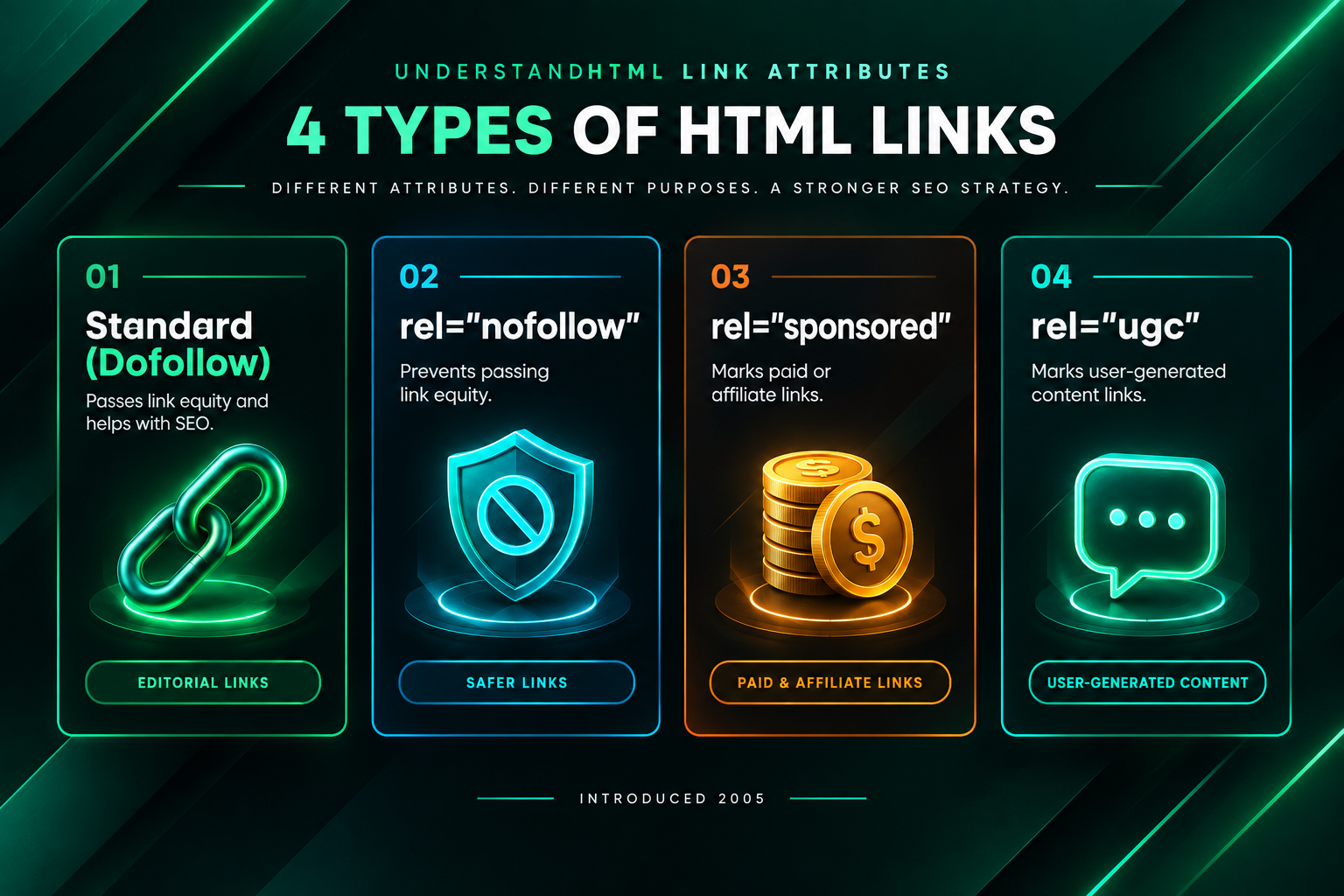
The rel=”sponsored” attribute was introduced alongside the 2019 update and is intended specifically for links that are part of paid arrangements, including paid placements, affiliate links, and advertising. Google’s guidelines indicate that paid links that pass signals without appropriate disclosure may be treated as a violation of its spam policies. Using the sponsored attribute is the recommended approach for any link acquired through a commercial arrangement.
The rel=”ugc” attribute is intended for user-generated content such as comments and forum contributions, where the site owner has not editorially selected the linked destination. Like nofollow, it signals to search engines that the link may not represent the publisher’s endorsement.
Choosing the correct attribute for each outbound link is a practical quality-control step. Misattributing paid links as editorial links, or failing to use the sponsored attribute for affiliate or compensated placements, may create compliance risk under Google’s link spam policies.
Do Outbound Links Help or Hurt SEO?
This question does not have a single definitive answer, and it is worth being precise about what the evidence does and does not show. The direct ranking impact of outbound links on the linking page is not conclusively established by independent research with transparent methodology. Correlation studies have found associations between pages that link to authoritative external sources and higher rankings, but correlation does not confirm that the outbound links caused the ranking improvement. Other content quality factors may explain the same pattern.
What is more clearly supported is that outbound links contribute to the overall editorial quality and usefulness of content. A well-researched article that cites primary sources, links to supporting data, or directs readers to relevant tools is generally more useful than one that makes unsupported claims in isolation. Search engines aim to surface useful content, and editorial outbound links are one signal among many that content has been produced with care.
On the other hand, outbound links to low-quality, irrelevant, or potentially harmful websites carry meaningful risk. If a page links to sites that Google has identified as spammy or manipulative, that association may negatively affect how the linking page is assessed. This is particularly relevant for sites that accept guest posts or user-generated content, where outbound links may be added by contributors rather than the site owner.
The practical implication is that outbound links are neither universally beneficial nor universally harmful. Their effect depends on the quality and relevance of the destination, the editorial context of the link, the attribute used, and the overall quality of the linking page and site.
Outbound Links vs Inbound Backlinks: Different Roles in SEO
A common source of confusion is treating outbound links and inbound backlinks as interchangeable SEO concepts. They are related but serve distinct purposes, and conflating them leads to poor strategic decisions.
Inbound backlinks, meaning links from other websites pointing to your pages, are widely regarded as one of the more significant ranking signals in competitive search environments. When authoritative, topically relevant sites link to your content, search engines may interpret this as an indication that your content is valuable and trustworthy. Building a strong backlink profile through editorial outreach, content marketing, digital PR, and similar methods is a core component of many SEO strategies.
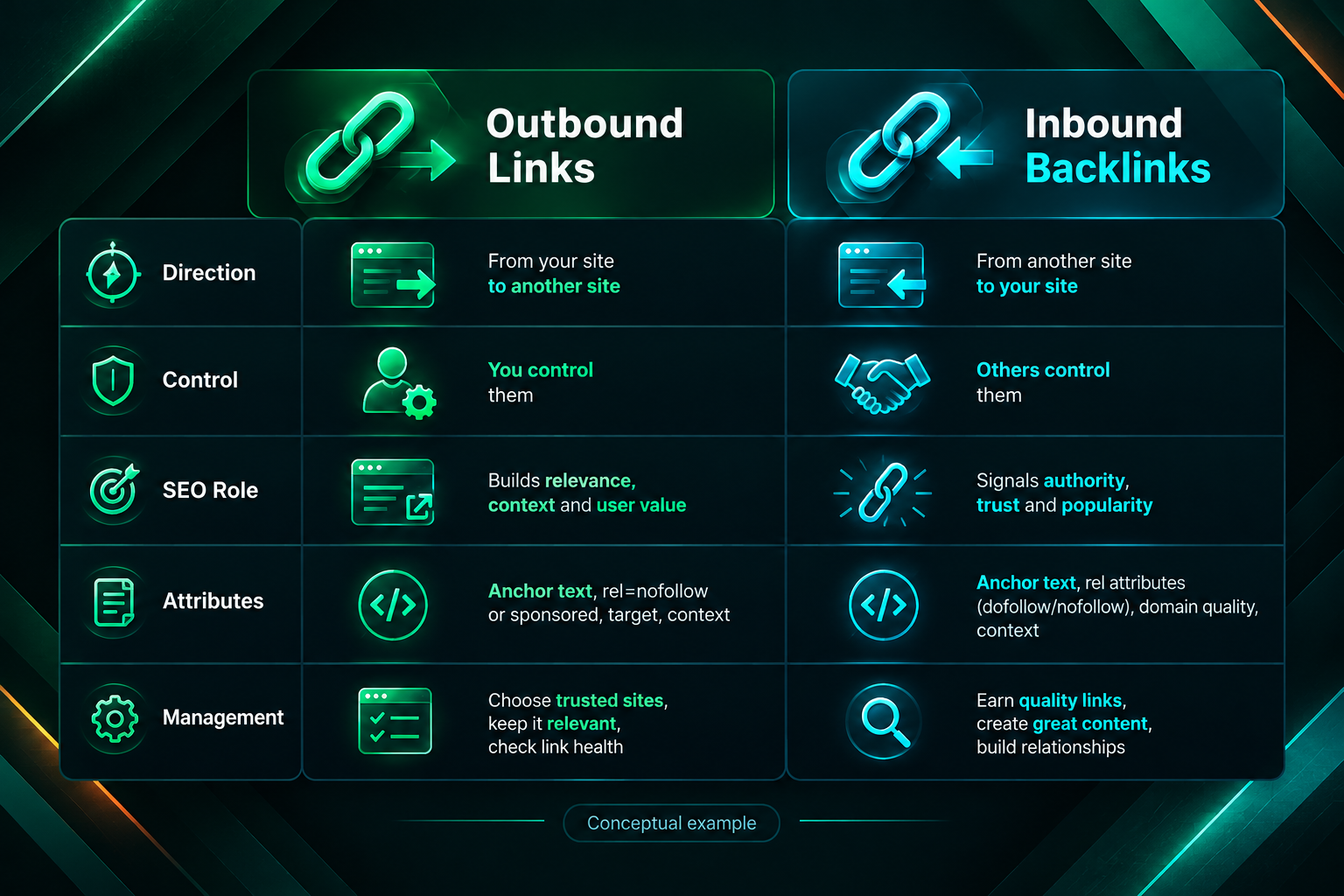
Outbound links, by contrast, are links you place on your own pages pointing to other sites. They do not directly build your backlink profile. They may contribute to content quality signals and user experience, but they are not a substitute for earning inbound links from external sources. A site with many outbound links to authoritative sources but few inbound backlinks from relevant sites is unlikely to rank well in competitive search results on the basis of its outbound links alone.
Understanding this distinction matters for budget and effort allocation. If the primary goal is to improve organic search rankings for competitive keywords, investing in earning high-quality inbound backlinks through outreach and content development is generally more directly relevant than optimising outbound link practices. Outbound link management is better understood as a content quality and compliance consideration rather than a primary link building tactic.
When Outbound Links Are Useful
There are several practical situations where outbound links add clear value to a page and its readers.
- Citing sources and evidence: When a page makes a factual claim, linking to the original study, report, or official documentation supports credibility and allows readers to verify the information. This is standard editorial practice in journalism, academic writing, and high-quality web content.
- Directing readers to complementary resources: A page covering a broad topic may link to more detailed guides, tools, or reference materials hosted elsewhere. This improves the reader’s experience without requiring the linking site to reproduce all of that content itself.
- Referencing products, services, or organisations: When a page mentions a specific company, tool, or product, linking to that entity’s official website is a natural and useful editorial choice.
- Supporting content partnerships and digital PR: In some content marketing contexts, outbound links are part of a reciprocal relationship between publishers. These arrangements require careful management to ensure compliance with search-engine link policies, particularly regarding the use of appropriate link attributes.
In each of these cases, the outbound link serves the reader first. Links added primarily to manipulate search engine signals, rather than to provide genuine value to the reader, are more likely to create compliance risk than SEO benefit.
Managing Outbound Link Quality
Outbound link quality management is relevant for any site that publishes content regularly, accepts guest contributions, or has accumulated a large archive of older pages. Over time, linked destinations change: pages are removed, domains expire and are re-registered by different owners, and content is updated or deleted. An outbound link that pointed to a useful resource when it was published may now point to a broken page, an irrelevant site, or in some cases a domain that has been acquired for spam purposes.
Regular auditing of outbound links is a practical maintenance task. SEO tools such as Ahrefs, Semrush, and Screaming Frog can crawl a site and identify broken outbound links, redirects, and links to potentially problematic destinations. Fixing broken outbound links improves user experience and removes associations with pages that no longer exist or have changed in character.

For sites that accept guest posts or allow contributors to add links, editorial review of outbound links before publication is important. Contributors may add links to their own properties, affiliate destinations, or low-quality sites. A clear editorial policy that specifies which types of outbound links are acceptable, and which require the sponsored or nofollow attribute, reduces compliance risk and maintains content quality.
Google’s Disavow Tool is sometimes discussed in relation to outbound links, but it is specifically designed for managing inbound backlinks that a site owner believes may be harming their rankings. It is not a tool for managing outbound links. Outbound link management is handled through direct editing of the linking page’s HTML or content management system.
Outbound Links and Link Building Strategy
For businesses and SEO teams focused on building their own backlink profile, outbound links are relevant in a few specific ways. First, the quality of outbound links on a site that is being considered as a link placement destination is one factor that experienced link builders assess when evaluating publisher quality. A site that links indiscriminately to low-quality or irrelevant destinations may be a less valuable placement than one with careful editorial standards, regardless of its domain-level authority metrics.
Second, when evaluating potential link building partners or guest posting opportunities, reviewing the outbound links already present on a site’s published content provides useful information about editorial standards. Sites that routinely publish content with keyword-rich anchor text linking to commercial pages, or that mix editorial and paid links without appropriate attributes, may carry higher compliance risk as placement destinations.
Third, for sites that are themselves trying to earn inbound backlinks through content marketing, the quality of their own outbound links contributes to the overall credibility of their content. Publishers and journalists who are considering linking to a piece of content may assess whether that content cites credible sources and links to relevant, authoritative references. Strong editorial outbound link practices can support the broader goal of earning high-quality inbound links.
Common Misconceptions About Outbound Links
Several persistent misconceptions about outbound links are worth addressing directly, as they can lead to poor editorial and SEO decisions.
Misconception: Outbound links always reduce your rankings. This is not supported by current evidence or Google’s documented guidance. The concern originates from early interpretations of PageRank that are not directly applicable to modern search algorithms. Avoiding all outbound links to protect ranking signals is not a strategy supported by reliable SEO research.
Misconception: Adding nofollow to all outbound links is the safest approach. Using nofollow on every outbound link regardless of context is not necessary and may not reflect the editorial nature of the links. Google’s guidance recommends using link attributes that accurately describe the relationship, not applying nofollow universally as a precaution.
Misconception: Outbound links to authoritative sites will directly improve your rankings. While linking to high-quality sources may contribute to content quality signals, there is no reliable independent evidence that adding outbound links to authoritative domains produces a direct, measurable ranking improvement. The relationship is more nuanced and depends on many other factors.
Misconception: Outbound links and backlinks are the same thing. As discussed earlier, these are distinct concepts. Outbound links leave your site; backlinks arrive at your site from other domains. Building your backlink profile requires earning links from external publishers, not adding links to your own pages.
Frequently Asked Questions
Do outbound links pass PageRank to other sites?
Standard outbound links without a nofollow or sponsored attribute may pass signals to the linked destination, though the precise mechanics of how Google handles this in its current algorithm are not publicly specified in detail. Using rel=”nofollow” or rel=”sponsored” instructs search engines to treat the link differently, though Google has stated that nofollow is now treated as a hint rather than a strict directive.
How many outbound links should a page have?
There is no universally recommended number. The appropriate number of outbound links depends on the length and purpose of the content, the editorial context, and the relevance of the linked destinations. Links should be added when they genuinely serve the reader, not to meet a target count. Pages with very large numbers of outbound links, particularly to commercial or low-quality destinations, may attract closer scrutiny from search engines.
Should I use nofollow on all external links?
Not necessarily. Google’s guidance recommends using link attributes that accurately reflect the nature of the link. Editorial links to relevant, trustworthy sources do not require nofollow. The sponsored attribute should be used for paid or affiliate links. The nofollow attribute is appropriate for links in user-generated content or situations where you cannot vouch for the linked destination. Applying nofollow universally is not required and may not accurately represent your editorial intent.
Can outbound links to low-quality sites harm my rankings?
Linking consistently to low-quality, spammy, or irrelevant sites may be interpreted as a negative quality signal about your content. While a single link to a low-quality destination is unlikely to cause significant harm, a pattern of such links across a site’s content may affect how search engines assess overall site quality. Regular outbound link audits help identify and address problematic links before they accumulate.
What is the difference between outbound links and backlinks in an SEO campaign?
Outbound links are links you place on your own pages pointing to other sites. Backlinks are links from other sites pointing to your pages. In an SEO campaign focused on improving rankings, earning high-quality backlinks from relevant external publishers is generally the more directly impactful activity. Outbound link management is a content quality and compliance consideration rather than a primary link acquisition method.
Do outbound links affect how Google crawls my site?
Outbound links provide paths for search engine crawlers to discover and index other sites. They do not directly determine how frequently or thoroughly Google crawls your own site. Crawl budget and indexing priorities for your own pages are influenced by factors such as site size, internal linking structure, page speed, and the frequency of content updates.
Outbound Links in Practice: What Actually Warrants Attention
Outbound links are a normal and necessary part of publishing useful web content. The practical decisions worth making about them are relatively straightforward: link to relevant, credible sources when doing so serves the reader; use the correct link attribute for paid, affiliate, or user-generated links; audit your outbound links periodically to identify broken or problematic destinations; and apply editorial standards to any contributor-added links before publication.
For businesses focused on improving organic search performance, outbound link management is a supporting quality consideration rather than a primary growth lever. The more significant investment for most sites in competitive search environments is earning high-quality inbound backlinks through editorial outreach, content development, and digital PR. These inbound links, when acquired from relevant and authoritative publishers, are more directly associated with ranking improvements than the outbound links a site places within its own content.
If your site is at an early stage of building its backlink profile, or if you are assessing whether your current link acquisition approach is well-structured, a review of both your inbound backlink profile and your outbound link practices as part of a broader SEO audit can provide a clearer picture of where attention is most warranted. Outbound links are one piece of a larger content quality and link strategy picture, and they are best managed as part of a coherent editorial approach rather than in isolation.


