Topical Trust Flow is a proprietary metric developed by Majestic that attempts to measure not just how trustworthy a website’s backlink profile appears to be, but which subject areas that trust is concentrated in. Understanding what it measures, how it is calculated, and where it fits into a broader link building strategy can help you make more informed decisions about backlink acquisition and publisher selection — without over-relying on a single third-party score.
Key Takeaways
- Topical Trust Flow is a Majestic-specific metric, not a Google ranking signal. It reflects Majestic’s own classification of a site’s backlink neighbourhood, not search engine authority.
- A high Topical Trust Flow score in a relevant category may indicate that a website has earned links from topically related, editorially credible sources — which is a useful quality signal during publisher assessment.
- Topical relevance in a backlink profile is widely considered important for SEO, but no third-party metric, including Topical Trust Flow, can guarantee rankings or traffic improvements.
- Topical Trust Flow is most useful as one input in a multi-metric publisher evaluation process, not as a standalone decision criterion.
- Link building campaigns focused on topical relevance tend to prioritise publishers whose primary subject matter aligns with the target website’s niche, which may support more natural-looking link profiles over time.
What Is Topical Trust Flow?
Topical Trust Flow is one of two Trust Flow metrics offered by Majestic, a backlink intelligence platform. The other is Citation Flow, which estimates the volume of links pointing to a URL without weighting for quality. Trust Flow, by contrast, attempts to measure the quality of those links by tracing how closely a site’s backlink profile connects to a set of seed sites that Majestic considers editorially credible. Topical Trust Flow extends this concept by assigning that trust score to one or more subject categories — for example, Business/Marketing, Health/Medicine, or Sports/Soccer — rather than expressing it as a single undifferentiated number.
In practical terms, Majestic analyses the topics of the sites linking to a given domain and uses that information to classify the domain’s trust within specific subject areas. A website that receives most of its backlinks from finance-related publishers will typically show a high Topical Trust Flow score in a finance-related category. A website with a scattered backlink profile spanning many unrelated topics may show lower or more fragmented Topical Trust Flow scores across multiple categories, or a lower peak score overall.
Majestic maintains a taxonomy of over 800 topic categories arranged in a hierarchical structure. Each domain or URL can be assigned a primary Topical Trust Flow category and a score within that category, typically on a scale of 0 to 100. The score reflects the concentration and quality of topically relevant links rather than raw link volume alone.
How Majestic Calculates Topical Trust Flow
Majestic’s Trust Flow calculation begins with a curated set of seed sites — websites that Majestic has determined to be editorially trustworthy based on their own criteria. These seed sites are not publicly disclosed in full, and the precise weighting methodology is proprietary. Trust is then propagated outward through the link graph: sites that receive links from seed sites inherit a portion of that trust, and sites that receive links from those sites inherit a smaller portion, and so on. The further a site sits from the seed set in the link graph, the lower its Trust Flow score tends to be.
Topical Trust Flow adds a subject-classification layer to this process. Majestic categorises each seed site and each site in its index by topic. When trust flows through the link graph, it carries topical context with it. A link from a health-focused seed site contributes to the recipient’s Trust Flow score within the health category. If a domain accumulates trust primarily through health-related links, its Topical Trust Flow score in the health category will be higher than in unrelated categories.
It is important to understand that this is Majestic’s own model, built on Majestic’s own crawl data and seed-site selection. It does not reflect Google’s internal link evaluation, PageRank, or any other search engine signal. Google has not endorsed Trust Flow, Topical Trust Flow, or any Majestic metric as a proxy for its ranking systems. Treating a high Topical Trust Flow score as confirmation that Google views a site favourably would be an overinterpretation of what the metric actually measures.
Why Topical Relevance Matters in Link Building
While Topical Trust Flow is a Majestic-specific construct, the underlying concept it attempts to capture — topical relevance in a backlink profile — is widely discussed in SEO practice and has some support in how search engines describe their own systems. Google’s documentation and public statements from its representatives have consistently emphasised that links from contextually relevant sources may carry more weight than links from unrelated sites. This does not mean that a link from an unrelated but authoritative site has no value, but it does suggest that topical alignment between a linking publisher and the target website is a meaningful quality consideration.
From a link building perspective, topical relevance influences publisher selection in several ways. A backlink from a well-regarded industry publication in your niche is generally considered more valuable than a link from a general-interest directory, even if both sites have similar raw link counts. The editorial context of the linking page — the surrounding content, the anchor text, the subject matter of the publication — all contribute to how a link may be interpreted by search engines and by human readers arriving via referral traffic.
Topical Trust Flow provides one way to assess this alignment at scale. When evaluating a prospective publisher for a guest post or niche edit placement, checking whether the site’s primary Topical Trust Flow category matches your target niche gives you a quick signal about whether that site’s backlink neighbourhood is topically coherent. A site with a high Topical Trust Flow score in a category relevant to your industry is more likely to have built its authority through genuine editorial engagement with that subject area, which is a positive quality indicator — though not a guarantee of SEO impact.
Topical Trust Flow in Publisher Assessment
During a link building campaign, publisher assessment typically involves evaluating multiple signals before deciding whether a placement is worth pursuing. Topical Trust Flow is one useful input in this process, but it works best alongside other indicators rather than in isolation.
A practical publisher assessment might consider the following alongside Topical Trust Flow:
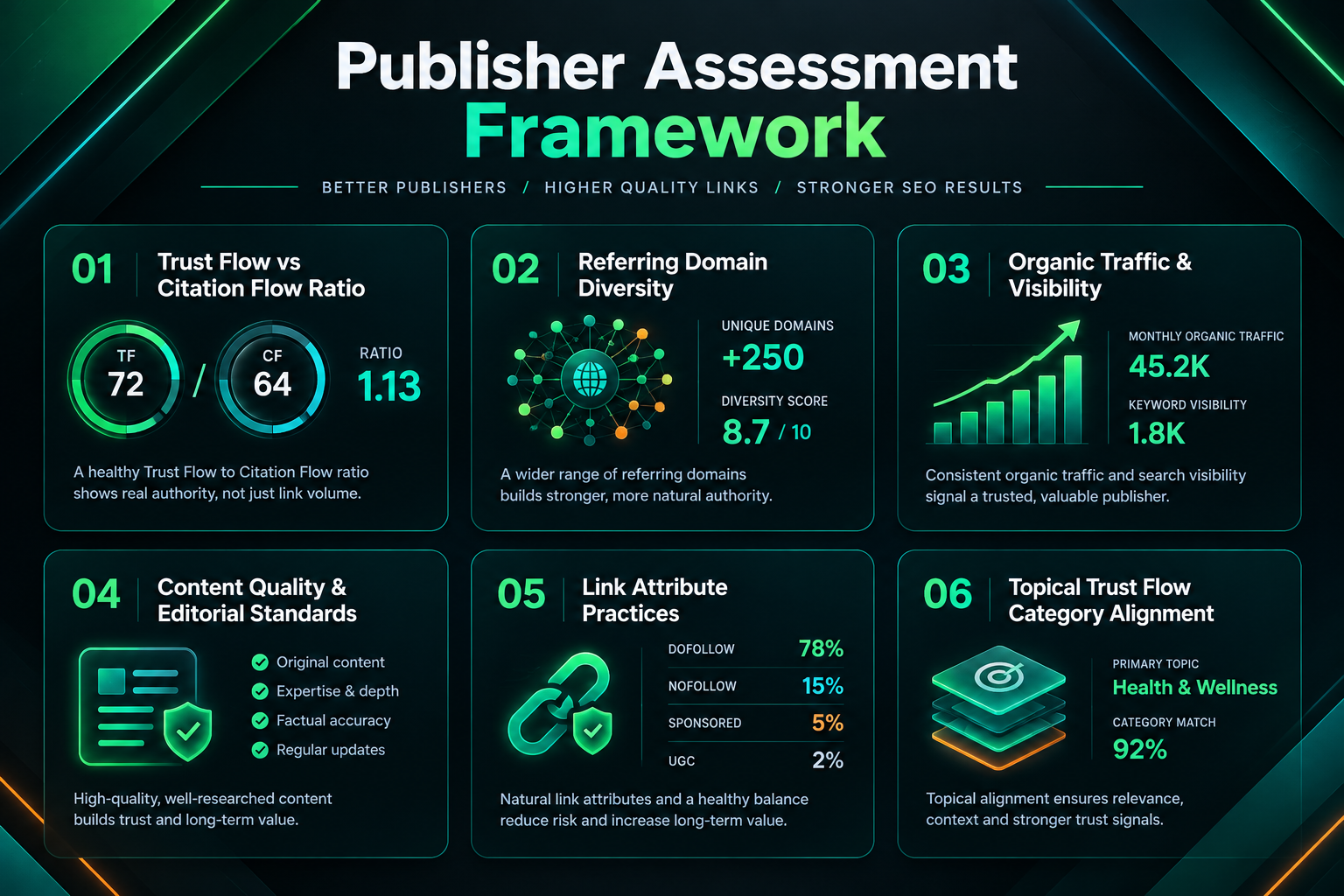
- Trust Flow and Citation Flow ratio: A site with a Trust Flow score close to or higher than its Citation Flow score is generally considered to have a healthier link profile than one where Citation Flow significantly exceeds Trust Flow, which can indicate link volume without corresponding quality.
- Referring domain diversity: A site that has earned links from a wide range of independent domains is generally more credible than one with many links from a small number of sources.
- Organic traffic and visibility: A publisher that receives meaningful organic search traffic is more likely to be indexed and valued by search engines than one with little or no organic presence.
- Content quality and editorial standards: Does the site publish original, well-researched content? Does it have a clear editorial focus? Is the content relevant to your target audience?
- Link attribute practices: Does the site use nofollow, sponsored, or UGC attributes appropriately? Are outbound links editorially placed or appear to be sold indiscriminately?
- Topical Trust Flow category alignment: Does the site’s primary Topical Trust Flow category match your niche or a closely related subject area?
No single metric, including Topical Trust Flow, should be used as the sole criterion for accepting or rejecting a publisher. A site with a moderate Topical Trust Flow score but strong organic traffic, genuine editorial standards, and clear topical relevance to your industry may be a better placement than a site with a higher score but thin content and questionable link practices.
Topical Trust Flow and Link Profile Analysis
Beyond individual publisher assessment, Topical Trust Flow can be used to analyse the overall topical composition of a website’s existing backlink profile. Majestic’s interface allows you to see the distribution of Topical Trust Flow categories across a domain’s referring links, which can reveal whether the site’s backlink profile is topically coherent or scattered across unrelated subject areas.
A website in the legal services sector, for example, might ideally show a backlink profile where the majority of Topical Trust Flow is concentrated in categories such as Law/Legal Services or Business/Finance. If the analysis reveals that a significant portion of the site’s Trust Flow comes from categories such as Entertainment or Sports, this could indicate that some of the site’s links are coming from topically unrelated sources — which may be worth investigating further, though it does not automatically indicate a problem.
This kind of analysis can inform link building strategy by identifying gaps. If a target website has strong Trust Flow in some relevant categories but weaker coverage in others that matter for its business, a campaign can be designed to pursue publishers in those underrepresented but relevant categories. This approach to building a more topically coherent backlink profile is sometimes described as topical authority building, though the relationship between backlink topicality and search rankings involves many other factors and cannot be reduced to a single metric.
Topical Trust Flow Compared to Other Authority Metrics
Several third-party SEO tools offer their own domain authority or link quality metrics, and it is worth understanding how Topical Trust Flow relates to them without treating any of them as interchangeable.
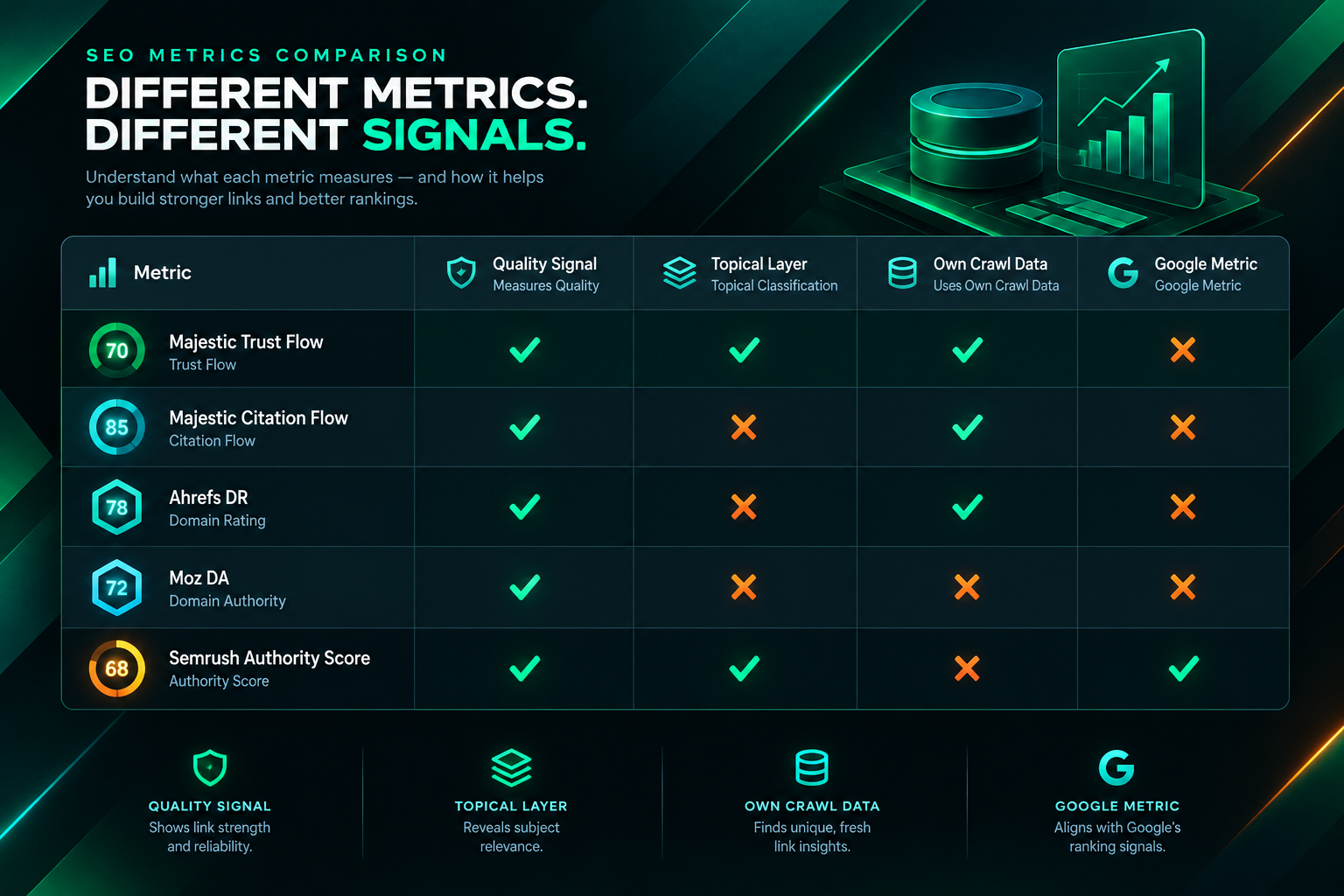
- Majestic Trust Flow (TF): The parent metric from which Topical Trust Flow is derived. Trust Flow is a single score reflecting overall link quality based on proximity to Majestic’s seed sites. Topical Trust Flow breaks this down by subject category.
- Majestic Citation Flow (CF): Measures link volume rather than quality. A high Citation Flow with a low Trust Flow may indicate a site has accumulated many low-quality links.
- Ahrefs Domain Rating (DR): Measures the strength of a domain’s backlink profile based on the number and quality of referring domains, using Ahrefs’ own crawl data and weighting model. It does not include a topical classification layer.
- Moz Domain Authority (DA): A Moz-proprietary score predicting a site’s likelihood to rank in search results, based on Moz’s link index. Like DR, it does not segment by topic.
- Semrush Authority Score: Semrush’s composite metric combining backlink data, organic traffic signals, and spam detection. It does not include a topical trust dimension equivalent to Majestic’s classification system.
Each of these metrics is calculated differently, uses different crawl data, and reflects different assumptions about what constitutes link quality. None of them are Google metrics, and none can be used to predict Google rankings with certainty. Topical Trust Flow is distinctive in that it attempts to classify trust by subject area, which makes it particularly relevant for assessing topical alignment — but it shares the same fundamental limitation as all third-party metrics: it is an approximation based on one tool’s model, not a direct window into search engine evaluation.
Practical Applications in Link Building Campaigns
For businesses and SEO teams managing link acquisition campaigns, Topical Trust Flow has several practical applications that go beyond simply checking a score before accepting a placement.
Setting Publisher Qualification Thresholds
Some link building teams use minimum Topical Trust Flow thresholds as part of their publisher qualification criteria. For example, a campaign targeting a competitive finance niche might require prospective publishers to have a Topical Trust Flow score of at least 15 in a finance-related category, alongside other quality requirements. These thresholds should be treated as guidelines rather than rigid rules, and they should be calibrated to the realistic publisher landscape in a given niche — in some industries, high Topical Trust Flow scores are common; in others, they are rare even among legitimate publishers.
Identifying Topically Relevant Outreach Targets
Majestic’s tools allow users to search for sites within specific Topical Trust Flow categories, which can help identify prospective outreach targets in a given niche. This can supplement other prospecting methods such as competitor backlink analysis, content-based prospecting, and industry directory research. Combining Topical Trust Flow category filtering with organic traffic data and content quality assessment tends to produce a more reliable prospecting list than using any single filter alone.
Auditing Existing Backlink Profiles
When conducting a backlink audit, reviewing the Topical Trust Flow distribution of a site’s existing links can help identify whether the profile is topically coherent and whether any clusters of links from unrelated categories warrant closer examination. This is particularly useful when preparing for a new link building campaign, as it helps establish a baseline and identify strategic priorities.
Reporting and Campaign Tracking
Some agencies include Topical Trust Flow data in client reporting as one indicator of backlink profile quality over time. Tracking changes in a site’s primary Topical Trust Flow category and score can provide a supplementary view of how a campaign is affecting the topical composition of the backlink profile. However, changes in Topical Trust Flow should not be presented as evidence of improved rankings or traffic — those outcomes depend on many additional factors and require direct measurement through tools such as Google Search Console and analytics platforms.
Limitations and Risks of Over-Relying on Topical Trust Flow
Topical Trust Flow is a useful tool, but over-relying on it carries real risks for link building strategy and campaign quality assessment.
The metric is based on Majestic’s crawl, which may not capture every link on the web and may lag behind recent changes to a site’s backlink profile. A site’s Topical Trust Flow score reflects its historical link acquisition patterns and may not accurately represent its current editorial quality or relevance. A site that previously earned strong topically relevant links but has since declined in content quality or editorial standards may still show a respectable Topical Trust Flow score.
Conversely, a newer site or a site in a niche where high-quality publishers are scarce may show a lower Topical Trust Flow score despite being a genuinely credible and relevant publisher. Dismissing such sites purely on the basis of a low score could mean missing valuable placement opportunities.
There is also a risk that focusing too heavily on Topical Trust Flow scores during publisher selection leads to neglecting other important quality signals, such as actual content quality, audience engagement, editorial independence, and compliance with search engine link policies. A placement on a site with a high Topical Trust Flow score but thin content, excessive outbound links, or undisclosed paid link practices may carry more risk than a placement on a lower-scoring but genuinely editorial site.
Finally, it is worth reiterating that Topical Trust Flow is not a Google metric. Optimising a backlink profile to maximise Topical Trust Flow scores is not the same as optimising it for search engine performance. The two may correlate in some cases, but they are not equivalent, and treating one as a proxy for the other can lead to misaligned campaign priorities.
Frequently Asked Questions
Is Topical Trust Flow a Google ranking factor?
No. Topical Trust Flow is a proprietary metric created by Majestic. Google has not endorsed it, and it does not directly influence Google’s ranking systems. It is a third-party approximation of link quality and topical relevance, useful for publisher assessment but not a substitute for Google’s own signals.
What is a good Topical Trust Flow score?
There is no universal benchmark. Scores vary significantly by industry, niche, and the competitive landscape of a given topic area. A score that is considered strong in one niche may be average or below average in another. It is more useful to compare a site’s Topical Trust Flow score against other sites in the same category than to apply a fixed threshold across all niches.
How is Topical Trust Flow different from Trust Flow?
Trust Flow is a single score reflecting the overall quality of a site’s backlink profile based on proximity to Majestic’s seed sites. Topical Trust Flow breaks that score down by subject category, showing which topic areas the site’s trust is concentrated in. A site can have a moderate overall Trust Flow but a high Topical Trust Flow score in a specific niche if most of its quality links come from that subject area.
Can I improve my website’s Topical Trust Flow?
Because Topical Trust Flow reflects the topical composition of a site’s backlink profile, acquiring more links from editorially credible publishers in relevant subject categories may improve the score over time. However, changes to Majestic’s index, crawl frequency, and scoring model mean that score changes are not always immediate or predictable. The goal of any link building campaign should be to improve search visibility and organic performance, not to optimise a third-party metric score.
Should I use Topical Trust Flow as the only metric when evaluating publishers?
No. Topical Trust Flow is most useful as one input in a multi-metric evaluation process. It should be considered alongside organic traffic data, content quality, referring domain diversity, link attribute practices, and topical relevance assessed through direct review of the publisher’s content — not as a standalone decision criterion.
Does a high Topical Trust Flow score mean a site is safe to get a link from?
Not necessarily. A high score indicates that Majestic’s model considers the site’s backlink profile to be topically coherent and relatively close to credible seed sites, but it does not guarantee that the site complies with search engine link policies, maintains editorial standards, or that a link from it will benefit your rankings. Manual review of the publisher remains important regardless of the metric score.
Using Topical Trust Flow as Part of a Broader Link Quality Framework
Topical Trust Flow is a genuinely useful metric when it is understood for what it is: one tool’s attempt to quantify topical relevance and link quality within a specific subject area. For businesses and SEO teams evaluating publishers, auditing backlink profiles, or planning topically focused link acquisition campaigns, it provides a structured way to assess whether a site’s backlink neighbourhood aligns with a given niche — which is a meaningful quality consideration even if it cannot be directly mapped to search engine signals.
The most effective use of Topical Trust Flow is as part of a broader publisher evaluation framework that combines metric-based screening with direct content review, organic visibility assessment, and an understanding of the link practices common in a given industry. Campaigns built around topical relevance — pursuing placements on publishers whose primary subject matter genuinely aligns with the target website’s niche — tend to produce backlink profiles that are more coherent and defensible over time, regardless of how any individual metric scores them.
If you are planning a link building campaign and want to understand how topical relevance fits into a publisher qualification process, discussing your niche, target pages, and existing backlink profile with an experienced link building team can help you develop criteria that are calibrated to your specific situation rather than applied as generic rules. A site-specific assessment is always more reliable than a universal threshold when it comes to making link acquisition decisions that align with your actual SEO and business goals.