

Wikipedia backlinks appear on one of the most authoritative websites on the internet, which makes them an obvious target for SEO professionals and business owners looking to strengthen their link profiles. The reality, however, is more nuanced than the domain authority alone suggests. Wikipedia links are nofollow by default, meaning they do not pass PageRank in the traditional sense, yet they continue to attract attention from SEO practitioners for reasons that go beyond direct link equity. This article explains what Wikipedia backlinks actually provide, where their value is realistic, where it is overstated, and what alternatives may better serve a structured link building campaign.
Key Takeaways
- Wikipedia links carry a nofollow attribute, which means they do not pass PageRank directly to the linked page under Google’s current link-handling approach.
- Despite being nofollow, Wikipedia citations can contribute to brand visibility, referral traffic, and topical credibility signals that may indirectly support an SEO strategy.
- Acquiring and maintaining a Wikipedia citation requires genuine editorial merit; manipulative or promotional edits are typically removed quickly by the Wikipedia community.
- For most link building campaigns focused on ranking improvement, editorial dofollow placements on topically relevant, high-quality websites are likely to deliver more measurable SEO impact.
- Wikipedia backlinks may be worth pursuing as a supplementary signal, but they are rarely a primary link building priority for competitive commercial keywords.
What Is a Wikipedia Backlink?
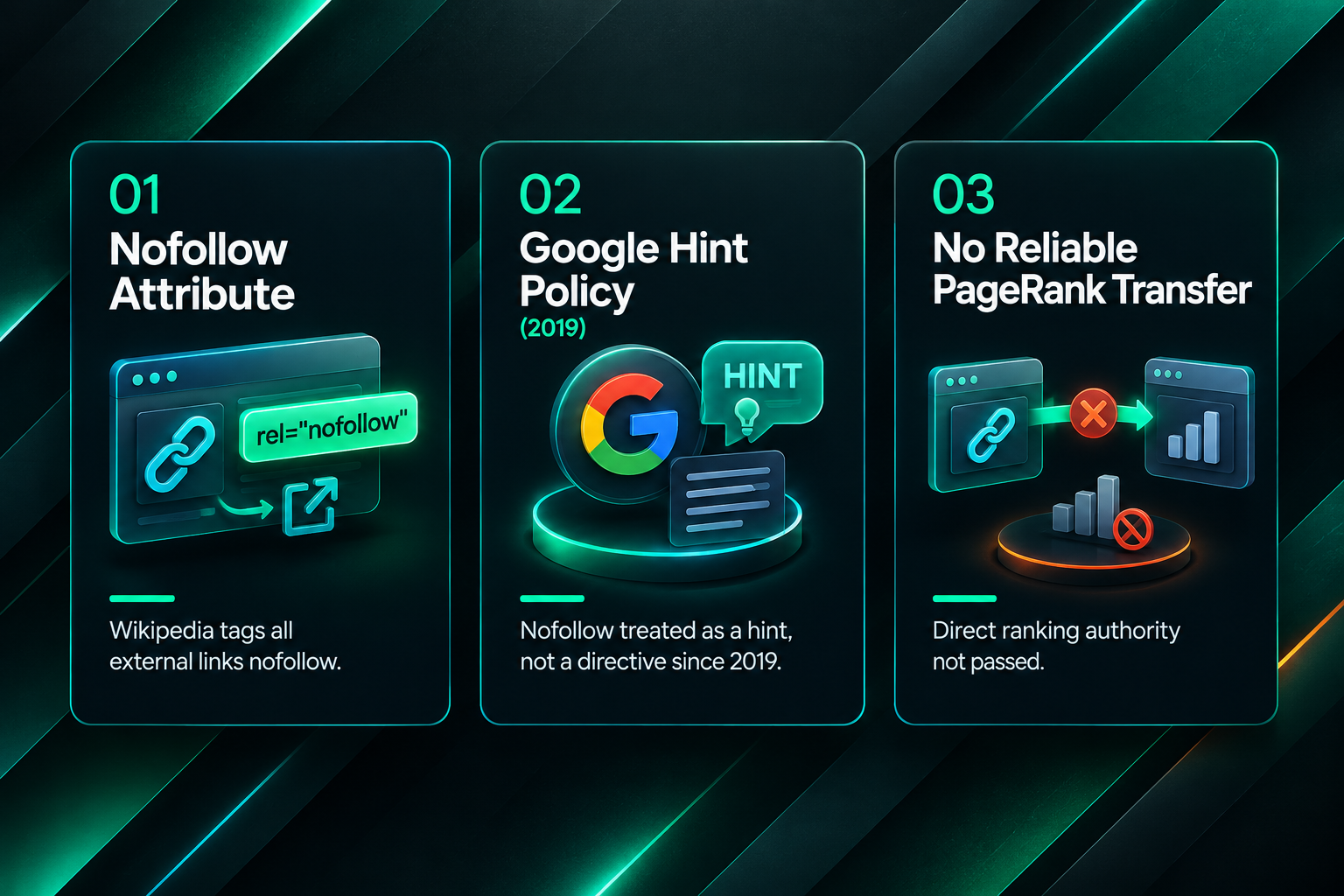
A Wikipedia backlink is a hyperlink placed within a Wikipedia article that points to an external website, typically as a citation or reference supporting a factual claim. Wikipedia uses the rel="nofollow" attribute on all external links, a policy that has been in place for many years to discourage link spam and manipulation. This attribute signals to search engine crawlers that the link should not be used to pass PageRank, the underlying metric Google uses to assess the authority of a page based on the quantity and quality of links pointing to it.
Wikipedia itself is one of the most linked-to and crawled websites on the internet. Its domain-level authority, as measured by third-party tools such as Ahrefs, Moz, and Semrush, is exceptionally high. This creates a common assumption that a link from Wikipedia must carry significant SEO weight. The distinction between domain-level authority metrics and the actual passing of link equity through a nofollow link is important to understand before evaluating whether pursuing a Wikipedia citation is worth the effort.
Do Wikipedia Backlinks Pass SEO Value?
Under Google’s documented guidance, nofollow links are treated as hints rather than directives since a policy update in 2019. Google stated at that time that it may choose to use nofollow links for crawling and indexing purposes, but it does not guarantee that PageRank flows through them. In practice, the consensus among SEO professionals is that nofollow links from Wikipedia do not reliably pass the kind of direct ranking authority that a dofollow editorial link from a relevant, high-quality website would provide.
This does not mean Wikipedia links are entirely without value. Several indirect benefits are worth considering, particularly for websites that are building topical authority or seeking to establish credibility in a specific subject area. The key is to understand what those benefits are and to weigh them honestly against the effort required to earn and maintain a Wikipedia citation.
It is also worth noting that Bing and other search engines have their own approaches to nofollow link handling, and these may differ from Google’s. Assuming uniform treatment across all search engines would be an oversimplification.
Indirect Benefits That May Support an SEO Strategy
Even without direct PageRank transfer, a Wikipedia citation can contribute to an SEO strategy in several ways that are worth understanding before dismissing the tactic entirely.
Referral Traffic From a High-Traffic Source
Wikipedia articles on popular topics attract substantial organic traffic. A citation link placed within a relevant, well-read Wikipedia article can generate genuine referral visits from readers who follow the link to learn more. This referral traffic is real, measurable in Google Analytics or Google Search Console, and may include users with genuine interest in the topic. For informational or research-oriented websites, this can be a meaningful secondary benefit, though the volume will depend heavily on the specific Wikipedia article and its own search visibility.
Topical Credibility and Brand Visibility
Being cited as a reference on Wikipedia can contribute to perceived authority in a subject area. When journalists, researchers, or other content creators encounter a Wikipedia article and follow its citations, a well-placed reference can introduce a brand or website to audiences who might not have found it through organic search alone. This kind of brand exposure does not translate directly into ranking improvements, but it can support broader content marketing and digital PR goals.
Crawl Pathways and Indexing
Because Wikipedia is crawled frequently by search engine bots, a link from a Wikipedia article may help search engines discover a page that is otherwise difficult to reach. This is a minor benefit for most established websites with healthy internal linking and existing backlink profiles, but it may be relevant for newer pages or websites with limited crawl coverage. The indexing benefit should not be overstated; most websites with reasonable technical SEO foundations do not rely on Wikipedia for crawl discovery.
Potential Influence on E-E-A-T Signals
Google’s quality evaluator guidelines reference the concept of Experience, Expertise, Authoritativeness, and Trustworthiness, commonly abbreviated as E-E-A-T. While E-E-A-T is not a direct ranking factor in the same way that PageRank is, it informs how Google’s quality systems assess content. Being cited by Wikipedia, a source that Google treats as a reliable reference point for factual information, may contribute to how a website is perceived in terms of topical authority. The evidence for this as a measurable ranking signal is limited and largely observational, so it should be treated as a plausible hypothesis rather than a documented mechanism.
How Wikipedia Links Are Acquired
Wikipedia operates on an open editing model, but its community of volunteer editors actively monitors for promotional or low-quality contributions. Acquiring a legitimate Wikipedia citation requires that the linked content genuinely supports a factual claim within a Wikipedia article and meets Wikipedia’s notability and verifiability standards. The process typically involves identifying a Wikipedia article where a gap or unsupported claim exists, creating or locating content on your website that provides a credible, well-sourced reference for that claim, and then editing the Wikipedia article to add the citation.
This process sounds straightforward, but it carries meaningful practical challenges. Wikipedia editors are experienced at identifying promotional intent, and edits that appear to serve a commercial purpose rather than improve the encyclopedia are frequently reverted. Links to commercial landing pages, product pages, or thinly sourced content are unlikely to survive editorial review. The content being cited must be genuinely informative, factually accurate, and relevant to the specific claim it is supporting.
There is also a maintenance dimension. Wikipedia articles are continuously edited, and a citation added today may be removed, restructured, or replaced by another editor in the future. Unlike a guest post or niche edit placement on a publisher’s website, a Wikipedia citation cannot be contractually guaranteed to remain in place. This impermanence is a meaningful limitation for anyone treating Wikipedia links as a reliable long-term link building asset.
Risks and Editorial Considerations
Attempting to manipulate Wikipedia for SEO purposes carries reputational and practical risks. Wikipedia’s conflict-of-interest guidelines explicitly discourage editing articles about topics in which you have a financial or personal stake without transparent disclosure. Editors who are identified as acting in bad faith may have their contributions reverted and their accounts flagged. In more serious cases, Wikipedia’s community may add notices to articles warning readers about promotional editing attempts, which can damage rather than support a brand’s credibility.
From a search engine policy perspective, Google’s spam policies focus on links that are intended to manipulate PageRank. Because Wikipedia links are nofollow, they are less likely to attract algorithmic scrutiny as manipulative link building. However, the broader practice of creating content solely to earn a Wikipedia citation, rather than to genuinely inform readers, sits in tension with the spirit of white-hat content strategy. A sustainable approach treats Wikipedia citations as a byproduct of genuinely useful, well-researched content rather than as a primary link acquisition target.
Wikipedia Backlinks Compared to Other Link Types
To assess whether pursuing a Wikipedia citation is worth the effort for a given campaign, it helps to compare it against the link types that form the core of most professional link building strategies.
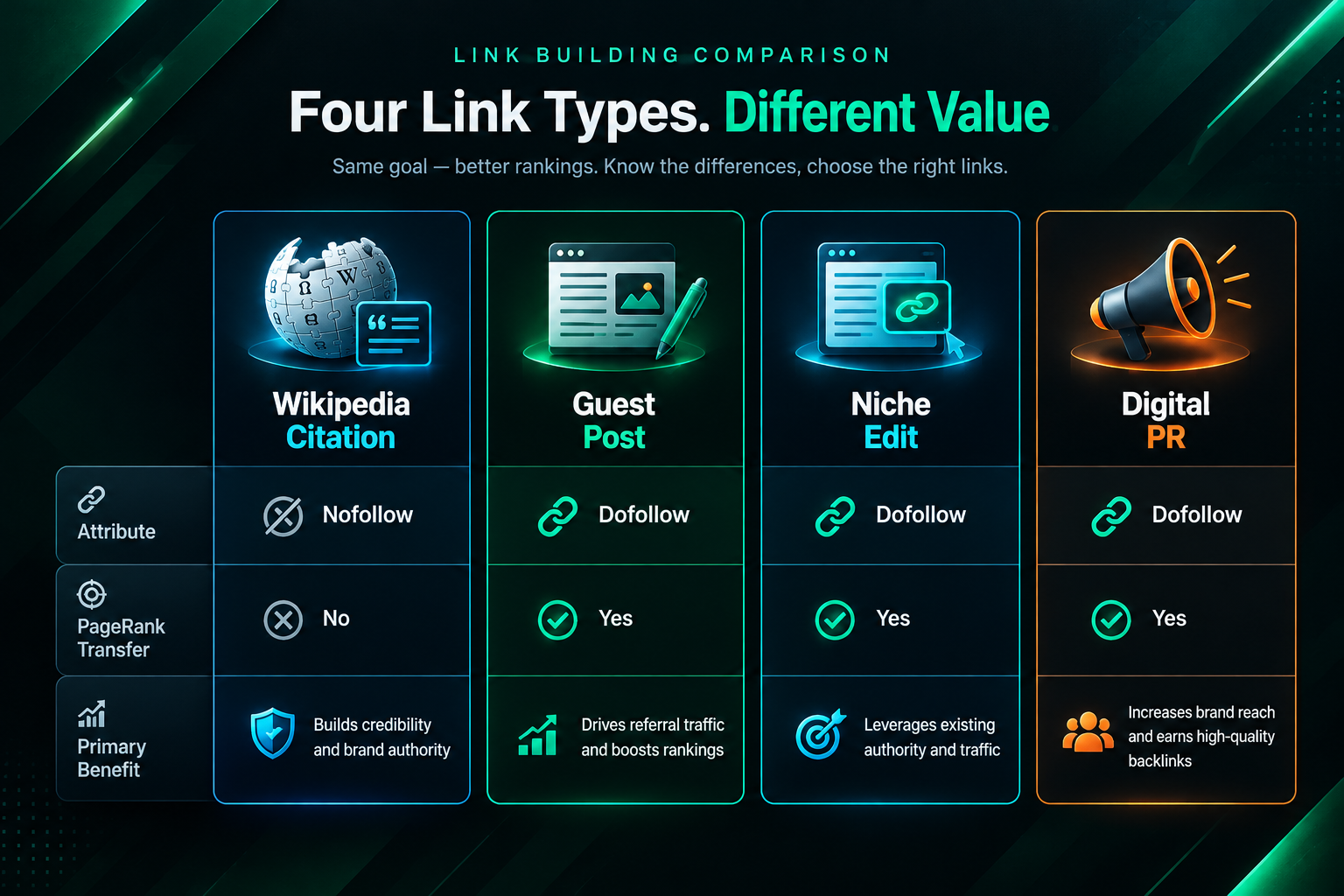
| Link Type | Attribute | PageRank Transfer | Topical Relevance Control | Placement Stability | Acquisition Effort | Primary SEO Benefit |
|---|---|---|---|---|---|---|
| Wikipedia citation | Nofollow | Not reliably passed | Limited | Variable; editable by anyone | Moderate to high | Referral traffic, brand visibility |
| Editorial guest post | Dofollow (typically) | Yes, when dofollow | High | Generally stable | Moderate to high | Link equity, topical authority |
| Niche edit / link insertion | Dofollow (typically) | Yes, when dofollow | High | Generally stable | Moderate | Link equity, contextual relevance |
| Digital PR placement | Dofollow (typically) | Yes, when dofollow | Moderate to high | Generally stable | High | Link equity, brand authority, traffic |
| Directory or profile link | Often nofollow | Not reliably passed | Low | Variable | Low | Brand signals, minor referral traffic |
This comparison illustrates that Wikipedia citations occupy a specific and limited role. They may contribute to brand signals and referral traffic, but they are unlikely to deliver the direct link equity that editorial dofollow placements provide. For campaigns where ranking improvement on competitive keywords is the primary goal, Wikipedia citations are generally a supplementary consideration rather than a core strategy.
When a Wikipedia Backlink May Be Worth Pursuing
There are circumstances where investing effort in a Wikipedia citation makes reasonable sense as part of a broader content and link strategy.
- Your website publishes genuinely reference-worthy content. If your site hosts original research, comprehensive data, or authoritative guides that Wikipedia editors would legitimately cite to support factual claims, a citation may arise naturally or be worth pursuing editorially.
- You are building topical authority in an informational niche. For websites in health, science, technology, or education sectors where E-E-A-T signals matter significantly, being cited by Wikipedia may contribute to how your content is perceived by both users and quality evaluators.
- Referral traffic from a specific Wikipedia article is meaningful. If a high-traffic Wikipedia article covers a topic directly relevant to your audience, the referral visits from a citation could deliver qualified readers who are already engaged with the subject matter.
- You are diversifying a backlink profile. A backlink profile that includes a range of link types, including nofollow citations from authoritative sources, may appear more natural than one composed entirely of dofollow guest post placements. Diversity in link type and source is generally considered a positive characteristic of a healthy profile.
When Wikipedia Backlinks Are Unlikely to Be a Priority
For most commercial link building campaigns, Wikipedia citations are not a primary focus, and there are clear situations where the effort is unlikely to justify the return.
- Your primary goal is ranking improvement on competitive commercial keywords. Nofollow links do not reliably pass the PageRank needed to move rankings in competitive niches. Dofollow editorial placements on topically relevant, high-authority websites are a more direct path to this goal.
- Your content is commercial or product-focused. Wikipedia’s editorial standards make it very difficult to cite commercial landing pages, product descriptions, or service pages. Attempts to do so are likely to be reverted.
- You need predictable, stable placements. Because Wikipedia articles can be edited by anyone at any time, a citation cannot be guaranteed to remain in place. Campaigns that require reliable, long-term link placements are better served by editorial guest posts or niche edits on publisher websites.
- Your budget and time are limited. The effort required to identify a suitable Wikipedia article, create or locate reference-worthy content, and navigate the editorial process may not be the best use of resources compared to outreach-based link acquisition methods that deliver dofollow placements.
Alternatives That May Deliver More Measurable SEO Impact
For businesses and agencies focused on measurable ranking and traffic outcomes, several link acquisition approaches are generally considered more effective than Wikipedia citations as primary strategies.
Manual Guest Post Outreach
Manual outreach to relevant publishers for guest post placements remains one of the most widely used link building methods. When executed well, it produces editorial dofollow links on topically relevant websites, with anchor text and target page selection aligned to campaign goals. The quality of the publisher, the relevance of the content, and the editorial standards of the placement all influence how much SEO value the link may contribute. Results vary depending on the website’s existing authority, the competitiveness of the target keywords, and the overall quality of the campaign.
Niche Edits and Link Insertions
Niche edits involve placing a link within existing content on a relevant publisher’s website, rather than creating a new article. This approach can be efficient because the host content already has its own backlink profile and search visibility. As with guest posts, the topical relevance of the host page, the quality of the publisher, and the naturalness of the link placement are important quality factors. Niche edits are not inherently superior or inferior to guest posts; the right choice depends on the campaign’s goals and the available publisher opportunities.
Digital PR and Content-Led Link Acquisition
Digital PR campaigns focus on creating genuinely newsworthy or data-driven content that earns editorial coverage and links from journalists, bloggers, and industry publications. This approach can produce high-authority dofollow links at scale when the content resonates, but it requires significant upfront investment in content creation and outreach. The links earned through digital PR tend to be highly natural and editorially motivated, which aligns well with search engine quality guidelines.
Resource Page and Broken Link Building
Resource page link building involves identifying pages on relevant websites that curate useful references for a specific topic and requesting inclusion of a genuinely useful resource. Broken link building involves finding broken outbound links on relevant pages and suggesting your content as a replacement. Both methods require research and outreach effort but can produce editorially motivated dofollow placements when the content being promoted is genuinely useful.
Frequently Asked Questions
Does Google count Wikipedia backlinks as ranking signals?
Wikipedia uses the nofollow attribute on all external links. Under Google’s current approach, nofollow links are treated as hints rather than directives, meaning Google may choose to use them for crawling or indexing but does not guarantee that PageRank flows through them. In practice, Wikipedia links are not considered a reliable source of direct ranking authority by most SEO professionals.
Can I add my own website to Wikipedia as a reference?
Technically, anyone can edit Wikipedia, but the platform’s community actively monitors for promotional or conflict-of-interest editing. Adding your own website as a citation is only appropriate if the content genuinely supports a factual claim in the article and meets Wikipedia’s verifiability and notability standards. Promotional edits are typically reverted, and repeated attempts may result in account restrictions.
Will a Wikipedia citation help my website get indexed faster?
Because Wikipedia is crawled frequently, a link from a Wikipedia article may help search engine bots discover a page. However, for most established websites with existing backlink profiles and healthy technical SEO, this is a minor benefit. Websites that rely on Wikipedia for crawl discovery likely have more fundamental indexing issues to address first.
Are Wikipedia backlinks safe from a Google spam policy perspective?
Because Wikipedia links are nofollow, they are less likely to be flagged as manipulative link building under Google’s spam policies, which focus primarily on links intended to pass PageRank artificially. However, creating content solely to earn a Wikipedia citation, or editing Wikipedia in bad faith, carries reputational risks and conflicts with Wikipedia’s own editorial guidelines.
How long does a Wikipedia citation typically last?
There is no guarantee of permanence. Wikipedia articles are continuously edited by volunteer contributors, and a citation can be removed, restructured, or replaced at any time. This impermanence distinguishes Wikipedia citations from editorial placements on publisher websites, where a link is more likely to remain in place over the long term.
Should Wikipedia backlinks be part of a professional link building campaign?
Wikipedia citations may serve as a supplementary element of a diversified link profile, particularly for informational or research-oriented websites. However, for most campaigns focused on ranking improvement and organic traffic growth, editorial dofollow placements on topically relevant, high-quality websites are likely to deliver more measurable SEO impact and should form the core of a structured link building strategy.
Deciding Whether Wikipedia Backlinks Belong in Your Link Strategy
Wikipedia backlinks occupy a specific and limited role in SEO. They do not pass PageRank reliably, they cannot be guaranteed to remain in place, and they are difficult to acquire legitimately for commercial content. At the same time, they can contribute to referral traffic, brand visibility, and topical credibility signals when earned through genuinely useful, reference-worthy content. For websites in informational niches where E-E-A-T signals matter, a Wikipedia citation may be a worthwhile supplementary goal, but it is rarely a substitute for the editorial dofollow placements that form the foundation of most effective link building campaigns.
If your primary objective is to improve rankings on competitive keywords, the most direct path involves building a profile of high-quality, topically relevant editorial links through manual outreach, guest posting, niche edits, or digital PR. Wikipedia citations can complement this profile, but they should not be the primary focus of a campaign designed to deliver measurable organic search results. A qualified link building provider can help assess which combination of link types and acquisition methods is most appropriate for your website’s current profile, competitive landscape, and business goals.


