

Deciding whether to disavow backlinks is one of the more consequential choices in SEO, and it is also one of the most frequently misunderstood. Used correctly, the disavow tool can help a website recover from a pattern of manipulative or low-quality links. Used carelessly, it can remove signals that were quietly supporting your rankings. This guide explains what disavowal actually does, when it is genuinely warranted, when it is not, and how to approach the decision in a way that is proportionate to the real risk your backlink profile presents.
Key Takeaways
- Google’s disavow tool is designed for websites that have received a manual action for unnatural links, or that have a documented history of manipulative link building they cannot remove through outreach.
- For most websites with a naturally acquired backlink profile, disavowal is rarely necessary and can occasionally cause harm by removing links that carry genuine value.
- Third-party metrics such as Domain Rating, Domain Authority, and Trust Flow are not Google signals; a low score alone is not a valid reason to disavow a linking domain.
- Before disavowing anything, a thorough backlink audit is essential to distinguish genuinely harmful links from low-quality but harmless ones.
- Disavowal is a last resort, not a routine maintenance task, and should be approached with caution and ideally with professional guidance.
What the Disavow Tool Actually Does
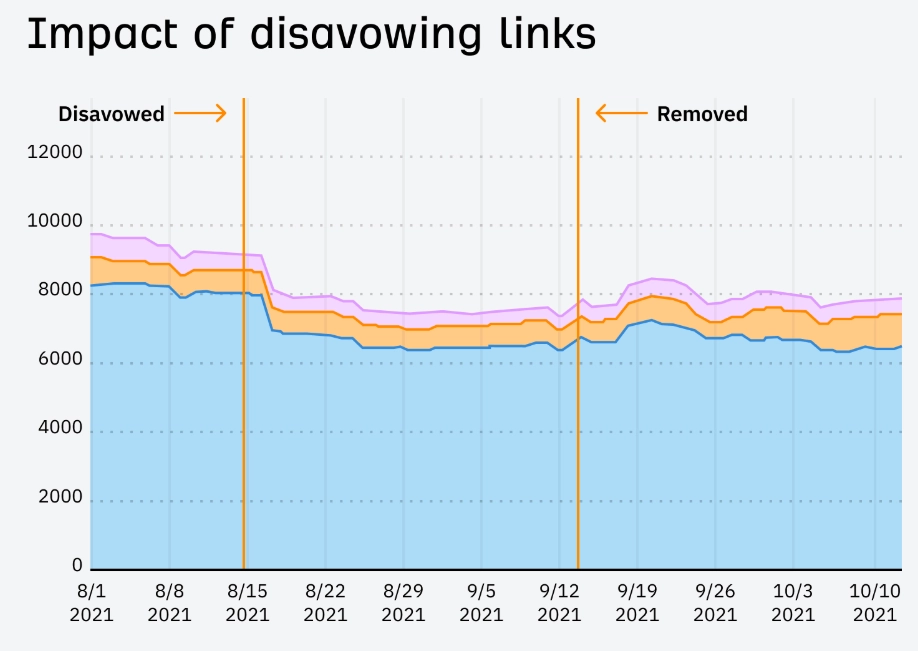
Google’s disavow tool, accessible through Google Search Console, allows website owners to ask Google to ignore specific backlinks or entire linking domains when assessing their site. When you submit a disavow file, you are not deleting those links from the web. The links remain live on the referring pages. You are instead signalling to Google that you do not want those links counted as endorsements of your website. Google has stated that it treats disavowed links as if they do not exist for ranking purposes, though the practical effect is not always immediate or guaranteed.
The tool was introduced primarily to help websites that had been penalised under Google’s link spam policies, particularly those that had participated in link schemes or had links built on their behalf without their knowledge. It is a remediation mechanism, not a general-purpose link hygiene tool. Google’s own guidance has consistently described it as something to use with caution, and the company has noted that its algorithms are increasingly capable of identifying and ignoring low-quality links without any action from the site owner.
When Disavowal Is Genuinely Warranted
The clearest case for using the disavow tool is when your website has received a manual action from Google specifically citing unnatural inbound links. A manual action appears in the Manual Actions report within Google Search Console and is issued by a human reviewer at Google, not an algorithm. If you have received one, Google’s recommended process is to first attempt to remove the problematic links by contacting the referring site owners directly, then disavow any links you were unable to remove, and finally submit a reconsideration request explaining the steps you took.
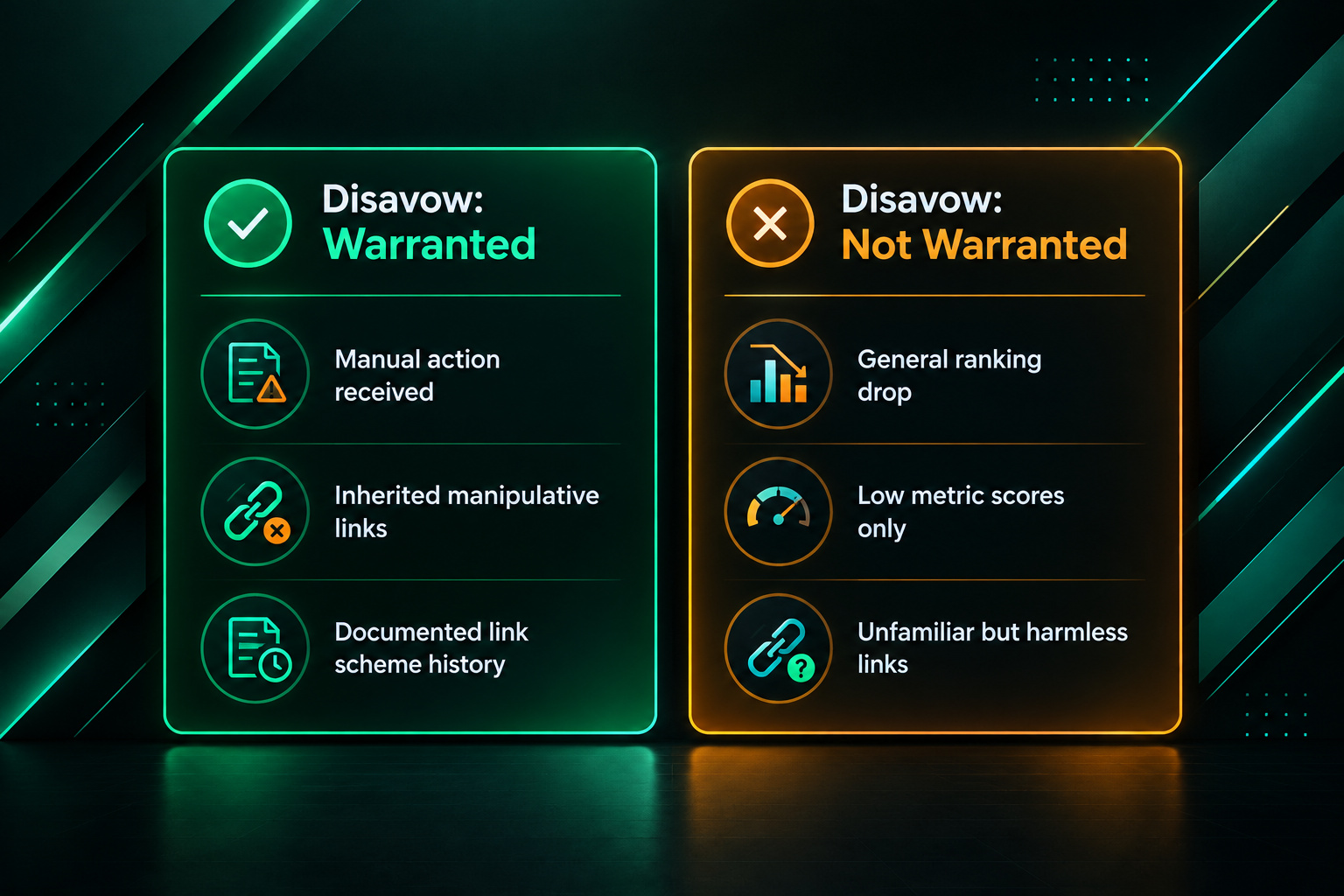
A second scenario where disavowal may be appropriate is when you have inherited a backlink profile with a documented history of manipulative link building. This can happen when acquiring an existing website, taking over an SEO campaign from a previous agency, or discovering that a contractor built links through private blog networks, link farms, or paid link schemes without your knowledge. In these situations, the links may not yet have triggered a manual action, but they represent a genuine policy risk. Proactive disavowal, following a careful audit, may be a reasonable precaution.
A third situation involves websites that previously received a manual action, successfully recovered, but still carry a residual cluster of links that were part of the original problem. If those links were not fully addressed during the initial cleanup, revisiting the disavow file may be appropriate.
When Disavowal Is Unlikely to Help
Many website owners consider disavowal when they notice a ranking drop, a traffic decline, or a cluster of links from unfamiliar or low-looking domains. In most of these cases, disavowal is not the right response. Google has stated publicly that its algorithms are designed to ignore most low-quality links rather than penalise sites for receiving them. A link from a low-traffic blog, a foreign-language directory, or a site with a low Domain Rating does not automatically harm your rankings. It is more likely to be ignored than to cause active damage.
Ranking drops and organic traffic declines have many possible causes that have nothing to do with backlinks. These include algorithm updates affecting content quality assessments, crawling or indexing problems, technical SEO issues such as slow page speed or broken internal links, content that no longer matches current search intent, increased competition from stronger pages, or changes to how Google interprets the topic of your website. Disavowing links will not address any of these causes. If you disavow links in response to a traffic drop caused by a content quality issue, you may remove some of the few positive signals your site has while the underlying problem remains unresolved.
Disavowal is also not a substitute for building a stronger backlink profile. If your website has few high-quality referring domains and you are concerned about competitive rankings, the more productive path is usually to invest in earning or acquiring editorially relevant links from authoritative, topically appropriate sources rather than removing the limited links you already have.
How to Assess Your Backlink Profile Before Deciding
A structured backlink audit is the essential first step before any disavowal decision. Auditing your backlink profile means systematically reviewing the domains and pages linking to your website to identify patterns that may indicate manipulative or policy-violating link building. Tools commonly used for this process include Google Search Console’s Links report, Ahrefs, Semrush, Majestic, and Moz. Each tool uses its own proprietary metrics and crawl data, so cross-referencing more than one source can give a more complete picture of your link profile.
During an audit, the characteristics that warrant closer scrutiny include links from domains that exist solely to sell or exchange links, links embedded in content that has no topical relevance to your website, links from pages that appear to be part of a private blog network, links using exact-match commercial anchor text at scale, links from domains that have been flagged for spam or malware, and large clusters of links that appeared suddenly from unrelated sources. None of these characteristics is automatically disqualifying on its own, but a pattern of several of them across a significant portion of your link profile is worth investigating further.
It is equally important to identify links that look unusual but are actually harmless. A link from a low-authority site that is genuinely relevant to your topic, a link from a foreign-language site that covers your industry, or a link from an older page with little traffic may look suspicious in a bulk export but carry no meaningful risk. Disavowing these links unnecessarily removes whatever signal they contribute, however small.
Distinguishing Harmful Links from Low-Quality but Harmless Ones
The practical distinction that matters for disavowal decisions is not whether a link looks impressive by third-party metrics, but whether it represents a pattern of manipulation that Google’s policies prohibit. Google’s spam policies describe link schemes as including buying or selling links that pass PageRank, excessive link exchanges, large-scale article campaigns with keyword-rich anchor text, and links built using automated programs. Links that fit these descriptions, particularly when they appear in volume, are the ones that create genuine policy risk. A single link from a low-quality but independently published blog post is a different matter entirely.
When assessing individual links, consider the context of the placement. Was the link editorially placed within relevant content, or does it appear in a footer, sidebar, or widget across hundreds of pages? Does the anchor text match a commercial keyword you were targeting, or is it a natural brand mention or URL? Does the linking domain have any genuine audience or editorial purpose, or does it appear to exist only to host outbound links? These contextual questions are more useful than any single metric score.
The Risk of Over-Disavowing
One of the most underappreciated risks in backlink management is disavowing too aggressively. Website owners who use automated tools to flag links for disavowal based purely on metric thresholds, such as disavowing every domain below a certain Domain Rating or Authority Score, risk removing links that are contributing positively to their rankings. Third-party authority metrics are proprietary calculations produced by SEO tool vendors. They are useful for comparative analysis, but they do not directly reflect how Google evaluates a link’s value. A domain with a low Domain Rating can still pass a meaningful signal if it is editorially relevant and independently published.
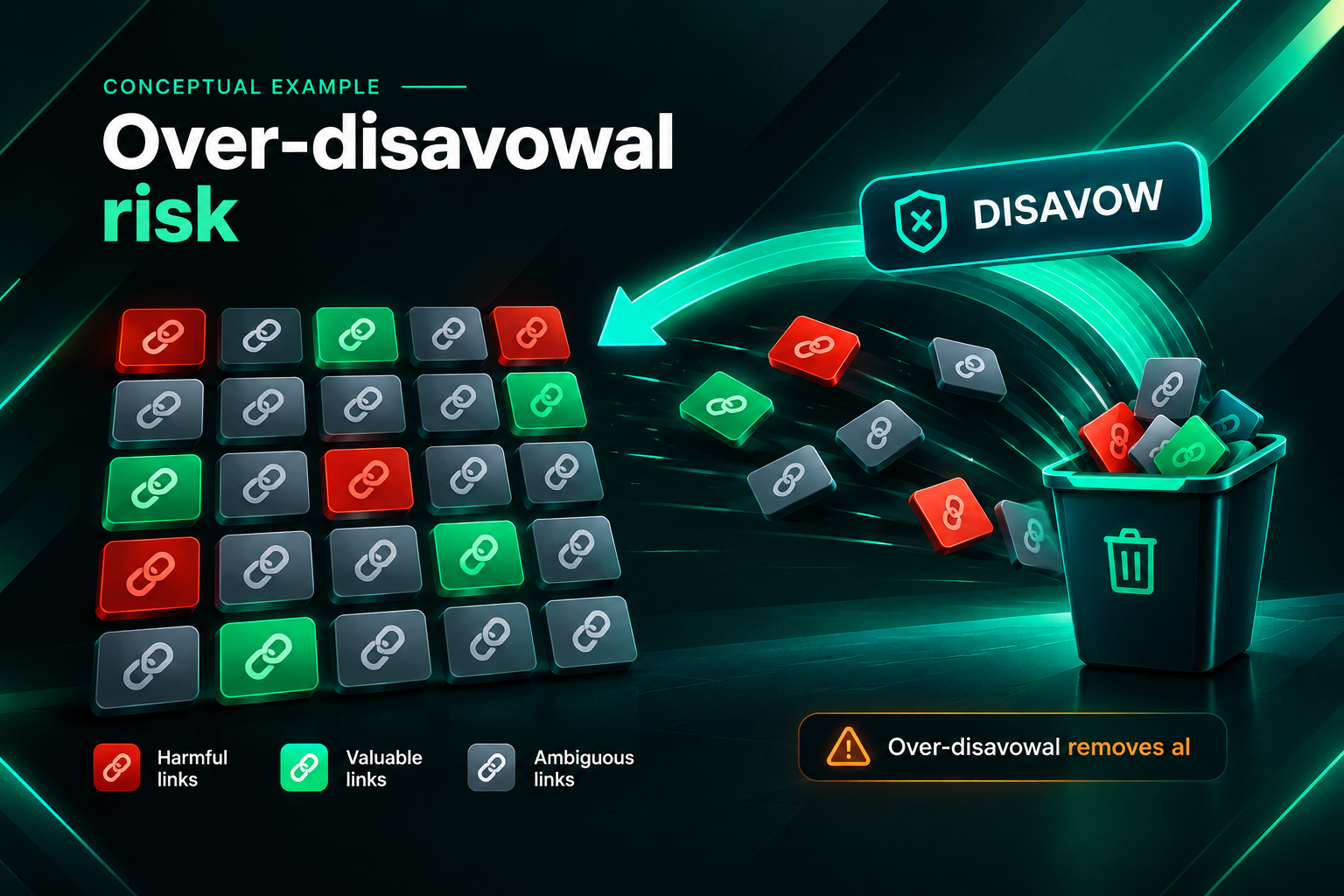
There are documented cases in the SEO community where aggressive disavowal of a large portion of a backlink profile was followed by ranking declines rather than improvements. While correlation does not prove causation in these situations, the pattern is consistent with the risk of removing links that were providing genuine value. If you are uncertain whether a link is harmful or merely low-quality, the more conservative approach is usually to leave it alone unless you have specific evidence of a policy violation or a manual action that requires you to address it.
The Correct Process for Disavowing Links
If you have completed a thorough audit and identified links that genuinely warrant disavowal, the process involves several steps. First, attempt to have the links removed by contacting the webmasters of the referring sites. Document your outreach attempts, including the dates and methods of contact, because this documentation may be required if you submit a reconsideration request following a manual action. If outreach is unsuccessful or impractical for a large volume of links, proceed to the disavow file.
The disavow file is a plain text document formatted according to Google’s specifications. You can disavow individual URLs or entire domains. Disavowing at the domain level is generally more efficient when a referring domain hosts multiple problematic pages, but it should be used carefully to avoid accidentally disavowing a domain that also hosts legitimate links to your site. The completed file is uploaded through the Disavow Links tool in Google Search Console. Google processes the file over time, and the effect on rankings, if any, may not be visible for several weeks.
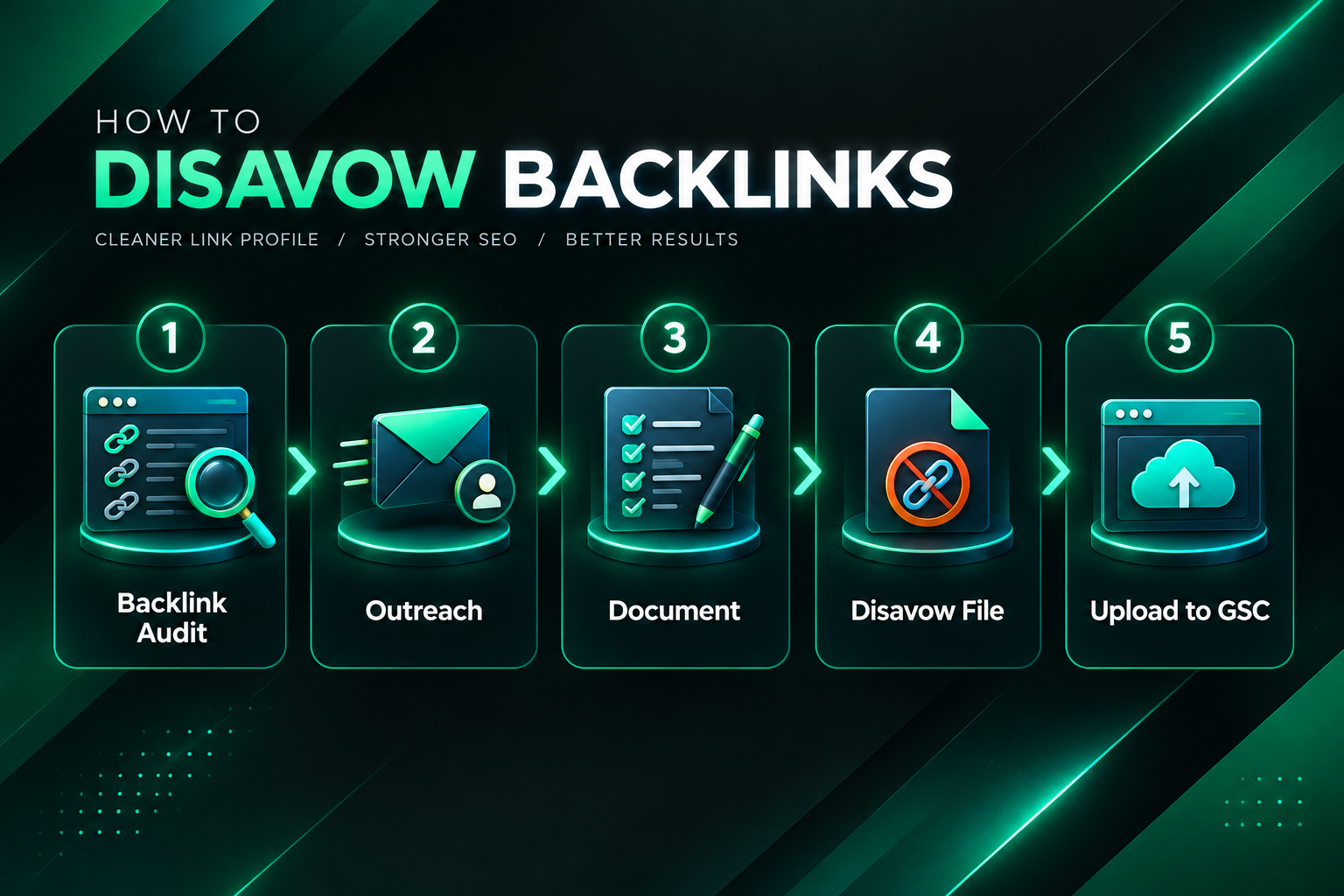
After submitting a disavow file, continue monitoring your backlink profile and your Manual Actions report. If you submitted the disavow file as part of a reconsideration request following a manual action, Google will notify you through Search Console when the request has been reviewed. A successful reconsideration request results in the manual action being lifted, though this does not guarantee an immediate ranking recovery, as other factors influence where pages rank.
Negative SEO and Disavowal
A related question that often arises alongside disavowal decisions is whether a competitor could harm your website by building low-quality links to it, a practice sometimes called negative SEO. Google has acknowledged that this type of attack is possible in principle, but the company has also stated that its algorithms are designed to be resilient to it in most cases. For the majority of websites, a sudden influx of low-quality links from an external source is unlikely to cause a manual action or a significant ranking drop, because Google’s systems are designed to discount rather than penalise links that appear manipulative.
If you believe your website is being targeted by a negative SEO campaign and you can identify a clear cluster of links that appeared suddenly from unrelated, low-quality sources, documenting and disavowing those links may be a reasonable precaution. However, this should be based on evidence of an actual attack rather than a general concern about unfamiliar links appearing in your profile. Monitoring your backlink profile regularly through Google Search Console or a third-party tool makes it easier to identify unusual patterns quickly.
Disavowal and Proactive Link Building
Disavowal decisions do not exist in isolation from the broader question of how a website builds and maintains its backlink profile. A website with a strong foundation of editorially earned links from authoritative, topically relevant sources is generally more resilient to the presence of low-quality links in its profile. Google’s algorithms are designed to weight high-quality signals more heavily, which means that improving the quality of your incoming links through legitimate acquisition is often a more productive investment than spending time auditing and disavowing marginal links.
For websites that have historically relied on manipulative link building tactics and are now transitioning to a more sustainable approach, disavowal of the most clearly problematic links may be a useful part of that transition. However, it should be accompanied by a parallel effort to build a healthier link profile through manual outreach, guest posting on editorially relevant publications, digital PR, and other methods that produce links with genuine editorial context. Cleaning up a problematic backlink profile without simultaneously building positive signals is unlikely to produce meaningful ranking improvements on its own.
If you are working with an outsourced link building provider or an SEO agency, it is worth discussing how they approach backlink quality assessment and what their process is for ensuring that acquired links meet editorial standards. Links acquired through transparent, editorially driven methods are less likely to create the kind of profile that warrants disavowal in the future.
Frequently Asked Questions
Does disavowing links improve rankings?
Disavowal can help restore rankings if a website has received a manual action for unnatural links and successfully addresses the problem through outreach and disavowal. For websites without a manual action, disavowal rarely improves rankings and can occasionally reduce them if legitimate links are removed by mistake. It is not a general ranking improvement tool.
How do I know if I have a manual action for unnatural links?
Manual actions are reported in the Manual Actions section of Google Search Console. If you have a manual action, you will see a notification there describing the issue. If the Manual Actions report shows no issues, your website does not currently have a manual action, regardless of what your backlink profile looks like.
Should I disavow links with a low Domain Rating or Domain Authority?
Not automatically. Domain Rating and Domain Authority are proprietary metrics from Ahrefs and Moz respectively. They are not Google signals and a low score does not mean a link is harmful. Many low-metric links are simply ignored by Google rather than penalised. Disavowing links based solely on metric thresholds risks removing links that carry some positive value.
How long does it take for a disavow file to take effect?
Google processes disavow files over time, and the company has not published a fixed timeline. In practice, effects may become visible over several weeks. If you submitted a disavow file as part of a reconsideration request, the review process itself adds additional time before any manual action is lifted.
Can I undo a disavow file if I made a mistake?
Yes. You can update or replace your disavow file at any time through Google Search Console. Removing a domain or URL from the disavow file signals to Google that you want those links to be considered again. However, the reversal is not instantaneous and may take time to be reflected in how Google processes your backlink profile.
Is it safe to disavow an entire domain rather than individual URLs?
Disavowing at the domain level is efficient when a referring domain hosts multiple problematic pages, but it should be used carefully. If the same domain also hosts legitimate, editorially placed links to your site, a domain-level disavowal will affect those links as well. Review the full list of links from any domain before deciding to disavow it at the domain level.
Should I hire a professional to conduct a backlink audit before disavowing?
For websites with a large or complex backlink profile, a history of aggressive link building, or an active manual action, professional guidance is worth considering. An experienced SEO professional can distinguish genuinely harmful links from low-quality but harmless ones more reliably than automated tools alone, and can help you avoid the risk of over-disavowing links that are contributing positively to your rankings.
Making a Proportionate Disavowal Decision for Your Website
The most important principle in any disavowal decision is proportionality. The disavow tool exists to address a specific problem: a backlink profile that contains links built through methods that violate Google’s spam policies, particularly when those links have resulted in or risk resulting in a manual action. It is not a routine maintenance tool, a ranking improvement shortcut, or a response to every unfamiliar link that appears in your profile.
Before submitting a disavow file, confirm that you have a genuine reason to do so, either a manual action in Google Search Console or documented evidence of manipulative link building in your profile’s history. Complete a thorough backlink audit using multiple data sources, and distinguish links that represent real policy risk from links that are simply low-quality or unfamiliar. Attempt outreach to remove the most clearly problematic links before disavowing. And if you are uncertain about any part of the process, consulting an SEO professional with experience in backlink auditing and penalty recovery is a reasonable step before making changes that can be difficult to reverse quickly.
If your primary concern is improving your website’s rankings and organic visibility, the more productive long-term investment is usually building a stronger, more authoritative backlink profile through editorially driven link acquisition rather than focusing primarily on removing links. A well-planned link building campaign that prioritises topical relevance, editorial quality, and genuine audience value is likely to deliver more measurable benefit than disavowal alone for most websites that have not received a manual action.


