

A referring domain is any website that contains at least one hyperlink pointing to your site. Understanding referring domains is fundamental to evaluating your backlink profile, planning a link building campaign, and interpreting the SEO metrics reported by tools such as Ahrefs, Semrush, and Moz. This guide explains what referring domains are, how they differ from backlinks, why the distinction matters in practice, and what to consider when assessing the quality of the sites linking to you.
Key Takeaways
- A referring domain is a unique website that links to your site at least once; multiple links from the same domain still count as one referring domain.
- Referring domains and backlinks are related but different metrics — growing the number of unique referring domains is generally considered more meaningful than accumulating many links from a small number of sources.
- The quality, topical relevance, and editorial context of referring domains matter more than raw quantity for sustainable SEO impact.
- Third-party metrics such as Domain Rating (Ahrefs), Domain Authority (Moz), and Authority Score (Semrush) can help you assess referring domains, but they are not Google ranking signals and should not be treated as guarantees of SEO performance.
- A healthy referring domain profile is one factor in organic search performance, but it works alongside content quality, technical SEO, and search intent alignment — not as a standalone solution.
Referring Domains vs Backlinks: Understanding the Difference
The terms referring domain and backlink are often used interchangeably, but they describe different things. A backlink is a single hyperlink from one page on an external website to a page on your site. A referring domain is the unique website from which one or more of those backlinks originate. If a news website publishes three separate articles that each link to your homepage, that counts as three backlinks but only one referring domain.
This distinction has practical consequences for how you interpret your link profile. A site with 500 backlinks from 10 referring domains has a very different profile from a site with 500 backlinks from 400 referring domains. The second profile suggests a broader range of independent sources endorsing the site, which is generally viewed more favourably by search engines than a concentrated cluster of links from a handful of domains. Google’s documentation on link schemes notes that links intended to manipulate PageRank — including patterns of excessive cross-linking — may be discounted or penalised, which is one reason diversity of referring domains tends to be a more meaningful growth target than raw backlink volume alone.
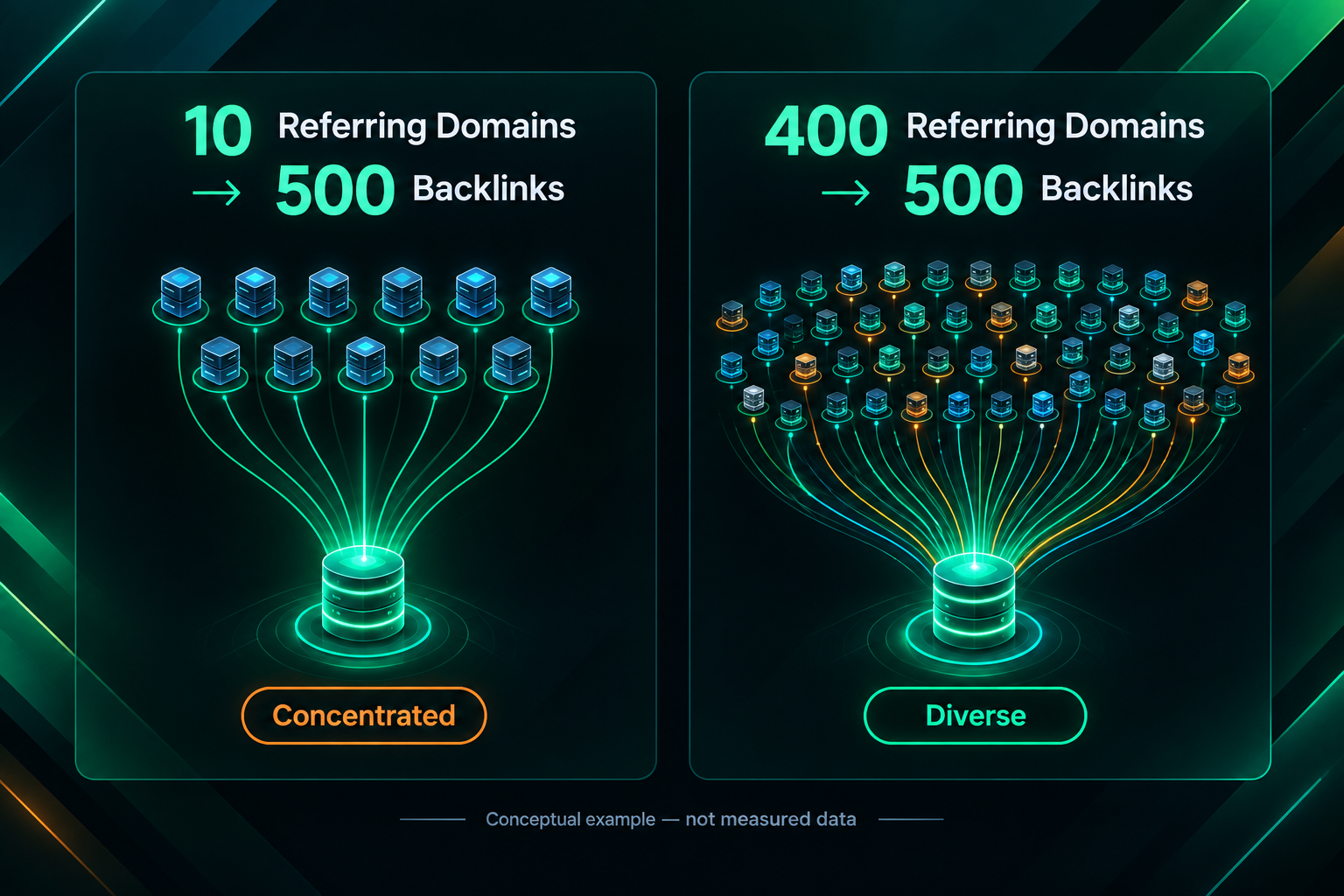
When reviewing SEO tool reports, pay attention to both metrics. A sudden spike in backlinks without a corresponding increase in referring domains may indicate that a single site has added many links at once, which warrants closer inspection. Conversely, steady growth in unique referring domains over time is typically a more reliable signal of a developing link profile.
How Referring Domains Influence SEO
Search engines use links as one of many signals to assess the authority, relevance, and trustworthiness of a page or domain. When a credible, topically relevant website links to your content, it can be interpreted as an editorial endorsement — a signal that your page offers something worth referencing. The accumulation of such endorsements from a diverse set of referring domains may contribute to improved rankings for competitive search queries, though the relationship is not linear and results depend on many other factors.
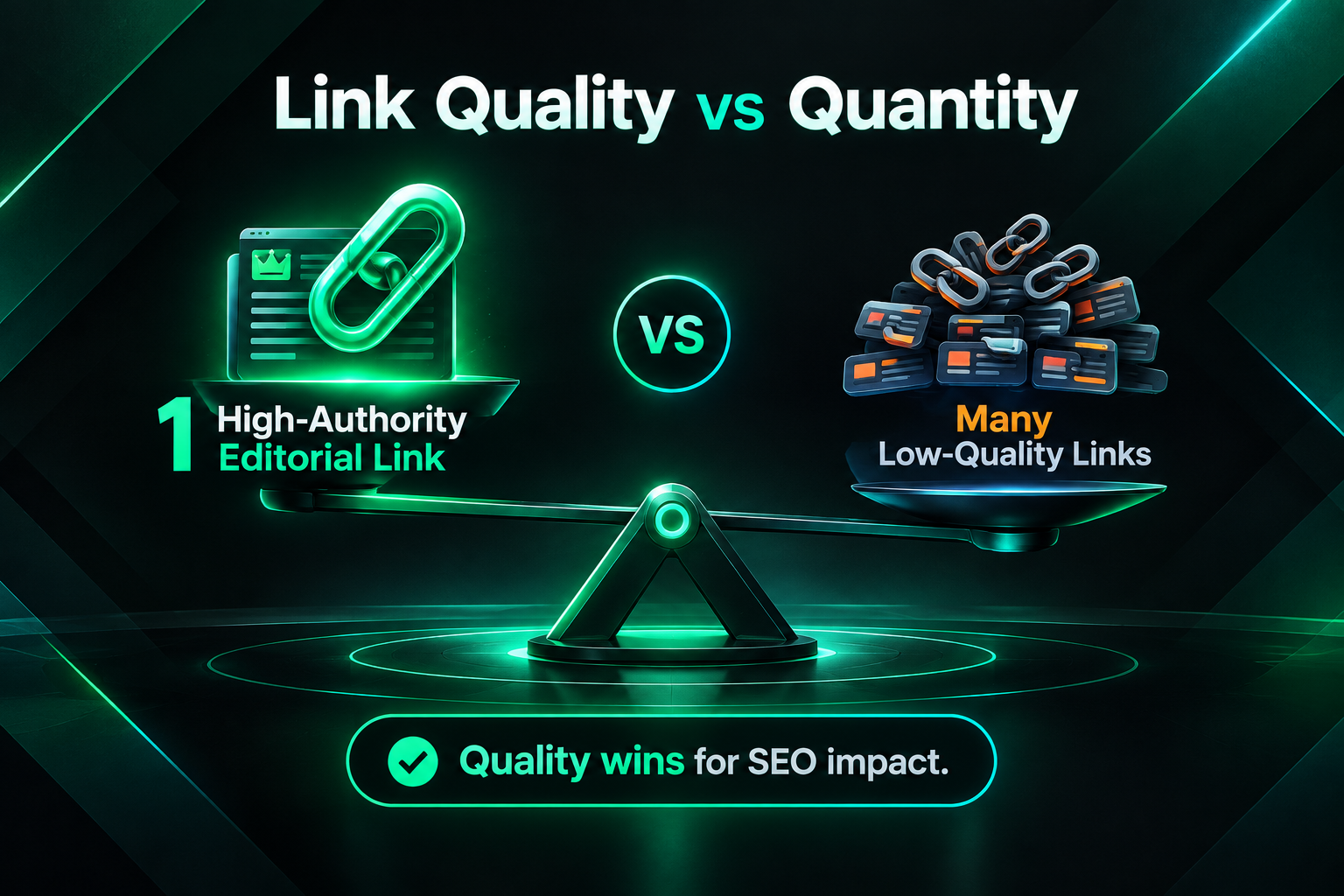
Google has publicly confirmed that links remain a significant ranking factor, but the company has also emphasised that link quality matters far more than quantity. A single link from a well-established, editorially rigorous publication in your industry may carry more weight than dozens of links from low-quality directories or unrelated websites. This is why experienced SEO practitioners focus on acquiring links from referring domains that are genuinely relevant to the topic, have their own established organic presence, and publish content with clear editorial standards.
It is also worth noting that not all links pass the same value. Links marked with the rel=”nofollow”, rel=”sponsored”, or rel=”ugc” attributes are treated as hints by Google rather than direct endorsements. A referring domain that links to you with a followed, editorially placed link is generally considered more valuable from a link equity perspective than one that links through a nofollow placement, though nofollow links can still drive referral traffic and contribute to a natural-looking link profile.
How to Find and Analyse Your Referring Domains
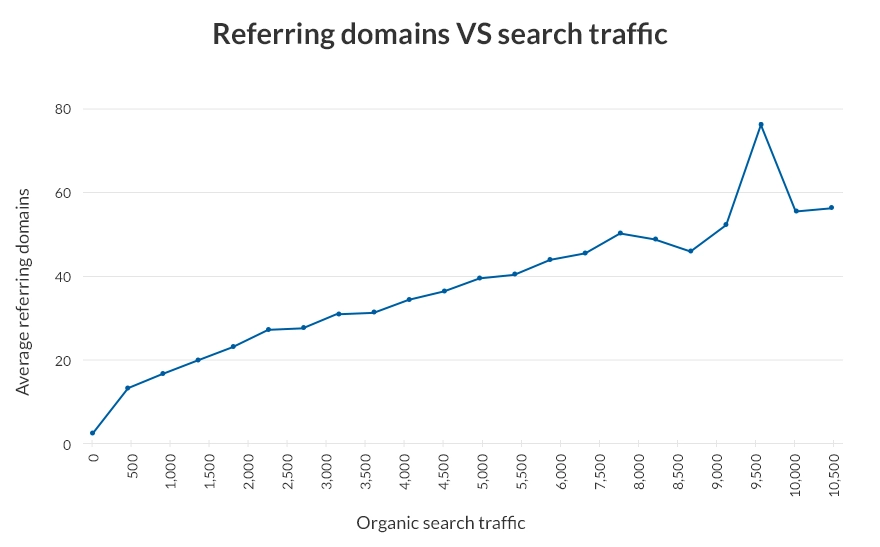
Several SEO tools allow you to audit your referring domain profile. Ahrefs, Semrush, and Moz all provide referring domain reports that show which external websites link to your site, how many links each domain contributes, the link attributes used, and proprietary authority metrics for each referring domain. Google Search Console also provides a links report that shows your top linking sites, though it does not include the same depth of filtering and metric data as third-party tools.
When reviewing your referring domain profile, consider the following dimensions:
- Domain-level authority metrics: Tools such as Ahrefs report Domain Rating (DR), Semrush reports Authority Score, and Moz reports Domain Authority (DA). These are proprietary scores based on each tool’s own link index and algorithm. They are useful for relative comparisons but are not Google metrics and do not directly determine rankings.
- Topical relevance: A referring domain that publishes content closely related to your industry or niche is generally more valuable than a high-authority domain with no thematic connection to your site.
- Traffic and organic visibility: A referring domain that itself ranks for relevant search queries and receives organic traffic is more likely to pass meaningful link value and referral visitors than a domain with no organic presence.
- Link placement and context: Links embedded naturally within editorial content — such as a citation within a relevant article — are typically more valuable than links placed in footers, sidebars, or author bios with no contextual relevance.
- Link attributes: Confirm whether links are followed or carry nofollow, sponsored, or ugc attributes, as this affects how search engines treat them.
- Spam indicators: Look for referring domains with very low authority scores, no organic traffic, thin or auto-generated content, or patterns suggesting they exist primarily to sell links. These may contribute little value and could, in extreme cases, attract unwanted attention during a manual review.
What Makes a Referring Domain Valuable?
Not every referring domain contributes equally to your SEO. The value of a referring domain is shaped by a combination of factors, and assessing these carefully is more useful than chasing a high domain count alone.

Topical Relevance and Editorial Context
A referring domain that covers topics closely aligned with your website’s subject matter is more likely to send a clear relevance signal to search engines. For example, a software company acquiring a link from a technology publication that regularly covers SaaS tools is likely to benefit more than the same company receiving a link from a general lifestyle blog. The surrounding content — the paragraph in which the link appears, the page topic, and the overall site theme — all contribute to how search engines interpret the relationship between the linking and linked pages.
Organic Presence and Real Audience
A referring domain that has its own established organic search presence, publishes content that attracts real readers, and maintains active editorial standards is generally a stronger source than a domain created primarily to host outbound links. When assessing a potential referring domain, checking whether it ranks for relevant queries in your target market and whether it generates measurable organic traffic can help you distinguish editorially credible sources from lower-quality placements.
Link Placement Within Content
Links placed within the main body of an article, surrounded by relevant contextual content, are typically considered more editorially meaningful than links placed in footers, navigation menus, or templated sections that appear across an entire site. Contextual placement also tends to generate more referral clicks from readers who are genuinely interested in the linked content.
Anchor Text
The anchor text — the visible, clickable words of a hyperlink — provides context about the linked page’s topic. A natural referring domain profile includes a variety of anchor text types: branded anchors (your company or website name), partial-match anchors, generic anchors such as “read more” or “this article”, and occasionally exact-match keyword anchors. An unnatural concentration of identical keyword-rich anchor text across many referring domains can appear manipulative and may attract scrutiny during a link quality review.
Referring Domains and Link Building Strategy
Growing the number of high-quality referring domains pointing to your site is a central goal of most link building campaigns. The methods used to acquire links from new referring domains vary considerably in their approach, editorial involvement, and risk profile.
Manual Outreach and Guest Posting
Manual outreach involves identifying relevant websites and contacting their editors or owners to propose a content contribution or link placement. Guest posting — writing an original article for publication on another website — is one of the most common outreach-based methods. When executed with genuine editorial value and placed on relevant, traffic-generating websites, guest posting can add credible referring domains to your profile. The process is time-intensive: identifying suitable publishers, personalising outreach, negotiating placements, and producing quality content all require sustained effort. Delivery timelines for outreach-based campaigns typically range from several weeks to a few months depending on the niche, the quality threshold applied, and the volume of placements targeted.
Niche Edits and Link Insertions
Niche edits involve adding a link to an existing published article on a referring domain rather than creating new content. This approach can place your link within content that already has an established readership and some search visibility. As with guest posting, the quality of the referring domain and the editorial relevance of the placement are the primary factors determining whether the link is likely to contribute meaningful value.
Digital PR and Earned Links
Digital PR campaigns aim to earn links from journalists, bloggers, and publishers by creating genuinely newsworthy content, original research, or data-driven assets. This approach can generate referring domains from high-authority news and media sites that are difficult to reach through direct outreach. The results are less predictable than outreach-based methods, and campaigns may require significant content investment before placements materialise.
Passive Link Earning
Some referring domains are acquired without active outreach when other websites voluntarily link to your content because they find it useful, original, or authoritative. Building a library of genuinely useful resources — original research, comprehensive guides, tools, or data — can attract passive links over time. This approach is sustainable but slow, and it works best when combined with active promotion and distribution.
Referring Domain Quality vs Quantity: What the Evidence Suggests
A common question among businesses starting a link building campaign is whether they should prioritise acquiring many referring domains quickly or focus on a smaller number of high-quality sources. The evidence from SEO research and Google’s own guidance consistently points toward quality over quantity, though the practical answer depends on your competitive landscape.
In highly competitive niches, a site may need a substantial number of referring domains to compete with established players that have built their profiles over many years. In less competitive markets or for long-tail queries, a smaller number of well-placed, relevant referring domains may be sufficient to support meaningful ranking improvements. The key point is that a referring domain profile built on low-quality, irrelevant, or manipulative sources is unlikely to produce durable SEO results and may create compliance risks if Google’s algorithms or manual reviewers identify unnatural link patterns.
It is also worth noting that referring domain counts reported by different SEO tools may vary because each tool maintains its own link index with different crawl coverage and update frequencies. A domain that appears in Ahrefs’ index may not appear in Semrush’s at the same time, and vice versa. These discrepancies are normal and do not necessarily indicate a problem with your link profile — they reflect differences in how each tool discovers and indexes links across the web.
Risks Associated with Low-Quality Referring Domains
Acquiring links from low-quality referring domains — whether through link schemes, private blog networks (PBNs), paid link directories, or automated link building — carries meaningful risks. Google’s spam policies explicitly identify manipulative link building as a violation, and the consequences can include algorithmic ranking suppression or, in more serious cases, a manual action that removes a site’s pages from search results entirely.
If your referring domain profile contains a significant proportion of spammy or irrelevant sources — whether acquired intentionally or through negative SEO — it is worth conducting a link audit using a tool such as Ahrefs or Semrush to identify potentially problematic domains. Google’s Disavow Tool allows site owners to request that specific links be ignored during ranking assessment, though Google advises using it cautiously and only when there is clear evidence of harmful links that cannot be removed through direct contact with the linking site.
It is important to distinguish between a naturally diverse profile that includes some lower-authority links — which is normal and expected — and a profile that contains a high proportion of links from domains that exist primarily to sell or exchange links. The former is unlikely to cause problems; the latter may attract scrutiny over time.
Referring Domains in the Context of a Broader SEO Strategy
Referring domains are one component of a broader SEO picture. A site with a strong referring domain profile but weak on-page content, poor technical SEO, or significant crawling and indexing issues is unlikely to achieve the organic visibility that the link profile alone might suggest. Similarly, a site with excellent content and technical foundations but very few referring domains may struggle to rank competitively for queries where established competitors have built substantial link profiles over time.
Before investing in a link building campaign aimed at growing referring domains, it is worth confirming that the target pages are technically accessible to search engine crawlers, that the content on those pages genuinely addresses the search intent of the queries you want to rank for, and that internal linking supports the flow of link equity to priority pages. Link building is most effective when it amplifies an already-solid foundation rather than compensating for unresolved technical or content issues.
For businesses considering outsourcing link acquisition, a reputable provider will typically conduct an initial assessment of your existing referring domain profile, identify gaps relative to competitors, and recommend a campaign approach aligned with your target pages and business goals. The expected timeline for measurable SEO impact from new referring domains varies — links need to be crawled and indexed before they can influence rankings, and ranking changes may take weeks or months to become visible depending on the competitiveness of the target queries and the overall state of the site.
Frequently Asked Questions
How many referring domains do I need to rank?
There is no universal number. The referring domain count needed to rank competitively depends on your niche, the specific queries you are targeting, and the profiles of the sites currently ranking above you. Analysing the referring domain profiles of top-ranking competitors for your target keywords using a tool such as Ahrefs or Semrush gives a more useful benchmark than any fixed rule.
Is a high Domain Rating or Domain Authority referring domain always better?
Not necessarily. Domain Rating (Ahrefs), Domain Authority (Moz), and Authority Score (Semrush) are proprietary metrics that estimate a domain’s link profile strength relative to other sites in each tool’s index. A high score on one of these metrics does not guarantee that a link from that domain will improve your rankings. Topical relevance, editorial context, and whether the link is followed are equally important considerations.
Can I have too many referring domains?
A large number of referring domains is not inherently problematic. However, if a significant proportion of those domains are low-quality, irrelevant, or part of link schemes, the overall profile may be less beneficial — or potentially harmful — compared to a smaller set of genuinely relevant, editorially placed links. Quality and diversity matter more than raw volume.
What is the difference between a referring domain and a linking page?
A referring domain is the website (domain) that contains the link. A linking page is the specific URL on that domain where the link appears. One referring domain can have multiple linking pages, each contributing a separate backlink to your site.
How long does it take for a new referring domain to affect my rankings?
After a new link is published, search engine crawlers need to discover and index it before it can influence rankings. This process can take anywhere from a few days to several weeks. Once indexed, any ranking impact may take additional weeks or months to become measurable, and the outcome depends on many factors including the competitiveness of the target query, the quality of the referring domain, and the overall state of your site’s SEO.
Should I disavow referring domains with low authority scores?
Not automatically. A low authority score alone is not sufficient reason to disavow a referring domain. Google’s guidance recommends using the Disavow Tool only for links that are clearly unnatural or harmful and that cannot be removed through direct contact with the linking site. Disavowing legitimate links — even from lower-authority domains — could remove value from your profile unnecessarily. A link audit by an experienced SEO professional is advisable before taking disavow action.
Using Referring Domain Insights to Guide Your Link Building Decisions
Understanding what a referring domain is and how to evaluate one gives you a more reliable foundation for link building decisions than focusing on backlink counts or authority scores in isolation. The most useful approach is to treat referring domain analysis as an ongoing process: regularly reviewing which domains link to your site, comparing your profile against competitors ranking for your target queries, identifying gaps where credible referring domains are absent, and prioritising outreach toward editorially relevant, traffic-generating publishers in your niche.
If you are working with an external link building provider, referring domain data is one of the clearest ways to track campaign progress and assess whether new placements are coming from sources that meet your quality criteria. Ask providers to share the referring domains they are targeting before placements are confirmed, and review each domain against the quality factors discussed in this guide — topical relevance, organic presence, editorial standards, and link placement context — rather than relying solely on a single authority metric.
Referring domain growth is a meaningful long-term SEO investment when it is pursued with genuine editorial standards and aligned with a site that is technically sound and content-ready. If you are unsure whether your current profile has gaps worth addressing, a structured link audit and competitor analysis is a practical starting point before committing to a campaign.


