Ahrefs Domain Rating is one of the most widely referenced metrics in SEO and link building, yet it is also one of the most frequently misunderstood. Knowing what Domain Rating measures, how it is calculated, and where it falls short helps you make better decisions about backlink acquisition, publisher selection, and campaign strategy — without over-relying on a single number.
Key Takeaways
- Domain Rating (DR) is a proprietary Ahrefs metric that estimates the relative strength of a website’s backlink profile on a logarithmic scale from 0 to 100. It is not a Google ranking signal.
- DR reflects the quantity and quality of referring domains pointing to a site, not the quality of its content, its organic traffic, or its topical relevance to your niche.
- A high DR does not guarantee that a link from that site will improve your rankings. Topical relevance, link placement, and the overall quality of the linking page all matter independently.
- DR is a useful starting point for evaluating potential link partners, but it should be used alongside other signals such as organic traffic, content quality, and niche relevance.
- Manipulating DR through link schemes is possible, which means inflated DR scores exist and should be treated with caution during publisher vetting.
What Is Domain Rating?
Domain Rating, commonly abbreviated as DR, is a metric developed and maintained by Ahrefs. It scores a website’s backlink profile strength on a scale from 0 to 100, where higher scores indicate a stronger and more extensive profile of inbound links. The scale is logarithmic, meaning the difference between DR 70 and DR 80 represents a far larger gap in backlink strength than the difference between DR 10 and DR 20. This design reflects the reality that acquiring high-quality links becomes progressively harder as a site’s profile grows.
Ahrefs calculates DR by analysing the number of unique referring domains pointing to a target website, weighting those domains by their own DR scores, and accounting for how many outbound links each referring domain sends. A link from a site that links to very few other domains passes more weight in the DR calculation than a link from a site that links to thousands of pages. The metric is updated regularly as Ahrefs crawls the web, so DR scores can change over time as new links are acquired or lost.
It is important to understand that DR is entirely proprietary to Ahrefs. It is not provided by Google, Bing, or any other search engine, and it does not directly reflect how search engines evaluate a website’s authority. Google has not used PageRank as a publicly visible metric since 2016, and it has never endorsed DR or any equivalent third-party metric as a proxy for its internal signals. DR is best understood as a comparative tool for assessing backlink profiles within the Ahrefs index, not as a definitive measure of SEO value.
How Domain Rating Is Calculated
The Ahrefs DR calculation follows a multi-step process. First, Ahrefs counts the number of unique domains linking to the target website using its own web crawl index. Second, each of those referring domains contributes DR score weight proportional to its own DR and inversely proportional to the number of unique domains it links to. A referring domain with a DR of 80 that links to only 10 other sites contributes more to the target’s DR than a DR 80 site that links to 10,000 sites. Third, all contributing scores are summed and mapped onto the 0–100 logarithmic scale.
Because the calculation is relative and the scale is logarithmic, DR scores shift across the entire index when Ahrefs discovers large numbers of new websites or when major sites gain or lose significant backlink volume. A website’s DR can therefore change even if its own backlink profile has not changed, simply because the broader distribution of scores across the index has shifted. This is a known characteristic of the metric and is worth keeping in mind when tracking DR over time.
Ahrefs has published documentation explaining the general methodology, though the precise weighting formulas are not fully disclosed. The company updates DR scores continuously as its crawler processes new and updated pages, so the score you see today may differ from the score recorded a month ago even for the same domain.
Domain Rating vs. Other Authority Metrics
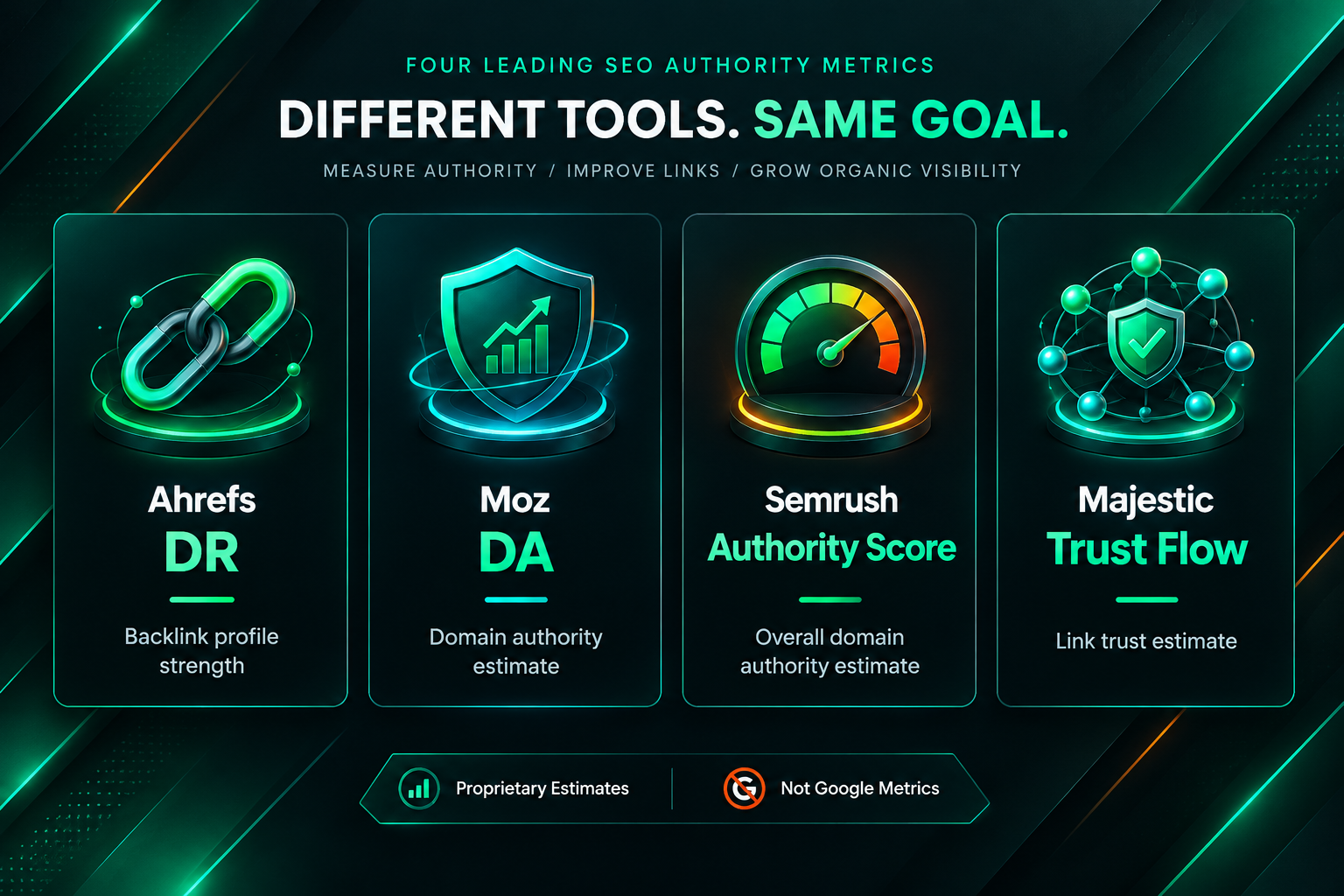
Domain Rating is not the only third-party authority metric available to SEO practitioners. Moz publishes Domain Authority (DA), Semrush uses Authority Score, and Majestic provides Trust Flow and Citation Flow. Each metric uses a different methodology, a different crawl index, and a different weighting approach. As a result, the same website can have meaningfully different scores across tools, and a site with a high DR may have a moderate DA or a low Trust Flow depending on the composition of its backlink profile.
None of these metrics are interchangeable, and none should be treated as a direct measure of how Google evaluates a domain. They are all proprietary estimates based on each tool’s own data. When evaluating potential link partners, using more than one tool can provide a more complete picture, but the most important factors — content quality, topical relevance, organic traffic, and editorial standards — are not fully captured by any single numerical score.
A practical distinction worth noting: Domain Rating measures the strength of the entire domain’s backlink profile, not the authority of the specific page where your link would appear. A high-DR domain may contain individual pages with very few inbound links, thin content, or poor topical alignment with your site. Page-level metrics such as Ahrefs URL Rating (UR) can provide additional context about the specific page rather than the domain as a whole.
What Domain Rating Does and Does Not Tell You
Domain Rating is a useful signal for quickly comparing the relative backlink strength of different websites. When you are evaluating a list of potential guest post publishers or niche edit opportunities, DR provides a fast way to filter out sites with very weak or very new backlink profiles. It can also help identify sites that have grown their backlink profiles significantly over time, which may indicate genuine editorial activity and organic link acquisition.
However, DR has meaningful limitations that matter in practical link building decisions. It does not measure topical relevance. A DR 60 website in the finance sector contributes nothing to the topical authority of a link building campaign targeting a health and wellness brand, regardless of how strong its backlink profile appears. Topical relevance — the degree to which the linking site, linking page, and surrounding content relate to your target niche — is a separate and important quality dimension that DR does not capture.
DR also does not measure organic traffic. A website can accumulate a high DR through aggressive link building while generating very little genuine organic search traffic. Sites with inflated DR scores and minimal real traffic are a known quality concern in link building. Checking estimated organic traffic through Ahrefs, Semrush, or similar tools alongside DR gives a more complete picture of whether a site is genuinely active and indexed well by search engines.
Additionally, DR does not reflect the editorial standards of a publisher. A site may have a strong backlink profile but accept paid placements without disclosure, publish thin or AI-generated content, or host links across unrelated niches. These factors affect the practical value and policy risk of a placement independently of the DR score.
Domain Rating in Link Building Campaigns
In link building practice, DR is commonly used as a minimum threshold filter during publisher prospecting. Many outreach campaigns set a baseline DR requirement — for example, targeting sites with a DR of 30 or above — to avoid placing links on very new or very weak domains. This is a reasonable starting point, but it should not be the primary or sole criterion for publisher selection.
A more complete publisher assessment for manual outreach or guest posting typically considers several factors alongside DR:
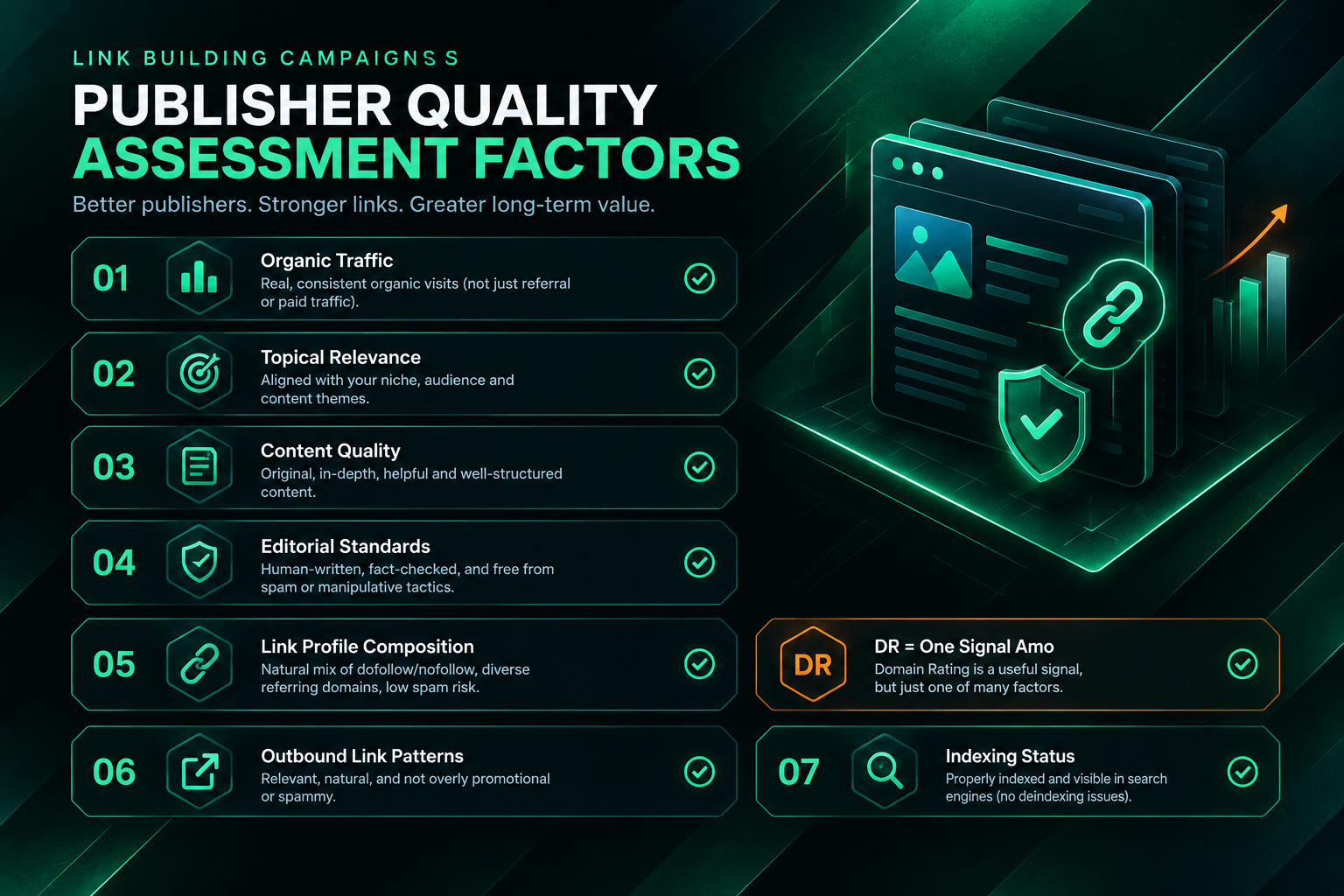
- Organic traffic estimates: Does the site receive genuine search traffic, suggesting it is indexed and trusted by search engines?
- Topical relevance: Does the site’s content align with the niche or industry of the target website?
- Content quality: Is the existing content well-written, accurate, and genuinely useful to readers?
- Editorial standards: Does the site appear to have real editorial oversight, or does it publish any submitted content without review?
- Link profile composition: Does the site’s own backlink profile look natural, or does it show signs of manipulation such as a sudden spike in links from low-quality sources?
- Outbound link patterns: Does the site link out to a diverse range of relevant, quality sites, or does it appear to sell links indiscriminately?
- Indexing status: Are the site’s pages indexed in Google Search Console or visible in search results?
Using DR as one signal within a broader vetting framework produces more reliable publisher selection than using it as a standalone threshold. A DR 45 site with strong topical relevance, genuine organic traffic, and clear editorial standards may deliver more practical SEO value than a DR 65 site with thin content and a history of indiscriminate link selling.
DR Manipulation and Inflated Scores
Because DR is a widely used benchmark in link building, some website operators attempt to inflate their DR scores artificially to make their sites appear more attractive to link buyers or outreach targets. Common manipulation tactics include acquiring large volumes of links from private blog networks (PBNs), link exchanges, or low-quality directories specifically to boost the referring domain count used in the DR calculation.
Ahrefs has implemented filters to reduce the influence of obviously spammy links on DR calculations, but no automated system catches every manipulation attempt. As a result, inflated DR scores exist in the market, and a site’s DR alone is not a reliable guarantee of genuine authority or editorial quality. This is one reason why manual review of a publisher’s content, traffic, and link profile remains important during campaign planning, regardless of the DR score shown.
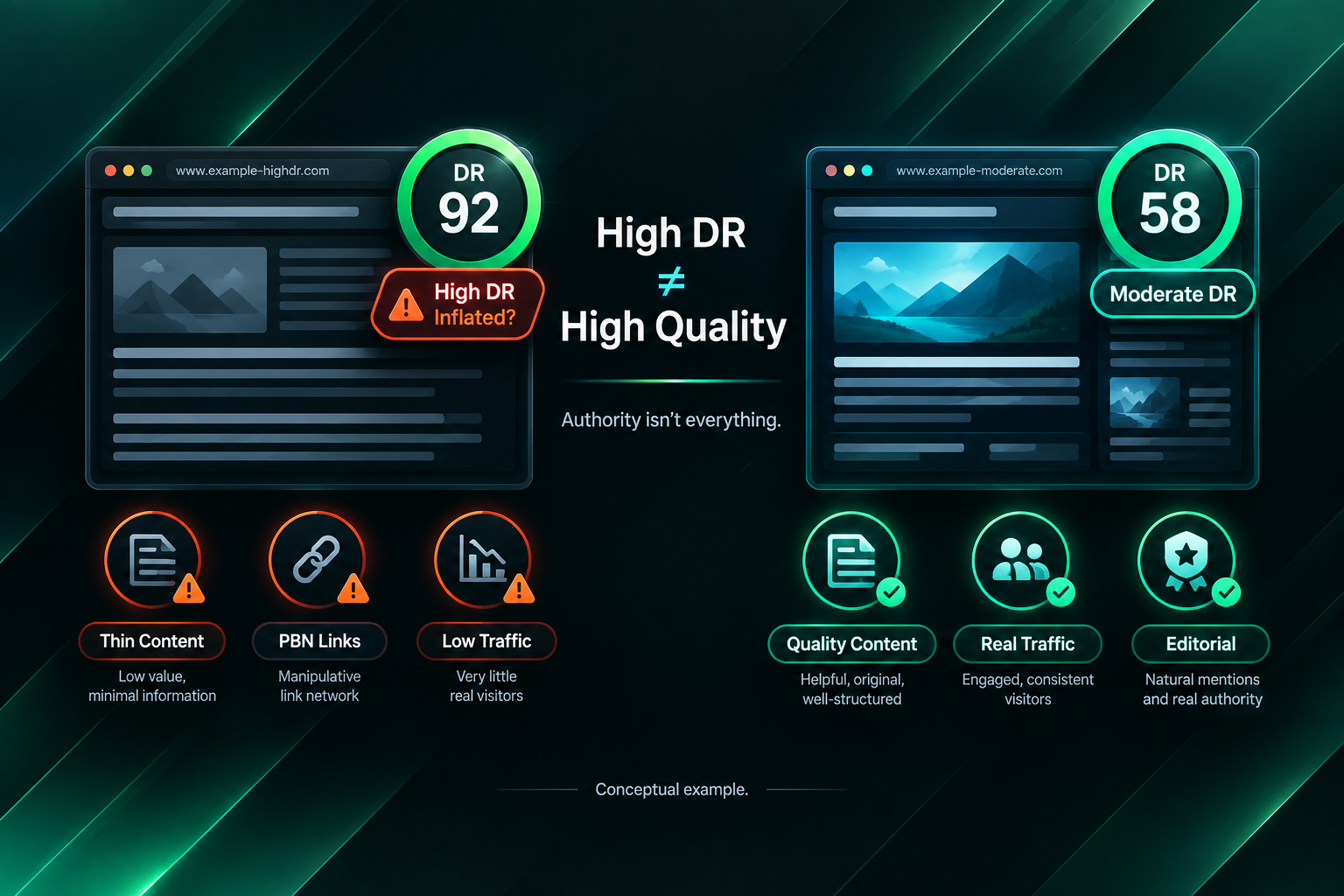
From a search-engine policy perspective, acquiring links from sites that have manipulated their DR through link schemes carries its own risks. If the linking site is later identified as part of a link network or spam operation, links from that site may be devalued or could attract scrutiny. This risk exists independently of what the DR score showed at the time of placement.
How DR Relates to Link Building Goals
Understanding what DR does and does not measure helps clarify realistic expectations for link building campaigns. An increase in the average DR of your referring domain profile does not automatically translate into improved search rankings, increased organic traffic, or higher revenue. These are separate outcomes influenced by many factors including content quality, search intent alignment, technical SEO health, competition in your target market, and the overall composition of your backlink profile.
Link building campaigns that focus exclusively on acquiring high-DR placements without considering topical relevance, anchor text diversity, target page alignment, and content quality may produce a stronger-looking backlink profile on paper without delivering meaningful ranking improvements. Conversely, a well-planned campaign that prioritises relevant, editorially sound placements on moderately authoritative sites may produce more measurable organic visibility improvements over time, even if the average DR of acquired links is not exceptionally high.
It is also worth distinguishing between domain-level DR and the practical impact of individual link placements. A single link from a highly relevant, well-trafficked page on a DR 50 site may contribute more to a campaign’s goals than multiple links from high-DR sites with no topical connection to your niche. Campaign strategy should account for this distinction rather than optimising for DR as an end in itself.
Using Domain Rating Responsibly in SEO Decision-Making
For business owners and marketing teams evaluating link building proposals or reviewing campaign reports, DR is a useful reference point but should not be the primary measure of campaign quality or success. A provider that reports only average DR of acquired links without discussing topical relevance, organic traffic of linking sites, or target page alignment is presenting an incomplete picture of campaign value.
When reviewing link building proposals or assessing existing backlink profiles, consider asking for information beyond DR:
- What is the estimated organic traffic of the linking sites?
- How does the topical focus of the linking sites relate to the target niche?
- What is the URL Rating of the specific pages where links will appear?
- How does the anchor text distribution across acquired links look relative to the existing profile?
- Are the placements editorially integrated into relevant content, or are they isolated in footers, sidebars, or link lists?
These questions help move the evaluation beyond a single metric and toward a more complete assessment of link quality and campaign suitability. DR remains a useful part of that assessment, but it works best as one input among several rather than as the defining measure of a link’s value.
Frequently Asked Questions
Is a higher Domain Rating always better for link building?
Not necessarily. A higher DR indicates a stronger backlink profile relative to other sites in the Ahrefs index, but it does not guarantee that a link from that site will improve your rankings. Topical relevance, page-level quality, organic traffic, and editorial standards all affect the practical value of a placement independently of DR. A moderately rated site with strong relevance and genuine traffic may be a better link partner than a high-DR site with thin content or no topical connection to your niche.
Does Google use Domain Rating as a ranking factor?
No. Domain Rating is a proprietary Ahrefs metric and is not used by Google in its ranking algorithms. Google has its own internal link evaluation systems, which are not publicly disclosed in detail. DR is a third-party estimate of backlink profile strength and should not be treated as a proxy for Google’s assessment of a domain’s authority.
Can Domain Rating drop even if I haven’t lost any links?
Yes. Because DR is calculated on a relative, logarithmic scale across the entire Ahrefs index, your score can change when other websites gain or lose significant backlink volume, even if your own profile has not changed. Ahrefs also periodically updates its crawl methodology, which can affect scores across the index. A small fluctuation in DR does not necessarily indicate a problem with your backlink profile.
What is a good Domain Rating for a link building target?
There is no universal threshold that defines a good DR for link building purposes. The appropriate benchmark depends on your industry, the competitiveness of your target keywords, and the current state of your own backlink profile. Many campaigns use a minimum DR of 20–30 as a basic filter to avoid very new or very weak domains, but the more important factors are topical relevance, content quality, and genuine organic traffic. A site-specific assessment is more useful than a fixed DR target.
How often does Ahrefs update Domain Rating scores?
Ahrefs updates DR scores continuously as its crawler processes new and updated pages across the web. The frequency of updates for any individual domain depends on how often Ahrefs crawls that site and its linking domains. Significant changes to a site’s backlink profile — such as a large influx of new referring domains or the loss of major links — will typically be reflected in the DR score within days to weeks, though exact timing varies.
Should I use Domain Rating as the main criterion when choosing guest post publishers?
DR is a useful starting filter but should not be the main criterion. Publisher selection for guest posting is more reliably guided by a combination of factors: topical relevance to your niche, estimated organic traffic, content quality, editorial standards, and the natural composition of the site’s existing backlink profile. Using DR alongside these signals produces more informed decisions than relying on DR alone.
What Domain Rating Means for Your Link Building Strategy
Domain Rating is a practical and widely used tool for comparing backlink profile strength across websites, and it has a legitimate role in link building campaign planning. Used as a quick filter during publisher prospecting, it helps identify sites with meaningful backlink profiles and exclude very new or very weak domains from outreach lists. For that purpose, it is genuinely useful.
The risk comes from treating DR as a measure of link quality, search-engine authority, or campaign success in isolation. A backlink profile composed of high-DR placements that lack topical relevance, genuine traffic, or editorial integrity may look strong in a report while delivering limited practical benefit to organic visibility. Conversely, a thoughtfully planned campaign targeting relevant, well-trafficked publishers — even at moderate DR levels — may produce more meaningful results over time.
For businesses and agencies evaluating link building strategies or reviewing provider proposals, the most useful approach is to treat DR as one signal within a broader quality framework. If you are working with an outsourced link building provider or planning a campaign, asking how publisher quality is assessed beyond DR — including topical relevance, organic traffic, content standards, and placement context — will give you a clearer picture of the campaign’s likely value. A provider that can explain its full vetting process, not just its DR minimums, is better positioned to deliver placements that support your actual SEO goals.