

Key Takeaways
- Manual link building involves earning high-quality backlinks through direct, personalized outreach rather than automated tools or link schemes.
- Core strategies include guest posting, broken link building, niche edits, the skyscraper technique, resource page outreach, and digital PR.
- A structured outreach process — from prospect identification through follow-up and tracking — consistently outperforms bulk automated approaches in link quality and Google compliance.
- Prospect vetting based on domain rating, organic traffic, niche relevance, and spam score helps protect your backlink profile from low-quality or harmful links.
- Scaling manual link building requires standardized workflows, defined team roles, and CRM tools, not simply sending more emails.
What Is Manual Link Building?
Manual link building is the practice of acquiring backlinks through deliberate, human-led outreach and relationship building rather than automated software, link exchanges, or purchased link packages. Each link is identified, evaluated, and requested individually — a process that prioritizes relevance, editorial quality, and long-term sustainability over volume.
The core distinction matters for SEO. Search engines, particularly Google, reward backlinks that are earned because another site genuinely finds your content useful. Links that are placed manually through contextual, niche-relevant outreach carry editorial weight. Links generated through automated schemes, private blog networks (PBNs), or bulk link farms carry significant penalty risk — particularly following Google’s Penguin update, which targeted unnatural linking patterns specifically.
White-hat link building built on genuine outreach is not a shortcut. It requires research, personalized communication, content quality, and consistent follow-through. The return, however, is a backlink profile that strengthens domain authority over time without exposing a site to algorithmic or manual penalties.
Manual vs. Automated Link Building
| Factor | Manual Link Building | Automated Link Building |
|---|---|---|
| Approach | Individual outreach, relationship-led | Software-generated, bulk submission |
| Link quality | High — editorially placed on vetted sites | Variable to low — often spammy or irrelevant |
| Niche relevance | Selected by human judgment | Often ignored or poorly matched |
| Google compliance | White-hat, aligned with guidelines | High penalty risk, violates link schemes policy |
| Scalability | Moderate — requires process and team | High volume, low effort |
| Longevity | Durable — links tend to remain live | Fragile — links frequently removed or devalued |
| Relationship value | Builds ongoing partnerships | None — transactional and anonymous |
| E-E-A-T signal | Positive — supports authority and trust | Neutral to negative |
Core Manual Link Building Strategies
Effective white-hat link building relies on a defined set of proven strategies. The right mix depends on your niche, existing content assets, and outreach capacity. Most established SEO programs use several of the following in parallel.
Guest Posting
Guest posting involves writing original content for a reputable third-party website in exchange for a contextual backlink to your own site. When placed on authoritative, niche-relevant sites, guest post links carry strong E-E-A-T signals and drive referral traffic alongside SEO value.
Effective guest posting begins with identifying sites that publish content aligned with your topic area, have genuine organic traffic, and maintain editorial standards. Pitching generic topics to high-volume directories does not produce the same results. The pitch should propose specific, useful content angles that genuinely serve the host site’s audience — not simply a vehicle for a link.
Broken Link Building
Broken link building identifies dead links on relevant websites — pages that return 404 errors — and proposes your own content as a replacement. Because webmasters want to maintain a good user experience, this outreach has a naturally helpful framing: you are alerting them to a problem and offering a solution simultaneously.
Tools such as Ahrefs or SEMrush can surface broken outbound links on target domains efficiently. The strongest opportunities arise when a broken link pointed to content that closely matches something you have already published or can create specifically for the campaign.
Skyscraper Technique
The skyscraper technique involves finding high-performing content in your niche that has already earned many backlinks, creating a meaningfully better version of that content, and then reaching out to sites that link to the original — proposing your improved resource instead. “Better” should be genuinely substantive: more current data, greater depth, clearer structure, or additional formats such as visual summaries or tool recommendations.
This strategy works best when your improved content offers something the original does not, rather than simply being longer. Outreach should explain the specific improvements concisely rather than making general claims about quality.
Resource Page Outreach
Resource pages are curated lists of useful links on a given topic, maintained by educational institutions, industry organizations, or niche blogs. Earning a placement on a resource page produces a highly contextual backlink with strong topical relevance. Outreach for resource pages should clearly explain what your resource covers and why it would add value for the page’s audience.
Niche Edits and Link Insertions
Niche edits involve requesting the addition of a contextual backlink into an existing, already-indexed piece of content on a relevant site. Because the host page already has established authority and traffic, niche edit links can carry significant SEO weight. The key is ensuring the inserted link fits naturally within the existing content and adds genuine value for readers — not simply appearing as a commercial placement.
Digital PR
Digital PR generates editorial backlinks by creating genuinely newsworthy content — original research, data studies, surveys, or expert commentary — and pitching it to journalists, bloggers, and online publications. Links earned through digital PR often come from high-authority news and media sites, providing both strong domain authority signals and broad referral traffic.
Journalist query platforms such as HARO (Help a Reporter Out), Qwoted, and Featured allow subject-matter experts to respond to specific press requests, earning editorial coverage and links when selected. This approach rewards genuine expertise and timely, specific responses over generic pitches.
Competitor Backlink Analysis
Analyzing the backlink profiles of ranking competitors reveals link acquisition opportunities you may have missed. If a competitor has earned links from a resource page, a round-up post, or an industry directory, those same sources may be open to linking to your content too — particularly if you can offer something comparable or superior. Tools such as Ahrefs and SEMrush make competitor backlink analysis straightforward, allowing you to export referring domains and identify outreach targets systematically.
The Step-by-Step Outreach Process
Manual outreach follows a repeatable workflow. Understanding each stage allows you to optimize conversion rates, maintain consistency across team members, and protect link quality over time.
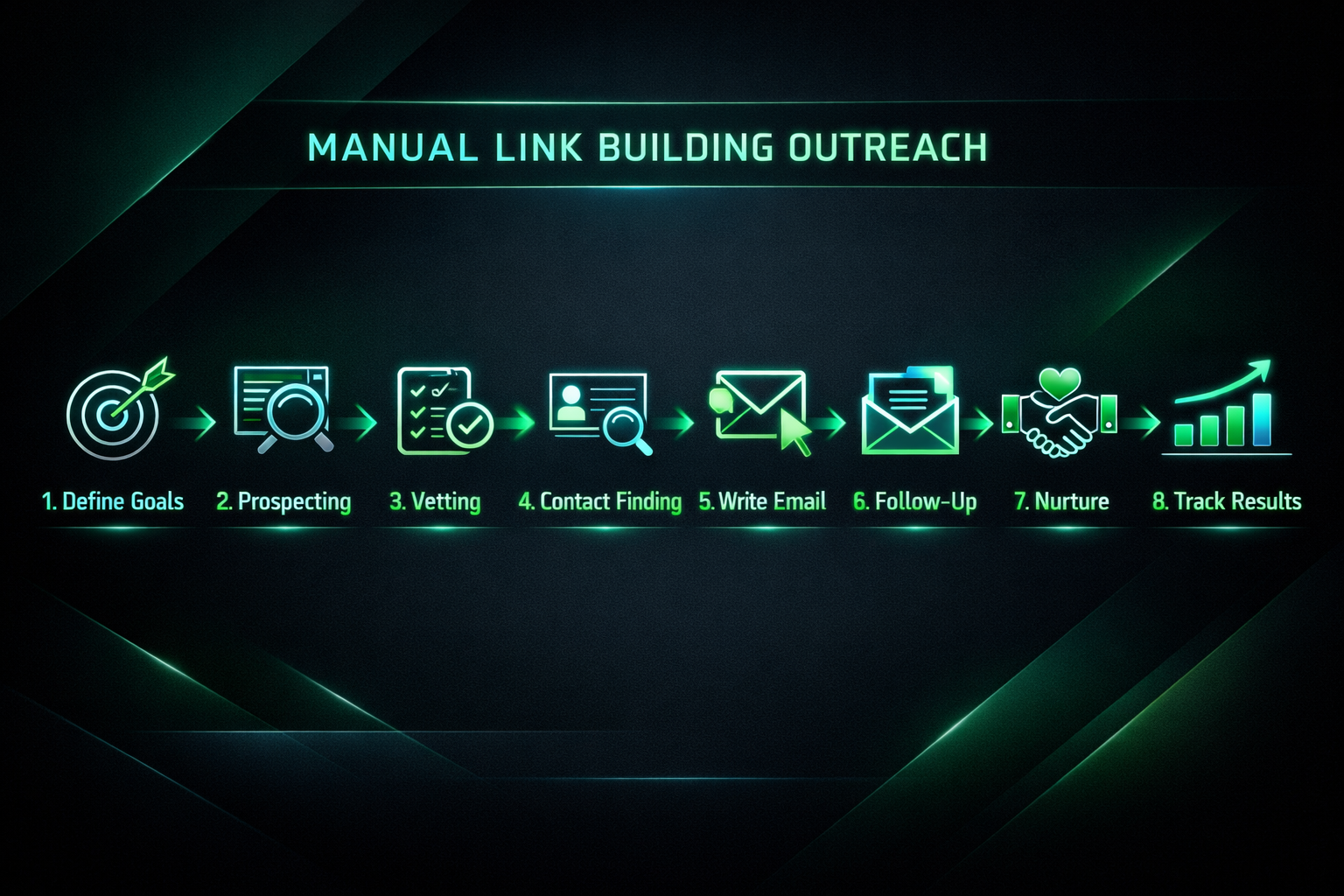
Step 1: Define Your Campaign Goals and Target Metrics
Before beginning link prospecting, define what success looks like. Decide which pages you are building links to, what domain rating or domain authority threshold you will accept, and what topical relevance criteria apply. Setting these parameters upfront prevents wasted outreach on low-value prospects and makes vetting faster.
Step 2: Link Prospecting
Link prospecting is the process of identifying candidate sites that may be willing to link to your content. Use Google search operators — such as intitle:”resources” + [your topic] or “write for us” + [niche keyword] — alongside Ahrefs or SEMrush competitor analysis to build your initial prospect list. Aim for a large enough pool that filtering still leaves an adequate volume of qualified targets.
Step 3: Prospect Vetting and Scoring
Not every site that appears relevant is worth pursuing. Link vetting should assess each prospect against a consistent set of criteria before you invest time in personalized outreach. The table below outlines a practical vetting framework.
| Metric | Recommended Threshold | Why It Matters |
|---|---|---|
| Domain Rating (DR) / Domain Authority (DA) | DR 30+ ideally DR 50+ | Indicates site’s overall link equity |
| Organic traffic | 500+ monthly visitors (Ahrefs estimate) | Confirms the site is actively indexed and visible |
| Referring domains | Diverse, not from a single source cluster | Flags potential link farm networks |
| Spam score | Below 30% (Moz) | Reduces association with low-quality link schemes |
| Niche relevance | Topically aligned with your target page | Contextual backlinks carry more SEO weight |
| Anchor text pattern | Mostly branded and natural anchors | Unnatural anchor ratios may signal a link farm |
Step 4: Contact Finding
Once you have a vetted prospect list, identify the correct contact — ideally an editor, content manager, or site owner rather than a generic info address. Tools such as Hunter.io, Voila Norbert, or LinkedIn can surface direct contact details. Reaching the right person materially improves response rates.
Step 5: Writing Personalized Outreach Emails
Personalized outreach emails are the single most important factor in outreach conversion. Generic mass emails are recognized immediately and ignored. Effective pitches demonstrate that you have read the site, reference a specific piece of their content, explain the value your resource adds for their audience, and make a clear, low-friction request.
A concise guest post pitch might reference a content gap on their site, propose a specific title addressing it, and include one or two relevant published examples as credibility signals. A broken link outreach email should identify the exact broken URL, explain what it used to link to, and propose your replacement with a brief explanation of relevance. Keep emails under 200 words where possible — clarity and brevity improve response rates more reliably than length.
Step 6: The Follow-Up Sequence
Most outreach responses come not from the initial email but from a follow-up sequence. A practical cadence is: initial email on day one, first follow-up at day four or five, second follow-up at day ten to twelve. A third follow-up at week three is optional and should close the thread politely if there is no response. Each follow-up should add brief value — a new angle, an updated resource, or a simple polite check-in — rather than simply repeating the original message. After three to four unanswered attempts, move on rather than risk marking your domain as a spam sender.
Step 7: Relationship Nurturing and Long-Term Partnerships
A placed link should not be the end of a relationship. Sites that have published your guest post or added a niche edit are warm contacts who may be open to future collaboration, co-authored content, expert quotes, or additional link placements. Building a record of reliable, high-quality contributors encourages editors to reach out proactively over time. This relationship building compounds the value of your outreach investment in ways that one-time placements cannot.
Step 8: Tracking, Measurement, and Reporting
Tracking outreach campaign performance closes the feedback loop and enables continuous improvement. Key metrics to monitor include: outreach email open rate, reply rate, placement rate (links earned per emails sent), average DR of acquired links, and any measurable change in organic traffic to target pages. Ahrefs Alerts and Google Search Console can flag when new links go live. Maintaining a tracking spreadsheet or CRM record of each placement — including the live URL, anchor text, and DR — allows you to audit your backlink profile and demonstrate ROI over time.
Tools That Support Manual Link Building
Manual link building is human-led, but the right tools reduce the time spent on prospecting, vetting, and outreach management substantially.
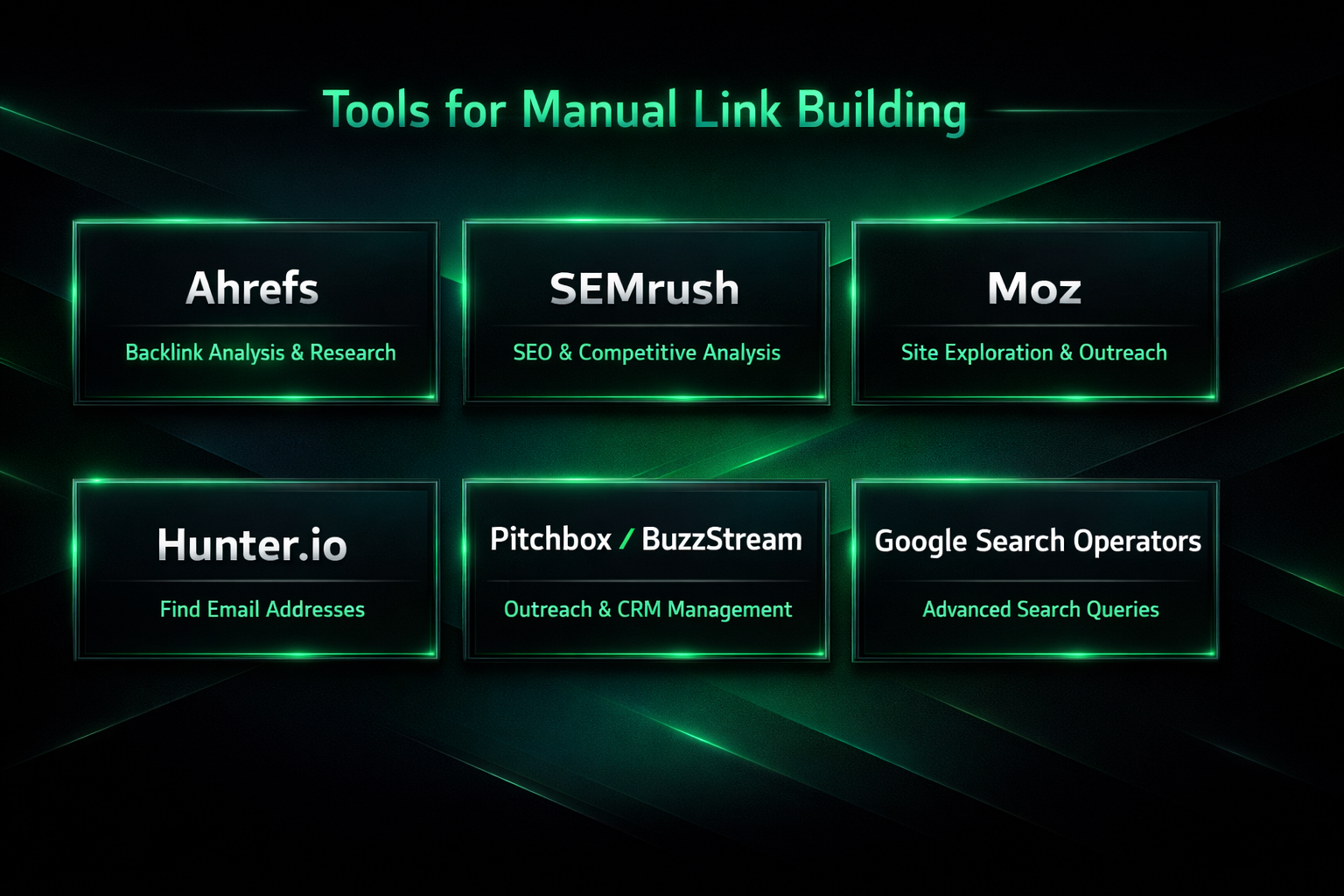
- Ahrefs: Competitor backlink analysis, broken link identification, DR checking, and content explorer for skyscraper research.
- SEMrush: Link gap analysis, domain overview, and keyword research to support content creation for outreach assets.
- Moz: Domain Authority scoring and spam score checking during prospect vetting.
- Hunter.io: Email discovery and verification for contact finding at scale.
- Pitchbox / BuzzStream / Woodpecker: Outreach campaign management, email scheduling, follow-up sequencing, and response tracking — without replacing the personalization requirement.
- Google Search Operators: Free prospecting method for resource pages, guest post opportunities, and niche directories using advanced search queries.
A note on AI tools in the current environment: AI can accelerate first-draft outreach template creation and prospect research summaries, but personalization that reads as genuinely human — referencing specific content, demonstrating real familiarity with the site — still requires human judgment. Over-reliance on AI-generated outreach at scale risks producing emails that editors recognize as templated, reducing response rates and potentially damaging your sender reputation.
Scaling Manual Link Building Without Losing Quality
Scaling a manual outreach process does not simply mean sending more emails. It means building systems — documented workflows, defined team roles, and consistent quality checkpoints — that allow volume to increase without compromising the standards that make manual link building effective in the first place.
A functional scaling structure typically assigns separate responsibilities for prospect research, vetting, contact finding, email writing and personalization, follow-up management, and link tracking. Standard operating procedures (SOPs) for each stage allow new team members to onboard without variability in output quality. A CRM or outreach management platform becomes essential at this point to avoid duplicate outreach to the same domains and to maintain a clear record of relationship history with each contact.
Sustainable SEO link building at scale also requires periodic backlink profile audits to identify and disavow any low-quality links that may have been placed incorrectly or that degrade over time. Quality control does not end at placement — it is an ongoing process.
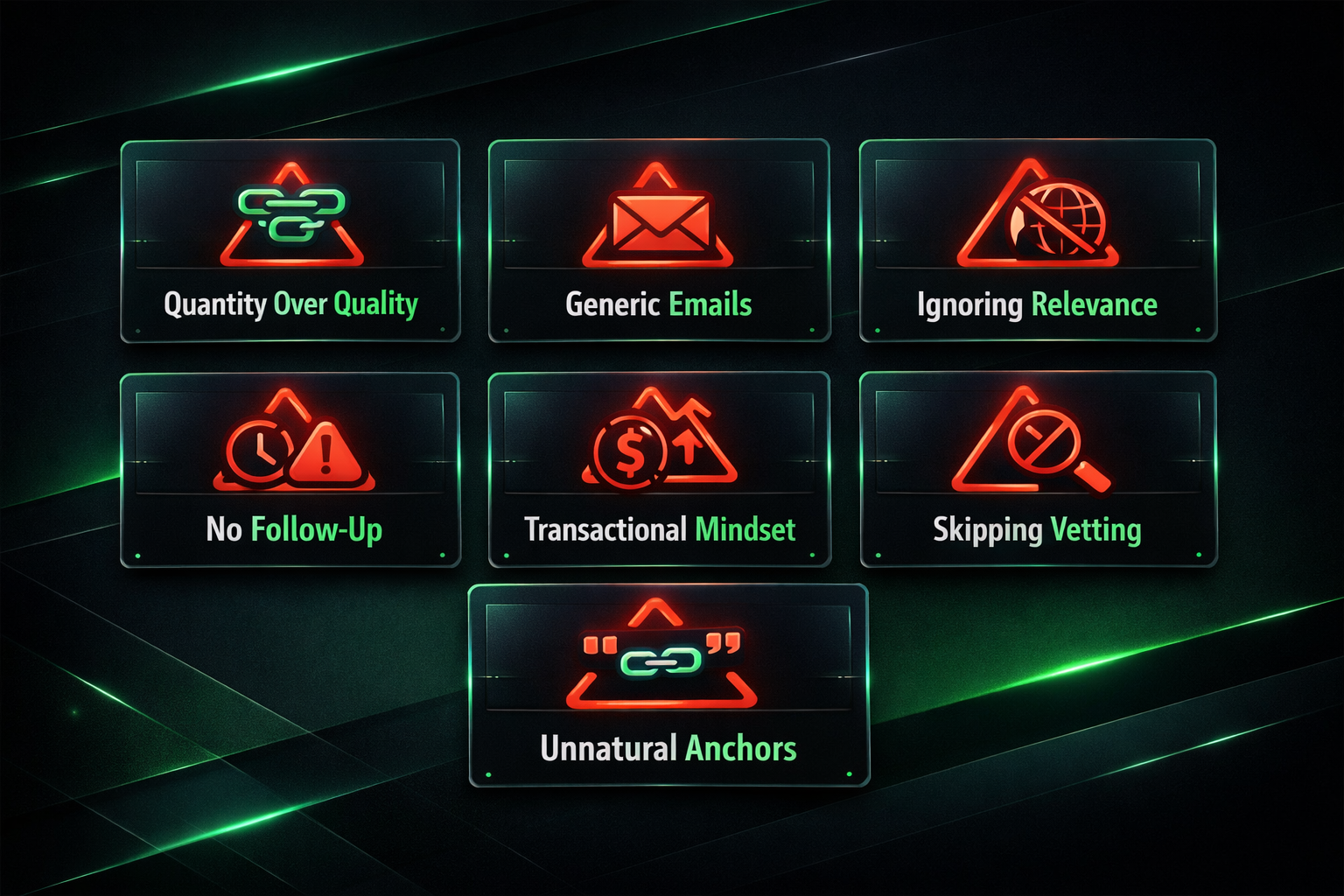
Common Mistakes to Avoid
- Prioritizing quantity over quality: Ten links from high-DR, niche-relevant authoritative websites consistently outperform one hundred links from low-quality directories with no real traffic.
- Generic outreach emails: Templates that fail to reference specific content on the target site are recognized and deleted. Personalization is not optional.
- Ignoring topical relevance: A backlink from a domain in an unrelated niche carries significantly less SEO weight and can create unnatural link patterns that attract algorithmic scrutiny.
- No follow-up process: Sending a single email and waiting passively misses the majority of conversion opportunities. A structured follow-up sequence is standard practice.
- Neglecting relationship nurturing: Treating outreach as purely transactional forfeits the compounding value of long-term editorial relationships.
- Skipping link vetting: Accepting any link offer without checking DR, traffic, spam score, and anchor text patterns exposes your backlink profile to quality and penalty risks.
- Unnatural anchor text concentration: Over-optimized exact-match anchor text across many new links can trigger algorithmic review. A natural anchor text distribution — branded, partial-match, and generic — is safer and more sustainable.
Frequently Asked Questions
How long does manual link building take to show results?
Most campaigns see measurable movement in organic rankings within three to six months of consistent link acquisition, though this varies by niche competitiveness, baseline domain authority, and the quality of links earned. Manual link building produces durable results rather than rapid spikes — the timeline reflects that difference.
How many follow-up emails should I send?
A standard follow-up sequence of two to three follow-ups after the initial email is widely considered appropriate. Beyond three unanswered contacts, continued outreach is unlikely to convert and risks your domain being marked as spam by recipients or email providers.
What is the difference between niche edits and guest posting?
Guest posting creates a new article on a third-party site, with your backlink placed within that new content. Niche edits — also called link insertions — place your backlink within an existing, already-indexed article on the target site. Both produce contextual backlinks; niche edits can deliver links from pages with established authority faster, while guest posts offer greater control over the surrounding content context.
Is it safe to use outreach tools and automation?
Outreach management tools such as Pitchbox, BuzzStream, or Woodpecker are safe and widely used to schedule emails, manage follow-up sequences, and track responses at scale. The risk arises when automation replaces personalization — sending identical bulk emails without any site-specific customization. Tools should support the outreach process, not replace the human judgment that makes it effective.
How do I know if a site is worth targeting for a backlink?
Evaluate each prospect against a consistent vetting framework: domain rating or domain authority (DR 30+ as a baseline), verified organic traffic, topical relevance to your target page, spam score below 30%, and a natural anchor text profile across the site’s existing backlinks. Sites that pass these criteria are worth personalizing an outreach email for.
Does manual link building still work in 2025?
Manual link building remains one of the most effective off-page SEO strategies available precisely because it produces the kind of editorial, contextually relevant backlinks that search algorithms are designed to reward. Automated and manipulative link schemes face increasing algorithmic and manual penalty risk. The value of genuine relationship-based link acquisition has increased as lower-quality tactics have become less reliable.
Building a Backlink Strategy Worth the Investment
Manual link building is not the fastest path to a larger backlink count — it is the most reliable path to a high-quality backlink profile that improves search authority durably. The strategies outlined here, from guest posting and broken link building to digital PR and niche edits, all share the same underlying principle: links should be earned because your content genuinely serves the audience of the site linking to it.
The outreach process that delivers that result requires structure — a vetting framework, personalized communication, a disciplined follow-up sequence, and ongoing relationship nurturing beyond the initial placement. When that process is documented into repeatable SOPs and supported by the right tools, it can be scaled without the quality compromises that cause automated approaches to underperform or backfire.
If your current backlink profile is thin, inconsistent in quality, or built through methods that carry penalty risk, a structured manual outreach campaign is worth planning carefully before launching. Auditing your existing links, defining your target metrics, and building your first prospect list with the vetting framework above are practical starting points that will serve any campaign at any scale.


