
Backlink Quality And Evaluate Link Quality For SEO Before Placement Approval
Backlink quality determines whether a placement supports rankings, strengthens trust and authority, or adds unnecessary SEO risk. As a professional outsource link-building agency, we do not approve a backlink only because a publisher offers it, a domain shows high DR, or a page appears acceptable in a backlink checker. We evaluate link quality through a structured backlink analysis process that covers the linking site, referring page, anchor text, link neighborhood, indexation, organic visits, and long-term placement stability.
Before any placement goes live, our team checks whether the backlink can pass link equity naturally, whether the external link appears within the body of relevant content, and whether the target keyword fits semantically into the article. This process helps SEO professionals, SaaS companies, e-commerce brands, affiliate marketers, website owners, and digital marketing agencies scale link-building campaigns without sacrificing quality control.
Backlink Quality Audit For SEO Results
A backlink quality audit is the process of evaluating whether an inbound link is worth approving before publication. For an outsourced link building agency, this audit protects the client’s overall backlink profile and ensures that every placement supports a clear SEO strategy.
A backlink audit should combine tool-based metrics with manual review. Ahrefs, Moz, Semrush, and similar backlink checker tools can show domain authority, DR, referring domains, organic traffic, link patterns, and anchor text distribution. Still, software alone cannot determine whether a page feels editorial, whether the content is relevant, or whether the publisher is likely to maintain the link after publication.
Our agency reviews backlink opportunities through three practical layers:
- Domain-level trust — traffic, authority, history, niche relevance, and link sources.
- Page-level value — content quality, indexability, internal visibility, and editorial depth.
- Link-level safety — anchor text, link location, dofollow and nofollow links, and outbound link context.
For clients who want safer acquisition, white hat link building services should prioritize manual outreach, real publisher placements, and quality backlinks build from websites with verifiable traffic.

Mon-Fri: 09:00 AM – 06:00 PM
Why Link Quality Matters For Rankings
Search engine systems evaluate more than the number of backlinks pointing to a website. A good backlink can support rankings because it transfers relevance, authority, and contextual confidence from one page to another. When dofollow links pass signals from a trusted linking site, they can help a target page compete in difficult SERPs.
Low-quality links create the opposite effect. A backlink from an irrelevant website, poorly reviewed expired domain, overloaded publisher, or weak network-based source may lose value quickly or contribute to risky link patterns. In competitive industries, poor links can also distort anchor text ratios and make a link profile look artificially manipulated.
Quality Vs Quantity In Link Building
Quality backlinks matter more than raw volume because one high-quality backlink from a relevant, traffic-verified publisher can outperform dozens of weak placements from thin websites. Quantity still matters in competitive SERPs, but it must be managed through controlled link velocity and careful publisher selection.
A professional link-building campaign should balance scale with review standards. We would rather approve 20 strong backlink placements from relevant publishers than 100 cheap links that create negative SEO risk or fail to pass more value over time.
Good, Bad, And Toxic Backlinks
A good link appears in quality content, supports the reader’s journey, and connects two semantically related pages. A weak backlink may be irrelevant, underpowered, or placed on a page with limited organic visibility. High-risk backlinks are more problematic because they often come from hacked sites, automated spam networks, foreign-language domains with no topical connection, or pages created only for manipulation.
Use this simple distinction during backlink analysis:
- Good backlink: relevant, editorial, indexed, traffic-supported, and useful for readers.
- Low-quality backlink: weak content, poor relevance, low organic visits, or limited SEO benefits.
- High-risk backlink: spam patterns, weak editorial control, irrelevant network signals, manipulation indicators, or harmful link sources.
- Neutral backlink: harmless but unlikely to pass link equity or influence rankings.
Backlink Value For AI Search Visibility
AI search engines such as ChatGPT, Perplexity, Gemini, and Claude increasingly surface information from entities that appear trustworthy, well-cited, and semantically consistent across the web. Editorial links from relevant websites help reinforce brand authority because they connect your company to known topics, services, and industries.
Backlinks do not work in isolation for AI visibility. Strong editorial links, earned media, quality content, entity consistency, and clear topical coverage work together. A backlink that supports SEO can also help AI systems associate a brand with specific expertise when the link appears in a meaningful context.
Link Analysis Framework Before Placement Approval
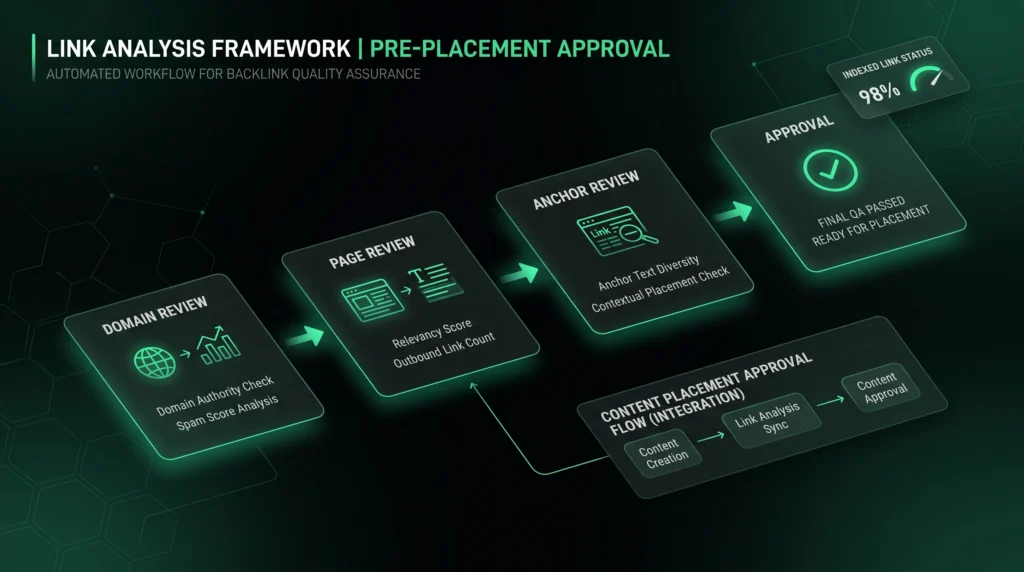
A link analysis framework gives every backlink opportunity a consistent approval path. Without a defined process, link-building teams may approve placements based on vanity metrics, publisher pressure, or incomplete data. That is how weak links enter a campaign.
Our agency uses a pre-approval checklist before any external link is accepted. The process of evaluating a placement includes domain review, page review, anchor text review, link neighborhood inspection, live backlink validation, and final approval. Each step reduces the risk of irrelevant links, manipulative anchors, and low-value placements.
Referring Domain Review
The referring domain review checks whether the linking site is real, active, and relevant. We look at organic visits, topic coverage, historical traffic trends, DR, DA, indexed pages, and the quality of other websites linking to the domain.
A high domain authority score can be useful, but it is never enough on its own. Some domains have strong metrics because of expired-domain manipulation or old backlinks that no longer reflect current website quality.
Referring Page Review
The referring page must support the backlink contextually. We review the title, headings, body content, internal links, outbound links, and target keyword alignment before approving a placement.
A good page should have enough depth to justify the external link. Thin content, generic AI-generated text, outdated information, or unrelated sections reduce the SEO benefits because the backlink does not sit inside a strong semantic environment.
Anchor Text Review
Anchor text helps search engines interpret the relationship between the linking page and the target page. Keyword-rich anchor text can be useful, but excessive exact-match anchors can look unnatural when repeated across a backlink profile.
Our agency manages anchor text distribution across branded, partial-match, topical, URL, and natural anchors. This reduces the risk of manipulation and keeps campaign scaling safer.
Link Neighborhood Check
A link neighborhood review looks at all external links on the referring page. If the same article links to gambling, adult, pills, crypto scams, and unrelated commercial pages, the placement may lose value or introduce risk.
Before approval, we check whether the page has:
- Relevant outbound links to credible resources.
- A reasonable number of external links.
- No links to poker, pills, adult, or obvious spam categories.
- No pattern of unrelated commercial anchors.
- No signs that the page exists only to sell links.
A strong backlink should sit among relevant citations, helpful resources, or editorial references. The surrounding links should make sense to a human reader.
Live Backlink Verification
After the placement goes live, we verify the backlink manually. We check whether the link is clickable, whether it points to the correct target URL, whether the anchor text matches approval, and whether the page can be crawled.
Live verification is important because publisher edits happen. Sometimes a planned dofollow link becomes nofollow, a target URL is changed, or the article is published on a weaker page than originally approved.
Final Approval Criteria
A backlink should be approved only when it passes domain, page, anchor, neighborhood, and technical checks. We use final approval criteria to decide whether a placement supports the client’s SEO strategy or should be replaced.
For agencies managing multiple clients, consistent approval rules are especially important. When teams ask whether they should build links internally or outsource fulfillment, white label link building for SEO agencies can help them scale outreach, publisher communication, and reporting without losing quality control.
Referring Domain Metrics For Quality Backlinks
Referring domain metrics help SEO teams filter backlink opportunities before manual review. Metrics are not perfect, but they provide a useful first layer for link analysis. A website with traffic, stable growth, relevant keywords, and healthy referring domains is usually safer than a site with inflated authority and no organic footprint.
Professional link-building teams should never approve a domain based on one metric. Ahrefs DR, Moz DA, Semrush traffic, keyword footprint, and backlink profile patterns should be reviewed together.
Domain Rating And Domain Authority
Domain Rating and Domain Authority estimate how strong a domain’s backlink profile may be. High DR and high domain authority can indicate that a linking site has earned strong inbound links over time.
However, DR and DA can be manipulated. A high-authority domain with no real traffic, irrelevant content, or spammy outbound links may not pass link equity in a meaningful way.
Organic Traffic Minimums
Organic traffic is one of the most useful filters in backlink analysis. A linking site with consistent organic visits is more likely to be trusted by search engine systems than a site built only to sell links.
During review, we usually check:
- Estimated monthly organic traffic.
- Ranking keyword count.
- Traffic source countries.
- Top pages by organic visits.
- Whether traffic comes from relevant topics.
- Whether traffic has been stable or artificially inflated.
Traffic does not need to be massive, but it should be real, stable, and supported by ranking keywords. A smaller relevant publisher can be more valuable than a high DR domain with no audience alignment.
Six-Month Traffic Trend
A six-month traffic trend shows whether a publisher is growing, stable, or declining. A sudden drop may indicate algorithm impact, content decay, technical problems, or manual quality issues.
We avoid placements on domains with extreme traffic volatility unless there is a clear explanation. Stable traffic reduces the risk that a backlink will lose value shortly after publication.
Referring Domain Growth
Healthy referring domain growth usually looks gradual and diverse. Unnatural spikes from unrelated websites, foreign-language domains, or low-quality directories can indicate risky link patterns.
A quality backlink source should have links pointing from real websites, not only automated platforms. This matters because trust and authority are built through credible references over time.
Audience Geography And Language Match
Audience geography helps determine whether the linking site can support the client’s market. A U.S. SaaS company usually benefits more from English-language publishers with American organic traffic than from unrelated sites ranking in countries outside its target audience.
Language match also matters. If the content, TLD, traffic origin, and target audience do not align, the backlink may appear irrelevant even when the domain has good metrics.
Technical Trust And Domain History

Technical trust signals help confirm that a publisher is legitimate, secure, and stable. A website can look attractive in a backlink checker but still show signs of poor maintenance or suspicious ownership history. That is why technical checks are part of our approval process.
We review DNS records, HTTPS usage, hosting patterns, domain history, indexation, and signs of expired-domain repurposing. These checks are practical, not theoretical. Publishers with unstable technical foundations are more likely to disappear, redirect, or lose search visibility.
DNS Records
DNS records can reveal whether a website is properly configured and actively maintained. Broken records, frequent hosting changes, or unusual technical setups may suggest instability.
When reviewing technical trust, we look for:
- Stable domain configuration.
- No obvious expired-domain footprint.
- No suspicious mass redirects.
- Consistent ownership and content history.
- No technical blocks that prevent crawling.
- No major mismatch between domain history and current topic.
We do not reject a publisher only because of DNS complexity. Still, technical irregularities become important when combined with thin content, sudden traffic spikes, or suspicious link sources.
HTTPS And SSL Usage
HTTPS is a basic trust requirement for modern websites. A publisher without SSL creates a poor user experience and may signal weak maintenance standards.
For link-building campaigns, HTTPS also affects perception. A backlink from a secure, professional website is more credible than an external link from a neglected site with browser security warnings.
Hosting Country And TLD Match
Hosting country and TLD do not need to match perfectly, but they should make sense. An English-language website targeting U.S. readers can use global hosting, but a strange mismatch between language, TLD, traffic, and content theme may require deeper review.
We look for consistency. When a domain claims to serve one audience but ranks for unrelated foreign keywords, the placement may not support the client’s SEO strategy.
Topical Relevance And Keyword Fit
Topical relevance is one of the strongest indicators of backlink quality. A backlink should connect pages that share a logical subject relationship. If the linking site covers marketing, SaaS, e-commerce, finance, or B2B operations, a link to a relevant commercial or informational page can make sense.
Keyword fit also matters. The target keyword should not be forced into a sentence. A natural backlink placement should read like an editorial recommendation, not a paid insertion designed only to pass link juice.
Niche Match Between Sites
A niche match means the linking site and target page serve related audiences. For example, a marketing technology blog can naturally link to a SaaS SEO guide, but a pet care blog linking to enterprise cybersecurity software may look irrelevant.
Search engines evaluate relationships semantically. The closer the topical connection, the more likely the backlink will support relevance and trust.
Guest Post Relevance
Guest post backlinks work best when the article is written for the publisher’s audience and not only for link placement. A good guest post provides practical insights, clear expertise, and a natural reason to cite the target page.
Our agency reviews guest post opportunities using practical relevance checks:
- Does the topic match the publisher’s existing categories?
- Would the publisher’s audience benefit from the target URL?
- Can the backlink be placed within the body naturally?
- Does the article support the target keyword without stuffing?
- Does the content meet editorial standards?
- Will the placement still make sense months after publication?
This approach improves approval rates and helps the backlink remain live long term.
Link Insertion Context
Niche edit links, also called link insertions, place a backlink into an existing article. This strategy can be effective when the article already has rankings, organic visits, and topical relevance.
The risk appears when the inserted link feels disconnected from the paragraph. We check whether the sentence around the link supports the target URL naturally and whether the page still reads well after the edit.
HARO And Digital PR Link Quality
HARO backlinks and digital PR links can deliver strong authority when they come from editorial coverage, journalist quotes, or earned media. These links often appear on high-authority websites and can strengthen brand credibility.
Not every earned media link passes the same value. Some editorial links are nofollow, some appear in syndicated content, and some pages may not rank. We still value digital PR when it builds real visibility and entity trust.
Semantic Relevance To Target Page
Semantic relevance means the linking page, anchor text, and target page share a meaningful topic relationship. The backlink should help a reader move from one useful resource to another.
A semantically relevant link can pass more value because it reinforces the target page’s topic. This is especially important for AI search visibility, where entities, attributes, and context influence how content is interpreted.
Editorial Page Quality Review
Editorial page quality determines whether the backlink appears inside content that deserves trust. A page may be indexed and hosted on a decent domain, but still fail if the article is thin, unreadable, outdated, or overloaded with commercial links.
Our agency checks whether the content meets editorial standards before approval. This protects clients from backlinks that may look acceptable in tools but fail human review.
Content Quality And Readability
Quality content should be clear, useful, and written for readers. It should not exist only to hold links. We review sentence quality, topical depth, formatting, originality, and whether the article answers real search intent.
A page is more likely to pass review when it has:
- Clear structure and logical flow.
- Useful information beyond generic SEO text.
- Natural use of keywords and entities.
- No obvious spun or low-effort writing.
- Helpful internal and external references.
- Readable formatting for human visitors.
Readability also affects trust. If a page is stuffed with awkward phrases or irrelevant sections, the backlink may appear manipulative even if the domain metric looks strong.
Last Update Date
A recent update date can indicate that the publisher maintains content. However, update dates can be misleading when websites refresh timestamps without improving articles.
We check whether the content itself is current. If facts, screenshots, statistics, or tool references are outdated, the page may lose value over time.
Author Credibility
Author credibility supports E-E-A-T. A real author bio, industry background, social presence, or publication history makes the page more trustworthy.
Anonymous content is not always bad, but it requires stronger domain and editorial signals. For sensitive industries such as finance, health, legal, and cybersecurity, author credibility matters even more.
Link Location On Page
A backlink within the body of the article usually has more contextual value than a footer, sidebar, author box, or random resource list. Placement location affects both user engagement and search engine interpretation.
We prefer contextual backlinks placed in relevant paragraphs. The link should support the reader at the exact point where more detail is useful.
Contextual Prominence
Contextual prominence measures how visible and meaningful the backlink is inside the article. A link buried near the bottom of an unrelated paragraph may pass less value than a clear citation in a relevant section.
The surrounding text should explain why the target page is useful. A strong backlink looks like a helpful recommendation, not an isolated anchor.
Paid Post Footprint
A paid post footprint appears when a website publishes obvious sponsored content at scale with little editorial control. Signs include generic topics, repeated outbound link patterns, commercial anchors, and unrelated client links across many posts.
We do not reject every sponsored or contributed article. We reject pages where the commercial footprint overwhelms the editorial value.
Anchor Text And Outbound Link Checks
Anchor text and outbound links shape how search engines interpret a backlink. A good link should use natural anchor text and appear near other relevant references. When anchors are over-optimized or outbound links point to unrelated industries, the backlink can look risky.
We manage anchor text distribution across the full campaign, not only one placement. This is essential because one keyword-rich anchor text may be fine, while repeated exact-match anchors across many publishers may suggest manipulation.
Anchor Text Naturalness
Natural anchor text fits the sentence. It can be branded, partial-match, topical, URL, or descriptive, depending on the page and campaign stage.
For new websites, we often use more branded and URL anchors. For established websites, partial-match anchors can be introduced carefully when the backlink profile is already diversified.
Anchor Abuse Warning Signs
Anchor abuse appears when too many backlinks use the same commercial phrase. This can create unnatural link patterns, especially if the same target keyword appears across unrelated publishers.
Warning signs include:
- Repeated exact-match anchors across many domains.
- Awkward grammar around the anchor.
- Anchors that do not match the linked page.
- Commercial anchors on irrelevant pages.
- Too many dofollow links using the same phrase.
- Sudden anchor text shifts during campaign scaling.
Anchor text should help the reader, not force an SEO signal. If the anchor feels unnatural, the placement should be revised before approval.
Outbound Link Quality
Outbound link quality shows whether the referring page links to trustworthy resources. A page with helpful references, credible citations, and relevant external links is usually safer than a page linking to random commercial sites.
We also check whether outbound links are excessive. If an article links to dozens of unrelated client pages, the backlink may lose value because the page appears built for link selling.
Poker, Pills, Adult Link Risks
Links to poker, pills, adult content, and other high-risk categories are major warning signs when they appear on unrelated publishers. These patterns can indicate spam monetization or weak editorial control.
A clean link neighborhood reduces the risk of association with low-quality websites. For client campaigns, we avoid publishers that repeatedly link to risky verticals outside their stated niche.
High-Quality Backlink Validation
High-quality backlink validation happens after approval and again after publication. A placement is not complete when the publisher says it is live. It is complete when the backlink is verified, indexed, technically correct, and documented.
Our agency tracks placement status, publication URL, anchor text, target URL, dofollow or nofollow attribute, indexation, and early ranking movement. Clients receive transparent link building reports so campaign performance can be reviewed without guessing.
Google Indexing Check
A backlink cannot deliver full SEO benefits if the referring page is not indexed. We check whether the page appears in Google and whether it is accessible to crawlers.
Indexing is not always immediate. New pages may take time, but persistent non-indexation can indicate thin content, blocked crawling, poor internal linking, or weak domain quality.
Dofollow Vs Nofollow Status
Dofollow and nofollow links serve different purposes. Dofollow links pass link equity more directly, while nofollow links may still support traffic, brand exposure, and natural link profile diversity.
A campaign should not consist only of dofollow links from commercial placements. A natural backlink profile often includes a mix of dofollow, nofollow, branded mentions, editorial links, and earned media references.
Target URL Accuracy
Target URL accuracy is basic but critical. A backlink pointing to the wrong URL, redirected page, staging domain, or broken page may waste the placement.
We verify the final destination before and after the placement goes live. If redirects are required, we check whether they are intentional and whether the target page can still pass value efficiently.
Hyperlink Validation
Hyperlink validation confirms that the external link is active, clickable, crawlable, and placed in the approved location. We also check whether the anchor text matches the agreed version.
Our post-publication validation usually includes:
- Confirm the article URL is live.
- Check whether the page is indexable.
- Verify the anchor text and target URL.
- Confirm dofollow or nofollow status.
- Review final link placement within the body.
- Record the placement in reporting.
- Monitor indexing and early performance signals.
Publisher edits happen more often than clients expect. Manual validation catches these issues before they affect reporting and campaign performance.
Low-Quality And Toxic Backlinks
Low-quality and toxic backlinks require different responses. A weak backlink may simply provide little value, while toxic backlinks may increase risk because they come from spam networks, hacked pages, irrelevant domains, or manipulative link sources.
For outsourced link-building campaigns, prevention is better than cleanup. We reject risky publishers before placement because removing bad links after publication is slower and less predictable.
Signs Of Low-Quality Links
Low-quality links often share visible patterns. They may come from sites with no organic visits, thin articles, irrelevant topics, excessive outbound links, or poor grammar.
Common warning signs include:
- No ranking keywords in Ahrefs or Semrush.
- Sudden traffic drops without recovery.
- Repeated sponsored posts across unrelated niches.
- Generic author profiles.
- Weak internal linking.
- No real audience engagement.
- Overloaded outbound link sections.
- Poor formatting and thin content.
A low-quality backlink may not trigger a penalty, but it usually does not support long-term SEO growth.
Toxic Backlink Risk Factors
High-risk backlinks often show stronger spam signals. These links may come from hacked websites, auto-generated pages, irrelevant domains, overloaded publisher networks, or sources created only for SEO manipulation.
The main concern is pattern risk. One suspicious backlink may not matter, but repeated toxic backlinks across a backlink profile can create signals that search engines may ignore or devalue.
Spammy Domain Patterns
Spammy domains often have inflated authority, unrelated content clusters, and unnatural outbound link footprints. A website may publish articles about SaaS, casino, supplements, loans, pets, and crypto with no editorial logic.
We also look for reused themes, duplicated author bios, fake traffic, and sudden referring domain spikes. These patterns suggest that the domain may exist primarily to sell links.
Disavow Tool Use Cases
The disavow tool should be used carefully. In most cases, search engines can ignore spammy backlinks without manual action, but disavow may be useful when a website has a history of aggressive link-building, obvious negative SEO, or a large number of toxic backlinks.
We do not recommend disavowing links just because a tool labels them toxic. Manual backlink analysis should confirm whether the links are genuinely risky.
Links Worth Ignoring
Some links are not worth removing or disavowing. Scraper links, random low-value mentions, and weak directory links often have little impact.
The smarter approach is to focus on building quality backlinks that improve the overall backlink profile. Strong editorial links can dilute weak signals and support better long-term authority.
FAQ
Backlink quality should be checked through domain review, page review, anchor text review, link neighborhood analysis, technical validation, and post-publication verification. Ahrefs, Moz, Semrush, and backlink checker tools can provide useful metrics, but manual review is needed to confirm whether the placement is editorial, relevant, indexed, and safe for the overall backlink profile.
No single backlink quality metric matters most in every campaign because organic traffic, topical relevance, referring domain quality, page context, and anchor text distribution work together. If one signal deserves priority, it is relevance supported by real traffic, because a relevant backlink from a trusted website with organic visits is usually more valuable than a high DR link from an irrelevant domain.
Yes, low-traffic backlinks can still pass SEO value when the linking page is relevant, indexed, editorial, and connected to a trustworthy domain. The exception is a website with no traffic, no rankings, no real content standards, and no audience, because that type of backlink may pass little value or lose value quickly.
Paid backlinks should be approved only when they meet strict quality, relevance, and placement standards. A paid placement can support SEO when it is contextual and useful, but cheap bulk placements, weak editorial review, irrelevant sources, and aggressive anchor patterns can increase risk and weaken the link profile.
Toxic backlinks should be disavowed when manual review confirms meaningful risk, especially after aggressive link-building, negative SEO, or links from obvious spam networks. The disavow tool should not be used only because software labels a link toxic, because removing useful links by mistake can reduce authority.
Fast link building can hurt rankings when link velocity looks unnatural, anchor text is over-optimized, or placements come from low-quality sources. Controlled scaling is different because a strong campaign can increase link velocity safely when backlinks come from relevant publishers, use natural anchors, and support a broader SEO strategy.


