When a URL changes, the redirect type you choose can affect how search engines interpret your backlinks and how much of their value is passed to the destination page. The debate around 301 vs 302 redirects for backlinks has evolved considerably as Google has updated its guidance, yet practical questions remain for SEO teams managing link building campaigns, site migrations, and URL restructuring. This article explains how each redirect type works, what the current evidence suggests about link equity transfer, and what to consider when redirects intersect with your backlink profile.
Quick Comparison
| Characteristic | 301 Redirect | 302 Redirect |
|---|---|---|
| Redirect type | Permanent | Temporary |
| Intended signal to search engines | The resource has moved permanently | The resource has moved temporarily |
| Link equity transfer (Google’s stated position) | Passes PageRank; historically considered full transfer | Google states it also passes PageRank in practice |
| Canonical signal | Strong; search engines typically consolidate to destination | Weaker; original URL may remain indexed |
| Indexing behaviour | Destination URL typically replaces source in index | Source URL may remain in index |
| Crawl and processing delay | May take weeks to months to fully consolidate | Similar delay; consolidation less certain |
| Typical use case | Permanent URL changes, site migrations, domain changes | A/B testing, temporary campaigns, maintenance pages |
| Risk of equity loss | Low when implemented correctly; some historical debate | Potentially higher if misused for permanent moves |
| Recommended for permanent backlink consolidation | Yes | Generally no |
What 301 and 302 Redirects Actually Mean
A redirect is an HTTP status code that tells browsers and search engine crawlers that a URL has moved. The number indicates the type of move. A 301 redirect signals a permanent move: the resource at the original URL has been relocated to a new address indefinitely. A 302 redirect signals a temporary move: the resource is currently available at a different URL, but the original address is expected to return. These are HTTP-level instructions, not visible to ordinary website visitors, but they carry meaningful implications for how search engines handle indexing and link equity.
Other redirect codes exist — 303, 307, and 308 among them — but 301 and 302 are the most commonly encountered in SEO contexts and the ones most frequently discussed in relation to backlink value. A 307 redirect is the HTTP/1.1 equivalent of a 302, preserving the request method, while a 308 is the permanent equivalent of a 307. For most practical link building and site migration discussions, the 301 vs 302 distinction remains the most relevant starting point.
How Redirects Interact with Backlink Equity
Backlink equity — sometimes called link juice or PageRank — refers to the ranking signal that a backlink passes from the linking page to the destination. When a URL that has earned backlinks is redirected, the question becomes: does the destination URL inherit that signal, and does the redirect type affect how much is transferred?
Google’s publicly documented position, confirmed by former Googler John Mueller in multiple statements, is that both 301 and 302 redirects pass PageRank. This represents a shift from older SEO guidance, which suggested that 302 redirects did not pass link equity and that only 301 redirects reliably transferred backlink value. Google has stated that it treats both redirect types similarly in terms of PageRank flow, provided the redirect is implemented correctly and the destination page is crawlable and indexable.
However, there is an important practical distinction that affects backlinks specifically: canonicalisation. A 301 redirect sends a strong canonical signal, meaning search engines are more likely to consolidate the link equity and indexing status to the destination URL. A 302 redirect, being temporary by definition, may cause search engines to retain the original URL in the index and treat the destination as a secondary location. This means that backlinks pointing to a 302-redirected URL may be associated with the original URL rather than the destination, which can complicate link consolidation during site migrations or domain changes.
The Historical Debate and Where It Stands Now
For many years, SEO practitioners operated under the assumption that 301 redirects passed approximately 90–99% of link equity, while 302 redirects passed little or none. This belief influenced site migration strategies, domain consolidation decisions, and even tactics for acquiring redirected domains with existing backlink profiles. Some of this guidance originated from early Google documentation and was reinforced by observational SEO studies, though the methodology of those studies varied considerably.
Google’s more recent guidance has clarified that the distinction in PageRank transfer between 301 and 302 redirects is less significant than previously believed. The more meaningful variable is whether the redirect is implemented correctly, whether the destination page is accessible to crawlers, and whether the redirect chain is short. A single, clean redirect from a well-linked URL to a relevant destination page is more likely to preserve backlink value than a multi-hop redirect chain, regardless of whether each hop uses a 301 or 302 status code.
That said, the canonical signal difference remains practically relevant. If you are permanently moving a URL that has earned valuable backlinks, using a 302 redirect introduces ambiguity. Search engines may not consolidate the link signals as efficiently, and the original URL may continue to compete with the destination in the index. For permanent changes, a 301 redirect remains the cleaner and more widely recommended choice among SEO professionals, even if the PageRank transfer difference is smaller than once thought.
Redirect Chains, Crawl Budget, and Backlink Value
One area where redirect type matters less than redirect structure is the issue of redirect chains. A redirect chain occurs when URL A redirects to URL B, which redirects to URL C, and so on. Each hop in a redirect chain introduces a potential point of signal dilution and increases the crawl cost for search engines. Long redirect chains can slow down the consolidation of backlink equity and may cause some crawlers to abandon the chain before reaching the final destination.
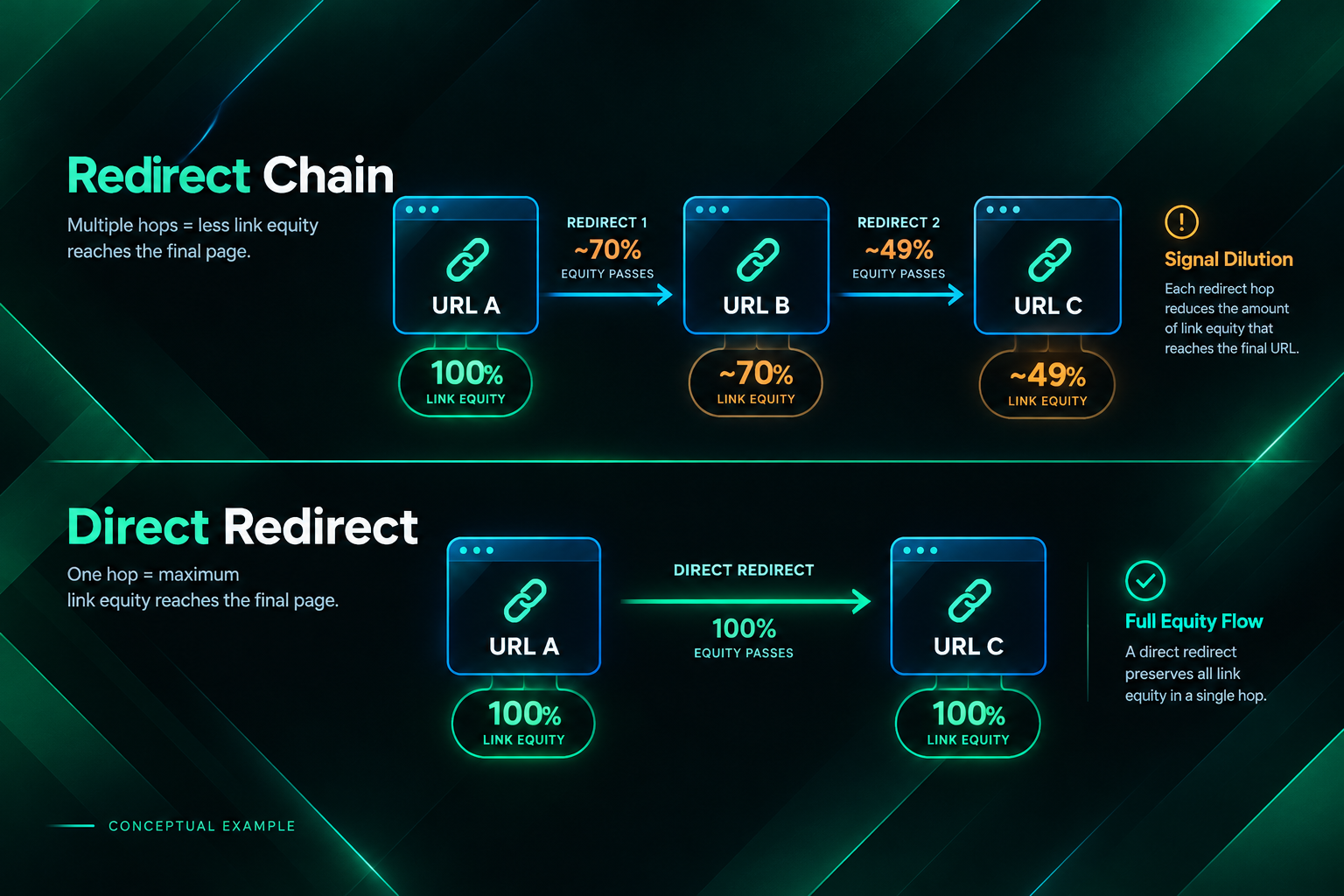
From a link building campaign perspective, redirect chains are worth auditing regularly. If backlinks point to a URL that sits in the middle of a chain, the equity those links pass may be reduced or delayed in reaching the intended target page. Tools such as Screaming Frog, Ahrefs, or Semrush can help identify redirect chains within a site’s architecture, allowing SEO teams to flatten chains where possible and ensure that backlinks point as directly as possible to the intended destination.
Crawl budget is a related consideration for larger websites. Search engines allocate a finite amount of crawling resource to each site. Redirect chains consume crawl budget without delivering indexable content, which can slow the discovery and processing of new backlinks. While crawl budget is generally a concern for large-scale sites rather than smaller ones, it is worth considering when planning site migrations or URL restructuring that affects pages with significant backlink profiles.
When Redirects Affect Link Building Campaigns
Redirects intersect with link building campaigns in several practical scenarios. Understanding each helps SEO teams and campaign managers make better decisions about URL structure, target pages, and backlink consolidation.
Site Migrations and Domain Changes
A site migration — moving from one domain to another, switching from HTTP to HTTPS, or restructuring URL paths — is one of the most common situations where redirect type directly affects backlink value. When a domain with an established backlink profile is migrated, 301 redirects from old URLs to their new equivalents are the standard recommendation. This signals to search engines that the move is permanent and encourages them to transfer the link equity and indexing status to the new URLs. Using 302 redirects during a permanent migration risks leaving the old URLs indexed and splitting the link signals between old and new locations.
Acquiring Domains with Existing Backlinks
Some link building strategies involve acquiring expired or auctioned domains that carry existing backlink profiles, then redirecting those domains to a target site. The intent is to inherit the referring domain’s backlink equity. Whether this approach delivers meaningful SEO benefit depends on several factors: the relevance of the acquired domain to the target site, the quality and topical alignment of the backlinks pointing to it, whether those backlinks are from genuine editorial sources, and how Google evaluates the redirect in context.
Google has indicated that it can and does evaluate the context of redirected domains. A redirect from a topically unrelated domain, or from a domain with a history of spam or manipulative link patterns, is unlikely to pass meaningful equity and may attract scrutiny. This tactic carries higher risk than acquiring editorial backlinks through manual outreach or guest posting, and the evidence for its long-term effectiveness is mixed. A site-specific assessment is advisable before pursuing this approach.
Target Page Changes During Active Campaigns
During an active link building campaign, the target page URL should ideally remain stable. If a target page URL changes after backlinks have been acquired — for example, due to a CMS migration or URL restructuring — a 301 redirect from the old URL to the new one is the appropriate response. This helps preserve the backlink equity that the campaign has built. Without a redirect, backlinks pointing to the old URL will lead to a 404 error, and the link equity they carried will be lost.
Campaign managers working with outsourced link building providers should communicate any planned URL changes before they occur. Retroactively fixing broken backlinks is possible through outreach to publishers requesting URL updates, but this adds time and cost to a campaign. Proactive URL management is considerably more efficient.
Temporary Redirects for Testing and Maintenance
A 302 redirect is appropriate when a URL genuinely needs to be temporarily unavailable — for example, during A/B testing of a landing page, a short-term promotional campaign, or scheduled maintenance. In these cases, using a 302 correctly signals to search engines that the original URL should remain indexed and that the redirect is not a permanent change. Using a 301 in this scenario could cause search engines to deindex the original URL, which would be counterproductive if the intention is to restore it.
Practical Implications for Link Building Strategy
For most link building campaigns, the redirect type question is less about choosing between 301 and 302 and more about ensuring that the URLs being targeted are stable, correctly configured, and free from redirect issues that could dilute the value of acquired backlinks.
Before launching a link building campaign, it is worth auditing the target pages for existing redirect issues. A target page that is itself the destination of a redirect chain, or that has a redirect pointing away from it, may not accumulate backlink equity as efficiently as a clean, directly accessible URL. Similarly, if the site has recently undergone a migration, confirming that all 301 redirects are correctly implemented and that the new URLs are indexed is a sensible precaution before investing in new backlink acquisition.
The quality and relevance of the backlinks acquired remain the primary determinants of link building campaign value. A high-quality editorial backlink from a topically relevant, well-regarded publication pointing to a stable target URL will generally deliver more measurable SEO benefit than a technically optimised redirect structure pointing to a low-quality or irrelevant destination. Redirect hygiene supports link building effectiveness; it does not substitute for it.
Assessing Backlink Quality Through Redirected URLs
When auditing a backlink profile using tools such as Ahrefs, Semrush, or Majestic, redirected URLs can sometimes appear as referring domains or backlinks. It is worth understanding what these entries represent. A backlink from a redirected URL means the linking page points to a URL that no longer serves content directly but instead redirects to another location. The equity value of that backlink depends on the redirect type, the redirect chain length, and whether the destination is relevant and accessible.
Third-party metrics such as Domain Rating (Ahrefs), Domain Authority (Moz), Authority Score (Semrush), and Trust Flow (Majestic) are proprietary calculations and are not Google metrics. They can be useful for comparative assessment of referring domains, but they do not directly measure how much PageRank a redirected backlink passes. A high Domain Rating on a redirected domain does not guarantee that the redirect will deliver meaningful ranking benefit to the destination site. These metrics should be treated as one input in a broader quality assessment, not as a definitive measure of backlink value.
Common Misconceptions About Redirects and Backlinks
Several persistent misconceptions about redirects and backlink equity are worth addressing directly.
- Misconception: 302 redirects never pass link equity. Google’s documented position is that both 301 and 302 redirects pass PageRank. The difference lies more in canonicalisation behaviour than in equity transfer.
- Misconception: A 301 redirect always passes 100% of link equity. Google has not confirmed a specific percentage. Some signal loss may occur, particularly through redirect chains or when the destination page is not well-optimised for the relevant topic.
- Misconception: Redirecting any domain with backlinks will improve rankings. The relevance, quality, and editorial nature of the backlinks pointing to the redirected domain matter significantly. Redirecting a domain with low-quality or spammy backlinks is unlikely to help and may introduce risk.
- Misconception: Redirect type is the most important factor in backlink value. Content quality, topical relevance, editorial context, and the authority of the linking page are generally more influential than whether a redirect uses a 301 or 302 status code.
- Misconception: Fixing redirects will immediately improve rankings. Search engines need time to recrawl and reprocess redirected URLs. Changes in rankings or organic visibility following redirect corrections may take weeks or months to become measurable, and other SEO factors will also influence outcomes.
Frequently Asked Questions
Does a 302 redirect pass link equity to the destination page?
According to Google’s documented guidance, a 302 redirect does pass PageRank to the destination page. However, a 302 redirect does not send a strong canonical signal, so the original URL may remain indexed and link signals may not consolidate as cleanly as with a 301 redirect. For permanent URL changes, a 301 redirect is generally the more appropriate choice.
Will fixing a 302 redirect to a 301 immediately improve my rankings?
Not necessarily, and not immediately. Search engines need to recrawl the affected URLs and reprocess the redirect signals, which can take weeks or longer depending on crawl frequency and site size. Any ranking changes will also depend on other factors including content quality, competition, and the overall backlink profile. Redirect corrections are one component of technical SEO, not a standalone ranking solution.
Should I use 301 redirects when migrating a site with valuable backlinks?
Yes, 301 redirects are the standard recommendation for permanent site migrations. They signal to search engines that the move is permanent and encourage consolidation of link equity and indexing status to the new URLs. Using 302 redirects during a permanent migration introduces ambiguity and may slow or reduce the transfer of backlink value.
How many redirects in a chain are acceptable before link equity is significantly affected?
Google has not published a specific limit, but the general SEO guidance is to keep redirect chains as short as possible — ideally a single hop. Longer chains increase crawl cost, introduce more potential points of failure, and may slow the consolidation of backlink equity. Where possible, update redirect chains so that the source URL points directly to the final destination.
Can I build backlinks to a redirected URL and expect the destination to benefit?
Backlinks are most effective when they point directly to the intended target page. Building backlinks to a URL that redirects to another location introduces an additional processing step and some uncertainty about how efficiently the equity transfers. If you are planning a link building campaign, ensure that target page URLs are stable, directly accessible, and not themselves the source of a redirect.
Is redirecting an expired domain with backlinks a reliable link building strategy?
This approach carries meaningful risk and the evidence for its long-term effectiveness is mixed. Google evaluates the context of redirected domains, including the relevance and quality of their backlink profiles. Domains with topically unrelated or low-quality backlinks are unlikely to deliver significant benefit and may attract scrutiny. A site-specific assessment and careful due diligence on the acquired domain’s backlink history are advisable before pursuing this tactic.
Choosing the Right Redirect Type for Your Backlink Strategy
The practical answer to the 301 vs 302 question for backlinks is more nuanced than older SEO guidance suggested. Google’s current position is that both redirect types pass PageRank, but 301 redirects provide a cleaner canonical signal and are the appropriate choice for any permanent URL change — including site migrations, domain consolidations, and URL restructuring that affects pages with existing backlink profiles. Using a 302 redirect for a permanent move introduces indexing ambiguity that can slow or complicate the consolidation of backlink equity.
For link building campaigns, the redirect type question is secondary to ensuring that target pages are stable, technically accessible, and free from redirect chains that could dilute the value of acquired backlinks. Auditing your site’s redirect structure before launching a campaign, and communicating any planned URL changes to your link building provider in advance, are practical steps that help protect the investment made in backlink acquisition.
If your site has recently undergone a migration, has a complex redirect structure, or you are considering acquiring a domain with an existing backlink profile, a technical SEO audit is a sensible starting point before making decisions about link building strategy. The interaction between redirects and backlink equity is one factor in a broader picture that includes content quality, topical relevance, and the competitive landscape of your target keywords. A qualified SEO provider can help assess how redirect configuration may be affecting your current backlink profile and what steps, if any, are worth prioritising.