Paid backlinks occupy one of the most debated corners of SEO, and the question of whether they violate Google’s guidelines has a clear answer in policy terms — but a more nuanced one in practice. Google’s spam policies explicitly prohibit buying or selling links that pass PageRank, yet paid link acquisition remains widespread. Understanding exactly what the policy covers, where the genuine risks lie, and what compliant alternatives exist is essential before making any link building decision.
Key Takeaways
- Google’s spam policies explicitly classify buying or selling links that pass PageRank as a link scheme, making most paid backlinks a direct policy violation.
- The risk is not theoretical: Google’s algorithms and manual review teams actively target unnatural link patterns, and penalties can significantly reduce organic visibility.
- The rel=”sponsored” or rel=”nofollow” attribute is required for paid placements; using it means the link does not pass PageRank and therefore does not provide the SEO benefit most buyers are seeking.
- Compliant link acquisition strategies — including editorial outreach, digital PR, and content-driven link building — can build authority without the policy exposure that paid links carry.
- Whether any link building approach is appropriate depends on a site’s existing profile, technical condition, content quality, and competitive landscape, not on a universal formula.
What Google’s Guidelines Actually Say About Paid Links
Google’s spam policies, documented in its Search Central guidelines, define a link scheme as any attempt to manipulate PageRank or a site’s ranking in Google Search results. Buying or selling links that pass PageRank is listed explicitly as an example of a link scheme. The policy covers both the site purchasing the link and the site selling it. Google’s guidance states that this includes exchanging money for links, exchanging goods or services for links, and sending a product to a reviewer in exchange for a link — unless that link carries a qualifying attribute.
The qualifying attribute matters significantly. Google requires that any paid or sponsored link use the rel=”sponsored” attribute, or at minimum rel=”nofollow”, to signal that the link should not be treated as an editorial endorsement. A link carrying either of these attributes does not pass PageRank in the way a standard followed link does. This means that a properly disclosed paid placement technically complies with Google’s policy — but it also means the link delivers little or no direct ranking benefit, which defeats the primary reason most businesses pay for backlinks in the first place.
The practical implication is straightforward: a paid link that passes PageRank violates Google’s guidelines, and a paid link that complies with Google’s guidelines by carrying the sponsored or nofollow attribute does not pass PageRank. There is no compliant middle ground that allows a paid link to function as a ranking signal.
How Google Detects Paid and Unnatural Links
Google uses a combination of algorithmic detection and manual review to identify unnatural link patterns. The Penguin algorithm update, first launched in 2012 and later integrated into Google’s core ranking system, was specifically designed to devalue or penalise sites with manipulative backlink profiles. While Google has not published a detailed technical description of every detection signal it uses, its public guidance and documented enforcement actions point to several patterns that attract scrutiny.
Algorithmic signals associated with unnatural link profiles include a sudden spike in referring domains pointing to a single page, a high proportion of exact-match anchor text across multiple linking domains, links from sites with no topical relevance to the target site, links embedded in site-wide footers or widgets across many domains, and clusters of links from domains that appear to exist primarily to sell placements. None of these signals is conclusive on its own, but combinations of them can trigger algorithmic devaluation or flag a site for manual review.
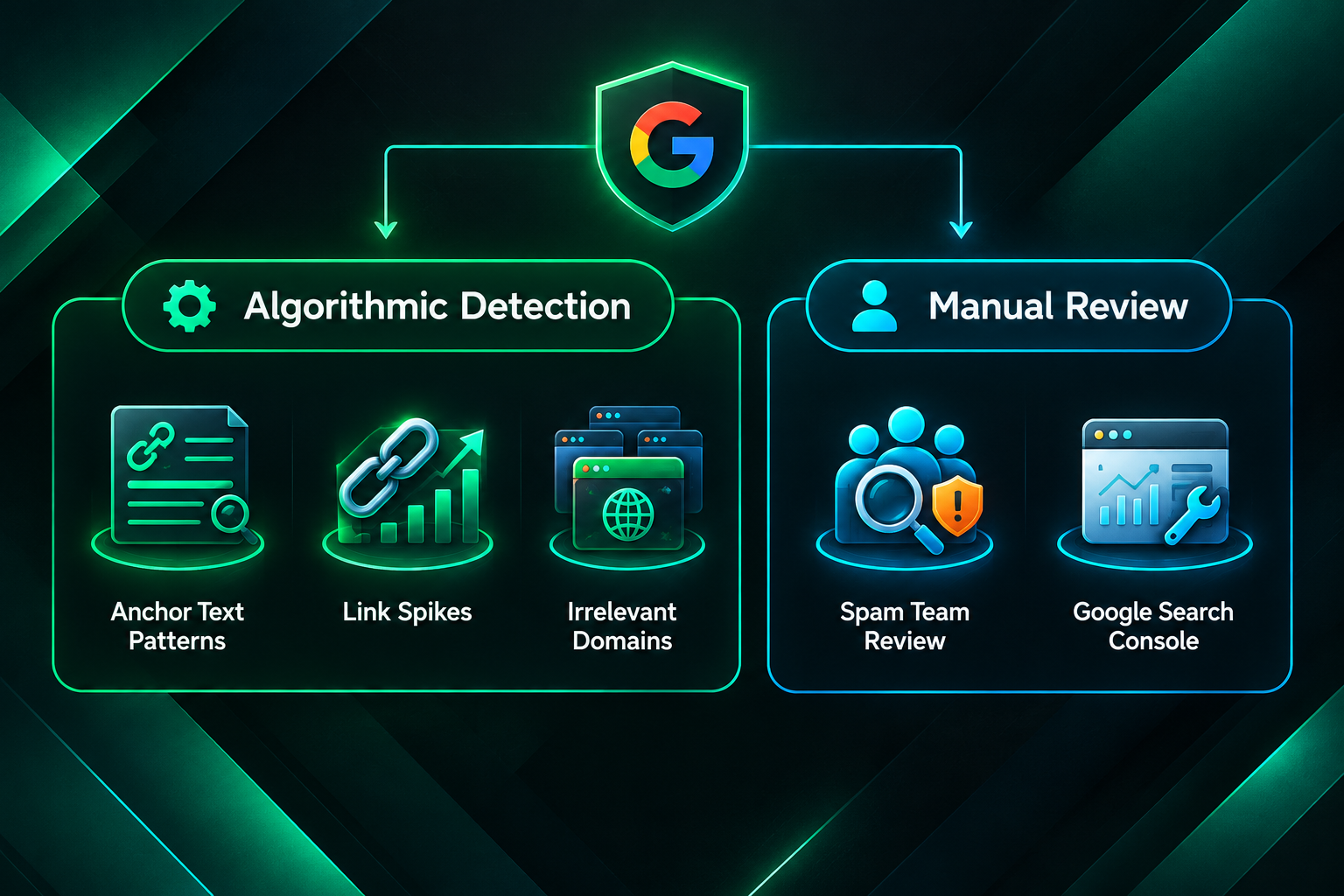
Manual actions are issued by Google’s spam team when a reviewer determines that a site’s link profile violates the spam policies. A manual action targeting unnatural inbound links can result in a partial or full demotion of the affected site’s rankings. Manual actions are visible in Google Search Console under the Security and Manual Actions section, and they require a reconsideration request after the problematic links have been addressed — typically through removal or disavowal.
It is worth noting that Google’s detection is not perfect, and many paid link campaigns operate for extended periods without triggering a visible penalty. However, the absence of an immediate penalty does not indicate that the links are passing full value or that the risk has been eliminated. Google has stated that it may simply choose to ignore links it identifies as manipulative rather than always issuing a manual action, meaning the investment may deliver no benefit even when no penalty is visible.
The Difference Between Paid Links and Paid Content
A common source of confusion is the distinction between paying for a link and paying for content that happens to include a link. Sponsored content, advertorials, and paid guest posts all involve a financial transaction, but the policy treatment depends on how the link within that content is attributed.
If a business pays a publisher to place an article that contains a followed link back to its site, that arrangement falls within Google’s definition of a paid link scheme regardless of whether the content itself is high quality. The payment is for the link’s SEO value, and Google’s policy does not make an exception for well-written sponsored content. The publisher is required to add the rel=”sponsored” attribute to any links within paid placements.
Legitimate guest posting, by contrast, involves a publisher independently deciding to accept and publish a contributed article based on its editorial merit, without a financial transaction for the link itself. The distinction is editorial independence: the publisher chooses to include the link because it adds value to their readers, not because they have been paid to do so. In practice, the line between paid guest posting and editorial guest posting can be blurry, particularly when agencies pitch content to publishers who accept contributions selectively. The key question Google’s guidelines point to is whether the link reflects a genuine editorial decision or a commercial transaction.
Real Risks of Buying Backlinks
The risks associated with paid link schemes are meaningful and worth examining honestly rather than dismissing or overstating.
Algorithmic Devaluation
Google’s systems may identify paid links and choose to ignore them rather than count them as ranking signals. In this scenario, the business has paid for links that deliver no SEO benefit. This outcome is difficult to detect because rankings may not change visibly — the links simply do not contribute to the site’s authority as intended.
Manual Penalties
A manual action for unnatural inbound links can cause significant ranking drops across a site’s pages. Recovering from a manual action requires identifying and removing or disavowing the problematic links, submitting a reconsideration request, and waiting for Google’s team to review the request. This process can take weeks or months and does not guarantee full ranking recovery, particularly if the site’s organic visibility was heavily dependent on the penalised links.
Vendor Quality and Longevity
Many paid link vendors operate link networks, private blog networks (PBNs), or low-quality content sites that exist primarily to sell placements. Links from these sources carry a higher detection risk and may be devalued quickly. Additionally, paid placements on third-party sites can be removed if the publisher changes their policy, the site is sold, or the payment arrangement lapses, meaning the link and any associated benefit may disappear without notice.
Reputational and Brand Risk
A site associated with a manual action or a publicly visible penalty may face reputational consequences beyond rankings, particularly in industries where trust and credibility are central to the business model. Agencies managing client campaigns that include paid links also carry responsibility for the policy exposure this creates.
What Compliant Link Building Looks Like
Compliant link acquisition focuses on earning links through editorial decisions made by publishers and site owners, rather than through financial transactions for followed links. Several established approaches can build a site’s backlink profile without the policy exposure that paid links carry.
Manual Outreach and Editorial Guest Posting
Manual outreach involves identifying relevant, authoritative publishers in a site’s niche and pitching original content contributions. When a publisher accepts a guest post based on its editorial merit and includes a followed link to the contributing site, that link reflects a genuine editorial decision. The quality of the placement depends on the publisher’s own authority, topical relevance, and audience engagement — factors that third-party metrics such as Ahrefs’ Domain Rating (DR) or Moz’s Domain Authority (DA) can help assess, though these metrics are not Google signals and should not be treated as guarantees of ranking impact.
Editorial guest posting at scale requires significant outreach effort, content production, and publisher relationship management. Outsourcing this process to a specialist provider can reduce the internal workload, but the quality of the resulting placements depends on the provider’s publisher network, vetting standards, and outreach methodology. A site-specific assessment is advisable before committing to a campaign, as the appropriate target publishers and anchor text strategy will vary by niche, existing backlink profile, and competitive landscape.
Digital PR and Earned Media
Digital PR involves creating content, data, or stories that journalists and publishers choose to cover and link to independently. This approach can generate high-authority links from news sites, industry publications, and reference resources that would be difficult or impossible to acquire through direct outreach. The links earned through digital PR are typically editorial by nature, meaning they carry no policy risk. However, digital PR campaigns require investment in content creation and media outreach, and results are less predictable than outreach-based methods because publication decisions rest entirely with the journalist or editor.
Niche Edits and Link Insertions
Niche edits involve adding a link to an existing published article rather than creating new content. When a publisher agrees to insert a link into existing content because it genuinely improves the article for their readers, the arrangement can be editorially defensible. However, niche edits are frequently sold as a paid service, in which case the same policy considerations as paid guest posts apply: a financial transaction for a followed link is a link scheme under Google’s guidelines, regardless of whether the host content is established or high quality. The editorial versus commercial distinction is the same as for guest posting.
Content-Driven Link Acquisition
Creating genuinely useful resources — original research, comprehensive guides, tools, or data sets — can attract links organically as other sites reference the content. This approach requires upfront investment in content quality and promotion but can generate links that are entirely editorial and therefore carry no policy risk. The timeline for results is typically longer than outreach-based methods, and the volume of links generated depends heavily on the content’s relevance, originality, and distribution reach.
Assessing Backlink Quality Beyond Policy Compliance
Policy compliance is a necessary condition for a link building strategy, but it is not sufficient on its own to determine whether a link will contribute meaningfully to a site’s organic performance. Several quality factors influence how much value a compliant editorial link may provide.
- Topical relevance: A link from a site covering closely related topics is generally more contextually appropriate than a link from an unrelated domain, regardless of the linking site’s authority metrics.
- Publisher authority and traffic: Links from sites with established organic traffic and genuine audiences are more likely to reflect real editorial value than links from low-traffic sites created primarily for link placement.
- Placement context: A link embedded naturally within the body of a relevant article carries more contextual weight than a link in a sidebar, footer, or author bio.
- Anchor text: Anchor text that describes the linked content naturally is appropriate; a high proportion of exact-match commercial anchor text across multiple links can appear manipulative regardless of whether the links were paid for.
- Link attribute: A followed link from an editorially independent publisher is the standard for a link that may contribute to rankings. Nofollow and sponsored links serve different purposes and should not be expected to function as ranking signals in the same way.
Third-party metrics such as DR, DA, Authority Score, and Trust Flow can provide a useful starting point for publisher assessment, but they are proprietary tool metrics, not Google signals, and they do not guarantee that a link will improve rankings or traffic. A link from a high-DR domain that is topically irrelevant or placed in a low-quality context may contribute less than a link from a mid-authority domain with strong topical alignment and genuine readership.
When Low Organic Visibility Is Not a Link Problem
Businesses sometimes consider paid links as a quick fix for underperforming pages or low organic visibility, but backlinks are not always the primary limiting factor. Low organic visibility can result from crawling or indexing problems that prevent pages from appearing in search results, content that does not match the search intent of target queries, thin or outdated content that does not satisfy user needs, internal linking structures that fail to distribute authority to priority pages, or strong competition from established sites with significantly larger and more authoritative backlink profiles.
Adding backlinks — whether paid or earned — to a page with fundamental content or technical issues is unlikely to produce meaningful ranking improvements. A site-specific audit that examines technical SEO health, content quality, search intent alignment, and the existing backlink profile is a more reliable starting point than assuming that link acquisition alone will resolve a visibility problem. Link building is most likely to contribute to improved rankings when the target pages are technically sound, content is genuinely competitive, and the primary gap relative to ranking competitors is in the quantity or quality of referring domains.
Frequently Asked Questions
Does Google always penalise sites that buy backlinks?
Not always immediately. Google may choose to ignore links it identifies as manipulative rather than issuing a manual action. However, ignored links provide no ranking benefit, and the risk of a manual penalty remains. The absence of a visible penalty does not mean the links are passing value or that the risk has been eliminated.
Is it safe to pay for guest posts if the content is high quality?
Quality of content does not determine policy compliance. If a financial transaction is involved in securing a followed link, Google’s guidelines classify the arrangement as a paid link scheme. The publisher is required to use the rel=”sponsored” attribute on any links within paid placements, which means the link does not pass PageRank.
What is the difference between a sponsored link and a paid backlink?
A sponsored link uses the rel=”sponsored” attribute to signal to Google that the link is part of a commercial arrangement. This complies with Google’s disclosure requirements but means the link does not function as a ranking signal. A paid backlink that uses a standard followed link attribute without disclosure violates Google’s spam policies and is the type of link that carries penalty risk.
Can I disavow paid links if I receive a manual action?
Yes. Google’s Disavow Tool allows site owners to ask Google to ignore specific links when assessing a site’s backlink profile. Disavowal is typically used as part of a manual action recovery process after attempting to remove the problematic links directly. Disavowal does not guarantee recovery, and the process requires careful identification of the links causing the issue.
How long does it take to recover from a paid link penalty?
Recovery timelines vary significantly depending on the extent of the unnatural link profile, how quickly problematic links can be removed or disavowed, and how long Google’s manual review team takes to process a reconsideration request. Recovery can take weeks to several months, and full restoration of previous rankings is not guaranteed, particularly if the site’s historical performance was heavily dependent on the penalised links.
Are niche edits safer than paid guest posts?
From a policy perspective, the same rules apply. If a niche edit involves a financial transaction for a followed link, it falls within Google’s definition of a link scheme. The age or quality of the host content does not change the policy classification. Editorially placed link insertions — where a publisher adds a link because it genuinely improves existing content — are a different matter, but distinguishing these from paid placements in practice requires transparency from the provider about their acquisition process.
Should I use nofollow links for brand awareness even if they don’t help rankings?
Nofollow and sponsored links can contribute to referral traffic and brand visibility even without passing PageRank. For some businesses, particularly those in competitive niches where editorial followed links are difficult to acquire, a diversified approach that includes compliant paid placements for awareness alongside an editorial link building programme may be worth considering. The value depends on the quality of the referring site’s audience and the relevance of the placement to the target market.
Deciding on a Link Building Approach That Manages Policy Risk
The core answer to whether paid backlinks are against Google’s guidelines is yes — when those links pass PageRank without the required disclosure attributes. This is not a grey area in Google’s published policy, even if enforcement is inconsistent in practice. The risk is real, the potential consequences are significant, and the compliant alternative — a link that carries the sponsored attribute — does not deliver the ranking benefit that motivates most paid link purchases.
Compliant link building through editorial outreach, digital PR, and content-driven strategies requires more time and investment than purchasing links, but it builds a backlink profile that is not dependent on avoiding detection. The appropriate strategy for any given site depends on its existing backlink profile, technical SEO health, content quality, competitive environment, and business goals — factors that a qualified SEO provider can assess before recommending a specific approach.
If you are evaluating link building options and want to understand which strategies may be appropriate for your site’s current situation, discussing your goals with an experienced provider before committing to a campaign is a practical starting point. A transparent conversation about acquisition methods, publisher vetting, and policy compliance is a reasonable expectation from any reputable link building service.