Managing an outreach email suppression list is one of the less glamorous but genuinely important parts of running a sustainable link building or digital PR campaign. Without a properly maintained suppression list, your outreach team risks repeatedly contacting people who have already opted out, emailing invalid addresses that damage sender reputation, or approaching publishers who have already declined or placed a link. This guide explains what a suppression list is, why it matters for outreach campaigns, and how to build and maintain one that keeps your campaigns clean, compliant, and effective over time.
Key Takeaways
- A suppression list is a record of email addresses, domains, and contacts that should be excluded from future outreach, including opt-outs, hard bounces, previous placements, and declined prospects.
- Maintaining a suppression list protects sender reputation, reduces wasted outreach effort, and helps campaigns remain compliant with email regulations such as CAN-SPAM and GDPR.
- Suppression lists should be updated continuously throughout a campaign, not just at the start or end of an outreach cycle.
- For agencies running white-label or multi-client campaigns, suppression lists must be segmented carefully to avoid cross-contaminating client data or re-approaching contacts on behalf of different clients inappropriately.
- Integrating suppression data with your outreach CRM or prospecting tool is the most reliable way to prevent suppressed contacts from re-entering active sequences.
What Is an Outreach Email Suppression List?
An outreach email suppression list is a structured record of contacts, email addresses, or domains that your team has decided to exclude from future outreach communications. In the context of link building and digital PR, suppression lists typically cover several distinct categories: people who have explicitly asked not to be contacted again, email addresses that have hard-bounced, publishers or webmasters who have already declined a placement request, websites where a link has already been secured, and contacts who fall outside updated targeting criteria.
The term is borrowed from email marketing, where suppression lists are a standard compliance mechanism. In outreach-driven link acquisition, the concept serves a similar purpose but with additional layers relevant to campaign management. A link building suppression list is not just about legal compliance — it is also a practical tool for avoiding duplicate outreach, protecting relationships with publishers, and keeping campaign data clean across multiple outreach cycles or client accounts.
Suppression lists are sometimes confused with blocklists or blacklists, but the distinction matters. A blocklist typically refers to an external list maintained by email service providers or anti-spam organisations that flags domains or IP addresses sending unwanted mail. A suppression list is an internal record your team controls and updates based on your own campaign history and contact preferences.
Why Suppression List Management Matters for Link Building Campaigns
Link building outreach depends on maintaining credible, professional relationships with publishers, editors, and webmasters. Contacting the same person twice with the same pitch after they have already declined, or emailing an address that has previously bounced, signals poor organisation and can damage your sender reputation with email service providers. Over time, a high bounce rate or a pattern of complaints from recipients who have previously opted out can cause your outreach domain to be flagged, reducing deliverability across all future campaigns.
From a compliance perspective, regulations such as the CAN-SPAM Act in the United States and the General Data Protection Regulation in the European Union impose specific obligations on commercial email senders. CAN-SPAM requires that opt-out requests be honoured within ten business days and that suppressed contacts are not re-added to active lists. GDPR imposes broader requirements around consent, data minimisation, and the right to erasure. While the precise legal obligations depend on the jurisdiction of both the sender and the recipient, maintaining a suppression list is a foundational step toward compliance in most markets. This article does not constitute legal advice, and teams operating across multiple jurisdictions should seek appropriate guidance.
Beyond compliance, suppression list management has a direct effect on campaign efficiency. Outreach teams that re-approach already-declined publishers waste prospecting time, consume outreach tool credits, and risk souring relationships that might otherwise have been revisited under different circumstances. A well-maintained suppression list allows your team to focus effort on genuinely new prospects rather than cycling through contacts who have already been exhausted.
What to Include in a Link Building Suppression List
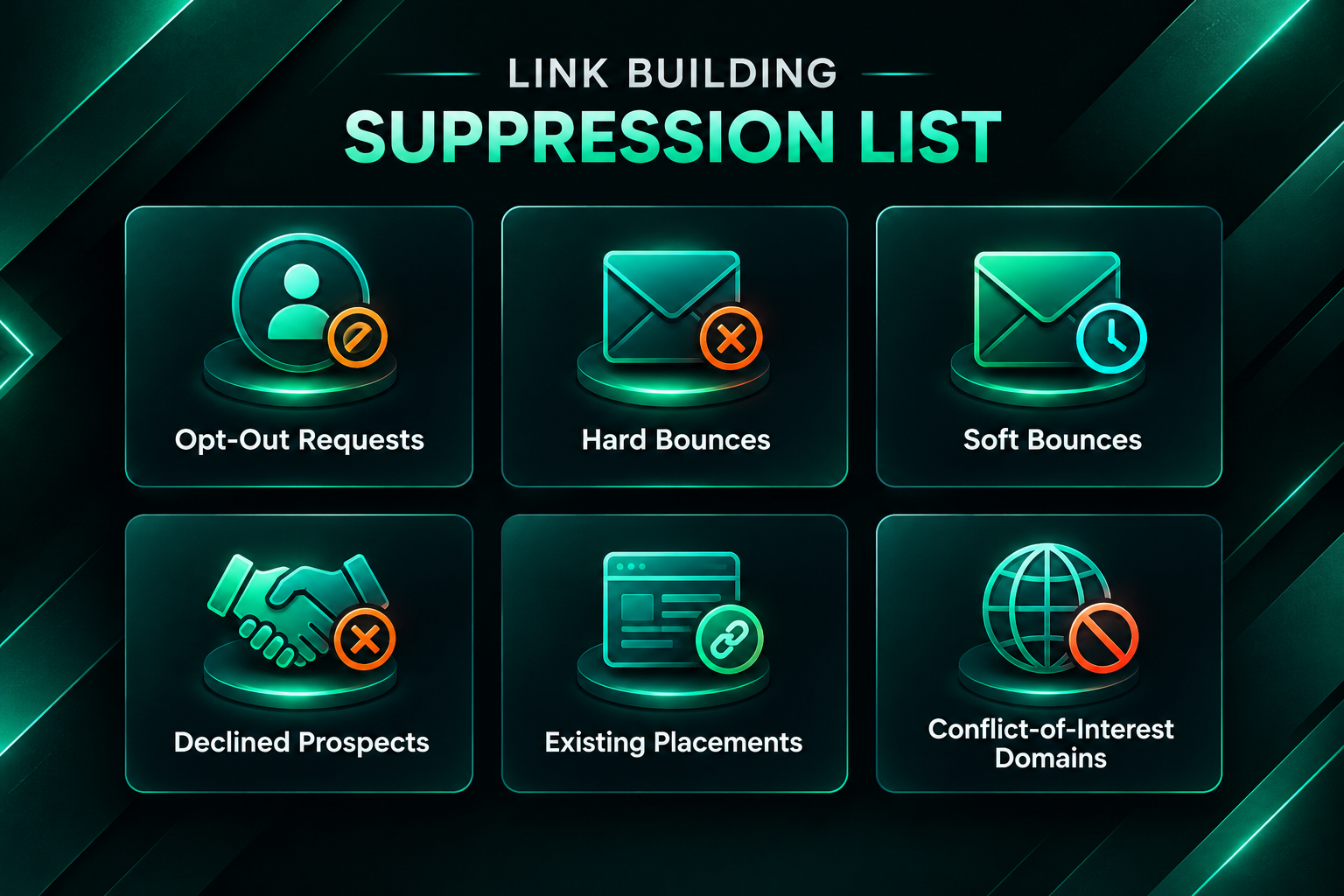
A useful suppression list for link building outreach typically contains several distinct categories of contact, each requiring slightly different handling.
Opt-Out and Unsubscribe Requests
Any contact who explicitly asks to be removed from your outreach list must be added to the suppression list immediately. This includes replies that say “please remove me”, “not interested — do not contact again”, or any equivalent phrasing. These contacts should be suppressed at the email address level and, depending on the nature of the request, potentially at the domain level if the request comes from a site owner or editor acting on behalf of their publication.
Hard Bounces
A hard bounce occurs when an email is permanently undeliverable — typically because the address does not exist, the domain has expired, or the mailbox has been closed. Hard-bounced addresses should be removed from active sequences and added to the suppression list immediately. Continuing to send to hard-bounced addresses increases your bounce rate, which most email service providers treat as a negative signal that can affect deliverability for your entire sending domain.
Soft Bounces Requiring Review
Soft bounces — temporary delivery failures such as a full inbox or a server timeout — do not automatically require suppression, but addresses that soft-bounce repeatedly over multiple attempts should be reviewed. If an address consistently fails to receive mail over several weeks, it is worth suppressing it to avoid ongoing deliverability risk.
Declined Prospects
Publishers or webmasters who have reviewed a pitch and declined should be recorded in the suppression list with a note about the reason and the date of the decline. Some declines are permanent (“we do not accept guest contributions”), while others may be situational (“not the right fit at this time”). Recording this distinction allows your team to make an informed decision about whether a contact might be approached again in a different context, with a different client, or after a meaningful interval.
Existing Placements
Websites where a link has already been placed for a given client should be suppressed from further outreach for that client, at least until there is a clear strategic reason to pursue a second placement. Re-approaching a publisher who has already placed a link can appear opportunistic and may reduce the editorial credibility of future requests.
Competitor or Conflict-of-Interest Domains
In some campaigns, certain domains may be off-limits for outreach due to existing client relationships, competitive conflicts, or editorial policies. These should be documented and suppressed at the domain level to prevent accidental contact.
How to Build and Structure Your Suppression List
The format of a suppression list depends on the tools your team uses for outreach, but the underlying structure should be consistent regardless of the platform. At minimum, each suppression record should include the email address or domain being suppressed, the category of suppression (opt-out, hard bounce, declined, placed, conflict), the date the record was added, the campaign or client context, and any relevant notes about the reason for suppression.
For small campaigns managed by a single person, a shared spreadsheet with clear column headers and a consistent naming convention may be sufficient. For larger teams or agencies managing multiple client campaigns simultaneously, a dedicated outreach CRM or prospecting platform with built-in suppression functionality is generally more reliable. Tools commonly used in link building outreach — such as Pitchbox, BuzzStream, Hunter, or Mailshake — offer varying degrees of suppression list management, including the ability to upload suppression lists before launching a sequence and to automatically flag contacts who reply with opt-out language.
Regardless of the tool, the suppression list should be treated as a living document that is updated continuously throughout a campaign. Assigning a specific team member responsibility for suppression list maintenance — and including suppression updates as a standard step in the campaign workflow — reduces the risk of records being missed or added inconsistently.
Maintaining Suppression Lists Across Multiple Clients or Campaigns
Agencies and in-house teams running outreach for multiple clients face an additional layer of complexity: suppression data from one client’s campaign may or may not be relevant to another client’s outreach. A publisher who declined a guest post pitch for a SaaS client may be entirely open to a pitch from a different client in a different niche. Conversely, a contact who has opted out of all commercial outreach should be suppressed universally, regardless of which client the outreach is nominally on behalf of.
The practical approach is to maintain two tiers of suppression data. The first tier is a universal suppression list covering opt-outs, hard bounces, and any contacts who have explicitly requested no further contact from your organisation. This list applies across all campaigns and clients. The second tier is a campaign-specific or client-specific suppression list covering declined prospects, existing placements, and conflict-of-interest domains that are only relevant in a particular context.
For white-label link building campaigns, where an agency is delivering outreach on behalf of another agency’s clients, suppression list management requires additional care. The white-label provider should maintain clear records of which contacts have been approached under which client account, and the commissioning agency should be able to access or verify suppression data as part of campaign reporting. Transparency about suppression practices is a reasonable expectation in any white-label arrangement.
Integrating Suppression Lists with Your Outreach Workflow
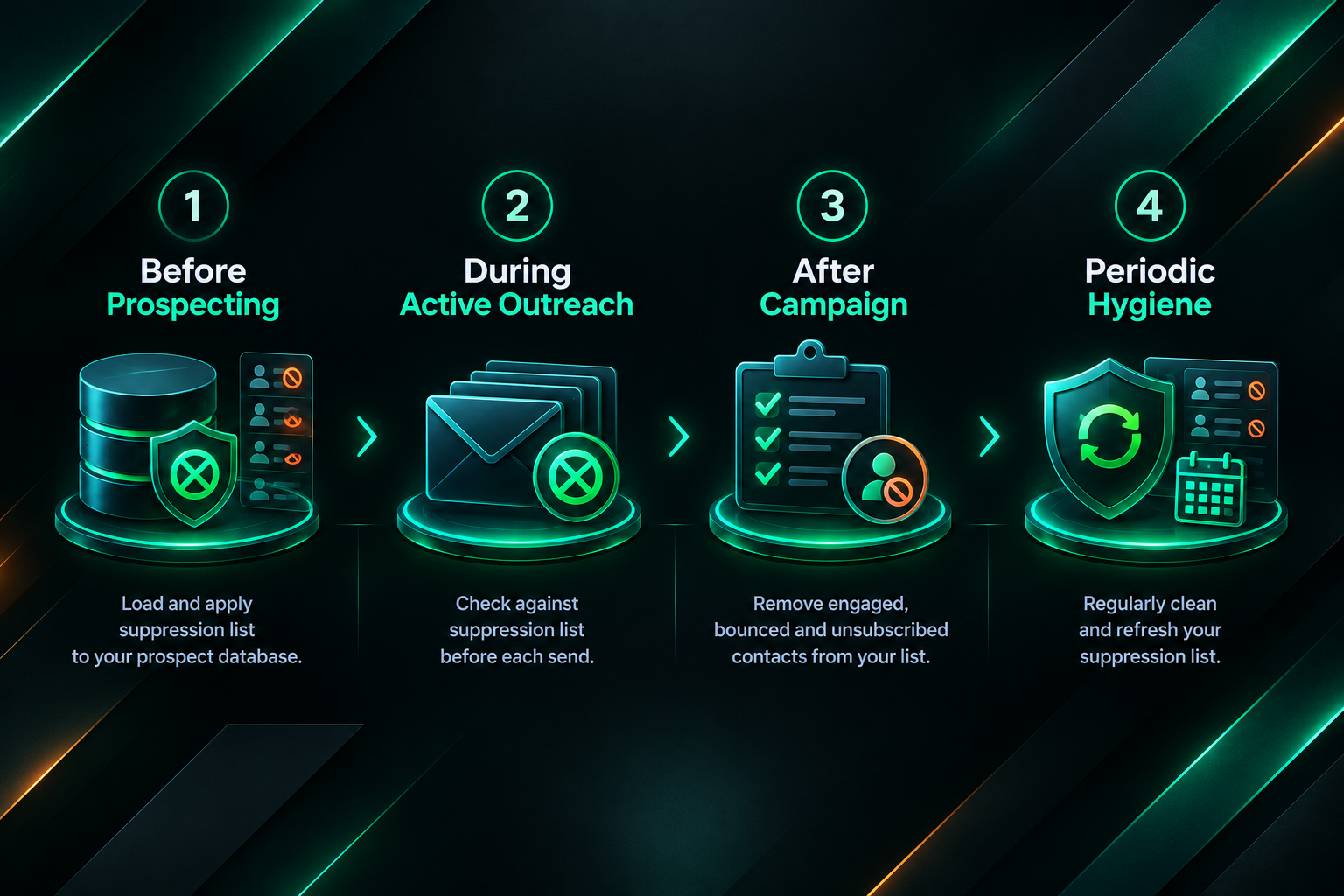
A suppression list that exists in a spreadsheet but is never checked before a new outreach sequence launches provides limited protection. The most reliable approach is to integrate suppression data directly into the tools and processes your team uses at each stage of the outreach workflow.
Before Prospecting
When building a new list of target publishers or webmasters, cross-reference the prospect list against your suppression list before any contact is made. Most outreach platforms allow you to upload a suppression list that will automatically exclude matching addresses or domains from active sequences. If your team uses a manual prospecting process, a simple lookup against the suppression spreadsheet before adding a contact to a campaign is a minimum safeguard.
During Active Outreach
Monitor replies and bounce notifications in real time during an active campaign. Opt-out requests and hard bounces should be added to the suppression list within one business day of receipt — ideally the same day. Waiting until the end of a campaign to process suppression updates increases the risk that a suppressed contact receives additional follow-up emails before the record is updated.
After Campaign Completion
At the end of each outreach cycle, conduct a suppression list audit. Review all new records added during the campaign, check for duplicates or inconsistencies, and merge campaign-specific suppression data into the appropriate tier of your master list. This audit also provides an opportunity to review declined prospects and assess whether any might be worth re-approaching in a future campaign under different circumstances.
Periodic List Hygiene
Email addresses and domains change over time. A contact who was suppressed due to a hard bounce two years ago may now have a valid address at a new domain. Conversely, a contact who was marked as a declined prospect may have changed roles or left the publication entirely. Periodic review of older suppression records — perhaps every six to twelve months for active campaigns — helps keep the list accurate without requiring a full rebuild.
Common Mistakes in Suppression List Management
Several recurring errors tend to undermine suppression list effectiveness in link building campaigns. Understanding these mistakes makes it easier to build processes that avoid them.
- Treating suppression as a one-time setup task. Suppression lists require continuous updates throughout a campaign. Setting up a list at the start of a campaign and not updating it until the next campaign begins is one of the most common causes of repeated contact with opted-out or declined prospects.
- Suppressing only at the email address level when domain-level suppression is more appropriate. If a site owner or editor has asked not to be contacted, suppressing only their specific email address may allow outreach to reach them through a different address at the same domain. For opt-out requests from site owners, domain-level suppression is generally more appropriate.
- Failing to share suppression data across team members. When multiple team members are conducting outreach simultaneously, suppression records must be stored in a shared location that all team members can access and update in real time. Individual spreadsheets or local files create gaps.
- Not recording the reason for suppression. A suppression record without context — such as whether a contact declined, bounced, or opted out — makes it difficult to make informed decisions about whether a contact might be approached again in a different context or after a meaningful interval.
- Confusing suppression with disqualification. Not every suppressed contact is permanently off-limits. A declined prospect from eighteen months ago may be worth reconsidering if the pitch, the client, or the target publication has changed significantly. Recording the reason and date of suppression allows your team to make that distinction rather than treating all suppressed contacts as permanently excluded.
Suppression Lists and Email Deliverability
Email deliverability — the ability of your outreach emails to reach the inbox rather than the spam folder — is directly affected by how well you manage suppression data. Internet service providers and email platforms assess sender reputation based on signals including bounce rates, spam complaint rates, and engagement patterns. A high hard-bounce rate suggests that a sender is not maintaining clean contact lists, which can trigger deliverability penalties that affect all outreach from the same domain or IP address.
Maintaining an up-to-date suppression list reduces hard bounces by ensuring that known invalid addresses are not re-contacted. It also reduces spam complaint rates by ensuring that contacts who have opted out do not continue to receive emails. Both of these outcomes contribute to a healthier sender reputation over time, which in turn supports the deliverability of future outreach campaigns.
It is worth noting that suppression list management alone does not guarantee strong deliverability. Other factors — including the quality of your outreach copy, the sending volume and frequency, the age and warm-up history of your sending domain, and the technical configuration of your email infrastructure (SPF, DKIM, and DMARC records) — also affect whether your emails reach the inbox. Suppression management is one important component of a broader deliverability strategy, not a standalone solution.
Frequently Asked Questions
How often should I update my outreach suppression list?
Suppression records should be added as soon as a triggering event occurs — typically within the same business day for opt-out requests and hard bounces. A broader audit of the full suppression list is worth conducting at the end of each campaign cycle and periodically for older records, perhaps every six to twelve months.
Should I suppress an entire domain or just a specific email address?
It depends on the nature of the suppression. For hard bounces affecting a single address, email-level suppression is usually sufficient. For opt-out requests from site owners or editors acting on behalf of a publication, domain-level suppression is generally more appropriate to prevent contact through alternative addresses at the same domain.
Can I re-approach a contact who previously declined a link placement request?
In some cases, yes — but only if there is a meaningful reason to believe the circumstances have changed, such as a different pitch angle, a different client, or a significant interval since the original decline. The suppression record should include the reason and date of the decline so your team can make an informed decision rather than re-approaching contacts arbitrarily.
Do suppression lists apply to all outreach channels, or just email?
Suppression lists are most commonly associated with email outreach, but the underlying principle — respecting opt-out requests and avoiding repeated contact with declined or exhausted prospects — applies to any outreach channel, including LinkedIn, contact forms, and social media direct messages. Whether a formal suppression list is maintained for non-email channels depends on the volume and structure of your outreach programme.
How should a white-label link building provider handle suppression lists for multiple agency clients?
A white-label provider should maintain a universal suppression list covering opt-outs and hard bounces that applies across all campaigns, and separate client-specific suppression lists covering declined prospects and existing placements. The commissioning agency should be able to request suppression data as part of campaign reporting to verify that their clients’ contacts are being managed appropriately.
Does maintaining a suppression list guarantee compliance with GDPR or CAN-SPAM?
No. A suppression list is an important component of email compliance, but it does not by itself guarantee compliance with GDPR, CAN-SPAM, or any other regulation. Compliance depends on a range of factors including the legal basis for initial contact, how personal data is stored and processed, and how opt-out requests are handled. Teams operating across multiple jurisdictions should seek appropriate legal guidance.
Building Suppression Management Into Your Long-Term Outreach Strategy
Suppression list management is most effective when it is treated as a standard operational process rather than an occasional administrative task. Teams that build suppression updates into their daily outreach workflow — assigning clear ownership, using tools that support automated suppression matching, and conducting regular audits — tend to maintain cleaner contact data, better sender reputation, and more productive relationships with publishers over time.
For businesses and agencies that outsource link building or digital PR outreach, it is reasonable to ask a prospective provider how they manage suppression data, how opt-out requests are processed, and whether suppression records are shared with clients as part of campaign reporting. A provider that has clear, documented processes for suppression list management is more likely to run campaigns that protect your sender reputation and maintain professional relationships with publishers on your behalf. If you are considering outsourcing outreach-driven link acquisition, discussing suppression management practices as part of your initial evaluation is a practical step toward a more transparent and sustainable campaign.