Original news reporting attracts some of the most authoritative backlinks available on the web, yet the process behind those links is rarely explained in practical terms. Understanding how publishers earn editorial links to their journalism can help brands, SEO teams, and agencies think more clearly about content-led link acquisition, digital PR strategy, and the realistic conditions under which high-quality backlinks form naturally.
Key Takeaways
- News publishers earn backlinks primarily through editorial citation, where other journalists, bloggers, and researchers reference original data, quotes, or findings as a source.
- The strongest link signals come from content that contains something genuinely new: proprietary data, exclusive interviews, primary research, or a documented first-hand account.
- Backlink acquisition through original reporting is not automatic; distribution, indexing speed, and source credibility all influence how many sites link to a piece.
- Brands and SEO teams can apply the same principles through data-led content, expert commentary, and digital PR campaigns, though results vary significantly by industry, audience, and execution quality.
- Editorial links earned through original reporting are generally considered high-quality signals, but their SEO impact depends on the broader backlink profile, content relevance, and site authority of both the publisher and the linking domain.
What Makes Original Reporting Linkable
A news article earns backlinks when it contains information that other writers, researchers, or publishers need to cite. This is the fundamental mechanism behind editorial link acquisition. The key distinction between a linkable news piece and a generic article is the presence of something that cannot be found elsewhere: a primary source, an exclusive data set, a documented event, or a named expert statement that other outlets must attribute.
Original reporting typically earns links through three overlapping qualities. First, it contains verifiable new information, such as survey results, freedom-of-information disclosures, or proprietary research findings. Second, it is published by a source that other journalists and editors already trust, which lowers the barrier to citation. Third, it reaches the right audience at the right time, meaning it is indexed, distributed, and discoverable before competing coverage saturates the topic.
When a news article contains a statistic that no other source has published, that figure becomes a citable asset. Other journalists writing on the same topic will link to the original source rather than paraphrase without attribution. This is why data journalism, investigative reporting, and exclusive interviews consistently attract more referring domains than opinion pieces or aggregated summaries of existing coverage.
The Main Mechanisms Behind Editorial Backlinks
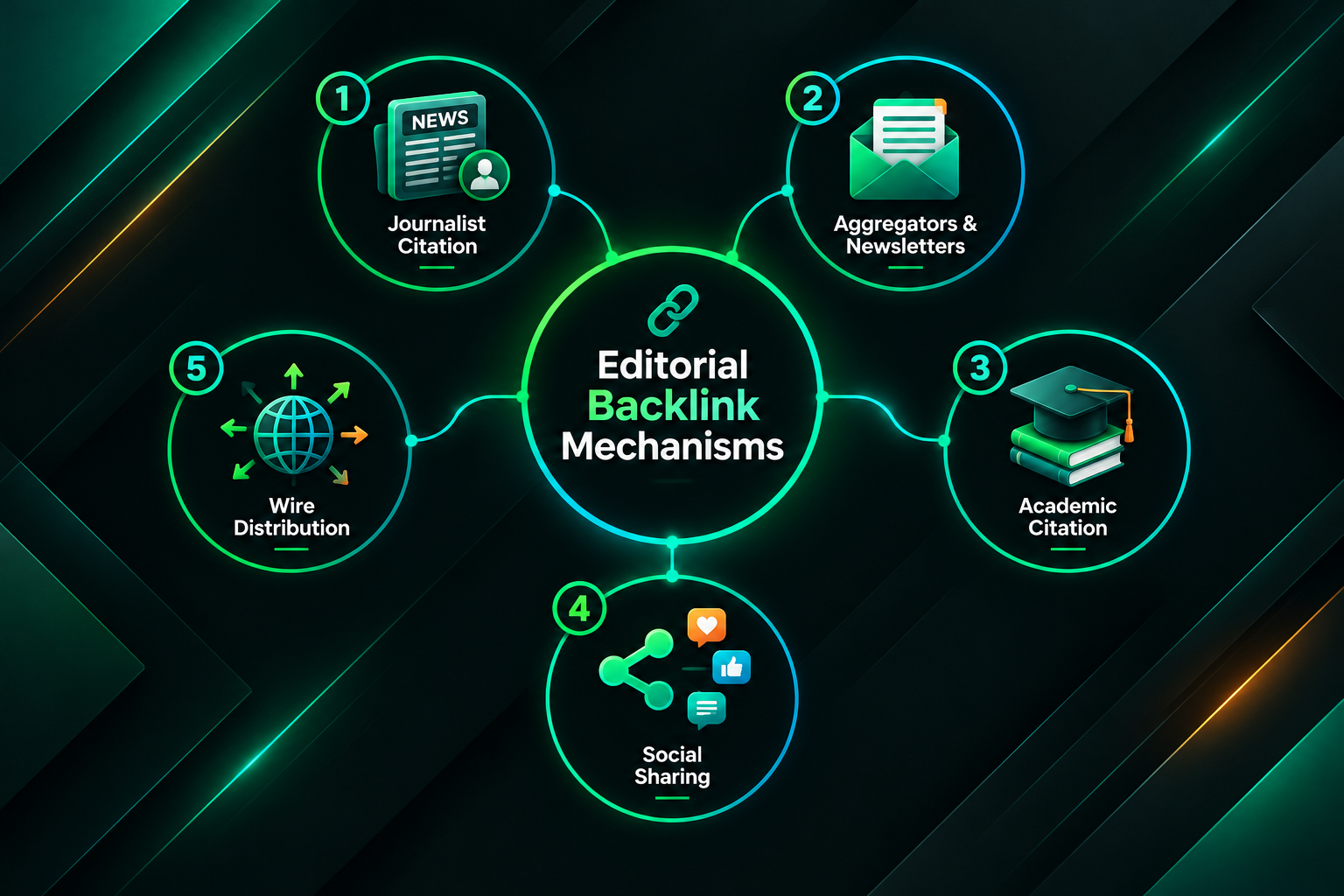
News publishers do not earn backlinks through a single method. Several distinct mechanisms contribute to a publication’s link acquisition, and understanding each one helps explain why some articles accumulate hundreds of referring domains while others attract none.
Citation by Other Journalists
The most common source of backlinks to original reporting is direct citation by other journalists covering the same story. When a reporter at a regional outlet writes about a topic that a national publication broke first, editorial standards typically require attribution and a link to the original source. This chain of citation can extend across dozens of outlets, each adding a referring domain to the original piece. The volume of links generated this way depends on how widely the story is picked up, which in turn depends on newsworthiness, distribution reach, and the credibility of the publishing outlet.
Aggregators, Newsletters, and Curated Roundups
Industry newsletters, content aggregators, and weekly roundup publications regularly link to original reporting as part of their editorial curation. These placements are often overlooked in link building discussions, but they can generate consistent referring domains from niche-relevant sources. A well-timed investigative piece published in a trade publication may be featured in several industry newsletters within days, each providing a contextually relevant backlink from an engaged audience.
Academic and Research Citation
Original reporting that documents events, trends, or data points of academic interest can attract citations from university websites, research papers, and institutional reports. These links tend to come from high-authority domains and are particularly durable because academic content is rarely updated or removed. Investigative journalism covering public health, economics, environmental issues, or technology policy is especially likely to attract this type of citation over time.
Social Sharing and Organic Discovery
While social media shares are not direct backlinks, widespread sharing increases the probability that a journalist, blogger, or researcher will discover the original article and link to it from their own content. Social amplification functions as a distribution mechanism that expands the pool of potential linking sites. Publishers with large social followings or strong email distribution lists can accelerate this process significantly, which is one reason why established news brands accumulate backlinks faster than newer outlets publishing equally strong content.
Press Release and Wire Distribution
Many news publishers distribute their findings through press releases or wire services when the content has broad commercial or public interest relevance. This approach can generate rapid syndication across news aggregators and regional outlets, though the backlink quality from syndicated content varies considerably. Links from wire-distributed content may come from lower-authority aggregator sites rather than editorially independent publications, which affects their relative value as link signals.
Content Formats That Attract the Most Backlinks
Not all original reporting earns backlinks at the same rate. Certain content formats consistently generate more referring domains than others, and understanding these patterns is useful for anyone planning a content-led link acquisition campaign.
-
- Original data and surveys: Proprietary research findings, commissioned surveys, and independently collected data sets are among the most consistently linkable content formats. When a publisher owns the data, every outlet that wants to reference the statistic must link back to the source.
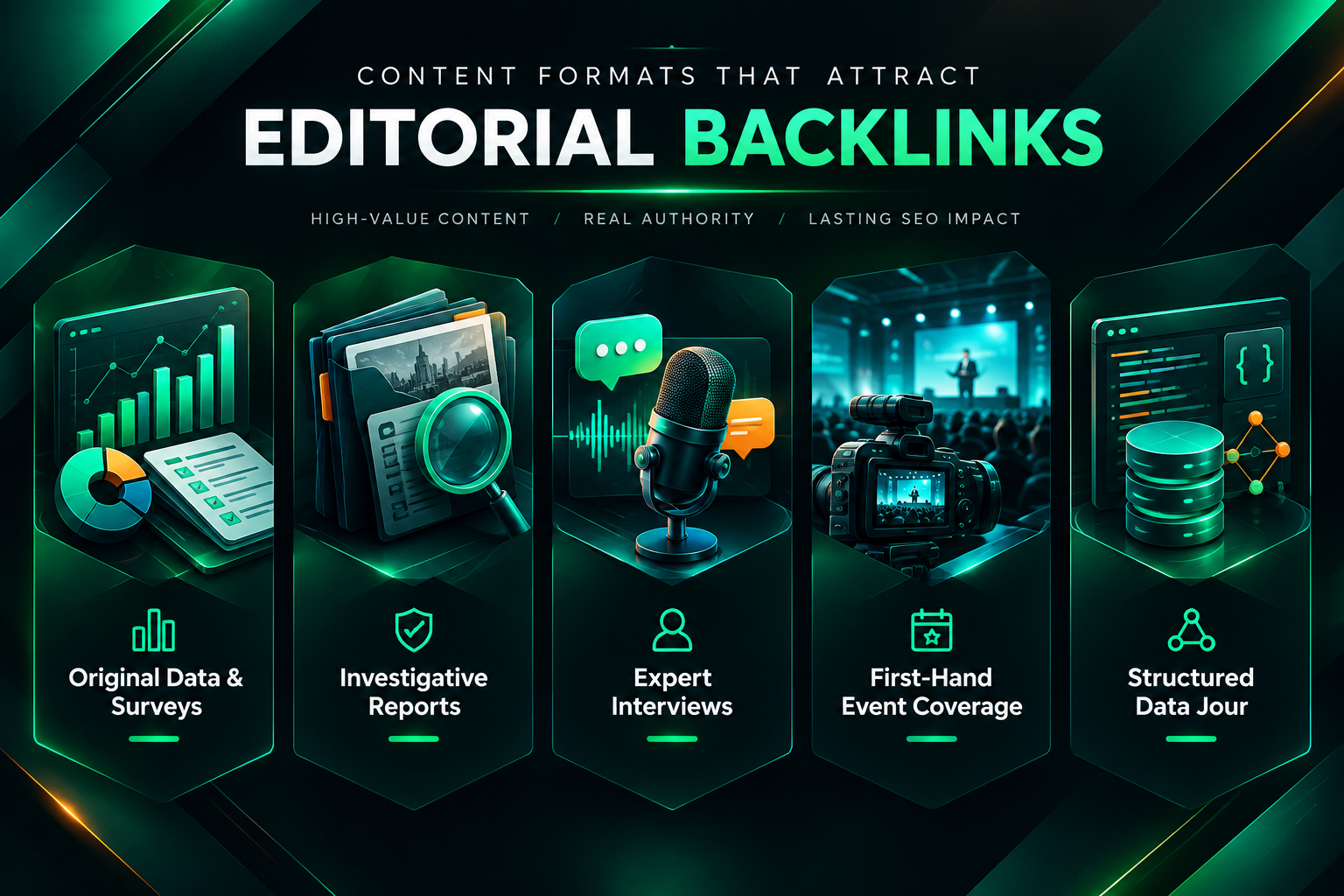
- Investigative reports and document disclosures: Long-form investigative journalism that uncovers previously undisclosed information attracts links from other journalists, advocacy organisations, and policy researchers who need to reference the documented findings.
- Exclusive interviews with named experts: A direct quote from a recognised authority on a topic gives other writers a reason to link rather than paraphrase. Named expert commentary is particularly effective in specialist industries where credible sources are limited.
- First-hand event coverage: Reporting from events, conferences, or breaking news situations that other outlets cannot access independently creates a natural citation need. Eyewitness accounts and documented primary sources are difficult to replicate without attribution.
- Structured data journalism: Interactive databases, visualisations, and structured data sets that other publishers embed or reference generate persistent backlinks over time, particularly when the data remains relevant beyond the initial publication date.
The Role of Publisher Authority and Trust
A news publisher’s existing authority and reputation significantly influence how many backlinks its original reporting earns. An established outlet with a large readership, strong domain history, and recognised editorial standards will attract more citations for the same quality of content than a newer publication with limited reach. This is not simply a matter of domain rating or authority score metrics; it reflects the practical reality that journalists and editors are more likely to cite sources they already know and trust.
This dynamic creates a compounding effect. Publishers that consistently produce original reporting build a reputation as primary sources, which makes future content more likely to be cited. Over time, this reputation becomes a structural advantage that is difficult for newer entrants to replicate quickly. For brands and SEO teams attempting to apply similar principles, this means that content-led link acquisition typically requires sustained investment before the compounding effect becomes measurable.
Third-party metrics such as Domain Rating from Ahrefs, Domain Authority from Moz, or Trust Flow from Majestic can provide a rough indication of a site’s link profile strength, but these are proprietary estimates rather than Google-provided signals. They should not be treated as direct measures of how much SEO value a backlink from a given publisher will transfer. The relevance of the linking site to the topic, the editorial context of the placement, and the overall quality of the linking page all contribute to the practical value of an editorial backlink.
Speed, Indexing, and the First-Mover Advantage
In news publishing, the timing of publication relative to competing coverage has a measurable effect on backlink acquisition. When a publisher is first to document a story with original sources, other outlets covering the same topic subsequently must cite the original rather than a competitor. This first-mover advantage is one reason why news organisations invest heavily in rapid publication workflows and fast indexing infrastructure.
For SEO purposes, indexing speed matters because a page that is not yet indexed cannot be discovered by journalists searching for sources. Publishers that have established crawl priority with search engines, through consistent publishing frequency and strong internal linking, tend to have their new content indexed faster. This reduces the window during which a competitor could publish similar content and capture the citation opportunity first.
Brands attempting to replicate this dynamic through digital PR or data-led content campaigns should consider publication timing carefully. Releasing original research ahead of an industry event, regulatory announcement, or seasonal trend can increase the likelihood that journalists covering those topics will discover and cite the content during their research phase.
What Brands and SEO Teams Can Learn From News Publishers
The principles behind editorial link acquisition in news publishing translate directly into content-led link building strategies for brands, though the execution differs in important ways. A brand cannot replicate the distribution infrastructure of an established news outlet overnight, but it can apply the same underlying logic: produce content that contains something genuinely new, make it easy to find and cite, and distribute it to the right audience at the right time.
Data-Led Content as a Link Asset
Commissioning original research, conducting proprietary surveys, or analysing first-party data to produce findings that no competitor has published is one of the most reliable ways for a brand to create linkable content. When the data is genuinely new and relevant to an industry audience, journalists and bloggers covering that industry have a practical reason to link rather than simply reference the topic in general terms. The link acquisition potential of data-led content depends heavily on the credibility of the methodology, the relevance of the findings, and the quality of the distribution effort.
Expert Commentary and Named Spokespeople
Journalists writing about specialist topics regularly seek expert quotes to add credibility to their coverage. Brands that position internal experts as accessible, credible commentators can earn editorial mentions and backlinks when those experts are cited in third-party articles. This approach, sometimes called reactive PR or expert positioning, works best when the spokesperson has demonstrable expertise and is available to respond quickly to journalist enquiries. Platforms that connect journalists with expert sources can facilitate this process, though the resulting links are earned through editorial judgement rather than guaranteed by participation.
Digital PR Campaigns Modelled on News Reporting
Digital PR campaigns that apply journalistic principles to brand content can generate editorial backlinks from news publishers and industry media. A well-executed digital PR campaign typically involves identifying a topic with genuine news value, producing original content or data to support it, and distributing it to relevant journalists and editors through targeted outreach. The distinction between digital PR and traditional link building outreach lies in the editorial framing: digital PR aims to create content that a journalist would choose to cover independently, rather than simply requesting a link placement.
Results from digital PR campaigns vary considerably depending on the industry, the quality of the content, the relevance of the target publications, and the strength of the outreach. Not every campaign generates the volume of backlinks anticipated, and some pieces that appear strong in concept attract limited coverage due to competing news cycles or audience mismatch. A realistic assessment of digital PR as a link acquisition method should account for these variables rather than treating it as a predictable output.
Limitations and Realistic Expectations
Original reporting as a backlink acquisition strategy has genuine strengths, but it also carries limitations that are worth understanding before committing resources to it.
The most significant limitation is that editorial links cannot be guaranteed. A publisher or brand can produce high-quality original content and distribute it effectively, but whether other sites choose to link is ultimately an editorial decision made by third parties. This uncertainty is inherent to the strategy and distinguishes it from link building methods where a placement is agreed in advance.
The resource requirement is also substantial. Producing genuinely original reporting or research-backed content requires time, expertise, and often financial investment in data collection, design, or specialist knowledge. Brands that attempt to replicate the format without the underlying substance, publishing thinly sourced content dressed up as original research, are unlikely to attract meaningful editorial links and may damage their credibility with journalists they approach.
Timeline expectations should be calibrated carefully. Even strong original content may take weeks or months to accumulate referring domains as it is discovered, indexed, and cited by other publishers. The SEO impact of those links, in terms of measurable ranking or traffic changes, may take additional time to become apparent and will depend on the broader competitive landscape, the existing backlink profile of the target page, and other on-site SEO factors.
Finally, not every industry or niche generates the same volume of journalist interest. A brand operating in a highly specialised B2B sector may find that the pool of relevant journalists and publications is small, which limits the potential scale of editorial link acquisition through this approach. In such cases, a combination of digital PR, targeted manual outreach, and guest posting on specialist publications may be more appropriate than a news-reporting model.
Frequently Asked Questions
Do news publishers actively pursue backlinks, or do they earn them passively?
Most established news publishers earn backlinks primarily through passive editorial citation, where other writers reference their reporting without being solicited. However, many publishers also actively distribute their content through press releases, social media, email newsletters, and journalist networks to increase the likelihood of being cited. The distinction between active distribution and link solicitation matters: editorial links result from a third party’s independent decision to cite a source, not from a direct request for a link.
How long does it take for original reporting to accumulate backlinks?
The timeline varies considerably. Breaking news on a widely covered topic can attract dozens of referring domains within hours. Investigative reports or data-led content on niche topics may accumulate links gradually over weeks or months as the content is discovered through search, social sharing, and newsletter curation. There is no universal timeline, and some high-quality pieces attract very few links despite strong content quality, often due to limited distribution reach or a crowded news cycle.
Are backlinks from news publishers more valuable than links from other sites?
Backlinks from established news publishers are generally considered strong signals because these sites tend to have high editorial standards, substantial referring domain profiles, and topical authority across a range of subjects. However, the SEO value of any individual link depends on multiple factors including the relevance of the linking page to the target content, the link attribute used, the placement context, and the overall quality of the linking site. A link from a highly relevant niche publication may be more valuable for a specific topic than a link from a large general news outlet with no topical connection.
Can a brand realistically replicate the link acquisition approach used by news publishers?
Brands can apply the same underlying principles, particularly through original data, expert commentary, and digital PR campaigns, but they face structural disadvantages compared to established news publishers. These include smaller distribution networks, less established journalist relationships, and lower baseline credibility as editorial sources. Brands that invest consistently in producing genuinely original content and building journalist relationships over time can improve their editorial link acquisition, but results are unlikely to match those of a major news outlet and will vary significantly by industry and execution quality.
What is the difference between a digital PR backlink and a guest post backlink?
A digital PR backlink results from a journalist or editor independently choosing to cite or cover a brand’s content or spokesperson, based on its news value. A guest post backlink is placed within content that the brand has written and submitted to a third-party publication, typically through a direct arrangement with the publisher. Both can produce editorially relevant placements, but the acquisition process, editorial involvement, and link context differ. Digital PR links are generally considered more editorially independent, while guest post placements involve a more direct arrangement between the brand and the publisher.
Should original reporting be the primary link building strategy for most businesses?
For most businesses, original reporting or data-led content is one component of a broader link acquisition strategy rather than the sole approach. The resource requirements are significant, results are not guaranteed, and the strategy works better for some industries and content types than others. A well-rounded link building programme may combine content-led digital PR with manual outreach, targeted guest posting, and niche-relevant placements, with the mix determined by the website’s goals, existing backlink profile, competitive landscape, and available budget.
Applying Editorial Link Principles to Your Own Strategy
The way news publishers earn backlinks to original reporting reflects a straightforward principle: content that contains something genuinely new and useful will attract citations from others who need to reference it. The mechanisms, whether journalist citation, newsletter curation, academic reference, or organic discovery, all depend on the same foundation of original, credible, well-distributed content.
For brands and SEO teams, the practical implication is that link acquisition through content requires genuine investment in substance, not just format. Producing a survey, commissioning research, or positioning an internal expert as a media source can create the conditions for editorial backlinks, but the results depend on execution quality, distribution reach, and the relevance of the content to the target audience. These are not shortcuts; they are the same conditions that determine whether a news publisher’s reporting gets cited or ignored.
If you are considering a content-led link acquisition approach or want to understand how digital PR and original research might fit into a broader link building campaign, a qualified SEO provider can help assess whether the strategy is appropriate for your website, industry, and goals before significant resources are committed.