Deciding whether to prioritise link building or content creation is one of the most common strategic questions in SEO budget planning. Both contribute to organic visibility, but they work differently, suit different website situations, and carry different costs, timelines, and risks. This article compares the two approaches honestly so that business owners, in-house SEO teams, and agency decision-makers can weigh the trade-offs before committing budget.
Quick Comparison
| Characteristic | Link Building | Content Creation |
|---|---|---|
| Primary function | Acquiring external signals that may improve authority and rankings | Creating pages that can rank, attract links, and serve user intent |
| Acquisition method | Manual outreach, guest posting, digital PR, niche edits, and similar tactics | Internal production: writing, editing, design, and publishing |
| Typical goals | Improve rankings for existing pages, build domain-level authority signals, earn referral traffic | Target new keyword opportunities, support the buyer journey, earn organic links over time |
| Dependency | Requires quality content on the target page to justify editorial links | Requires backlinks to compete in most established markets |
| Time to measurable SEO impact | Often several months after placement and indexing | Weeks to months for indexing; ranking impact varies widely by competition |
| Ongoing investment | Campaigns typically require sustained outreach to maintain and grow link equity | Content requires updating and internal linking to remain competitive |
| Link retention | Links can be removed by publishers; retention varies by placement type and quality | Content-generated links may persist if the page remains authoritative |
| Risk considerations | Low-quality or policy-violating links may attract search-engine scrutiny | Thin, duplicate, or intent-mismatched content may not rank and can dilute crawl budget |
| Cost structure | Per-link or retainer fees; costs vary significantly by publisher quality and niche | Writer, editor, designer fees; in-house or agency production costs |
| Best suited for | Sites with solid content that need stronger external authority signals | Sites with weak topical coverage or few rankable pages |
What Each Strategy Actually Does
Link building and content creation are often discussed as competing priorities, but they address different parts of the same ranking equation. Understanding what each one does independently makes the investment decision clearer.
How Link Building Works
Link building is the process of acquiring hyperlinks from external websites to pages on your own site. Search engines use these external links as one of many signals when evaluating a page’s relevance and authority relative to competing pages. The underlying logic is that a page earning links from credible, topically relevant sources is more likely to be useful than one that has not. Manual outreach, guest posting on relevant publications, digital PR campaigns, and niche edits to existing articles are among the most common acquisition methods used by professional link building services.
The quality of a backlink depends on factors such as the topical relevance of the linking page, the editorial context of the placement, the link attribute (followed or nofollowed), and the overall quality of the linking domain. Third-party metrics such as Domain Rating from Ahrefs, Domain Authority from Moz, and Trust Flow from Majestic are commonly used during publisher assessment, but these are proprietary estimates rather than Google-provided scores. A high metric score does not guarantee that a link will improve rankings, and a lower-metric link from a highly relevant niche publication may carry more practical value in some contexts.
How Content Creation Works
Content creation involves producing pages, articles, guides, tools, or other assets that target specific search queries, serve user intent, and give search engines something to index and rank. Without rankable content, there are no pages to build links to and no organic entry points for potential customers. Content also functions as the foundation for earning links naturally over time: well-researched guides, original data, and genuinely useful resources attract editorial citations from other sites without active outreach.
Content quality has become a more prominent factor in how search engines evaluate pages. Thin content, pages that do not match the dominant search intent for a query, or articles that duplicate what already ranks without adding meaningful depth are less likely to perform well regardless of how many backlinks point to them. Content creation is therefore not simply a volume exercise; the relevance, depth, and accuracy of each page matter.
Why the Two Strategies Are Interdependent
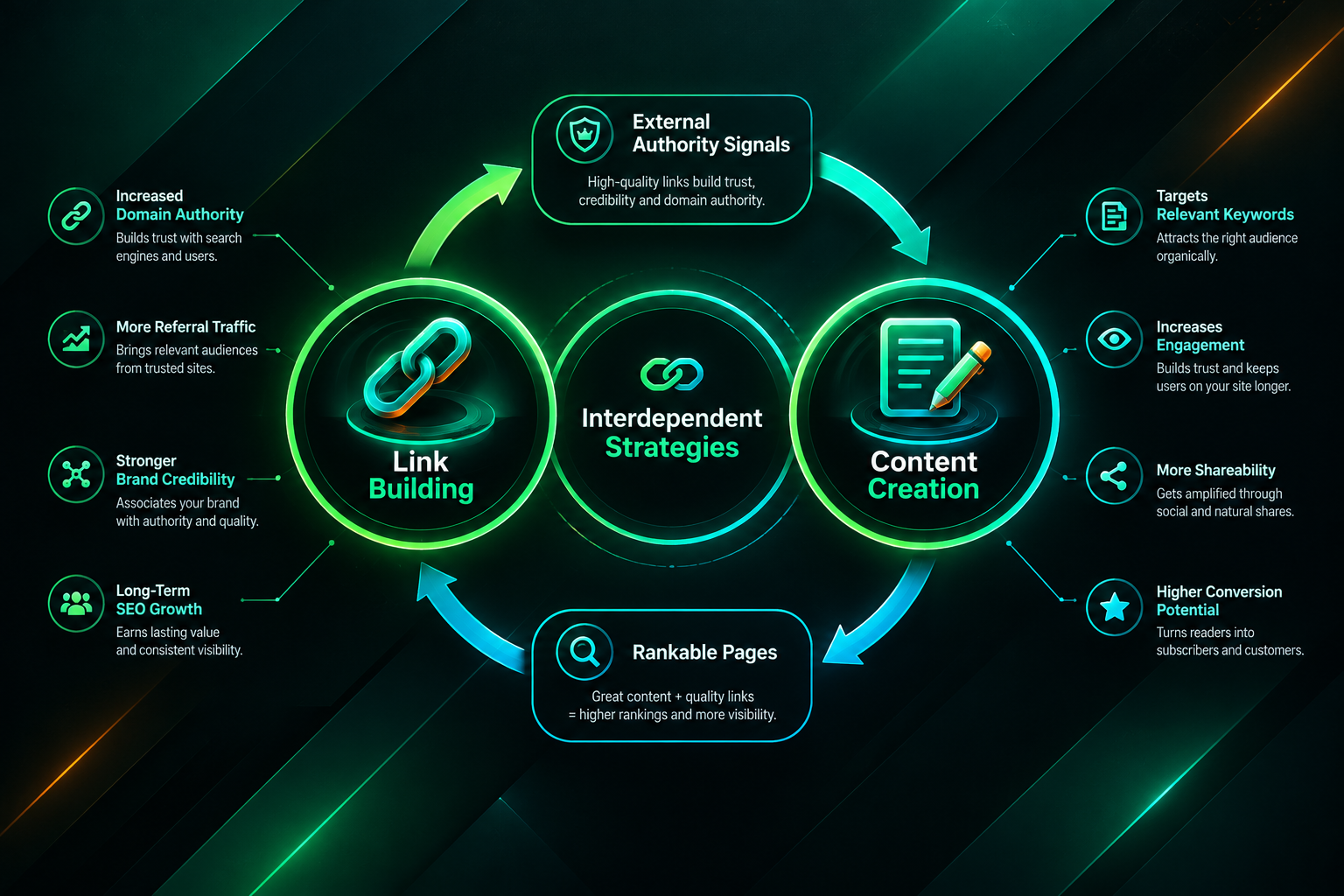
The most important practical reality about link building versus content creation is that neither strategy works well in isolation for most websites competing in established markets. This interdependency is frequently underestimated when SEO budgets are being planned.
Link building without sufficient content quality is likely to underperform. A backlink pointing to a thin, poorly written, or intent-mismatched page may not produce the ranking improvement the campaign was designed to achieve. Publishers conducting genuine editorial review are also less likely to link to low-quality pages, which limits the acquisition options available. When a link building campaign is planned, the target pages typically need to be in a condition that justifies an editorial recommendation from an external site.
Content creation without any link building can also stall in competitive markets. A well-written article targeting a keyword with strong competition will often struggle to rank if the pages already occupying the top positions have significantly stronger backlink profiles. In markets where the top-ranking pages have accumulated hundreds of referring domains over several years, producing new content alone is rarely sufficient to displace them. The content may be indexed and receive some impressions, but meaningful ranking improvements in competitive niches typically require external authority signals as well.
This interdependency means the question is rarely a binary choice between one or the other. The more useful question is which investment is the more urgent constraint for a specific website at a specific point in its development.
Factors That Influence Which Investment to Prioritise
Several website-specific and market-specific factors affect whether link building or content creation is the more pressing need. A site-specific assessment is generally required before making a confident recommendation, but the following factors are commonly relevant.
Existing Content Coverage
A website with few pages targeting its core commercial and informational queries has a content gap problem that link building alone cannot solve. If there are no pages targeting the queries your potential customers are searching for, acquiring backlinks to existing pages will not create new organic entry points. In this situation, expanding topical coverage is typically the more urgent priority.
Conversely, a website that already has well-structured, intent-matched content covering its main topics but is consistently outranked by competitors with stronger backlink profiles may benefit more immediately from a focused link acquisition campaign targeting those existing pages.
Competitive Backlink Landscape
Examining the backlink profiles of pages currently ranking for your target keywords can reveal how much external authority is required to compete. If the top-ranking pages have accumulated a large number of referring domains from credible sources over time, content quality alone is unlikely to close that gap quickly. In highly competitive niches, link building investment may need to begin alongside or shortly after content production rather than being deferred indefinitely.
In lower-competition niches or for long-tail queries, well-optimised content may rank with fewer external links, making content creation the more efficient first investment. The competitive threshold varies significantly by industry, geography, and query type.
Technical SEO Condition
Low organic visibility does not always indicate a link building or content problem. Crawling and indexing issues, slow page speed, poor internal linking, duplicate content, or recent website migrations can suppress rankings regardless of how many backlinks a site has acquired. Investing in link building or content creation before resolving significant technical SEO problems is likely to produce weaker results than expected. A technical audit is a reasonable first step when a site’s performance is significantly below what its content and backlink profile might suggest.
Website Age and Existing Backlink Profile
Newer websites typically have fewer referring domains and lower domain-level authority signals than established competitors. For a new site entering a competitive market, building an initial backlink profile alongside foundational content is often necessary to gain any meaningful organic traction. An established site with a reasonable existing backlink profile may find that targeted content expansion produces faster results than additional link acquisition, depending on the specific pages and queries being targeted.
Business Goals and Timeline
Link building and content creation operate on different timelines and serve different business objectives. Content can begin generating impressions and some traffic relatively quickly after indexing, particularly for lower-competition queries. The SEO impact of link building typically takes longer to become measurable, often several months after placements are live and indexed, because search engines need time to crawl, evaluate, and incorporate new signals. If a business needs to generate organic traffic quickly from new keyword opportunities, content creation may produce earlier visible results. If the goal is to improve rankings for pages that already exist and are already receiving some impressions, a link building campaign targeting those pages may be the more direct investment.
Realistic Timelines and What to Expect
Both strategies require patience, and neither produces guaranteed outcomes. Setting realistic expectations before committing budget helps avoid premature campaign abandonment or misattributed results.
New content typically takes weeks to be indexed and may take several months to reach stable ranking positions, particularly in competitive markets. Rankings for new pages often fluctuate during an initial period as search engines assess the page’s relevance and quality. Some pages never reach the first page of results despite strong content quality, particularly when competing against pages with significantly stronger backlink profiles.
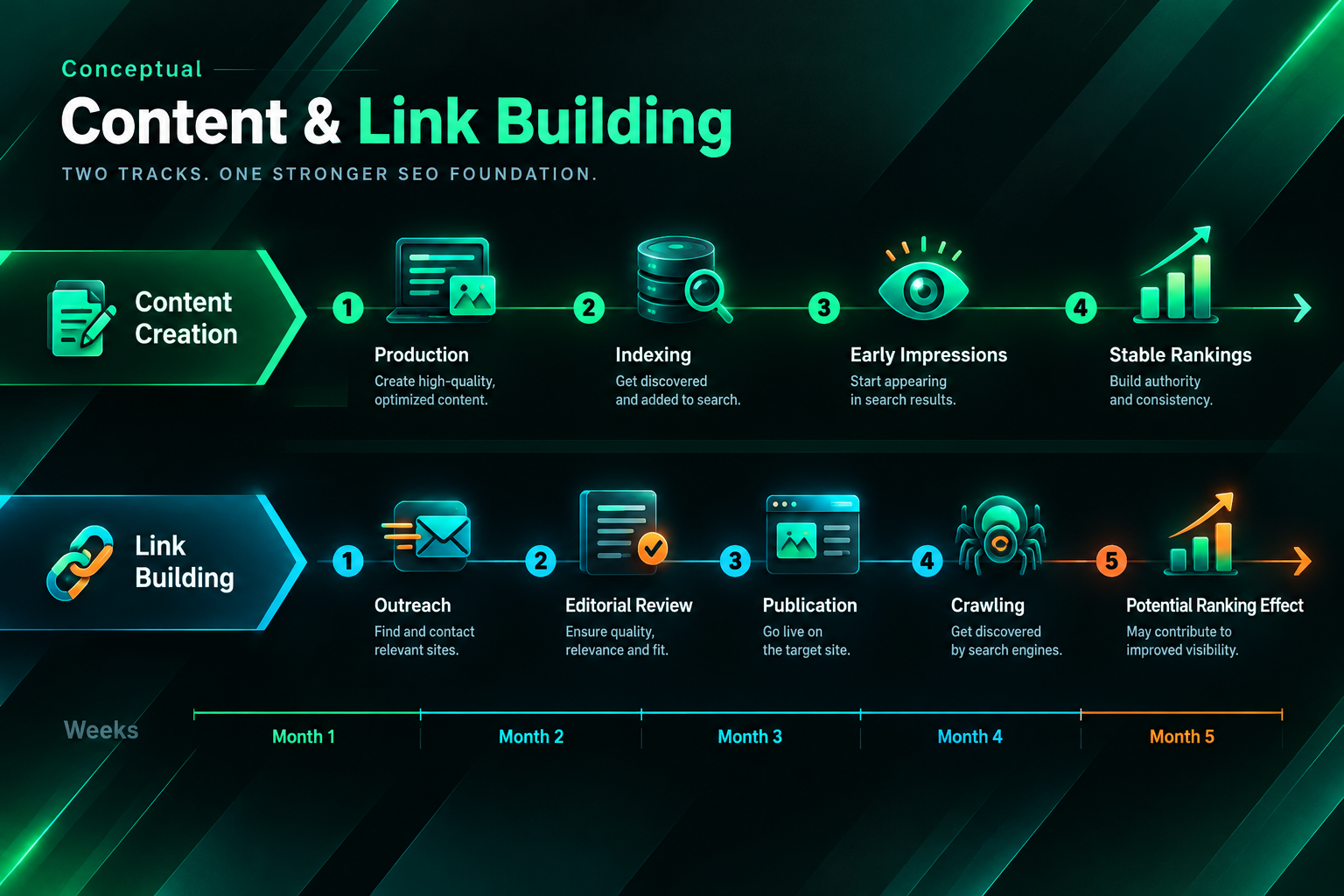
Link building campaigns involve outreach, editorial review, content production for guest posts, and publication timelines that vary by publisher. A placement acquired through manual outreach may take several weeks from initial contact to going live. After publication, the link needs to be crawled and indexed before any potential ranking effect can begin. Measurable ranking or traffic changes following a link building campaign are generally observed over a period of months rather than weeks, and the magnitude of the effect depends on many factors including the quality and relevance of the placements, the competitiveness of the target queries, and the overall condition of the target pages.
Neither strategy should be evaluated over a period of only a few weeks. Campaigns that are abandoned before sufficient time has passed to observe results make it difficult to draw meaningful conclusions about what is or is not working.
Risks and Limitations of Each Approach
Both link building and content creation carry risks that are worth understanding before allocating budget.
Link Building Risks
The primary risk in link building is acquiring links that violate search-engine guidelines on link schemes, which can attract manual actions or algorithmic penalties. Links acquired through paid placements that are not properly disclosed, links from low-quality or irrelevant sites, and links from networks designed to manipulate rankings all carry elevated risk. The risk level varies significantly by acquisition method: editorial links earned through genuine outreach and high-quality guest content carry different risk profiles than links purchased through link marketplaces or private blog networks.
Link loss is another practical limitation. Publishers can remove or change links after placement, and there is generally no guarantee that a link will remain live indefinitely. Monitoring the backlink profile over time and understanding any replacement or refund terms offered by a link building provider is a reasonable part of campaign management.
Content Creation Risks
Content creation risks are less often discussed but are meaningful. Producing large volumes of thin, low-quality, or duplicative content can dilute crawl budget, create keyword cannibalisation between pages targeting similar queries, and potentially attract negative quality assessments. Content that does not match the dominant search intent for a target query is unlikely to rank well regardless of its length or production quality. Investing heavily in content production without a clear keyword strategy and intent analysis can result in pages that generate little organic traffic despite significant production cost.
Content also requires ongoing maintenance. Pages that ranked well when first published may decline as competitors update their content, as search intent evolves, or as the information becomes outdated. Content creation is therefore not a one-time investment but an ongoing commitment.
Budget Allocation Considerations
There is no universally correct budget split between link building and content creation. The appropriate allocation depends on the website’s current state, competitive environment, and business goals. However, a few practical principles are worth considering.
- Audit before allocating: Understanding the specific gaps in your current content coverage and backlink profile before committing budget reduces the risk of investing in the wrong area first.
- Content quality is a prerequisite for effective link building: If target pages are not in a condition that would justify an editorial recommendation, link building investment is likely to underperform. Addressing content quality issues on priority pages before or alongside a link building campaign is generally more efficient.
- Sustained investment typically outperforms one-off campaigns: Both content creation and link building tend to produce better results when treated as ongoing programmes rather than isolated projects. A single batch of content or a short link building campaign is unlikely to produce lasting competitive advantage in most markets.
- Diversification across both strategies is common for established sites: Many businesses running active SEO programmes invest in both simultaneously, allocating budget according to the most pressing constraint at each stage of their growth.
- Niche and industry affect the balance: Some industries are more link-competitive than others. Finance, legal, health, and software markets tend to require stronger backlink profiles to compete. Local or niche markets with lower competition may respond more readily to content investment alone.
When Outsourcing Link Building Makes Sense
For businesses that have established content but lack the internal resources or publisher relationships to run effective link acquisition campaigns, outsourcing link building to a specialist provider can be a practical option. Manual outreach at scale requires significant time, established publisher contacts, and experience in assessing placement quality, all of which take time to develop in-house.
Outsourced link building is typically most effective when the website already has well-optimised target pages, a clear understanding of which pages and queries to prioritise, and realistic expectations about timelines and results. Handing off link acquisition to a provider without first ensuring that target pages are in good condition is likely to produce weaker results than a campaign built on a solid content foundation.
When evaluating a link building provider, it is worth asking about their publisher assessment process, how they evaluate topical relevance, what link attributes are standard for their placements, how they handle link loss, and what reporting they provide. Understanding these details helps set appropriate expectations and assess whether the provider’s approach aligns with your risk tolerance and campaign goals.
Frequently Asked Questions
Can I do link building without creating new content?
Yes, link building can target existing pages without requiring new content production. However, the quality and relevance of the target page affects both the likelihood of securing editorial placements and the potential ranking impact of those placements. If existing pages are thin or poorly optimised, improving them before or alongside a link building campaign is generally advisable.
Does content creation generate links on its own?
High-quality, original content can attract editorial links over time without active outreach, particularly if it contains original research, useful data, or comprehensive guidance that other publishers want to reference. However, passive link acquisition is unpredictable and typically slower than active outreach campaigns. Most websites in competitive markets cannot rely solely on content quality to build a competitive backlink profile.
How long before link building produces measurable results?
The timeline varies depending on the number and quality of placements, the competitiveness of the target queries, and how quickly search engines crawl and index new links. Measurable ranking or traffic changes are generally observed over a period of several months rather than weeks. Results are not guaranteed and depend on many factors beyond the link building campaign itself.
Is it better to build many links quickly or fewer links over time?
A sudden, large increase in backlinks from low-quality or irrelevant sources can attract search-engine scrutiny. A more gradual, sustained acquisition of relevant, editorially placed links from credible publishers is generally considered a lower-risk approach. The appropriate pace depends on the website’s existing profile, the competitive environment, and the quality of the placements being acquired.
What if my website has both weak content and a weak backlink profile?
This is a common situation for newer or underinvested websites. In most cases, establishing foundational content that targets core queries and serves user intent is the more logical first step, as it creates the pages that link building campaigns will later target. Running both programmes in parallel is possible if budget allows, but content quality on priority pages should be addressed before significant link building investment is made to those pages.
Does the type of business affect which strategy to prioritise?
Yes. E-commerce sites with many product pages may benefit from content that supports the buyer journey alongside link building to category and product pages. SaaS businesses often invest heavily in comparison and feature content alongside link acquisition to those pages. Local businesses may find that local citation building and content targeting local queries produces results with less link building investment than national competitors require. The appropriate strategy depends on the business model, target market, and competitive landscape.
Choosing Between Link Building and Content Creation: A Practical Framework
The decision between link building and content creation is rarely a permanent either-or choice. Most websites that achieve sustained organic growth invest in both over time, adjusting the balance as their content coverage, backlink profile, and competitive position evolve. The more useful question is which investment addresses the most significant constraint on your organic performance right now.
If your website lacks pages targeting your core commercial and informational queries, content creation is the more urgent priority. Without rankable pages, link building has limited targets and limited impact. If your website has solid content that is consistently outranked by competitors with stronger backlink profiles, a focused link acquisition campaign targeting those pages may produce more direct improvement than additional content production alone.
Before committing significant budget to either strategy, a review of your current content coverage, backlink profile, technical SEO condition, and competitive landscape will produce a more reliable investment decision than a general rule about which strategy is universally better. If you are considering outsourcing link building as part of a broader SEO programme, discussing your website’s current state and goals with a qualified provider before starting a campaign is a reasonable first step.