When a page is blocked by robots.txt, Google and other search engines are instructed not to crawl it. But what happens to any backlinks pointing from that page to your site? Whether those links pass any SEO value is a question that comes up regularly during link audits, technical SEO reviews, and outreach campaigns. The answer depends on how crawling, indexing, and link equity actually interact — and the relationship between them is less straightforward than it might first appear.
Key Takeaways
- A robots.txt disallow directive prevents crawling, but it does not automatically prevent a page from being indexed or from passing link signals if Google discovers the URL through other means.
- If Googlebot cannot crawl a linking page, it generally cannot read the links on that page, which means those backlinks are unlikely to contribute to your site’s link equity in practice.
- The relationship between crawlability, indexability, and link value is distinct — blocking one does not automatically block the others, and the outcomes can vary depending on how the page is discovered.
- For link building campaigns, acquiring links from pages that are reliably crawlable and indexable is the most dependable way to ensure placements contribute to organic visibility.
- Auditing your existing backlink profile for links from blocked or non-indexed pages is a useful quality-control step, though removing or disavowing such links is rarely urgent unless other risk factors are present.
How robots.txt Blocking Actually Works
The robots.txt file is a plain-text file hosted at the root of a domain that instructs web crawlers which pages or directories they are permitted or not permitted to crawl. A disallow directive tells a compliant crawler — including Googlebot — to skip a specific URL or path. Importantly, robots.txt controls crawling only. It is not a mechanism for controlling indexing, and it does not directly control whether a page passes link signals.
Google has documented this distinction clearly. A page blocked by robots.txt can still appear in search results if other pages link to it, because Google may index the URL based on those external signals without ever crawling the page’s content. In that scenario, Google knows the page exists but has no information about what is on it — including any outbound links it contains. This is a critical point for understanding how backlinks from blocked pages behave.
The robots.txt standard is also advisory rather than enforced. Compliant crawlers respect it, but the file does not prevent a page from being accessed by users, by non-compliant bots, or by crawlers that choose to ignore it. For SEO purposes, the relevant question is specifically how Googlebot and other major search-engine crawlers handle blocked pages and the links they contain.
What Happens to Link Equity from a Blocked Page
If Googlebot is blocked from crawling a page by robots.txt, it cannot read the HTML of that page. Because it cannot read the HTML, it cannot discover or process the outbound links on that page. This means that backlinks placed on a robots.txt-blocked page are, in practical terms, unlikely to pass PageRank or contribute to the linking site’s authority signals as far as Google is concerned.
This is the most direct answer to the question of whether backlinks from robots.txt-blocked pages count: in most cases, they do not contribute measurable link equity, because the crawler that would process those links is prevented from reaching the page in the first place. The link exists in the HTML, but Google has no way to read it.
There is an important nuance, however. If a page is blocked by robots.txt but is still indexed — because Google discovered the URL through another linking page and chose to index it without crawling — the situation becomes more ambiguous. Google has acknowledged that it may index URLs it has not crawled, but in those cases it also lacks the page’s content, which means it cannot process outbound links from that page either. The practical outcome is the same: the backlink is unlikely to contribute link equity.
A separate scenario involves pages that were previously crawlable and indexed, and were later blocked by robots.txt. In that case, Google may retain cached information about the page for some time, including its outbound links. Over time, as the page is no longer recrawled and the cached version ages, the link signals from that page are likely to diminish. How quickly this happens depends on factors including how frequently Google would otherwise recrawl the page and how the page’s link profile changes.
The Difference Between Crawling, Indexing, and Link Value
Understanding backlinks from blocked pages requires separating three concepts that are often conflated: crawling, indexing, and link equity. Each operates independently to a degree, and changes to one do not automatically change the others.
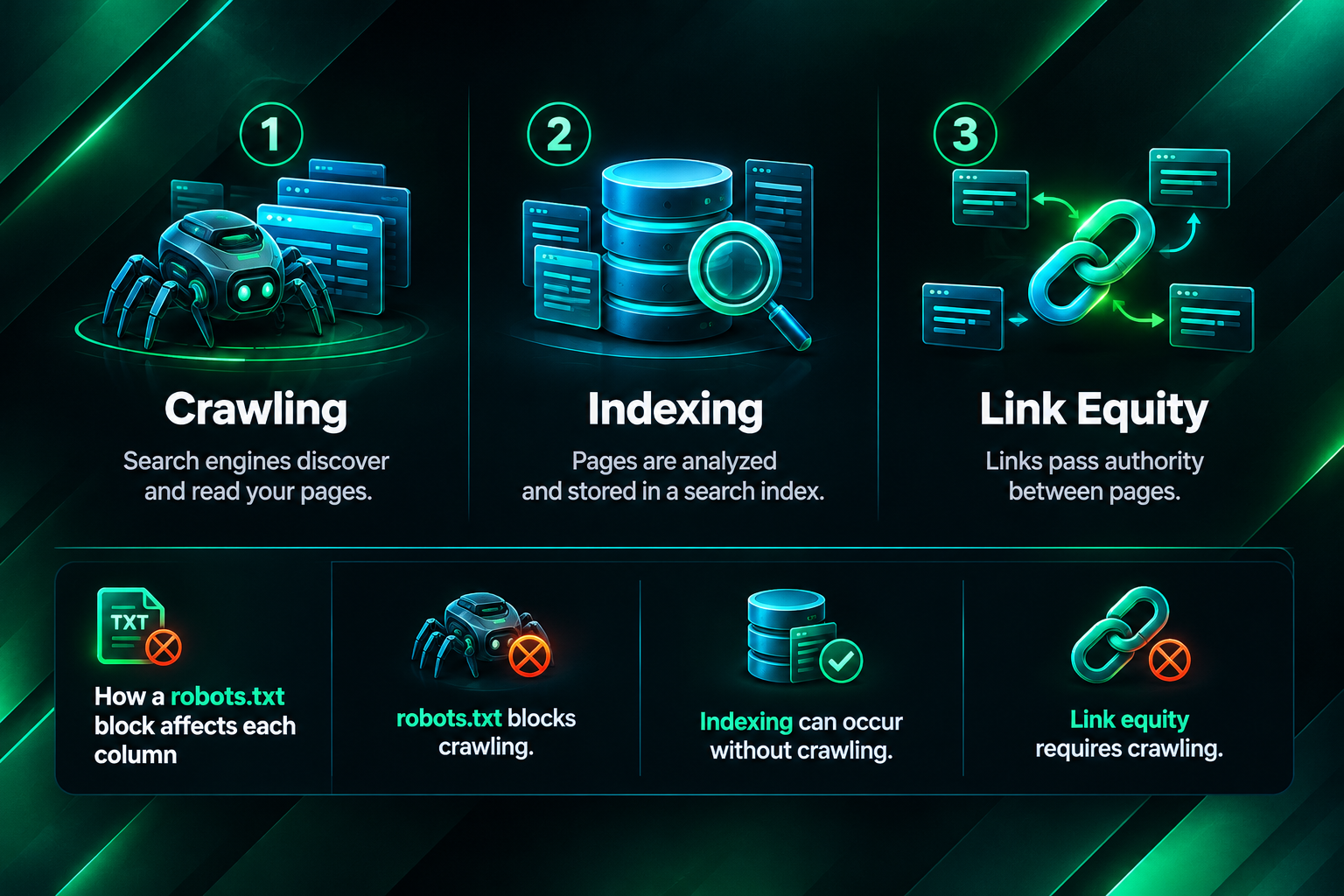
- Crawling is the process by which a search engine bot visits a URL, downloads the page’s content, and processes its HTML — including discovering outbound links.
- Indexing is the process by which a search engine adds a URL to its index, making it eligible to appear in search results. A page can be indexed without being crawled if the URL is known from other sources.
- Link equity (sometimes called PageRank or link juice) refers to the authority or ranking signal that passes from one page to another through a hyperlink. For link equity to pass, the linking page generally needs to be crawled so that the search engine can read and process the link.
A robots.txt disallow directive directly affects crawling. Its effect on indexing is indirect — Google may still index a blocked URL if it learns about it from other pages. Its effect on link equity is also indirect but practically significant: because crawling is blocked, the links on the page cannot be read, and link equity is therefore unlikely to pass. Using a noindex directive or a canonical tag would affect indexing through a different mechanism, and neither is equivalent to a robots.txt block in terms of how link equity is handled.
How Third-Party SEO Tools Handle Blocked Pages
Tools such as Ahrefs, Semrush, and Majestic maintain their own link indexes built from their own crawlers. These crawlers operate independently of Google and may or may not respect robots.txt directives in the same way. As a result, a backlink from a robots.txt-blocked page may appear in a third-party tool’s link report even if Googlebot has never crawled the linking page.
This creates a potential discrepancy between what a link audit tool reports and what Google actually processes. A link that appears in Ahrefs or Semrush as a referring domain does not necessarily mean that Google has crawled the linking page or that the link contributes to your site’s ranking signals. Metrics such as Domain Rating (Ahrefs), Authority Score (Semrush), or Trust Flow (Majestic) are proprietary calculations based on each tool’s own crawl data. They are not Google metrics and do not directly reflect how Google values a specific link.
When reviewing a backlink profile, it is worth checking whether high-value-looking links originate from pages that are actually crawlable and indexable by Google. A link from a page with a strong third-party metric but a robots.txt block may contribute less to organic performance than the tool’s numbers suggest.
Practical Implications for Link Building Campaigns
For businesses and SEO teams running link acquisition campaigns — whether through manual outreach, guest posting, niche edits, or digital PR — the crawlability and indexability of linking pages are quality factors worth assessing alongside more commonly discussed metrics like domain authority or traffic estimates.
A well-executed outreach campaign should aim for placements on pages that Googlebot can crawl and that are indexed in Google Search. Verifying this before or after a placement is a straightforward quality-control step. You can check whether a specific URL is indexed using the site: operator in Google Search, or by inspecting the URL in Google Search Console if you have access to the linking domain. Checking robots.txt is as simple as visiting the domain’s /robots.txt file and reviewing the relevant directives.
When working with a link building provider, it is reasonable to ask whether their quality assessment process includes checking that linking pages are crawlable and indexed. Placements on blocked or non-indexed pages are unlikely to contribute to campaign goals regardless of how strong the domain’s other metrics appear. This is particularly relevant for campaigns targeting competitive niches where link quality has a meaningful effect on outcomes.
It is also worth noting that some publishers block certain sections of their site — such as tag pages, author archives, or paginated content — while leaving editorial content fully crawlable. A link placed within a crawlable article on a domain that also has some blocked directories is not affected by those other blocks. The relevant question is always whether the specific linking page is crawlable, not whether any part of the domain uses robots.txt restrictions.
When Blocked Backlinks Appear in Your Profile
During a backlink audit, you may encounter links from pages that are currently blocked by robots.txt. This can happen for several reasons: the publisher may have restructured their site and inadvertently blocked previously crawlable pages, the block may have been intentional for reasons unrelated to your link, or the link may have been acquired on a page that was never crawlable.
In most cases, backlinks from blocked pages do not require urgent action. If the link is not being crawled by Google, it is not passing link equity — but it is also not actively harming your site. The primary concern with low-quality or harmful backlinks is typically links that Google can read and that may be associated with manipulative link schemes. A link that Google cannot access is unlikely to trigger a manual action or algorithmic penalty on its own.
That said, if a link audit reveals a pattern of backlinks from blocked, non-indexed, or otherwise inaccessible pages — particularly if those links were acquired through a paid campaign — it may indicate a quality issue with the link source or the acquisition method. In that context, reviewing the broader campaign strategy is more useful than focusing on individual disavow decisions.
If you do decide to disavow links from blocked pages, the practical effect is likely to be minimal, since Google was probably not processing those links anyway. Disavow files are most useful for links that Google can read and that you believe may be contributing to a negative signal. Prioritise disavowing links from crawlable, indexed pages that show clear signs of being part of a link scheme, rather than spending time on links from pages Google cannot reach.
robots.txt vs. noindex: A Common Point of Confusion
A related question that often arises alongside the robots.txt discussion is how noindex directives affect link equity. The two mechanisms are frequently confused, and the distinction matters for link building decisions.
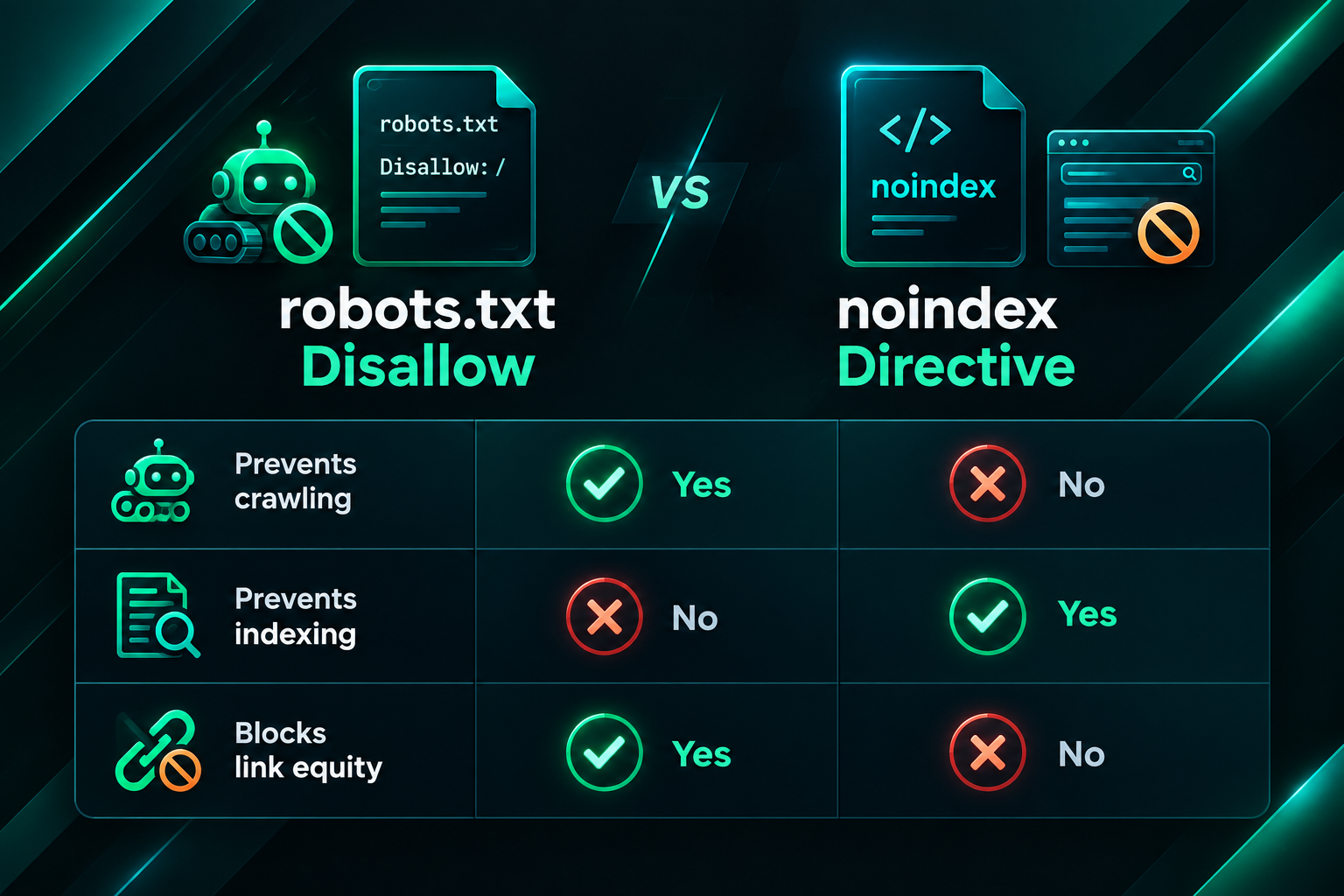
A noindex directive — typically delivered via a meta robots tag or an HTTP header — tells Google not to include the page in its search index. Unlike a robots.txt block, a noindex directive does not prevent crawling. Googlebot can still visit the page, read its content, and process its outbound links. However, Google has stated that it does not transfer PageRank through links on noindex pages, as part of how it handles pages excluded from the index.
This means that a noindex page and a robots.txt-blocked page can both result in backlinks that do not pass link equity, but through different mechanisms. A robots.txt block prevents the crawler from reading the link at all. A noindex directive allows the crawler to read the link but instructs Google not to pass ranking signals through it. The practical outcome for link equity is similar, but the technical path is different.
For link building quality assessment, both scenarios — linking pages that are blocked by robots.txt and linking pages that carry a noindex directive — are worth identifying during an audit. Neither type of page is likely to contribute meaningfully to your site’s organic performance through link equity, regardless of how the domain’s other metrics appear in third-party tools.
Assessing Link Quality Beyond Crawlability
Crawlability and indexability are necessary conditions for a backlink to pass link equity, but they are not the only quality factors that matter. A page that is fully crawlable and indexed can still produce a low-value or potentially harmful link if other quality signals are weak.
Factors that contribute to backlink quality beyond crawlability include:
- Topical relevance — whether the linking page’s content is related to the topic of the page being linked to, which affects how contextually meaningful the link appears to search engines.
- Editorial context — whether the link appears within relevant body content rather than in a footer, sidebar, or link list that may carry less weight.
- Link attributes — whether the link is followed or carries a nofollow, sponsored, or UGC attribute, each of which affects how Google processes the link signal.
- Domain and page history — whether the linking domain has a history of quality content and natural link acquisition, or shows signs of being part of a link network.
- Referring domain diversity — whether your backlink profile draws from a range of independent domains rather than concentrating links from a small number of sources.
A comprehensive link quality assessment considers all of these factors together. Crawlability is the starting point — a link from a blocked page is unlikely to contribute regardless of other quality signals — but it is not sufficient on its own to determine whether a link is valuable or appropriate for a given campaign.
Frequently Asked Questions
Can a robots.txt-blocked page still appear in Google Search?
Yes. Google may index a URL it has not crawled if other pages link to it, making the URL known to Google without the page’s content being accessible. In that case, the page may appear in search results with limited or no snippet information. However, because Google has not crawled the page, it cannot process the outbound links on it.
Should I disavow backlinks from robots.txt-blocked pages?
In most cases, disavowing these links is not a priority. If Google cannot crawl the linking page, it is unlikely to be processing the link as a ranking signal. Disavow files are most useful for crawlable links that show clear signs of being part of a manipulative scheme. Focus your disavow efforts on links that Google can actually read.
Do third-party tools like Ahrefs or Semrush show links from blocked pages?
They may, because these tools use their own crawlers, which may not respect robots.txt in the same way as Googlebot, or may have crawled the page before the block was added. A link appearing in a third-party tool’s index does not confirm that Google has crawled the linking page or that the link contributes to your rankings.
Is a noindex page the same as a robots.txt-blocked page for link equity purposes?
Not exactly. A noindex page can still be crawled, so Google can read its outbound links — but Google has indicated it does not pass PageRank through links on noindex pages. A robots.txt-blocked page prevents crawling entirely, so Google cannot read the links at all. Both outcomes are similar in practice for link equity, but the mechanisms differ.
How can I check whether a linking page is crawlable and indexed?
You can check the domain’s robots.txt file directly by visiting domain.com/robots.txt and reviewing the relevant directives. To check indexation, use the site: operator in Google Search (site:example.com/page-url) or use the URL Inspection tool in Google Search Console if you have access. Third-party tools can also indicate whether a page is indexed, though their data may not always reflect Google’s current state.
Does blocking a page with robots.txt protect it from passing negative link signals?
If a page on your own site is blocked by robots.txt, Google cannot crawl it and therefore cannot follow outbound links from it. This means the page will not pass link equity to external sites — but it also means Google cannot read any content on the page, which removes both positive and negative signals associated with that content. Blocking a page is not a reliable strategy for managing link equity flow; internal linking structure and nofollow attributes are more appropriate tools for that purpose.
What This Means for Your Link Acquisition Strategy
The core finding is straightforward: backlinks from robots.txt-blocked pages are unlikely to contribute to your site’s organic performance through link equity, because Googlebot cannot crawl the linking page and therefore cannot process the links it contains. This applies regardless of how strong the linking domain’s third-party metrics appear, and regardless of whether the link was acquired through outreach, guest posting, or any other method.
For businesses evaluating link building campaigns or auditing existing backlink profiles, this means that crawlability and indexability of linking pages are practical quality checkpoints — not just technical details. A placement on a high-traffic, topically relevant page that is fully crawlable and indexed is meaningfully different from a placement on a page that appears strong in a tool’s dashboard but is blocked from Googlebot.
If you are working with a link building provider or managing outreach in-house, building crawlability checks into your quality assessment process is a reasonable step. It does not need to be the only quality factor you assess, but it should be part of the picture alongside topical relevance, editorial context, link attributes, and domain history. For campaigns where link quality has a direct effect on competitive outcomes, these details can make a meaningful difference to how much value each placement actually delivers over time.
If you are unsure how to assess the crawlability and indexability of your existing backlinks, or how to build these checks into a new campaign, discussing your backlink profile with an experienced SEO or link building specialist is a practical starting point. A site-specific review will give you a clearer picture of which links in your profile are likely contributing to your organic visibility and which may not be.