

When you consolidate URLs, migrate content, or restructure a website, two technical tools come up repeatedly: canonical tags and redirects. Both influence how search engines interpret your pages and, critically, how link equity flows through your site. Choosing the wrong option can dilute the value of backlinks you have worked hard to acquire, so understanding the practical difference between these two approaches matters for anyone managing an SEO campaign or planning a link building strategy.
Quick Comparison
| Characteristic | Canonical Tag | 301 Redirect |
|---|---|---|
| Implementation type | On-page HTML signal or HTTP header | Server-level HTTP response |
| Page accessibility | Original URL remains accessible to users and crawlers | Original URL is no longer accessible; users are sent to the destination |
| Search engine treatment | A hint that search engines may or may not follow | A directive that search engines generally follow |
| Link equity transfer | Partial and uncertain; depends on crawl and indexing decisions | Generally transfers most link equity to the destination URL |
| Backlink impact | Backlinks to the original URL may or may not consolidate fully | Backlinks to the original URL typically consolidate to the destination |
| Use case | Duplicate or near-duplicate content; preferred URL signalling | Permanent URL changes; site migrations; page consolidation |
| Reversibility | Easily removed or changed | Technically reversible but may cause crawl confusion if changed frequently |
| Risk of misuse | Ignored if cross-domain or contradictory signals exist | Redirect chains can dilute equity; incorrect destination wastes link value |
| Typical scenario | Syndicated content, parameter URLs, session IDs, print versions | Rebranding, domain migration, page merges, deleted pages with backlinks |
What Canonical Tags and Redirects Actually Do
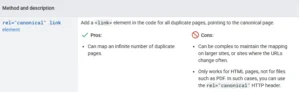
A canonical tag is an HTML element placed in the <head> section of a page that tells search engines which URL should be treated as the authoritative version of that content. It does not move the user anywhere. Both the original URL and the canonical URL remain accessible, and crawlers can still visit either page. The canonical tag is best understood as a preference signal rather than a command. Google and other search engines may choose to honour it or override it based on other signals such as internal linking patterns, sitemap entries, and the content similarity between the two URLs.
A 301 redirect, by contrast, is a server-level instruction that permanently forwards one URL to another. When a user or crawler requests the original URL, the server responds with a 301 status code and sends them directly to the destination. The original URL effectively ceases to exist as a standalone destination. For backlinks, this distinction is significant: a redirect consolidates all incoming link signals at the server level, while a canonical tag attempts to consolidate them through a softer editorial signal that search engines interpret at their discretion.
How Each Option Affects Link Equity and Backlinks
Link equity, sometimes called link juice, refers to the ranking value that passes from one page to another through a hyperlink. When external websites link to a URL, that link equity is associated with the specific URL they linked to. What happens to that equity when you implement a canonical tag or a redirect determines how much of your backlink value is preserved or lost.
Link Equity Through Canonical Tags
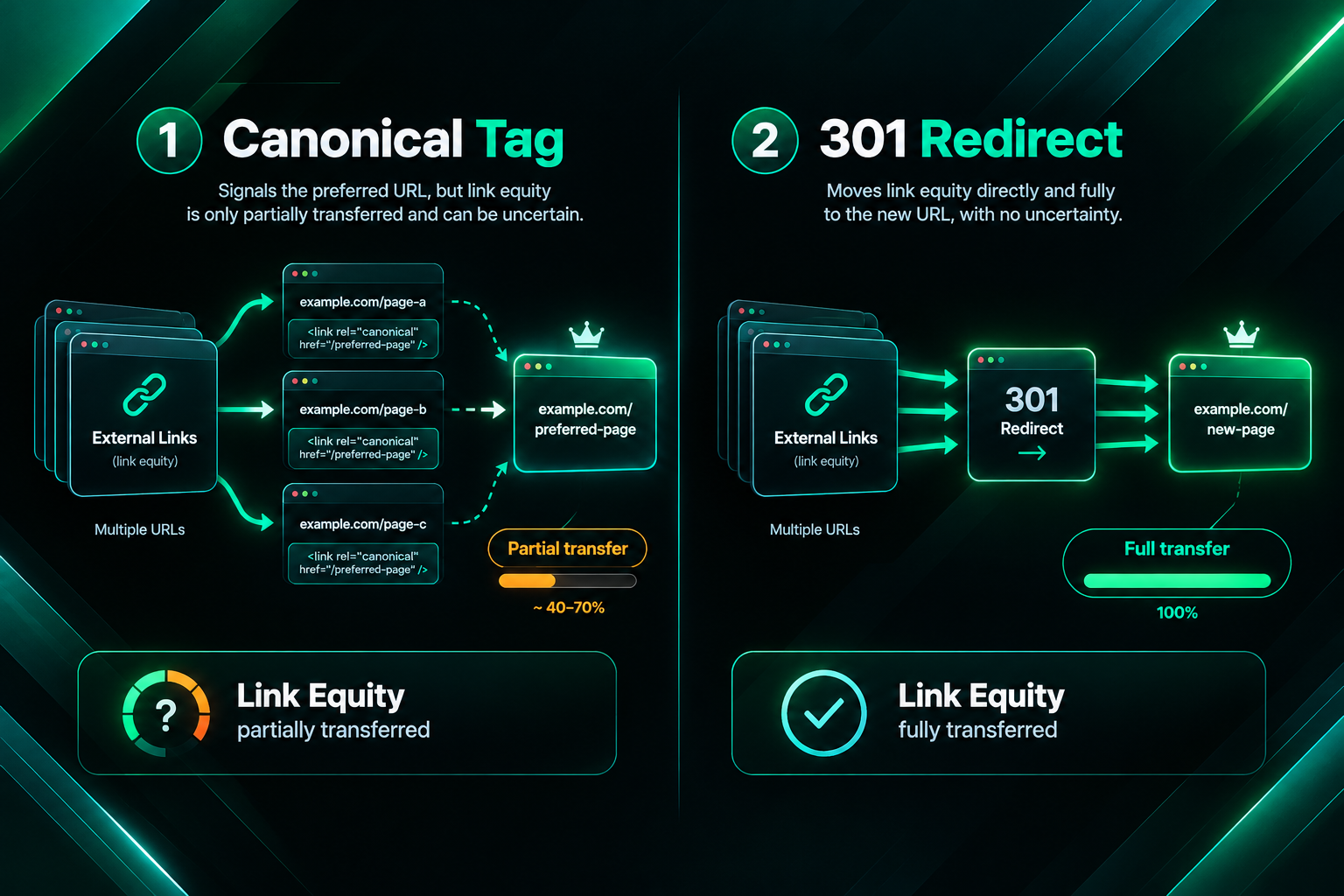
When a canonical tag points from a duplicate or variant URL to a preferred URL, Google’s documented guidance indicates that it will attempt to consolidate link signals toward the canonical. However, because the canonical tag is treated as a hint rather than a directive, this consolidation is not guaranteed. If Google decides the canonical is incorrectly specified, or if conflicting signals exist such as the non-canonical URL being linked to heavily from internal pages, the search engine may index the non-canonical version instead and attribute link equity there. For backlinks specifically, this means that links pointing to a non-canonical URL may not fully transfer their value to the preferred page, particularly if the canonical relationship is inconsistent or the pages are not sufficiently similar in content.
Link Equity Through 301 Redirects
A properly implemented 301 redirect generally transfers the majority of link equity from the original URL to the destination. Google has confirmed that 301 redirects pass PageRank, though the company has also noted that some signal loss may occur in the process. In practical terms, a clean 301 redirect from a page with established backlinks to a relevant destination page is widely considered the more reliable method for preserving link value during URL changes. The key qualifier is relevance: redirecting a page to an unrelated destination is unlikely to preserve meaningful equity and may be treated as a soft 404 or ignored by search engines.
Redirect Chains and Their Effect on Backlinks
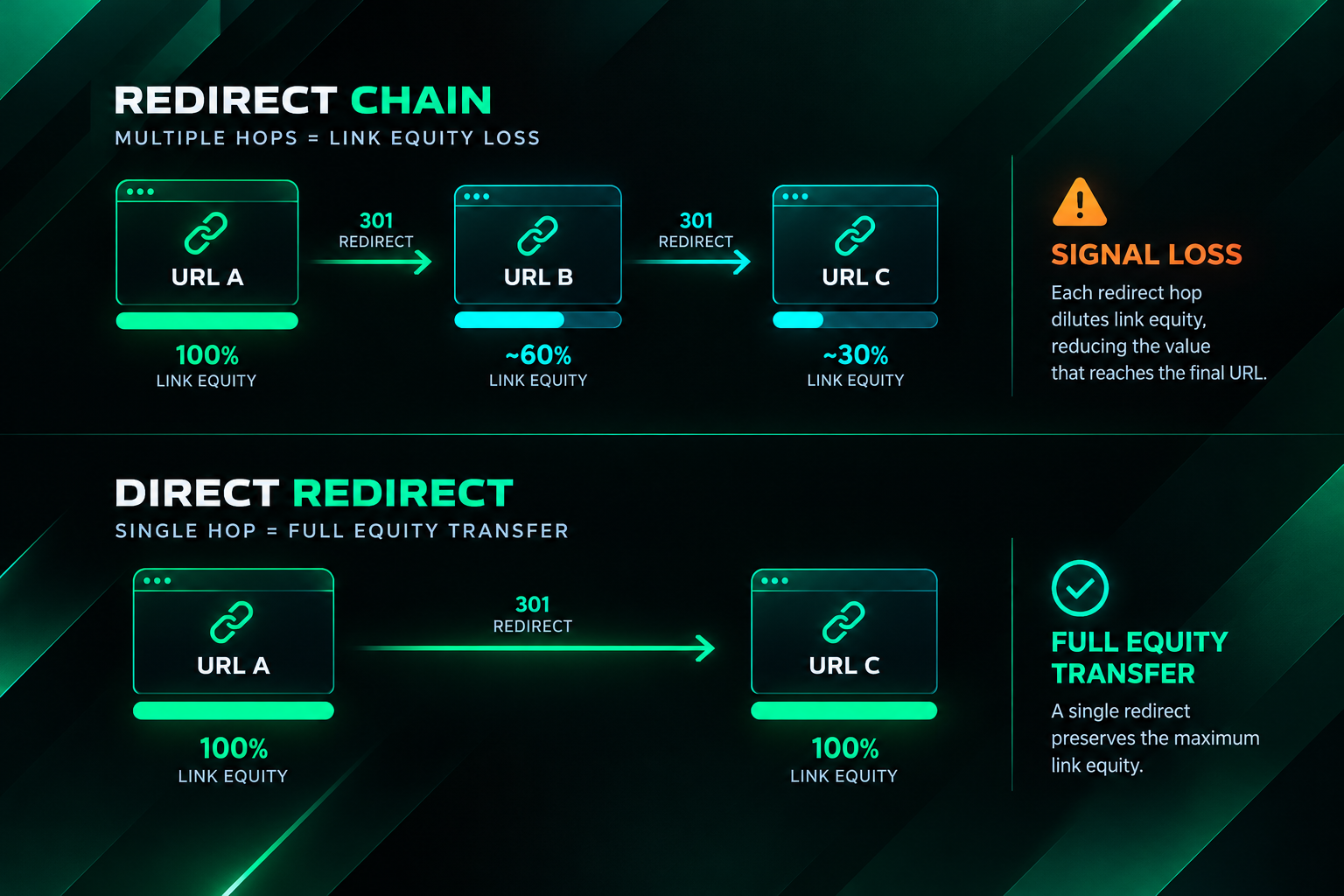
A redirect chain occurs when URL A redirects to URL B, which then redirects to URL C. Each hop in the chain introduces additional signal loss and increases crawl overhead. If backlinks point to URL A and the chain passes through multiple intermediate URLs before reaching the final destination, the equity that arrives at the destination may be meaningfully reduced compared to a direct redirect. Auditing and collapsing redirect chains is therefore an important maintenance task for any website that has undergone multiple migrations or restructuring phases.
When to Use a Canonical Tag
Canonical tags are most appropriate when you need to keep multiple versions of a URL accessible while signalling a preferred version to search engines. Common scenarios include:
- Parameter-based URLs: E-commerce and content platforms often generate multiple URLs for the same page through tracking parameters, session IDs, or sorting filters. A canonical tag on each variant pointing to the clean URL prevents duplicate content issues without breaking the functionality that generates those parameters.
- Syndicated content: When your content is republished on another website, a canonical tag on the syndicated copy pointing back to your original URL signals to search engines that your version is the authoritative source. This approach is commonly used in content partnerships and media syndication.
- Print or mobile versions: If your site serves separate print-friendly or device-specific versions of the same page, canonical tags can consolidate signals toward the primary version.
- Near-duplicate product pages: Retailers with colour or size variants of the same product may use canonical tags to consolidate link signals toward a primary product page while keeping variant pages accessible for user experience purposes.
In all of these cases, the original URL must remain live and accessible. If the page is being permanently retired, a redirect is the more appropriate tool.
When to Use a Redirect
Redirects are the appropriate choice whenever a URL is being permanently moved, merged, or retired. The most common scenarios relevant to backlink preservation include:
- Domain migrations: When a website moves to a new domain, 301 redirects from every old URL to the corresponding new URL are essential for preserving the backlink profile built on the old domain. Without redirects, all external links pointing to the old domain effectively become broken links that deliver no equity to the new site.
- Page consolidation: When two or more pages covering similar topics are merged into a single stronger page, redirecting the retired URLs to the surviving page consolidates their combined backlink equity.
- URL restructuring: Changing URL slugs, moving pages between subdirectories, or switching from HTTP to HTTPS all require redirects to preserve link equity and avoid broken links for users and crawlers.
- Deleted pages with backlinks: If a page is removed but had meaningful external backlinks, redirecting it to the most relevant surviving page is preferable to returning a 404 error, which causes those backlinks to deliver no equity.
Cross-Domain Canonicals: A Special Case for Backlinks
A cross-domain canonical tag points from a page on one domain to a preferred URL on a different domain. This is technically supported by Google and is the standard mechanism for content syndication. However, cross-domain canonicals carry a specific implication for backlinks: if external sites link to the syndicated copy on the secondary domain, and Google honours the cross-domain canonical, those links may be attributed to the original domain rather than the domain hosting the syndicated content. This can be advantageous for the original publisher but means that a site hosting syndicated content with a cross-domain canonical pointing away from itself is unlikely to accumulate meaningful link equity from those placements.
For link building campaigns, this distinction matters when evaluating whether a placement on a syndication partner’s site will contribute to your backlink profile. If the publisher applies a cross-domain canonical pointing to your domain, the placement may function more like a direct link to your site. If no canonical is applied and the content is duplicated, search engines may attribute the link equity inconsistently. Clarifying the canonical and link attribute setup with any syndication partner before a campaign is therefore a practical quality step.
Practical Implications for Link Building Campaigns
Understanding the difference between canonical tags and redirects becomes directly relevant during several common link building and site management scenarios.
Acquiring Links to Pages That Have Been Redirected
If you are building links to a URL that has since been redirected, the equity from those new backlinks will pass through the redirect to the destination. This is generally acceptable for a single clean redirect, but it is worth confirming that the redirect chain is short and that the destination page is genuinely relevant to the anchor text and context of the linking page. A link building campaign targeting a redirected URL that eventually leads to an unrelated page is unlikely to deliver the intended SEO benefit.
Reclaiming Lost Link Equity Through Redirects
A backlink audit may reveal that external sites are linking to old URLs that now return 404 errors. These represent lost link equity. Implementing 301 redirects from those broken URLs to the most relevant live pages can recover some of that equity. This is a technical SEO task that complements link building rather than replacing it, but it can meaningfully improve the effective backlink profile of a site without requiring new outreach.
Evaluating Publisher Sites During Outreach
When assessing a potential link placement on a publisher’s website, it is worth checking whether the page you are being linked from, or the domain itself, has significant redirect chains or canonical issues. A page that is itself non-canonical, or that sits behind a redirect chain, may not pass link equity as effectively as a clean, directly indexed page. Publisher quality assessment during manual outreach should include basic technical checks alongside content relevance and domain authority metrics.
Site Migrations and Protecting Your Backlink Profile
A site migration without a comprehensive redirect map is one of the most common causes of sudden backlink profile degradation. When URLs change without redirects, every external link pointing to the old URLs becomes a broken link. The referring domains remain in your backlink data, but the equity they represent is no longer reaching your site. Planning a migration with a full crawl of existing URLs, a mapping of old to new URLs, and server-level 301 redirects in place before the migration goes live is the standard approach for protecting accumulated link equity.
Common Mistakes and Misconceptions
Several misunderstandings about canonical tags and redirects appear regularly in SEO discussions and can lead to poor decisions about backlink management.
- Treating canonical tags as equivalent to redirects: A canonical tag does not move users or guarantee that search engines will consolidate link equity. It is a preference signal. For permanent URL changes, a redirect is the appropriate tool.
- Assuming all link equity is preserved through redirects: While 301 redirects generally transfer most link equity, some signal loss may occur, and redirects to irrelevant destinations are unlikely to preserve meaningful value. The relevance of the destination matters.
- Ignoring canonical tags on syndicated content: Publishers and content partners who do not apply canonical tags to syndicated content may inadvertently create duplicate content issues and dilute link equity across multiple domains.
- Building links to non-canonical URLs: If your link building campaign targets a URL that is marked as non-canonical in favour of a different URL, the equity from those links may not consolidate as expected. Confirming that target pages are the canonical versions before building links to them is a basic quality check.
- Neglecting redirect maintenance after migrations: Redirect maps created during a migration can become outdated as the site evolves. Periodic audits to identify new 404 errors and broken redirect chains help maintain the integrity of the backlink profile over time.
Frequently Asked Questions
Does a canonical tag pass the same link equity as a 301 redirect?
Not reliably. A canonical tag is a hint that search engines may or may not follow, so link equity consolidation through a canonical is less certain than through a 301 redirect. For permanent URL changes where backlink preservation is a priority, a 301 redirect is generally the more dependable option.
Can I use both a canonical tag and a redirect on the same URL?
If a URL returns a 301 redirect, the canonical tag on that page is effectively irrelevant because users and crawlers are sent to the destination before the page is rendered. Canonical tags are only meaningful on pages that are actually served to crawlers. Using both simultaneously on the same URL is redundant and may indicate a configuration error worth investigating.
What happens to backlinks pointing to a 404 page?
Backlinks pointing to a URL that returns a 404 error deliver no link equity to your site. The referring domain still appears in your backlink data, but the value is not reaching any live page. Implementing a 301 redirect from the 404 URL to the most relevant live page can recover some of that equity, though the amount depends on how long the 404 has been in place and how frequently the linking pages are recrawled.
Should I build links to a page that has a canonical tag pointing elsewhere?
Generally, no. If a page has a canonical tag pointing to a different URL, search engines may attribute the link equity from any new backlinks to the canonical URL rather than the page you targeted. It is better to build links directly to the canonical URL to ensure the equity reaches the intended page.
How do redirect chains affect backlinks acquired through outreach?
Each additional hop in a redirect chain may reduce the link equity that reaches the final destination. If you are building links to a URL that passes through two or more redirects before reaching the live page, the SEO benefit of those links may be lower than if the target URL resolved directly. Collapsing redirect chains to a single hop is a recommended technical SEO practice for sites actively building backlinks.
Do cross-domain canonical tags help with link building?
Cross-domain canonical tags can consolidate link equity toward the original domain when content is syndicated, which benefits the original publisher. However, they are not a substitute for direct editorial backlinks. A link on a syndicated page with a cross-domain canonical pointing to your domain may function differently from a standard editorial link, and the outcome depends on how search engines interpret the canonical relationship in each specific case.
Is it worth auditing canonical and redirect issues before starting a link building campaign?
A basic technical audit before a link building campaign is a sensible step. Identifying and resolving canonical conflicts, redirect chains, and 404 errors on target pages ensures that the link equity from new placements reaches the intended pages efficiently. Building links to pages with unresolved technical issues reduces the return on your outreach investment.
Choosing the Right Approach Before Building or Protecting Backlinks
The choice between canonical tags and redirects is not primarily a link building decision; it is a technical SEO decision that has direct consequences for how your backlinks perform. Canonical tags are the appropriate tool for managing duplicate content and signalling preferred URLs when multiple versions of a page must remain accessible. Redirects are the appropriate tool for permanent URL changes, page consolidations, and domain migrations where preserving backlink equity is a priority.
For businesses and agencies investing in link acquisition, the practical takeaway is straightforward: confirm that your target pages are the canonical versions of their URLs, that they resolve without redirect chains, and that any historical URL changes have been handled with clean 301 redirects. These technical foundations determine how much of the equity from new and existing backlinks actually reaches the pages you are trying to rank. A link building campaign built on a technically sound site is more likely to deliver measurable SEO benefit than the same campaign applied to a site with unresolved canonical conflicts or broken redirect structures.
If you are planning a link building campaign and are uncertain whether your site’s technical setup is optimised to receive and retain link equity, a site-specific technical review before outreach begins is a worthwhile step. Addressing canonical and redirect issues in advance means that every placement you earn works as effectively as possible toward your ranking and visibility goals.


