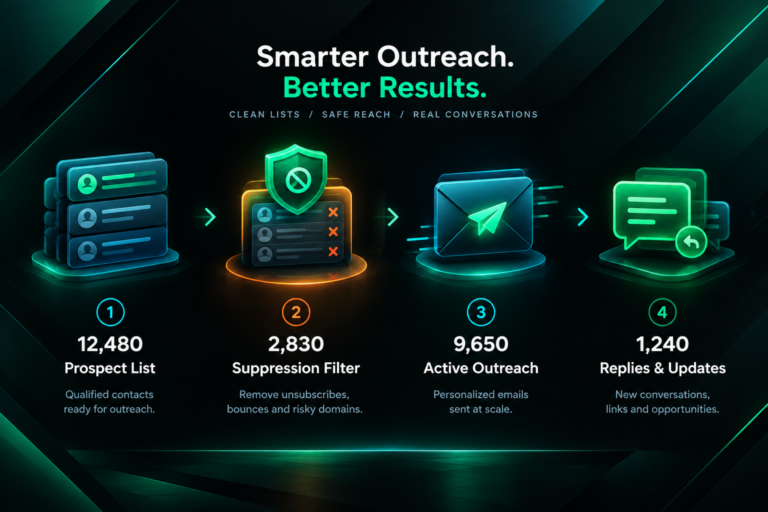
Sending outreach emails to unverified or invalid publisher addresses is one of the most avoidable causes of poor campaign performance in link building. High bounce rates damage sender reputation, reduce deliverability for future messages, and waste the prospecting work that came before. Verifying publisher email addresses before you begin outreach is a practical, low-effort step that protects your domain, improves response rates, and keeps your contact list accurate. This guide explains how the verification process works, which methods and tools are most reliable, and what to watch for when building or cleaning a publisher contact list.
Key Takeaways
- Email verification before outreach reduces hard bounces, which protects your sending domain’s reputation and improves deliverability for all future campaigns.
- A combination of syntax checking, domain validation, MX record lookup, and SMTP verification provides the most reliable results.
- Dedicated email verification tools automate bulk list cleaning, but manual checks remain useful for high-priority publisher contacts.
- Even a verified email address does not guarantee the contact is the right person or that the publisher accepts guest contributions — editorial research is still required.
- Maintaining a clean, regularly updated publisher contact list is an ongoing process, not a one-time task.
Why Publisher Email Verification Matters for Link Building Outreach
In link building outreach, the quality of your contact list directly affects whether your campaign reaches the right editorial decision-makers. A publisher email address that bounces hard — meaning the address does not exist or the domain rejects delivery — signals to email service providers that your sending domain may be unreliable. Accumulate enough hard bounces and your domain’s sender reputation deteriorates, causing future messages to land in spam folders or be blocked entirely, even when the recipient addresses are valid.
Beyond deliverability, unverified contact lists create a practical efficiency problem. Outreach teams spend time personalising pitches, writing subject lines, and following up on contacts that were never reachable. In manual outreach campaigns, where each message is individually crafted to match a publisher’s content and audience, this wasted effort is particularly costly. Verifying addresses before the campaign begins concentrates effort on contacts that can actually receive and read your message.
There is also a reputational dimension. Repeatedly emailing catch-all addresses, role-based inboxes such as info@ or contact@, or addresses associated with inactive domains can result in spam complaints. Spam complaints carry more weight than bounces in most email service provider scoring systems and can accelerate deliverability problems. A clean, verified publisher list reduces this risk before it becomes a campaign-level problem.
Understanding the Types of Email Verification
Email verification is not a single check — it is a layered process that moves from simple formatting rules to active server-level confirmation. Understanding each layer helps you choose the right approach for your outreach volume and publisher list quality.
Syntax and Format Validation
The first and most basic check confirms that an email address is formatted correctly: it contains a local part, an @ symbol, and a domain with a valid top-level domain extension. Syntax validation catches obvious errors such as missing @ symbols, double dots, or invalid characters. Most email verification tools and outreach platforms apply this check automatically, but it is worth running manually on any list assembled through scraping or manual data entry, where formatting errors are common.
Domain and MX Record Validation
A domain validation check confirms that the domain in the email address exists and is currently active. An MX record lookup goes one step further by checking whether the domain has mail exchange records configured — in other words, whether it is set up to receive email at all. A publisher website that exists as a live domain but has no MX records configured cannot receive email, making any address at that domain undeliverable. This check is particularly useful when prospecting newer or smaller publisher sites where technical configuration may be inconsistent.
SMTP Verification
SMTP verification — sometimes called mailbox verification or ping verification — involves connecting to the recipient mail server and simulating the beginning of an email delivery without actually sending a message. The server’s response indicates whether the specific mailbox exists and is accepting mail. This is the most accurate form of automated verification available without sending a real email. However, some mail servers are configured to accept all incoming connections regardless of whether the mailbox exists, a configuration known as a catch-all server. In these cases, SMTP verification will return a valid result even for addresses that do not exist, which is a known limitation of the method.
Catch-All Domain Detection
Identifying catch-all domains is an important step that many outreach teams overlook. A catch-all domain accepts email sent to any address at that domain, whether or not the specific mailbox exists. This means that an address such as [email protected] might appear valid during SMTP verification even if no one named editor works there. Most dedicated email verification tools flag catch-all domains separately so you can decide whether to include, exclude, or manually investigate those contacts before sending. For high-volume campaigns, excluding catch-all addresses reduces the risk of bounces and spam complaints from unmonitored inboxes.
Disposable and Role-Based Address Detection
Disposable email addresses — temporary addresses created through services designed to avoid spam — occasionally appear in publisher contact lists assembled from public directories or scraped sources. These addresses expire quickly and are rarely monitored by editorial staff. Role-based addresses such as admin@, webmaster@, or noreply@ are often managed by multiple people or automated systems rather than the individual responsible for editorial decisions. Most verification tools flag both categories. For link building outreach specifically, role-based addresses are worth investigating further: some publishers do use contact@ or editorial@ as their primary outreach inbox, while others do not monitor them at all.
Tools and Methods for Verifying Publisher Email Addresses
Several categories of tools support publisher email verification, ranging from standalone verification services to features built into outreach platforms. The right choice depends on your list size, campaign frequency, and existing workflow.
Dedicated Email Verification Services
Standalone email verification platforms such as NeverBounce, ZeroBounce, Hunter.io, Bouncer, and Kickbox allow you to upload a list of addresses and receive a cleaned, categorised output. These services typically classify each address as valid, invalid, catch-all, disposable, or unknown, and provide a deliverability risk score. Bulk verification through these platforms is efficient for large publisher lists and is generally more thorough than the verification built into most outreach tools. Most services charge per verification or offer subscription plans based on monthly volume.
When using a dedicated verification service for link building outreach, it is worth noting that the accuracy of results depends partly on how recently the service updated its data for a given domain. Publisher websites sometimes change email configurations, migrate hosting, or update their contact details without notice. Running verification close to the time of sending — rather than weeks in advance — reduces the chance of acting on outdated results.
Email Finder and Verification Tools
Tools such as Hunter.io, Snov.io, and Voila Norbert combine email discovery with verification. They can search for likely email addresses associated with a publisher domain and verify those addresses in the same workflow. This is useful when you have identified a target publisher site but have not yet found a specific contact. These tools typically use a combination of publicly indexed data, pattern matching based on known address formats at a domain, and SMTP verification. The confidence scores they return reflect the probability that an address is valid, not a guarantee.
Outreach Platform Verification Features
Many outreach platforms used in link building campaigns — including Pitchbox, Respona, and Mailshake — include built-in email verification or integrate with third-party verification services. Using verification within your outreach platform reduces the number of tools in your workflow and ensures that addresses are checked immediately before sending. However, the depth of verification built into outreach platforms varies. If deliverability is a priority concern, supplementing platform-level checks with a dedicated verification service is a reasonable precaution for large campaigns.
Manual Verification for High-Priority Contacts
For a small number of high-priority publisher contacts — for example, a well-regarded industry publication where a placement would be particularly valuable — manual verification is worth the additional time. Manual methods include checking the publisher’s contact page, about page, or author profiles for a named editorial contact; searching LinkedIn for the editor or content manager and cross-referencing their listed email format; and using a tool like Hunter.io to identify the domain’s common email pattern before constructing a likely address. Manual verification does not replace SMTP checking but adds editorial context that automated tools cannot provide.
Building a Verification Workflow for Outreach Campaigns
A repeatable verification workflow reduces errors and ensures that list quality is maintained across campaigns rather than treated as a one-off task.
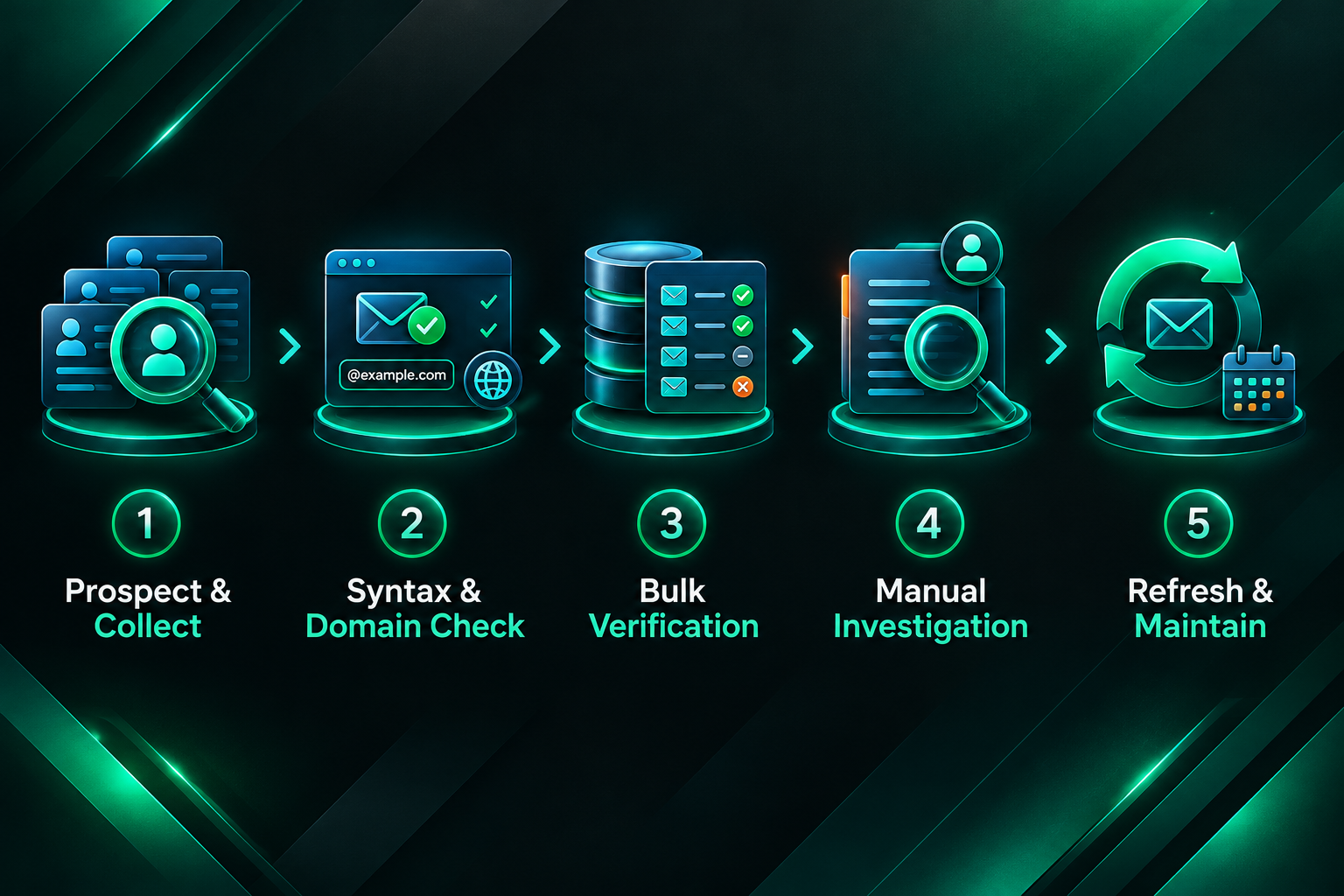
Step One: Prospect and Collect Raw Contact Data
Publisher prospecting typically produces a raw list of domains and, where available, associated contact names or email addresses. At this stage, the list may contain addresses from multiple sources: publisher contact pages, author bylines, WHOIS records, email finder tools, or previous campaign databases. Record the source of each address, as this helps assess likely accuracy before verification begins.
Step Two: Apply Syntax and Domain Checks
Before running more resource-intensive checks, filter the list for obvious formatting errors and confirm that each domain is active and has MX records configured. This step removes clearly invalid entries quickly and reduces the volume sent to paid verification services, which can lower costs on large lists.
Step Three: Run Bulk Verification
Upload the filtered list to your chosen verification service and review the categorised output. Remove addresses classified as invalid. Decide how to handle catch-all addresses based on your campaign’s risk tolerance: excluding them entirely is the safest approach for protecting sender reputation, while including them with a lower sending priority is an option if the publisher is otherwise a strong prospect.
Step Four: Investigate Role-Based and Catch-All Addresses Manually
For publishers where the only available address is role-based or the domain is flagged as catch-all, a brief manual check of the publisher’s website may reveal a named editorial contact or a more specific address. This step is most worthwhile for publishers with strong topical relevance to your target pages, where the effort of finding the right contact is justified by the potential value of the placement.
Step Five: Maintain and Refresh the List Over Time
Publisher contact details change. Editors move to new roles, publications change ownership, and domains migrate to new hosting configurations. A publisher contact list that was accurate six months ago may contain a meaningful proportion of outdated addresses today. Building a schedule for periodic re-verification — particularly before each new outreach campaign — keeps list quality consistent and prevents deliverability problems from accumulating over time.
Common Mistakes in Publisher Email Verification
Several avoidable errors reduce the effectiveness of email verification in outreach campaigns. Understanding them helps you build a more reliable process.
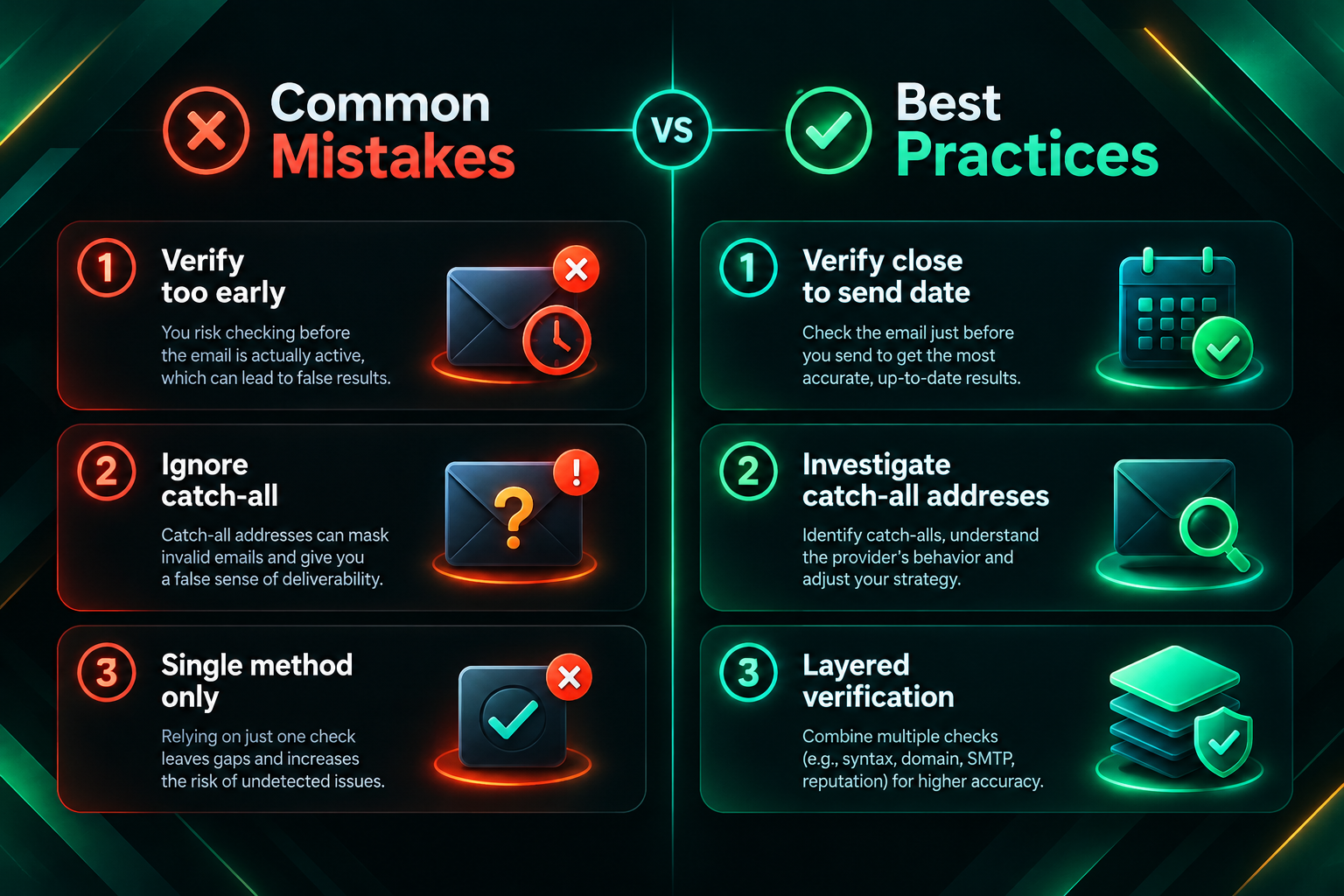
- Verifying too far in advance: Running verification weeks before sending means some results will be outdated by the time the campaign launches. Verify as close to the send date as your workflow allows.
- Treating catch-all results as valid: A catch-all result means the server accepts all mail, not that the specific address exists. Sending to large volumes of catch-all addresses without further investigation increases bounce and complaint risk.
- Relying on a single verification method: Syntax checking alone misses invalid domains. Domain checking alone misses non-existent mailboxes. Combining multiple layers produces more reliable results.
- Ignoring the difference between deliverable and appropriate: A verified, deliverable address may still belong to the wrong person. An email that reaches a publisher’s billing department rather than their editorial team is unlikely to generate a response regardless of its deliverability status.
- Failing to remove previously bounced addresses: If an address hard-bounced in a previous campaign, it should be suppressed in future sends. Most email service providers track bounce history, but manual list management sometimes misses previously failed contacts.
Email Verification in the Context of Link Building Quality
Publisher email verification is one component of a broader publisher quality assessment process. In manual outreach link building, the goal is not simply to reach any publisher but to reach publishers whose sites are topically relevant, editorially credible, and likely to produce placements that contribute meaningfully to a backlink profile. Verifying an email address confirms that a message can be delivered; it does not confirm that the publisher is a suitable link source.
A thorough publisher assessment before outreach typically considers the site’s topical relevance to the target page, the quality and consistency of its existing content, its organic visibility and traffic trends, the presence of a genuine editorial process, and the characteristics of its existing backlink profile. Third-party metrics such as Domain Rating from Ahrefs, Domain Authority from Moz, or Trust Flow from Majestic can provide a starting point for assessing a publisher’s link profile, but these are proprietary estimates rather than Google-provided signals, and they should be used alongside qualitative editorial assessment rather than as the sole criterion for inclusion or exclusion.
When outreach is conducted at scale — as it often is in outsourced link building campaigns — maintaining both contact list quality and publisher quality standards requires systematic processes. Email verification supports the contact quality side of that equation, while publisher vetting addresses the editorial and SEO quality side. Both are necessary for a campaign that produces durable, relevant placements.
Protecting Sender Reputation During Outreach
Sender reputation is the cumulative assessment that email service providers and receiving mail servers make of your sending domain and IP address based on your sending history. A strong sender reputation improves the likelihood that your outreach emails reach the inbox rather than the spam folder. Email verification is one of the most direct ways to protect sender reputation, but it works alongside other practices that outreach teams should maintain.
Warming up a new sending domain gradually — starting with low volumes and increasing over several weeks — establishes a positive sending history before high-volume outreach begins. Using a dedicated sending domain or subdomain for outreach, separate from your primary business domain, limits the impact of any deliverability problems on your main email operations. Monitoring bounce rates, open rates, and spam complaint rates through your email service provider’s reporting gives early warning of deliverability issues before they become severe. Most email service providers recommend keeping hard bounce rates below one percent and spam complaint rates below 0.1 percent, though these thresholds may vary by provider and sending context.
Frequently Asked Questions
What is the difference between a hard bounce and a soft bounce in outreach?
A hard bounce occurs when an email cannot be delivered because the address does not exist, the domain is invalid, or the receiving server has permanently rejected the message. A soft bounce is a temporary delivery failure, often caused by a full inbox or a temporary server issue. Hard bounces are the primary concern in email verification because they indicate a permanently undeliverable address and carry more weight in sender reputation scoring. Soft bounces may resolve on their own but are worth monitoring if they recur for the same address.
How accurate are automated email verification tools?
Accuracy varies by tool and by the type of address being checked. For standard mailboxes on well-configured domains, reputable verification services typically achieve high accuracy. Catch-all domains represent the main limitation: because these servers accept all connections, verification tools cannot confirm whether a specific mailbox exists. The accuracy of email finder tools that construct likely addresses from domain patterns also varies depending on how consistently a publisher uses a single address format. No automated tool provides a guarantee of deliverability for every address.
Should I include catch-all addresses in my outreach list?
This depends on your campaign’s risk tolerance and the value of the publisher contact. Excluding catch-all addresses entirely is the safest approach for protecting sender reputation. If a publisher is a strong prospect and the only available address is at a catch-all domain, a manual check of the publisher’s website or LinkedIn profile may reveal a more specific contact. If no alternative is available, sending to a catch-all address at low volume with careful monitoring is a reasonable approach, provided you suppress the address promptly if it bounces.
How often should I re-verify a publisher contact list?
For active outreach campaigns, re-verifying before each new campaign send is a reasonable standard. For a maintained publisher database used across multiple campaigns, a quarterly review helps catch addresses that have become invalid due to staff changes, domain migrations, or publication closures. The appropriate frequency depends on how quickly your list grows and how much time passes between campaigns.
Does email verification improve outreach response rates?
Email verification improves deliverability, which is a prerequisite for a response but not a guarantee of one. A verified email that reaches the right inbox still depends on a relevant, well-crafted pitch, a suitable publisher, and timing to generate a response. Verification removes a technical barrier to response; it does not replace the editorial and personalisation work that drives actual engagement in link building outreach.
Can I verify email addresses without a paid tool?
Basic syntax and domain checks can be performed manually or with free tools. Some email finder platforms offer a limited number of free verifications per month. For small lists of high-priority contacts, free-tier access to tools like Hunter.io may be sufficient. For bulk verification of large publisher lists, paid services are generally more practical and provide more detailed categorisation, including catch-all detection and deliverability risk scoring.
Making Email Verification a Standard Part of Your Outreach Process
Publisher email verification is most effective when it is treated as a standard step in the outreach workflow rather than an occasional fix applied after deliverability problems appear. Building verification into the prospecting and list-building stage — before personalisation and sending begin — prevents wasted effort and protects the sender reputation that all future campaigns depend on.
For teams managing outreach at scale, whether in-house or through an outsourced link building partner, the combination of automated bulk verification and selective manual investigation for high-value contacts provides a practical balance between thoroughness and efficiency. The goal is a contact list where each address is as likely as possible to reach the right editorial decision-maker at a publisher that is genuinely relevant to your campaign’s target pages.
If your outreach campaigns are producing high bounce rates, low response rates, or deliverability problems, reviewing your verification process is a logical first step. In many cases, improving contact list quality through systematic verification produces measurable improvements in campaign reach without requiring changes to the outreach messaging itself. For campaigns where publisher quality, editorial relevance, and contact accuracy all need to be managed together, discussing your current process with an experienced link building team may help identify where the most significant improvements are available.