Choosing the right guest post topic is one of the most consequential decisions in a link building campaign. A well-matched topic increases the likelihood of editorial acceptance, keeps the placed link contextually relevant, and makes the content genuinely useful to the publisher’s readers. A poorly chosen topic, by contrast, often results in rejection, a weak placement, or a link that provides little SEO or referral value. This guide explains how to approach guest post topic selection systematically, covering publisher research, audience alignment, editorial fit, and the practical factors that separate accepted pitches from ignored ones.
Key Takeaways
- Guest post topic selection should start with the publisher’s existing content, not with your own link targets or preferred messaging.
- A topic that serves the publisher’s audience first is more likely to pass editorial review and earn a contextually relevant, editorially placed link.
- Topical relevance between the guest post, the publisher’s site, and your target page is an important quality signal for the resulting backlink.
- Researching content gaps on a publisher’s site helps you pitch topics that add value rather than duplicate what already exists.
- Realistic expectations matter: even well-researched topic pitches are sometimes declined, and editorial standards vary significantly across publishers.
Why Topic Selection Matters for Guest Post Link Building
Guest posting as a link acquisition method involves contributing original content to a third-party publisher in exchange for an editorially placed backlink. The quality and relevance of that backlink depend heavily on how well the guest post topic fits the publisher’s site and audience. Search engines assess the context surrounding a link, not just the domain it comes from. A link placed within a genuinely relevant, well-written article on a topically aligned site carries different signals than a link dropped into a loosely related post that exists primarily to host outbound links.
From a practical standpoint, publishers receive many pitches. Editors are more likely to accept a topic that fills a gap in their content library, addresses a question their readers are already asking, or complements their editorial calendar. A topic chosen primarily for the convenience of the link builder, rather than for the publisher’s audience, tends to produce generic content that editors either reject outright or accept with minimal enthusiasm, resulting in a placement that underperforms.
Topic selection also affects the naturalness of the link itself. When the guest post topic is closely related to the page you want to link to, the anchor text and surrounding context can be written in a way that reads naturally rather than forced. This matters both for editorial acceptance and for the quality signals the link sends once it is live.
Start with the Publisher, Not Your Own Goals
The most common mistake in guest post topic selection is starting from the link builder’s perspective rather than the publisher’s. It is tempting to identify the page you want to rank, decide what anchor text you want, and then reverse-engineer a topic that allows you to include that link. This approach produces pitches that feel self-serving, and experienced editors recognise them quickly.
A more effective approach begins with a thorough review of the publisher’s website. Read recent articles to understand the tone, depth, and format the site favours. Identify the topics the site covers consistently and the subtopics it has addressed less thoroughly. Look at the comments section, social shares, and any reader questions visible in the content itself. These signals indicate what the audience finds valuable and what gaps remain.
Pay attention to the publisher’s stated guest post guidelines if they are publicly available. Many publishers specify preferred topic areas, word counts, formatting expectations, and the types of links they will and will not accept. Ignoring these guidelines is one of the fastest ways to have a pitch dismissed without consideration.
Researching the Publisher’s Existing Content
Before pitching any topic, conduct a structured review of the publisher’s content archive. This does not require specialist tools, though SEO platforms such as Ahrefs or Semrush can make the process faster and more thorough.
Identify Covered Topics and Content Gaps
Use the publisher’s site search or a tool’s site explorer to map the topics already covered. Look for subject areas the site addresses frequently and those it has touched on only briefly or not at all. A content gap, meaning a topic relevant to the publisher’s audience that the site has not yet covered in depth, is often the strongest basis for a guest post pitch. Editors are more receptive to topics that add something new to their content library than to topics that duplicate existing articles.
When using an SEO tool to assess a publisher’s content, look at which pages attract organic traffic and which keywords the site ranks for. This helps you understand what the audience is already finding useful and where there may be demand for additional coverage. A topic that aligns with a keyword cluster the publisher is already building authority around is likely to be welcomed more readily than one that sits outside their established topical focus.
Assess Audience Intent and Reading Level
Different publishers serve different audiences. A site aimed at small business owners will expect different content than one aimed at enterprise marketing directors or technical developers. Read several articles carefully to gauge the assumed knowledge level, the types of examples used, and whether the content tends toward practical how-to guidance or broader strategic discussion. Your proposed topic should fit naturally within the existing content ecosystem rather than standing out as inconsistent in tone or depth.
Review the Publisher’s Most Shared and Linked Content
Articles that have attracted significant social engagement or external backlinks indicate what the publisher’s audience and the broader web find valuable. If a publisher’s most successful content tends to be detailed practical guides, pitching a shallow overview is unlikely to succeed. Matching the format and depth of the publisher’s best-performing content improves the likelihood of acceptance and increases the chance that the guest post itself will attract engagement after publication.
Aligning the Topic with Your Link Target
Once you have identified topics that would genuinely serve the publisher’s audience, the next step is to assess which of those topics can also accommodate a natural, contextually relevant link to your target page. This is where the interests of the publisher and the link builder need to align rather than conflict.
Topical Relevance Between the Guest Post and Your Target Page
The guest post topic and the page you want to link to should share a clear thematic connection. If your target page covers project management software for remote teams, a guest post about productivity strategies for distributed workforces creates a natural context for that link. A guest post about unrelated topics, even on a high-authority domain, produces a link that sits in an awkward context and may provide weaker relevance signals.
Topical relevance is not just about keyword matching. It is about whether a reader who finds the guest post genuinely useful would also find the linked page useful. When the connection is logical and serves the reader, the link reads as a natural editorial recommendation rather than a paid placement. This distinction matters both for editorial acceptance and for the quality of the resulting backlink.
Avoiding Over-Optimised Topic Angles
A topic angle that exists solely to justify a specific anchor text is usually detectable by experienced editors. If the entire article is structured around leading the reader to a single link, the content tends to feel promotional rather than informative. A better approach is to choose a topic broad enough to be genuinely useful on its own terms, with your target page referenced as one relevant resource among others where appropriate. This produces more natural content, improves editorial acceptance rates, and results in a placement that is less likely to attract scrutiny.
Practical Methods for Generating Relevant Topic Ideas
Generating strong guest post topic ideas requires combining knowledge of the publisher’s content with an understanding of what their audience is likely searching for or discussing. Several practical methods can help.
Use Search Demand as a Starting Point
Identify questions and search queries relevant to the publisher’s niche that the site has not yet addressed. Tools such as Ahrefs, Semrush, or free alternatives like Google’s People Also Ask feature can surface questions that real users are asking within a topic area. A guest post that answers a specific, commonly searched question provides clear value to the publisher’s audience and gives the editor a concrete reason to accept the pitch.
Look at What Competing Publishers Cover
Reviewing what similar publishers in the same niche are covering can reveal topics that are gaining traction in the industry but have not yet been addressed by your target publisher. Pitching a timely, relevant topic that the publisher’s competitors have covered but the publisher has not can position your contribution as filling a visible gap. Be careful not to pitch topics that are already saturated across the niche, as editors are unlikely to want another version of an article that exists in dozens of similar forms.
Draw on Industry Developments and Emerging Questions
Guest posts that address recent developments, emerging challenges, or evolving best practices within an industry tend to feel fresh and timely. If a regulatory change, a new technology, or a shift in market conditions is creating new questions for the publisher’s audience, a guest post that addresses those questions directly can be particularly compelling. This approach requires staying informed about the publisher’s industry, which is one reason why guest posting campaigns benefit from genuine subject-matter knowledge rather than generic content production.
Consider the Publisher’s Content Formats
Some publishers favour listicles, others prefer long-form guides, and some focus on opinion pieces or data-driven analysis. Pitching a topic in a format the publisher does not typically use creates unnecessary friction. If the publisher’s most successful content takes the form of practical step-by-step guides, frame your topic pitch in that format. If the site favours expert roundups or case study-style articles, consider whether your topic can be presented in a way that fits that preference.
Evaluating Publisher Quality Before Committing to a Topic
Topic selection does not happen in isolation from publisher quality assessment. Before investing time in developing a topic pitch, it is worth confirming that the publisher is a suitable placement target. A well-chosen topic on a low-quality or editorially weak site may produce a link with limited value, regardless of how relevant the content is.
Publisher quality assessment typically considers factors such as the site’s organic traffic and traffic trends, the topical relevance of the site to your industry, the editorial standards evident in existing content, the site’s existing backlink profile, and whether the site appears to accept links indiscriminately or maintains genuine editorial standards. Third-party metrics from tools such as Ahrefs Domain Rating or Moz Domain Authority can provide a rough indication of a site’s link profile strength, but these are proprietary estimates rather than Google metrics, and they should be used as one input among several rather than as the sole basis for a placement decision.
A publisher that accepts any topic from any contributor, regardless of relevance or quality, is likely operating more as a link marketplace than as a genuine editorial publication. Links from such sites may carry different risk profiles than links from publishers with consistent editorial standards. This distinction is worth considering when selecting both the publisher and the topic, since a genuinely editorial placement requires a topic that meets real editorial criteria.
Structuring Your Topic Pitch
Once you have identified a topic that serves the publisher’s audience and accommodates a natural link to your target page, the pitch itself needs to communicate the value of the topic clearly and concisely. Most editors receive a high volume of outreach and make quick decisions about which pitches to pursue.
An effective topic pitch typically includes a clear working title, a brief explanation of what the article will cover and why it is relevant to the publisher’s audience, an indication of the angle or unique perspective the article will take, and a note on why this topic fills a gap in the publisher’s existing content. Avoid lengthy introductions about your credentials or your organisation. Editors are primarily interested in whether the topic will serve their readers, not in a detailed biography of the contributor.
Where possible, demonstrate familiarity with the publisher’s content by referencing a specific article or topic area that your proposed piece would complement or extend. This signals that the pitch is tailored rather than mass-distributed, which improves response rates and editorial goodwill.
Common Reasons Guest Post Topics Are Rejected
Understanding why topic pitches fail helps avoid the most common mistakes. Editors typically decline pitches for a small number of recurring reasons.
-
- The topic already exists on the site. Pitching a topic the publisher has already covered in depth suggests the pitcher has not reviewed the site’s content archive.
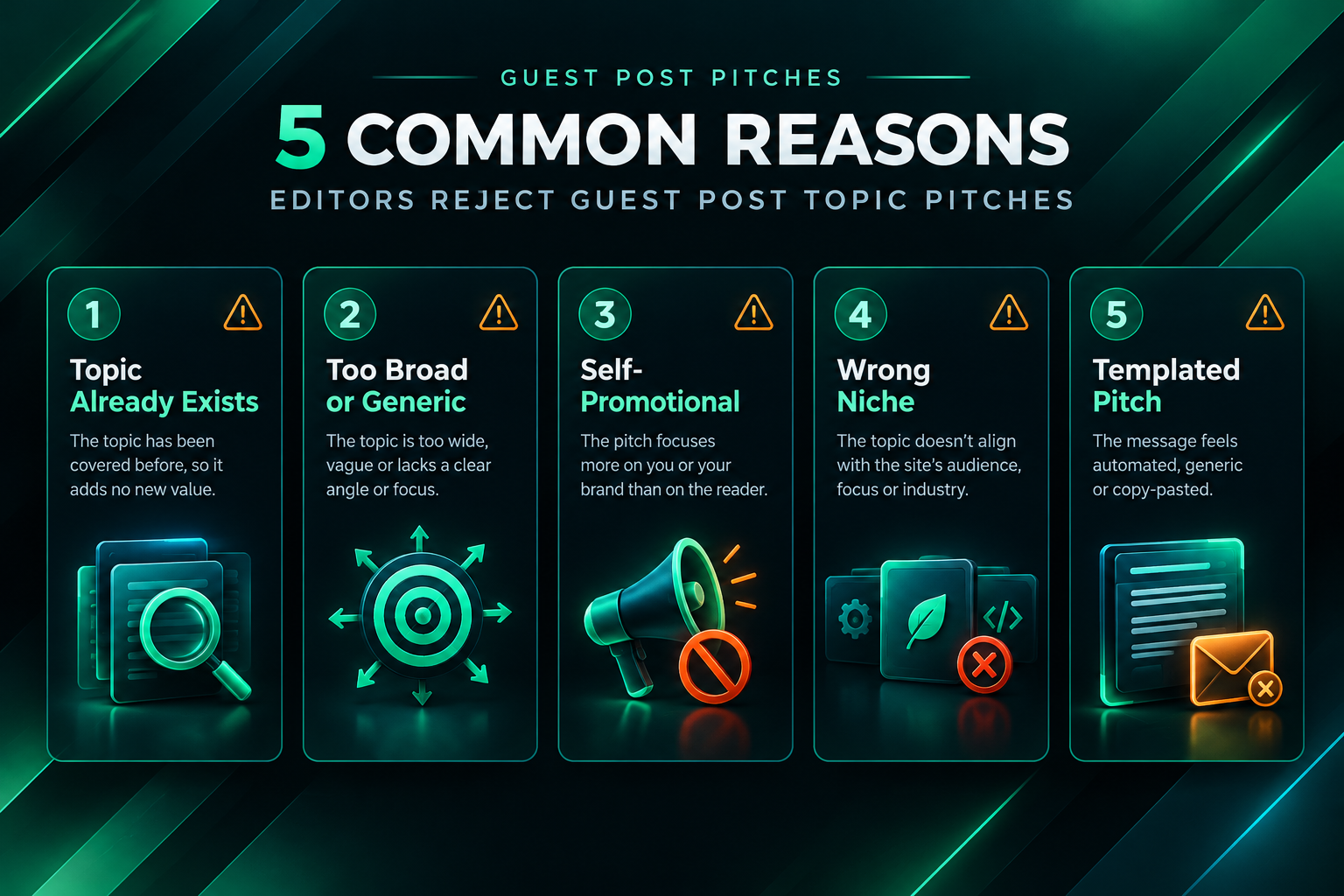
- The topic is too broad or too generic. A pitch for an article titled something like “Tips for Better Marketing” provides no clear indication of what the article will actually say or why it would be useful to the publisher’s specific audience.
- The topic is clearly self-promotional. If the proposed article reads as a thinly veiled advertisement for the contributor’s product or service, most editors will decline it.
- The topic does not match the publisher’s niche. Even a well-written pitch for a genuinely useful topic will be declined if the subject matter falls outside the publisher’s editorial focus.
- The pitch is clearly templated. Mass outreach pitches that make no reference to the specific publisher’s content or audience are easy to identify and are typically ignored.
Realistic Expectations for Guest Post Topic Acceptance
Even well-researched, carefully tailored topic pitches are sometimes declined. Editorial decisions depend on factors that are not always visible to the pitcher, including the publisher’s current content calendar, recent changes in editorial direction, the volume of pitches already received, and internal resource constraints. A declined pitch does not necessarily mean the topic was poorly chosen; it may simply reflect timing or capacity on the publisher’s side.
Acceptance rates for guest post outreach vary considerably depending on the quality of the publisher list, the relevance of the topics pitched, the strength of the outreach copy, and the industry. Campaigns that target highly authoritative publishers with strict editorial standards will typically see lower acceptance rates than campaigns targeting mid-tier publishers with more open contribution policies. Neither approach is universally superior; the right balance depends on the goals of the campaign, the target pages being linked to, and the existing backlink profile of the site being promoted.
It is also worth noting that guest posting is one link acquisition method among several. Depending on the website, the industry, and the campaign goals, other approaches such as niche edits, digital PR, resource page link building, or unlinked brand mention outreach may be more efficient for certain objectives. A well-structured link building campaign often combines multiple methods rather than relying exclusively on guest posting.
Frequently Asked Questions
How many topic ideas should I pitch to a publisher at once?
Most outreach practitioners recommend pitching two or three topic ideas in a single email rather than one. This gives the editor options without overwhelming them. If one topic does not fit their current needs, another may. Avoid sending a long list of topics, as this can make the pitch feel unfocused or automated.
Should the guest post topic always be directly related to my product or service?
Not necessarily. The topic should be related to the publisher’s audience and should create a natural context for a link to your target page. That target page does not have to be a product or service page; it could be a useful resource, a guide, or a tool that is genuinely relevant to the article’s subject matter. Forcing a direct product mention into every guest post tends to reduce editorial acceptance rates and produces less natural content.
How do I find content gaps on a publisher’s site without paid SEO tools?
You can use the site’s own search function, browse its category and tag pages, and use Google’s site: search operator to see what the publisher has already indexed. Reading through the site’s most recent articles and its most popular content (often listed in a sidebar or footer) also reveals patterns in what has and has not been covered. Free tools such as Google Search Console (if you have access to the publisher’s data, which you typically will not) or Google’s People Also Ask feature can supplement manual research.
Does the guest post topic affect the SEO value of the resulting link?
The topic affects the contextual relevance of the link, which is one factor in how the link may be interpreted by search engines. A link placed within a topically relevant article on a relevant publisher site is generally considered to carry stronger relevance signals than a link placed in an unrelated article. However, the overall SEO value of a backlink depends on many factors beyond topic relevance, including the publisher’s domain authority, the link’s placement within the content, the link attributes used, and the broader backlink profile of the receiving site.
How long should a guest post be to meet editorial standards?
Word count expectations vary by publisher and niche. Many publishers specify a minimum word count in their contributor guidelines. Where no guidance is given, matching the average length of the publisher’s existing articles is a reasonable starting point. Depth and usefulness matter more than length alone; a focused 900-word article that fully addresses a specific question is typically more valuable than a padded 2,000-word piece that repeats itself.
Can I reuse the same topic across multiple publishers?
Submitting identical or near-identical content to multiple publishers is generally considered poor practice and may violate individual publishers’ contributor agreements. Most publishers expect original content that has not been published elsewhere. However, you can address the same broad subject area with different angles, examples, or formats for different publishers, provided each article is genuinely original and tailored to the specific audience.
Choosing Topics That Work for Publishers and Your Campaign
Effective guest post topic selection requires balancing two sets of interests: the publisher’s need for content that serves their audience, and the link builder’s need for a contextually relevant placement that supports their SEO goals. These interests are not inherently in conflict. When a topic genuinely serves the publisher’s readers and naturally accommodates a relevant link, both parties benefit, and the resulting placement is more likely to have lasting editorial and SEO value.
The practical steps are straightforward: research the publisher’s existing content thoroughly, identify genuine gaps or underserved questions, assess whether a natural link to your target page fits within that topic, and pitch in a way that demonstrates you have done the work. Avoid the temptation to reverse-engineer topics from your preferred anchor text or to pitch generic ideas that could apply to any site in the niche.
For businesses and agencies managing guest posting at scale, the discipline of topic research can be time-consuming but is difficult to shortcut without affecting placement quality. If your team lacks the capacity to conduct thorough publisher research for every outreach target, working with a specialist link building provider that handles publisher vetting, topic development, and outreach as part of a managed campaign may be worth exploring. The quality of the topic selection process tends to be reflected directly in the quality and relevance of the placements that result.