When running email outreach for link building, a bounced email is more than a minor inconvenience. Bounces affect your sender reputation, reduce the number of prospects you actually reach, and can quietly undermine an otherwise well-planned campaign. Understanding the difference between a hard bounce and a soft bounce helps you respond appropriately, protect your sending domain, and keep your outreach list clean enough to produce consistent results.
Quick Comparison
| Characteristic | Hard Bounce | Soft Bounce |
|---|---|---|
| Definition | Permanent delivery failure | Temporary delivery failure |
| Common causes | Invalid address, non-existent domain, address blocked permanently | Full inbox, server temporarily unavailable, message too large |
| Recommended action | Remove from list immediately | Retry after a short interval; remove if repeated |
| Impact on sender reputation | High — signals poor list hygiene | Lower — but accumulation still causes harm |
| Deliverability risk | Significant if not addressed promptly | Moderate; manageable with monitoring |
| List hygiene response | Immediate suppression required | Monitor and suppress after threshold |
| Frequency in outreach | Common with unverified or aged prospect lists | Common during high-volume send periods |
| Outreach tool handling | Most tools auto-suppress after first occurrence | Most tools retry automatically before flagging |
What Is a Hard Bounce?
A hard bounce occurs when an email cannot be delivered due to a permanent reason. The receiving mail server returns a definitive rejection, indicating that the address does not exist, the domain is invalid, or the recipient’s server has permanently blocked messages from your sending address. Unlike a temporary failure, a hard bounce will not resolve itself if you try again later — the underlying problem is structural.
In link building outreach, hard bounces most commonly appear when prospect lists contain outdated contact details, when a website has changed ownership and the old editor’s address is no longer active, or when an email address was never valid in the first place. Scraping contact information from websites without verification is a frequent source of hard bounces, because published addresses are often generic, outdated, or formatted incorrectly.
The practical consequence of a hard bounce is straightforward: the address must be removed from your outreach list immediately. Continuing to send to a hard-bounced address signals to email service providers and receiving mail servers that your list hygiene is poor, which can reduce deliverability for every other email you send from the same domain. Most reputable outreach platforms automatically suppress hard-bounced addresses after the first occurrence, but it is worth confirming that your chosen tool handles this correctly.
What Is a Soft Bounce?
A soft bounce occurs when an email fails to deliver for a temporary reason. The recipient’s address is valid and the domain exists, but something prevented delivery at the time of sending. Common causes include a full inbox, a mail server that was temporarily offline, a message that exceeded the recipient’s size limit, or a server-side filter that flagged the message without permanently rejecting the sender.
Soft bounces are generally less alarming than hard bounces, but they should not be ignored. A single soft bounce on a valid address may resolve itself if you retry after a reasonable interval — many outreach tools do this automatically. However, if the same address produces repeated soft bounces across multiple attempts, it is worth treating it similarly to a hard bounce: the address may have become inactive, the inbox may be permanently full, or the server may be consistently filtering your messages.
In the context of link building outreach, soft bounces can also indicate that your sending domain or IP has been temporarily flagged by a recipient’s mail server. This is a different problem from a full inbox and may require reviewing your sending volume, domain warm-up status, or email authentication setup rather than simply retrying the same address.
Why Bounce Rates Matter for Outreach Deliverability
Email deliverability refers to the likelihood that a sent message actually reaches the recipient’s inbox rather than being filtered into spam or rejected entirely. Bounce rates are one of the signals that internet service providers and mail servers use to assess whether a sender is trustworthy. A high hard bounce rate suggests that the sender is not maintaining their list, which is a common characteristic of spam operations. As a result, senders with elevated bounce rates may find that even their valid emails are increasingly routed to spam folders or blocked outright.
For link building outreach specifically, deliverability has a direct effect on campaign results. If a meaningful proportion of your outreach emails are not reaching editors, webmasters, or content managers, your effective outreach volume is lower than your send volume suggests. This means your response rate calculations may be misleading, and your campaign may underperform not because of weak pitches or irrelevant targets, but because the emails are not being seen at all.
Industry guidance from email service providers generally suggests keeping hard bounce rates below two percent and total bounce rates as low as practically achievable. These thresholds are not universal rules, and different platforms and receiving servers apply their own standards, but they provide a useful benchmark for assessing whether a list needs attention before or during a campaign.
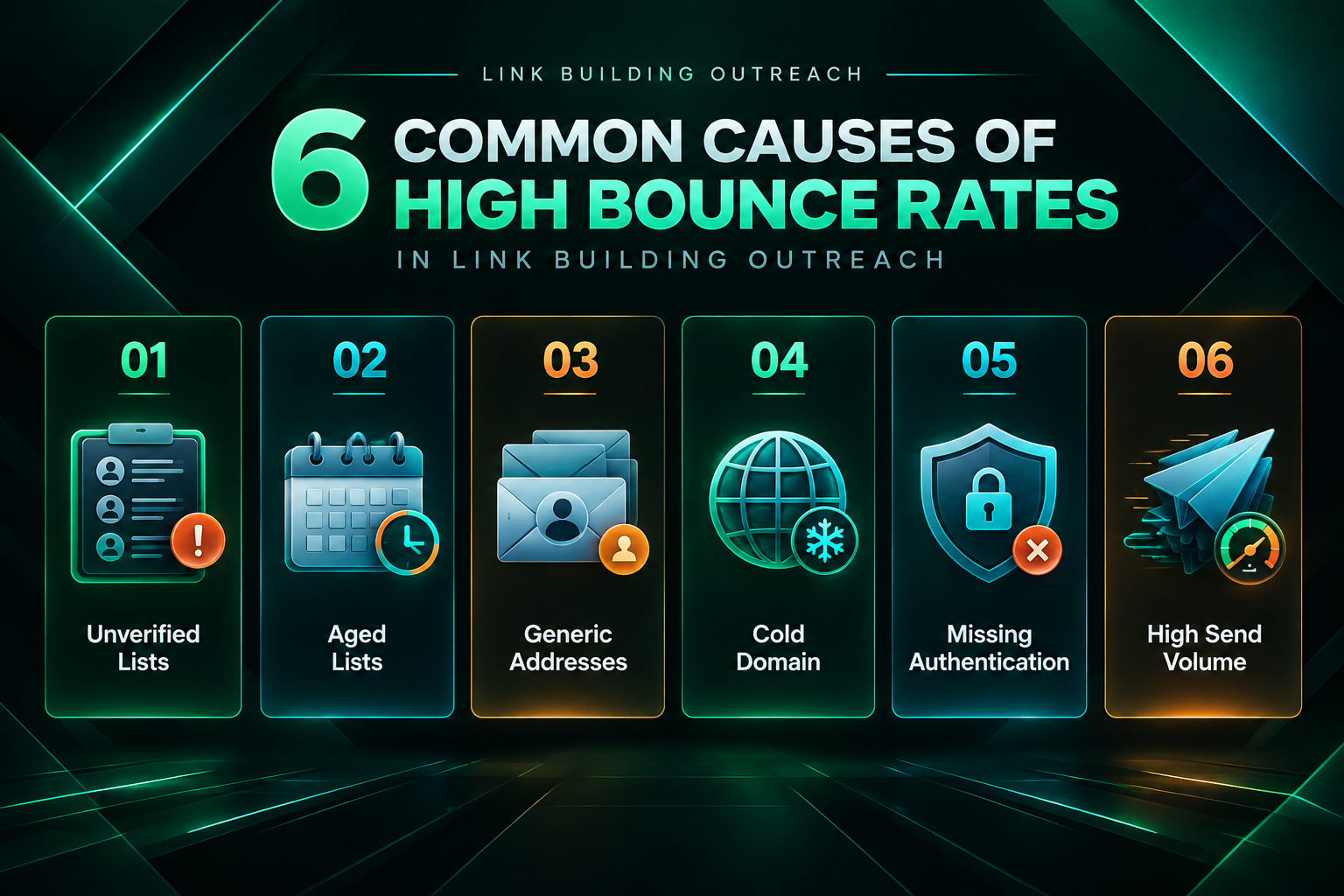
Common Causes of High Bounce Rates in Link Building Campaigns
Understanding why bounces occur helps you address the root cause rather than simply reacting after the fact. Several factors are particularly common in link building outreach contexts.
- Unverified prospect lists: Contact details gathered from website footers, WHOIS records, or scraped directories are often outdated or inaccurate. Without verification, a significant proportion of these addresses may produce hard bounces.
- Aged outreach lists: A list that was accurate six or twelve months ago may contain a notable number of invalid addresses today. Staff turnover, domain changes, and website closures all contribute to list decay over time.
- Generic or role-based addresses: Addresses such as info@, contact@, or hello@ are sometimes filtered more aggressively by receiving servers, increasing the likelihood of soft bounces or spam filtering.
- Sending from a cold or unwarmed domain: A newly registered sending domain that has not been gradually warmed up may trigger soft bounces or spam filters, particularly when sending at volume.
- Missing or misconfigured email authentication: SPF, DKIM, and DMARC records help receiving servers verify that your email is legitimate. Missing or incorrectly configured authentication records can increase the likelihood of rejection or filtering.
- High send volume from a single domain: Sending a large number of emails in a short period from a single domain can trigger rate-limiting or temporary blocks from receiving servers, producing soft bounces that would not occur at lower volumes.
How to Reduce Bounces Before a Campaign Starts
Proactive list hygiene is more effective than reactive cleanup. Verifying email addresses before sending reduces hard bounce rates, protects your sending domain, and improves the accuracy of your campaign metrics. Several email verification tools can check whether an address is formatted correctly, whether the domain exists and has active mail exchange records, and whether the specific mailbox is likely to accept messages. No verification tool can guarantee zero bounces, but verification meaningfully reduces the proportion of invalid addresses in a list.
For link building outreach, it is also worth considering the source of your prospect contacts. Addresses found through manual research on target websites, LinkedIn profiles, or editorial contact pages tend to be more accurate than those gathered through automated scraping. Where possible, cross-referencing a contact name with the website’s current team page or a recent byline reduces the risk of reaching out to someone who has left the organisation.
Domain warm-up is a separate but related consideration. If you are sending outreach from a relatively new domain or a domain that has not been used for high-volume email, gradually increasing your daily send volume over several weeks helps establish a positive sending reputation before you scale up. Sending at full volume from a cold domain is a common cause of soft bounces and spam filtering that is unrelated to the quality of your prospect list.
Managing Bounces During an Active Outreach Campaign
Even with thorough preparation, some bounces will occur during any outreach campaign. The key is to monitor bounce data in near real time and respond appropriately rather than allowing problems to accumulate.
For hard bounces, the response is consistent: suppress the address immediately and do not retry. If your outreach tool does not do this automatically, configure it to do so or handle suppression manually. Allowing hard-bounced addresses to remain in active sequences wastes send capacity and harms your sender reputation with each additional attempt.
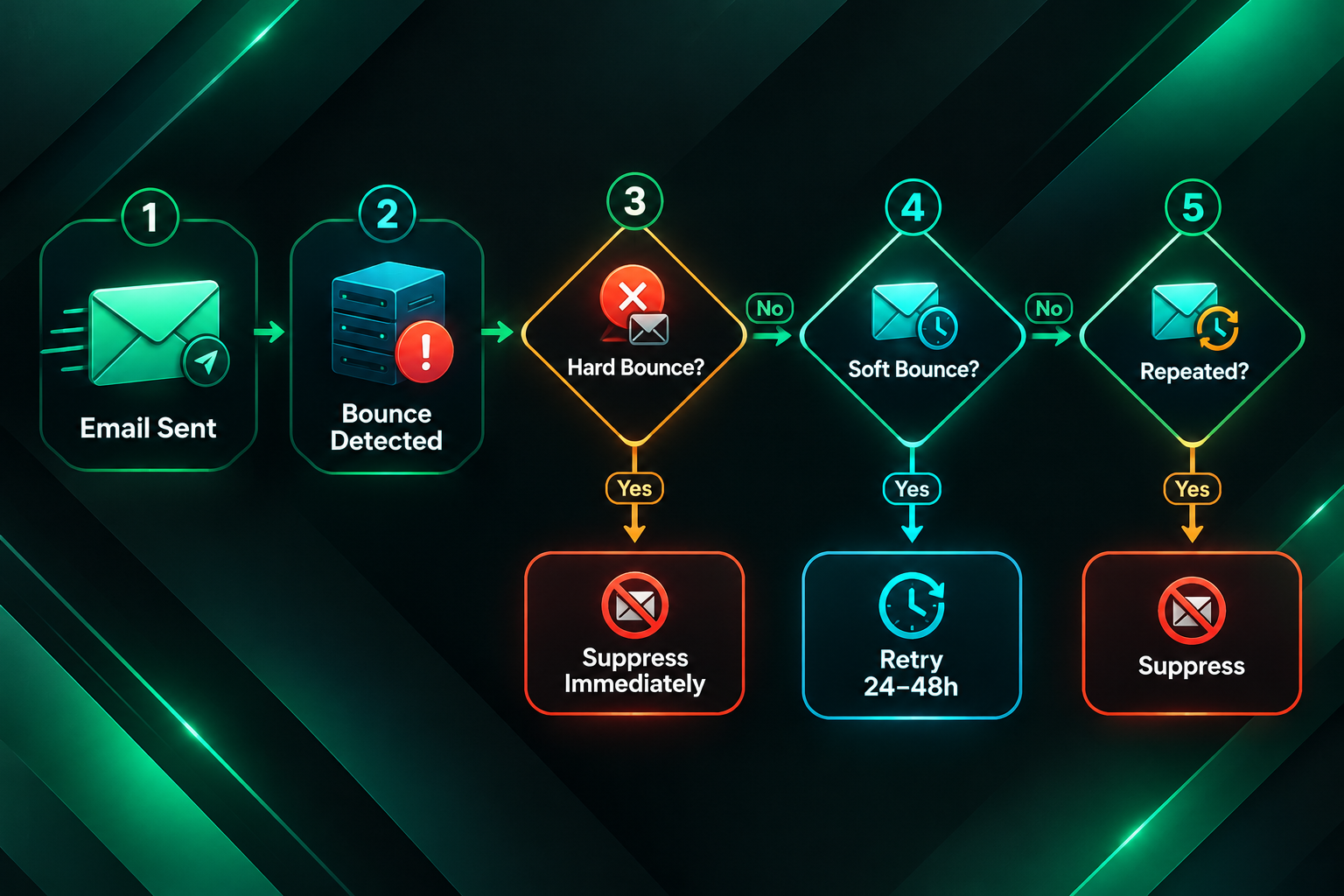
For soft bounces, the appropriate response depends on the cause. If the bounce is due to a full inbox or a temporary server issue, a single automatic retry after twenty-four to forty-eight hours is reasonable. If the same address soft-bounces repeatedly across two or three attempts, treat it as effectively unreachable for the current campaign and suppress it. Some outreach platforms allow you to configure retry logic and soft bounce thresholds, which is worth setting up before a campaign begins rather than adjusting mid-send.
Monitoring your overall bounce rate throughout a campaign also helps you identify whether a systemic problem has developed. A sudden increase in soft bounces across multiple addresses may indicate that your sending domain has been temporarily flagged, that your sending volume has exceeded a threshold, or that a batch of addresses from a particular source is lower quality than expected. Investigating the pattern rather than treating each bounce in isolation helps you identify and address the underlying issue more quickly.
Bounce Rates and Outreach Sender Reputation
Sender reputation is a composite assessment that mail servers and email service providers use to decide how to handle incoming messages from a given domain or IP address. Bounce rates are one input into this assessment, alongside spam complaint rates, engagement signals such as opens and replies, and authentication status. A domain with a strong sender reputation is more likely to have its messages delivered to the inbox; a domain with a poor reputation may find messages filtered to spam or rejected before delivery.
Hard bounces have a more immediate negative effect on sender reputation than soft bounces, because they signal that the sender is not maintaining basic list hygiene. However, a consistently high soft bounce rate can also degrade reputation over time, particularly if it is accompanied by low engagement or high spam complaint rates. For link building outreach, where response rates are typically low relative to commercial email marketing, maintaining a clean list and a healthy sender reputation is especially important because there is less positive engagement signal to offset the negative signals from bounces.
If your sending domain’s reputation has already been damaged by high bounce rates or spam complaints, recovery typically requires a period of reduced sending volume, thorough list cleaning, and consistent authentication. In some cases, it may be more practical to use a separate subdomain or a dedicated outreach domain rather than attempting to rehabilitate a domain that has been significantly affected. This is a decision that depends on the severity of the reputation damage and the importance of the affected domain to your broader email infrastructure.
Bounce Handling in Outsourced Link Building Campaigns
When link building outreach is managed by an external provider, bounce handling becomes part of the campaign management process rather than an internal responsibility. A competent outsourced link building team will typically use verified prospect lists, maintain dedicated outreach domains that are separate from a client’s primary business domain, and monitor bounce rates as part of ongoing campaign quality control.
Before engaging an outsourced provider, it is reasonable to ask how they source and verify contact information, what bounce thresholds they monitor, and how they handle hard and soft bounces within their outreach sequences. Providers who use unverified bulk lists or who do not monitor bounce rates actively may achieve lower placement rates and may inadvertently create deliverability problems that affect future outreach from the same domain.
Using a dedicated outreach domain — separate from the client’s primary domain — is a common practice in professional outreach campaigns. This approach means that any reputation effects from outreach activity do not affect the client’s main business email infrastructure. It is worth confirming whether a provider uses this approach and how they manage the reputation of their outreach domains over time.
Frequently Asked Questions
What is the main difference between a hard bounce and a soft bounce?
A hard bounce is a permanent delivery failure, meaning the email address is invalid or the domain does not exist. A soft bounce is a temporary failure, such as a full inbox or a server being briefly unavailable. Hard bounces require immediate list removal; soft bounces may resolve with a retry but should be suppressed if they recur.
How many bounces are acceptable in a link building outreach campaign?
There is no universal threshold that applies to every campaign or platform, but many email service providers suggest keeping hard bounce rates below two percent. Soft bounce rates should also be monitored and kept as low as practically achievable. Rates above these levels may indicate list quality problems or sending infrastructure issues that warrant investigation.
Can soft bounces turn into hard bounces?
Not technically — the bounce type is determined by the server response code at the time of delivery. However, an address that consistently produces soft bounces may effectively be unreachable, and it is practical to treat it similarly to a hard bounce after a defined number of failed attempts. Some outreach tools automatically reclassify repeated soft bounces for suppression purposes.
Does a high bounce rate affect my ability to reach other prospects?
Yes. A high hard bounce rate in particular can damage your sending domain’s reputation, which may cause even valid addresses to receive your emails in their spam folder or not at all. This is why list hygiene and bounce management affect the overall effectiveness of an outreach campaign, not just the individual bounced addresses.
Should I use a separate domain for link building outreach?
Using a dedicated outreach domain is a common practice among professional outreach teams. It separates the reputation effects of outreach activity from your primary business email domain. If you are running outreach at scale or using an outsourced provider, confirming whether a dedicated domain is used and how it is maintained is a reasonable due diligence question.
How can I verify email addresses before sending outreach?
Several email verification tools can check address formatting, domain validity, and mailbox existence before you send. No tool can guarantee zero bounces, but verification meaningfully reduces the proportion of invalid addresses in a list. Manual cross-referencing with current website team pages or recent bylines can further improve accuracy for link building prospect lists.
What should I do if my bounce rate suddenly increases mid-campaign?
A sudden increase in bounces mid-campaign may indicate a systemic issue such as a sending domain being temporarily flagged, a batch of low-quality addresses from a particular source, or a sending volume that has exceeded a threshold. Pausing the campaign to investigate the pattern, checking authentication records, and reviewing the source of the affected addresses is a more effective response than simply continuing to send.
Managing Bounce Rates as Part of a Sustainable Outreach Strategy
Hard bounces and soft bounces are not just technical email metrics — they are practical indicators of list quality, sending infrastructure health, and campaign sustainability. A link building outreach campaign that consistently produces high bounce rates will reach fewer genuine prospects, generate weaker response rates, and may create deliverability problems that persist beyond the current campaign.
Addressing bounce rates effectively requires attention at every stage: verifying contacts before sending, warming up sending domains appropriately, configuring outreach tools to handle bounces correctly, and monitoring rates throughout a campaign rather than only reviewing them at the end. For teams managing outreach in-house, building these practices into a standard campaign workflow reduces the risk of avoidable deliverability problems. For businesses using an outsourced link building provider, understanding how the provider handles bounce management is a useful indicator of overall campaign quality and professionalism.
The goal of bounce management is not to achieve a perfect zero-bounce rate — some level of bouncing is inevitable in any outreach campaign. The goal is to keep bounce rates low enough that your sending reputation remains healthy, your valid prospects receive your emails, and your campaign metrics accurately reflect the quality of your outreach rather than being distorted by delivery failures. Approached this way, bounce management is a foundational part of effective, sustainable link building outreach rather than an afterthought.