Publishing a clearly documented research methodology is one of the most effective ways to make a digital PR campaign credible enough to earn editorial coverage and high-quality backlinks. Journalists, editors, and bloggers are far more likely to cite a study when they can verify how the data was collected, who was surveyed, and what limitations apply. This guide explains what a publishable research methodology involves, how to structure and present it, and what decisions affect whether your campaign earns the links and coverage it deserves.
Key Takeaways
- A transparent research methodology increases editorial trust and makes your digital PR asset more likely to earn genuine backlinks from authoritative publishers.
- The methodology section should explain data sources, sample size, collection period, analytical approach, and known limitations in plain language.
- Methodology transparency is not just an ethical standard — it directly affects whether journalists will cite your research or ignore it.
- Publishing methodology details on a dedicated, crawlable page improves the asset’s long-term link-earning potential and supports ongoing digital PR outreach.
- Poorly documented or fabricated research can damage brand credibility and attract low-quality coverage that provides little SEO value.
What Research Methodology Means in a Digital PR Context
In academic publishing, a research methodology describes the systematic process used to gather and analyse data. In digital PR, the term carries the same meaning but serves a different primary purpose: giving journalists and editors enough information to decide whether your findings are worth reporting. A digital PR campaign built around original research — a survey, a data analysis, an index, or a freedom-of-information request — needs a methodology section that explains what was done, why it was done that way, and what the results can and cannot tell us.
Without this documentation, a campaign asset is essentially asking publishers to take its conclusions on trust. Most experienced journalists will not do that, particularly for claims that are likely to be challenged or that touch on sensitive topics. A well-written methodology section removes that barrier. It signals that the team behind the research understood what they were measuring, applied a consistent process, and is willing to be transparent about the study’s scope and constraints.
From a link building perspective, research assets with documented methodologies tend to attract citations from higher-authority publications. These are the kinds of editorially earned backlinks that are most likely to contribute to a site’s authority profile over time, as opposed to placements acquired through paid insertion or low-editorial-bar directories.
Choosing the Right Research Format Before You Write the Methodology
The methodology you publish will depend on the type of research your campaign is based on. The most common formats used in digital PR include consumer or business surveys, analysis of publicly available datasets, proprietary data drawn from a company’s own platform, freedom-of-information requests, and expert panels or interviews. Each format has different documentation requirements and different levels of credibility with different types of publishers.
Survey-based research requires documentation of the survey instrument, the recruitment method, the sample size, the demographic breakdown of respondents, the fieldwork dates, and the name of the research agency if one was used. Analysis of public datasets requires identification of the source, the version or date of the dataset, the variables selected, and the analytical steps applied. Proprietary platform data requires a clear explanation of what the dataset represents, how it was anonymised or aggregated, and what the population of users or transactions actually covers.
Choosing the right format before the research begins makes the methodology easier to document accurately. Retrofitting a methodology to data that was collected without a clear plan is one of the most common reasons digital PR research fails editorial scrutiny. Deciding in advance what question the research will answer, what data will answer it, and how that data will be collected and analysed gives you a methodology that can be written honestly and completely.
Core Elements of a Publishable Research Methodology
A methodology section for a digital PR asset does not need to be written in academic style, but it does need to cover the elements that allow a reader to assess the reliability of the findings. The following components are typically expected by editors at national publications, trade press, and specialist online media.
Research Question and Objective
State clearly what the research was designed to find out. This does not need to be a formal hypothesis, but it should be specific enough that a reader can judge whether the data collected was appropriate for the question being asked. Vague objectives — such as “exploring attitudes towards X” — are harder to defend than specific ones, such as “measuring the proportion of UK adults who have experienced X in the past 12 months”.
Data Source and Collection Method
Identify where the data came from and how it was gathered. For surveys, name the panel provider or recruitment method, specify whether responses were collected online, by telephone, or in person, and state the fieldwork dates. For dataset analysis, name the source, provide a URL or reference where possible, and note the date the data was accessed or downloaded. For proprietary data, describe the population it represents without disclosing confidential business information.
Sample Size and Representativeness
State the total number of respondents, records, or observations included in the analysis. Where the research makes claims about a specific population — UK adults, small business owners, e-commerce retailers — explain how the sample was selected and whether it is representative of that population. If the sample is not statistically representative, say so clearly. Journalists who understand research will appreciate the honesty; those who do not will rarely check, but the transparency protects your brand if the findings are challenged.
Analytical Approach
Describe how the raw data was processed to produce the findings. For survey data, this might include how responses were weighted, how open-ended answers were coded, or how subgroup comparisons were made. For dataset analysis, explain which variables were selected, how missing data was handled, and what statistical or computational methods were applied. Keep this section in plain language where possible; the goal is clarity, not the appearance of technical sophistication.
Limitations
Every research project has limitations, and acknowledging them openly is a mark of credibility rather than weakness. Common limitations in digital PR research include self-reported data, online panel bias, small subgroup samples, a single point-in-time measurement, or a dataset that covers one geography or industry. Stating these limitations does not undermine the findings; it shows that the team understands the boundaries of what the data can support and prevents journalists from discovering the limitations themselves and treating them as a reason to distrust the whole study.
Fieldwork Dates and Publication Date
Include the dates during which data was collected and the date the research was published or made available. This allows journalists to assess whether the findings are current and helps future researchers or journalists who discover the asset later understand its temporal context. Research that does not include fieldwork dates is harder to cite responsibly and may be treated with suspicion by editors at publications with rigorous standards.
How to Structure and Present the Methodology on Your Website
The methodology section should be published on the same page as the research findings or on a clearly linked companion page. Burying it in a PDF, hiding it behind a form, or omitting it entirely are common mistakes that reduce the campaign’s credibility and its link-earning potential. A dedicated methodology section that is part of the main research page is the most accessible format for journalists working to a deadline.
Use clear subheadings to separate each component of the methodology. Plain prose works better than bullet points for most methodology sections because it allows you to explain the reasoning behind methodological choices, not just list them. Where technical terms are unavoidable, define them briefly. The audience for a digital PR methodology section is not a peer-review committee; it is a journalist or editor who needs to decide in two minutes whether the research is credible enough to cite.
Make the page crawlable and indexable. A methodology published as an image, a locked PDF, or a JavaScript-rendered element that search engines cannot read will not contribute to the page’s topical authority or its ability to attract organic discovery by journalists searching for data on the topic. Use standard HTML, include the methodology content in the page’s main body, and ensure the page is included in the site’s XML sitemap.
Consider adding a short plain-language summary at the top of the methodology section for readers who want a quick overview before reading the detail. Something like: “We surveyed 2,000 UK adults online in March 2024 using a nationally representative panel. Full details of the methodology are below.” This summary can also be included in press releases and outreach emails to give journalists an immediate sense of the research’s scope.
Common Mistakes That Undermine Methodology Credibility
Several recurring errors reduce the credibility of digital PR research and make it harder to earn coverage from quality publications. Understanding these mistakes helps teams avoid them during the planning and documentation stages.

- Overstating representativeness: Describing an online convenience sample as “nationally representative” without weighting or quota controls is a claim that experienced journalists and editors will challenge. Be precise about what the sample represents.
- Omitting the fieldwork period: Research without dates cannot be assessed for currency. Always include when data was collected, not just when the campaign was published.
- Hiding limitations: Omitting known limitations does not make them disappear. It makes them more damaging when they are discovered, because the omission looks deliberate.
- Vague data sourcing: Phrases like “data from various public sources” or “industry research” without specific attribution are red flags for editors. Name the source, provide a reference, and note the access date.
- Conflating correlation with causation: Research findings that describe associations between variables should not be presented as causal relationships unless the study design supports that interpretation. Journalists who understand data will push back on overclaimed findings.
- Fabricating or manipulating data: This is the most serious error and carries significant reputational and legal risk. Digital PR research that is later found to be fabricated can result in retractions, brand damage, and loss of the backlinks the campaign earned.
How Methodology Transparency Affects Link Quality and Editorial Coverage
The connection between methodology transparency and link quality is direct. Publications with strong editorial standards — national newspapers, specialist trade press, academic blogs, and authoritative industry sites — apply scrutiny to the research they cite. A campaign asset that cannot withstand that scrutiny will either be ignored by these publishers or covered only by lower-quality sites that do not check sources carefully.
From a link building perspective, a placement on a high-authority editorial site that cites your research because it is credible is fundamentally different from a placement on a low-quality site that publishes anything it receives. The former is the kind of editorially earned backlink that may contribute meaningfully to a site’s authority profile over time. The latter provides little SEO value and may attract no referral traffic at all.
Methodology transparency also affects the longevity of a campaign asset. Research that is well-documented and credible can continue to attract citations months or years after the initial outreach campaign ends, as journalists and researchers discover it through search or through references in other articles. A poorly documented asset is unlikely to earn this kind of ongoing organic coverage because it does not give future readers enough information to assess its reliability.
For teams managing digital PR as part of a broader link acquisition strategy, the methodology section is not an administrative afterthought. It is a core component of the asset’s value and should receive the same attention as the headline findings, the visual design, and the outreach copy.
Integrating Research Publication into a Digital PR Outreach Campaign
Publishing the methodology is one step in a broader campaign workflow. The research asset — including the findings, the methodology, and any supporting data or visualisations — needs to be live and accessible before outreach begins. Sending journalists to a page that is not yet published, or that contains placeholder content, wastes the outreach opportunity and damages the campaign’s credibility.
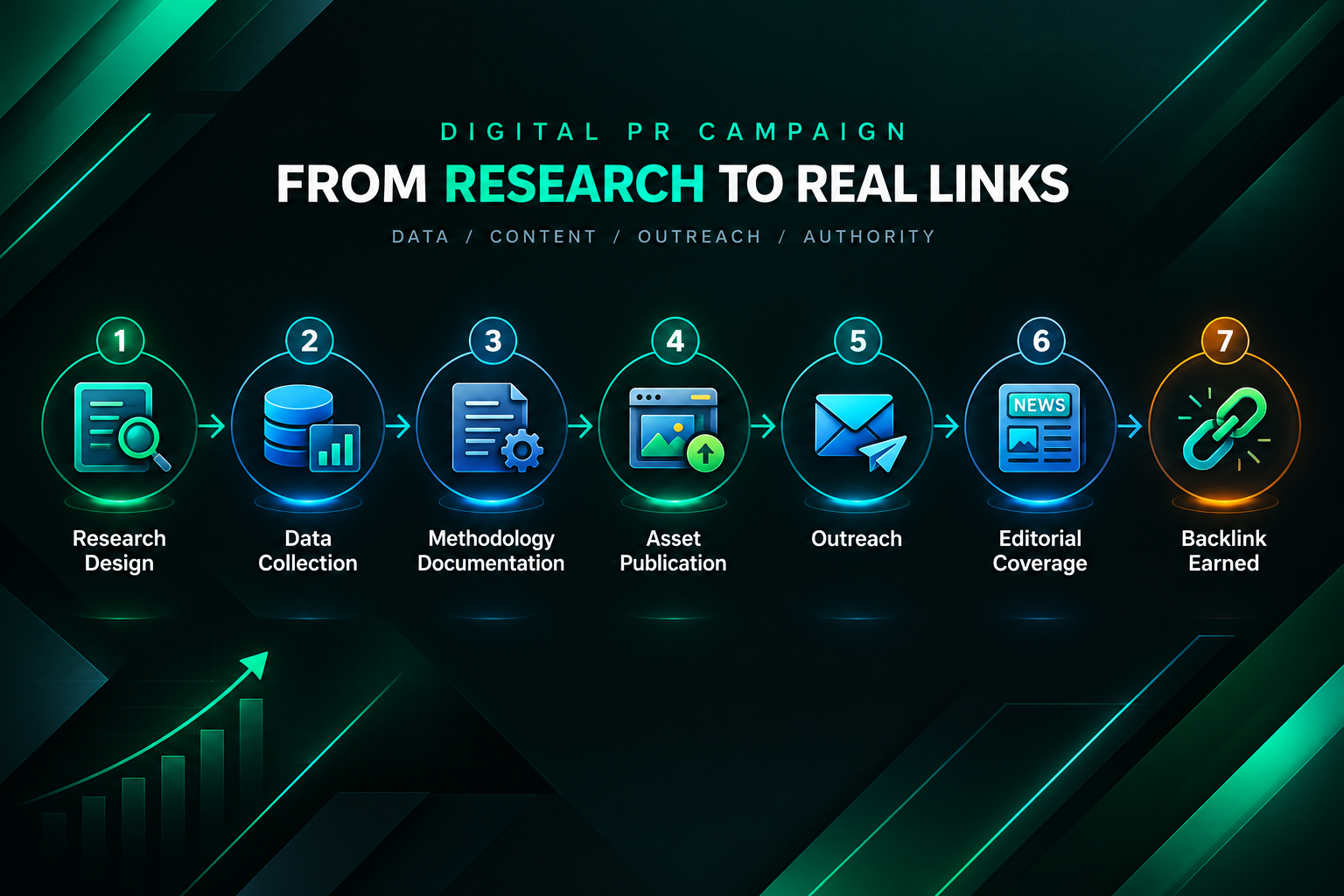
The outreach email or press release should reference the methodology briefly, giving journalists enough information to assess the research’s scope without requiring them to read the full methodology section before deciding whether to cover the story. A sentence such as “The findings are based on a survey of 1,500 UK small business owners conducted in January 2024 by [research agency]” provides the key credibility signals in a format that fits a busy journalist’s workflow.
Where the research is based on a dataset that journalists can download or explore themselves, providing access to the underlying data increases the likelihood of in-depth coverage and additional citations. Some publications will want to run their own analysis of the data, and making this possible — within the constraints of data protection and confidentiality — can result in more detailed and more authoritative coverage than a standard news story.
Follow-up outreach should reference the methodology if a journalist raises questions about the research’s reliability. Having a clear, honest answer ready — including an acknowledgement of limitations where relevant — is more effective than a defensive response that avoids the question. Journalists who receive a transparent and helpful response to a methodological question are more likely to proceed with coverage than those who receive evasive or incomplete answers.
When to Involve a Research Agency or Specialist
Not every digital PR team has the in-house expertise to design and execute research that will withstand editorial scrutiny. For campaigns where the research findings are central to the story — rather than supporting context — involving a specialist research agency or an academic collaborator can significantly improve the credibility and coverage potential of the asset.
A research agency brings expertise in questionnaire design, panel recruitment, data weighting, and statistical analysis that most marketing teams do not have internally. An academic collaborator can provide peer-level credibility that is particularly valuable for research touching on health, finance, social issues, or other areas where journalists apply heightened scrutiny. The cost of involving a specialist needs to be weighed against the potential value of the coverage and backlinks the campaign may earn, and against the reputational risk of publishing research that is later found to be methodologically weak.
Where a research agency is used, their name and role should be included in the methodology section. This is standard practice in credible digital PR research and is expected by editors at publications with rigorous standards. Omitting the agency’s name when one was used — or implying that the research was conducted in-house when it was not — is a form of misrepresentation that can damage trust if it is discovered.
Frequently Asked Questions
Does every digital PR campaign need a published methodology?
Not every campaign is built around original research, so not every campaign needs a methodology section. Campaigns based on expert commentary, creative concepts, or curated data from existing public sources have different documentation requirements. However, any campaign that presents original data or makes factual claims based on research the brand conducted should include a methodology section. Without it, the campaign is asking publishers to cite findings they cannot verify.
How long should a digital PR methodology section be?
Length should be determined by what needs to be explained, not by a target word count. A survey of 2,000 respondents with straightforward analysis might require 300 to 500 words to document adequately. A multi-source dataset analysis with complex weighting or modelling may require more. The goal is completeness and clarity, not brevity or length for its own sake.
Should the methodology be published before or after outreach begins?
The full research asset, including the methodology section, should be live and accessible before outreach begins. Journalists who receive a pitch and visit the page to assess the research need to find complete information. A page that is under construction or that lacks the methodology section at the time of outreach reduces the likelihood of coverage and may result in the campaign being dismissed before the journalist has read the findings.
Can a methodology section help with SEO as well as PR?
A well-structured methodology page that is crawlable and indexed can contribute to the topical authority of the research asset and the broader site. It may also attract organic discovery by journalists, researchers, and students searching for data on the topic. The primary purpose of the methodology section is editorial credibility, but there is no conflict between writing it clearly for human readers and ensuring it is technically accessible to search engines.
What should I do if a journalist questions the methodology after coverage has been published?
Respond promptly, honestly, and specifically. If the question identifies a genuine limitation that was not adequately disclosed, acknowledge it and consider updating the methodology section to address it. If the question reflects a misunderstanding of the research design, explain the relevant aspect of the methodology clearly and without defensiveness. Transparent and helpful responses to methodological questions protect the campaign’s credibility and the relationship with the publication.
Is it acceptable to update the methodology section after publication?
Minor clarifications and corrections are generally acceptable and should be made promptly if an error is identified. Significant changes to the methodology after publication — particularly changes that affect the interpretation of the findings — should be clearly labelled as updates, with the original version noted where relevant. Quietly altering a methodology section to address criticism without disclosure is a form of misrepresentation that can damage trust if it is discovered.
Making Research Methodology Work for Your Digital PR Strategy
Publishing a transparent and complete research methodology is not a bureaucratic requirement — it is a practical investment in the credibility and link-earning potential of your digital PR campaign. Campaigns built on well-documented research are more likely to earn coverage from authoritative publications, more likely to attract ongoing organic citations, and more likely to withstand the scrutiny that serious editorial teams apply to the data they report.
The methodology section should be treated as a core component of the research asset, planned before data collection begins and written with the same care as the headline findings. It should be published on a crawlable, accessible page, referenced briefly in outreach communications, and updated honestly if questions or corrections arise after publication.
For businesses and agencies considering digital PR as part of a broader link acquisition strategy, the quality of the underlying research and its documentation is one of the most important factors determining whether the campaign earns the kind of editorially placed backlinks that may contribute to long-term authority. If you are planning a research-led digital PR campaign and want to discuss how methodology, outreach, and link acquisition strategy fit together, speaking with an experienced link building team can help you assess the approach before committing resources to execution.