Paginated content creates a specific internal linking challenge that many websites handle poorly. Whether you are managing a blog archive, an e-commerce category with hundreds of products, or a long article split across multiple pages, the way you structure internal links between those pages directly affects how search engines crawl, index, and assign authority to your content. Getting this wrong can mean important pages receive little crawl attention, link equity becomes fragmented, or users land on page three of a series with no clear path to the beginning. This article explains how to approach internal linking for paginated pages in a way that supports both search engine understanding and user experience.
Key Takeaways
- Paginated pages require deliberate internal linking so that crawlers can discover all pages in a series and users can navigate them logically.
- Google no longer supports the rel=prev/next HTML attribute as a pagination signal, so on-page link structure and self-referencing canonical tags carry more weight than they once did.
- Consolidating link equity toward a primary page, such as page one of a series, is generally preferable to distributing it thinly across every paginated URL.
- The right approach depends on the type of paginated content, the website’s crawl budget, and whether individual paginated pages have standalone search value.
- Internal linking for pagination should be reviewed alongside technical SEO decisions such as canonicalization, indexation directives, and site architecture.
What Pagination Means for Internal Linking
Pagination refers to the practice of splitting a large set of content across multiple URLs, each representing a sequential page. Common examples include product category pages on e-commerce sites, blog post archives, search results pages, and long-form articles divided into chapters or sections. Each paginated URL is a distinct page from a crawler’s perspective, which means internal linking decisions affect how much crawl attention each page receives and how link equity flows through the site.
Internal links are one of the primary signals search engines use to understand site structure and to determine which pages are most important. When paginated pages are linked inconsistently or only through next and previous navigation buttons, crawlers may struggle to reach deeper pages efficiently, and the pages that do get crawled may receive very little link equity because the chain of links dilutes authority with each step. A page that is five clicks deep in a paginated series and linked only from page four is unlikely to receive meaningful crawl attention or ranking consideration for competitive queries.
The internal linking structure for paginated content therefore needs to serve two goals simultaneously: making every page in the series reachable by crawlers, and concentrating link equity on the pages that have the most search value. These goals sometimes pull in different directions, which is why a one-size-fits-all approach rarely works well.
How Google Treats Paginated Content
Google’s documented approach to pagination has changed significantly over the years. The rel=prev and rel=next HTML link attributes were once recommended as a way to signal sequential relationships between paginated pages, but Google announced in 2019 that it had stopped using these attributes as an indexing signal. This means websites that still rely on rel=prev/next as their primary pagination strategy are not receiving the benefit they may expect.
Google’s current guidance emphasizes that each paginated URL should be treated as a standalone page. If a paginated page has unique, valuable content, it may be indexed and ranked independently. If it does not, webmasters are encouraged to use canonical tags or noindex directives to manage how those pages appear in search results. Google also notes that it can generally follow paginated series through standard next and previous links, but this does not guarantee that all pages will be crawled or indexed, particularly on large sites with limited crawl budget.
Bing and other search engines have their own crawling and indexing behaviors, and their handling of paginated content may differ from Google’s. Assumptions based solely on Google’s documentation should not be applied universally across all search engines without verification.
The Core Internal Linking Approaches for Paginated Pages
There are several practical approaches to internal linking for paginated content, and the most appropriate one depends on the type of content, the site’s architecture, and the intended search outcome for each page in the series.
Sequential Next and Previous Links
The most basic approach is to include visible next and previous navigation links on each paginated page. This allows both users and crawlers to move through the series in order. The limitation is that this creates a chain structure where page one links to page two, page two links to page three, and so on. Link equity diminishes with each step, meaning pages near the end of a long series receive very little authority passed through internal links. For a series with three or four pages this may be acceptable, but for a category with twenty or thirty paginated pages it is likely to leave later pages poorly supported.
Linking All Paginated Pages from a Central Hub
A more effective approach for many sites is to create a central hub page, often the first page of the series or a dedicated index page, that links directly to every page in the paginated set. This flattens the link structure so that each page is reachable in two clicks from the hub rather than being buried in a sequential chain. It also concentrates internal link equity more evenly across the series. The practical challenge is that this approach can create very long navigation elements on the hub page, which may affect user experience and could dilute the hub page’s own link equity if it links to a large number of destinations.
Numbered Pagination Navigation
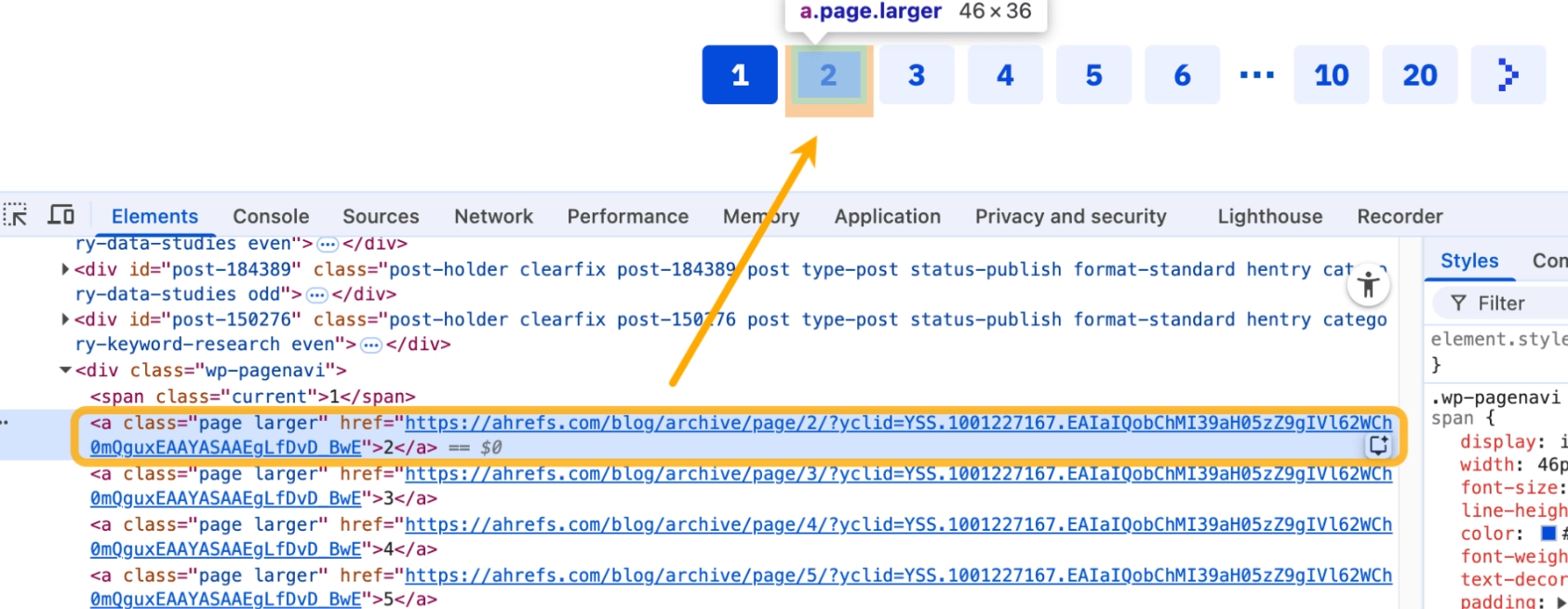
Numbered pagination, where users can see and click on page numbers such as 1, 2, 3, and so on, is a common middle ground. It typically shows a limited range of page numbers around the current page, with links to the first and last pages. This approach gives crawlers a path to all pages without requiring the hub page to link to every URL individually. From an internal linking perspective, it still creates some equity dilution for pages far from the beginning, but it is more manageable than a pure sequential chain and more practical than a full hub-to-all-pages model for large paginated sets.
View All Pages
Some sites offer a view-all option that loads all paginated content on a single URL. From an internal linking and SEO perspective, this can be advantageous because it consolidates content and link equity on one page rather than distributing them across many. Google has historically indicated a preference for view-all pages when they load quickly and provide a good user experience. The drawback is that very large view-all pages can be slow to load, which may negatively affect Core Web Vitals and user experience metrics. This approach is most practical for content sets of moderate size.
Canonical Tags and Their Relationship to Internal Links
Canonical tags and internal linking work together when managing paginated content, and decisions about one affect the other. A canonical tag tells search engines which URL should be treated as the primary version of a page. For paginated series, some sites set the canonical tag on all paginated pages to point to page one, signaling that page one is the preferred version for indexing purposes.
This approach can help consolidate link equity and indexation signals toward page one, but it creates a tension with internal linking. If pages two, three, and beyond are canonicalized to page one, internal links pointing to those pages still pass some equity, but the pages themselves are unlikely to rank independently. This may be the right outcome if the paginated pages have no standalone search value, but it is the wrong approach if individual pages contain unique content that users might search for directly.
Self-referencing canonical tags, where each paginated page canonicalizes to itself, are generally recommended when individual pages have distinct content worth indexing. This approach, combined with clear numbered navigation and links back to page one, gives search engines accurate signals about the relationship between pages without suppressing any of them unnecessarily.
Crawl Budget Considerations for Large Paginated Sites
Crawl budget refers to the number of pages a search engine will crawl on a given site within a specific period. For small sites, crawl budget is rarely a concern. For large e-commerce sites, news publishers, or any site with thousands of paginated URLs, crawl budget management becomes an important factor in how internal links are structured.
When a site has extensive pagination, every paginated URL competes for crawl attention. If crawlers spend significant time on low-value paginated pages, they may not reach more important pages as frequently. Internal linking decisions can help manage this by directing crawl attention toward pages with genuine search value and away from pages that are unlikely to rank or that duplicate content found elsewhere in the series.
Practical steps that may help include using noindex directives on paginated pages that have no standalone search value, reducing the number of paginated URLs through larger page sizes or view-all options where appropriate, and ensuring that the most important pages in the series are linked prominently from high-authority pages on the site. These decisions should be made based on a site-specific assessment rather than applied as universal rules, because the right balance between crawlability and indexation varies considerably depending on the site’s size, content type, and competitive landscape.
Internal Linking Best Practices for Specific Paginated Content Types
E-Commerce Category Pages
E-commerce category pages with paginated product listings present one of the most common and complex pagination challenges. The primary page, typically page one of the category, usually has the most link equity and is the most likely to rank for category-level queries. Internal links from the site’s main navigation, homepage, and other high-authority pages typically point to page one, while pages two and beyond receive links only through pagination navigation.
For e-commerce sites, a practical approach is to ensure that page one of each category is well-linked from the site’s main navigation and internal content, while using numbered pagination navigation for subsequent pages. Individual product pages should be linked directly from category pages rather than relying on pagination to make them discoverable. If certain products are particularly important, linking to them from editorial content such as buying guides or comparison pages can provide additional internal link equity independent of the category pagination structure.
Blog Archives and Post Listings
Blog archive pages that list posts in reverse chronological order are often paginated, with older posts appearing on later pages. From a search perspective, these archive pages rarely have strong standalone value because they are essentially lists of links rather than substantive content. A common and reasonable approach is to noindex paginated archive pages beyond page one, ensuring that crawlers can still follow links to individual posts but that the archive pages themselves do not compete for indexation or dilute the site’s crawl budget.
Individual blog posts should be internally linked from relevant content across the site rather than relying on archive pagination as their primary discovery mechanism. Category and tag pages, related post sections, and editorial internal links within post content are generally more effective for distributing link equity to individual posts than archive pagination chains.
Long-Form Articles Split Across Multiple Pages
Some publishers split long articles into multiple pages to increase pageviews. From an SEO perspective, this practice is generally discouraged because it fragments content and link equity across multiple URLs, making it harder for any single page to rank for the article’s target queries. If an article is split across pages, each page should include clear navigation to all other pages in the series, and the first page should be the canonical version unless each section has genuinely distinct search value.
A view-all option that consolidates the full article on one URL is often preferable for SEO purposes, provided the page loads efficiently. If splitting is necessary for technical or editorial reasons, internal links from other content on the site should point to the first page of the series, and the relationship between pages should be made clear through both navigation links and, where appropriate, structured data.
Anchor Text for Pagination Links
Anchor text in pagination navigation is typically functional rather than keyword-rich. Labels such as Next, Previous, Page 2, and Page 3 are standard and appropriate. Search engines understand these as navigational links rather than editorial endorsements, so there is no meaningful SEO benefit to using keyword-rich anchor text in pagination controls. The more important anchor text decisions relate to editorial internal links that point to specific pages within a paginated series from other content on the site.
When linking editorially to a specific page within a paginated series, the anchor text should describe the content of the destination page accurately. For example, a link to page three of a product category that contains a specific product type might use anchor text that describes that product type rather than generic text like click here or page three. This helps search engines understand the context of the destination page and may contribute to its relevance signals for related queries.
Common Internal Linking Mistakes with Paginated Content
Several recurring mistakes affect how well paginated content performs in search. Relying solely on JavaScript-rendered pagination links is one of the most significant, because crawlers may not execute JavaScript reliably, meaning pages beyond the first may not be discovered at all. Pagination navigation should use standard HTML anchor tags with crawlable href attributes wherever possible.
Another common mistake is applying the same canonical tag to all pages in a series without considering whether individual pages have standalone value. Blanket canonicalization to page one can suppress pages that contain unique content worth indexing. Conversely, failing to use any canonicalization on pages that genuinely duplicate content from page one can create indexation and duplicate content issues.
Blocking paginated URLs in robots.txt is also problematic. If crawlers cannot access paginated pages, they cannot follow links to the products, posts, or other content listed on those pages. Even if the paginated pages themselves are not intended to rank, they often need to be crawlable so that the content they link to can be discovered and indexed.
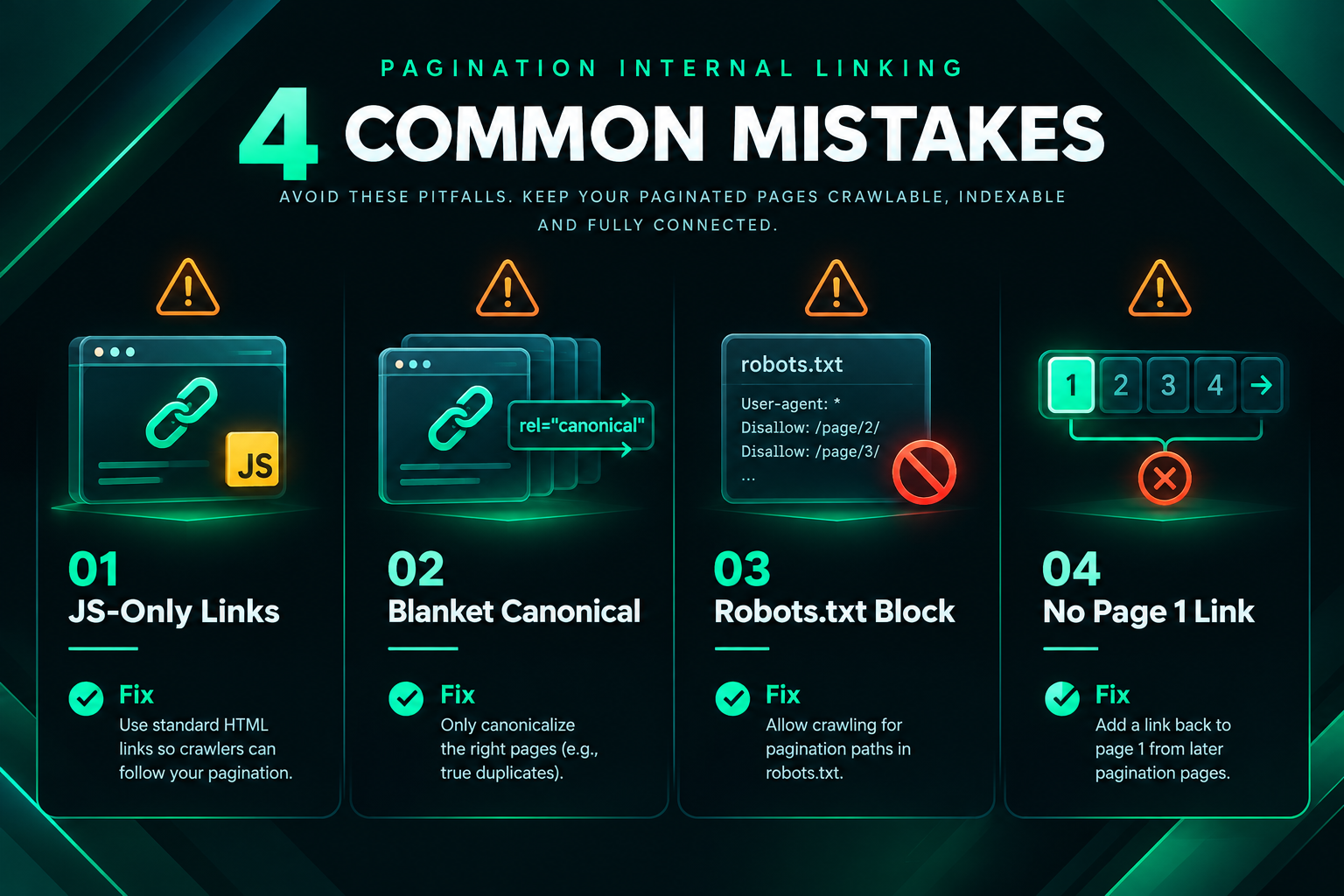
Finally, neglecting to link back to page one from subsequent pages is a missed opportunity. A clear link from every page in a series back to the first page helps consolidate link equity toward the primary URL and gives users a consistent way to return to the beginning of the series.
How Internal Linking for Pagination Relates to Broader Link Building
Internal linking for paginated pages is one component of a site’s overall link architecture, and it interacts with external link building in meaningful ways. External backlinks that point to page one of a paginated series contribute link equity that flows through the site’s internal link structure. If the internal linking between paginated pages is poorly structured, some of that externally acquired equity may not reach the pages that need it most.
For sites running link building campaigns, ensuring that internal linking is well-structured before or alongside external outreach can improve the impact of acquired links. A backlink pointing to a category page that is well-connected to its product pages through clear internal links will distribute equity more effectively than the same backlink pointing to a page that is internally isolated. This is particularly relevant for e-commerce sites where category pages are common targets for external link acquisition but individual product pages also need link equity to rank for specific queries.
Reviewing internal linking as part of a broader SEO audit, rather than treating it as a separate technical task, tends to produce better outcomes. The relationship between crawl structure, internal link equity distribution, external backlink targets, and content quality all affect how well paginated content performs in search, and changes to one element can affect the others.
Frequently Asked Questions
Does Google still support rel=prev and rel=next for pagination?
No. Google announced in 2019 that it had stopped using rel=prev and rel=next as indexing signals. These attributes no longer influence how Google crawls or indexes paginated content, so sites should not rely on them as a pagination SEO strategy. On-page link structure, canonical tags, and indexation directives are the primary tools available for managing paginated content in search.
Should paginated pages beyond page one be noindexed?
It depends on whether those pages contain content with standalone search value. If paginated pages are essentially lists of links with no unique content, noindexing them can help focus crawl budget on more valuable pages. If individual paginated pages contain distinct content that users might search for directly, noindexing them would suppress that content unnecessarily. A site-specific assessment is needed to make this decision correctly.
How does pagination affect crawl budget?
Large paginated sets can consume significant crawl budget, particularly on sites with thousands of paginated URLs. Crawlers that spend time on low-value paginated pages may crawl high-priority pages less frequently. Managing pagination through a combination of internal linking, canonical tags, and indexation directives can help direct crawl attention toward pages with genuine search value.
Is a view-all page better for SEO than paginated pages?
A view-all page can be advantageous because it consolidates content and link equity on a single URL, which may make it easier for search engines to understand and rank the full content set. However, view-all pages that are very large may load slowly, which can negatively affect user experience and Core Web Vitals. The right choice depends on the size of the content set and the site’s technical capabilities.
Should internal links from editorial content point to page one or to specific paginated pages?
In most cases, editorial internal links should point to page one of a paginated series, as this is typically the primary URL with the most link equity and the strongest indexation signals. Links to specific paginated pages may be appropriate when those pages contain distinct content that is directly relevant to the linking context, but this should be an intentional editorial decision rather than a default practice.
Can poor internal linking for paginated pages affect external link building results?
Yes. External backlinks contribute link equity that flows through a site’s internal link structure. If internal linking between paginated pages is fragmented or poorly structured, externally acquired equity may not reach the pages that need it. Reviewing and improving internal link architecture before or alongside an external link building campaign can help ensure that acquired links have the intended impact.
Deciding on the Right Pagination Link Structure for Your Site
There is no single correct way to handle internal linking for paginated pages. The right approach depends on the type of content being paginated, the size of the paginated set, the site’s crawl budget, whether individual pages have standalone search value, and how the paginated content fits into the broader site architecture. A blog with a three-page archive needs a different approach than an e-commerce site with fifty category pages each containing thirty pages of products.
The most consistent principle across all paginated content types is that internal links should make every page in a series reachable by crawlers without burying important pages deep in a sequential chain, and link equity should be concentrated toward the pages with the most search value rather than distributed thinly across every paginated URL. Canonical tags, indexation directives, and on-page navigation all work alongside internal linking to achieve this, and decisions about each element should be made together rather than in isolation.
If your site has significant paginated content and you are unsure whether the current internal linking structure is supporting or limiting your search performance, a technical SEO audit that covers crawl structure, internal link equity distribution, and indexation is a reasonable starting point. For sites running or planning external link building campaigns, aligning internal link architecture with campaign targets can improve the measurable impact of acquired links. A qualified SEO professional or agency with experience in technical site structure can help assess the specific situation and recommend an approach suited to your site’s content, size, and goals.