Internal linking architecture shapes how search engines crawl your site, how link equity flows between pages, and how clearly your topical expertise is communicated. Two models dominate the conversation: the silo structure and the hub-and-spoke model. Both aim to organise content logically and distribute authority efficiently, but they approach the problem differently. Understanding those differences can help you choose an architecture that fits your content strategy, your site’s size, and your SEO objectives.
Quick Comparison
| Characteristic | Silo Structure | Hub-and-Spoke Model |
|---|---|---|
| Core concept | Strict topical separation into isolated content silos | Central hub page linked to and from related spoke pages |
| Cross-topic linking | Discouraged or restricted between silos | Permitted; spokes can link to multiple hubs |
| Link equity flow | Contained within each silo; flows up and down the hierarchy | Flows between hub and spokes; more flexible distribution |
| Topical authority signal | Strong within each isolated topic cluster | Strong for the hub topic; spokes reinforce hub authority |
| Content scalability | Can become rigid as site grows; new silos required for new topics | Easier to extend by adding spoke pages to existing hubs |
| Navigation complexity | Simpler within a silo; harder to surface related content across silos | More flexible; users can move between related topics |
| Best suited for | Large sites with clearly distinct topic areas; e-commerce category pages | Content-heavy sites, blogs, SaaS resource centres, service sites |
| External link targeting | Links often directed to silo root or category pages | Links often directed to hub pages to amplify spoke authority |
| Implementation effort | High upfront planning; strict editorial discipline required | Moderate planning; more forgiving as content evolves |
| Risk of over-restriction | Higher; relevant cross-topic links may be blocked unnecessarily | Lower; contextual linking is encouraged |
What Is a Silo Structure?
A silo structure organises website content into distinct, self-contained topic groups. Each silo covers one subject area, and internal links are kept within that silo rather than crossing into unrelated topic areas. The idea is to send a concentrated topical relevance signal to search engines by keeping pages about the same subject tightly connected to one another and separated from pages about different subjects.
In a physical silo, grain is stored separately to prevent contamination. The SEO metaphor works similarly: a silo about commercial property insurance should link internally to pages about liability cover, policy types, and claims processes, but not to pages about home insurance or car cover that belong to separate silos. The goal is to make each silo appear as a coherent, authoritative resource on its specific topic.
Silos can be implemented in two ways. A physical silo uses URL structure and site architecture to separate topics, often through subdirectories such as /commercial-insurance/ and /home-insurance/. A virtual silo relies on internal linking patterns alone, without necessarily reflecting the separation in the URL structure. Physical silos are generally easier to maintain consistently, but virtual silos offer more flexibility when restructuring an existing site.
The silo model became popular in part because it mirrors how search engines assess topical relevance. When a cluster of pages on the same subject links to one another and to a clear category or pillar page, the signal of expertise on that subject may be stronger than if those pages were scattered across a loosely organised site. However, strict silo implementation can also prevent useful contextual links between related topics, which may limit the user experience and reduce the natural flow of link equity across the site.
What Is a Hub-and-Spoke Model?
The hub-and-spoke model, sometimes called the pillar-and-cluster or topic cluster model, organises content around a central hub page that covers a broad topic comprehensively. Spoke pages explore specific subtopics in greater depth and link back to the hub. The hub page, in turn, links out to each spoke. This bidirectional linking creates a web of topical relevance that reinforces the hub page’s authority on the broader subject.
A SaaS company might create a hub page on project management software, then produce spoke pages covering time tracking, task assignment, team collaboration features, and integration options. Each spoke links back to the hub, and the hub links to each spoke. A user or search engine crawler moving through this structure encounters a coherent, interconnected resource on the broader topic rather than isolated pages competing with one another.
Unlike the strict silo model, the hub-and-spoke approach does not prohibit links between spoke pages or between different topic clusters when those links are contextually relevant. A spoke page about time tracking might reasonably link to a spoke page about reporting features if the connection genuinely helps the reader. This flexibility makes the model easier to maintain as a site grows and content evolves.
The hub-and-spoke model has gained significant traction in content marketing and SEO because it aligns well with how search engines assess topical authority. When a hub page earns external backlinks, some of that authority flows to the spoke pages through internal links. Conversely, spoke pages that attract their own backlinks can pass authority back to the hub. This reciprocal flow may strengthen the overall cluster’s visibility for related search queries, though the degree of benefit depends on content quality, link relevance, and competitive factors in the target market.
How Internal Link Equity Flows Differently in Each Model
Link equity, sometimes called PageRank or link juice in informal SEO discussions, refers to the authority value that passes between pages through hyperlinks. The way each model handles this flow has practical implications for which pages rank and how effectively external backlinks benefit the wider site.
In a silo structure, link equity is deliberately contained within each silo. A strong backlink pointing to a silo’s root category page distributes authority downward to the supporting pages within that silo, but not sideways to pages in other silos. This concentration can be advantageous when you want to build authority for a specific topic area without diluting it across the site. The risk is that pages in weaker silos may receive little benefit from backlinks earned by stronger silos, even when those pages cover related subjects.
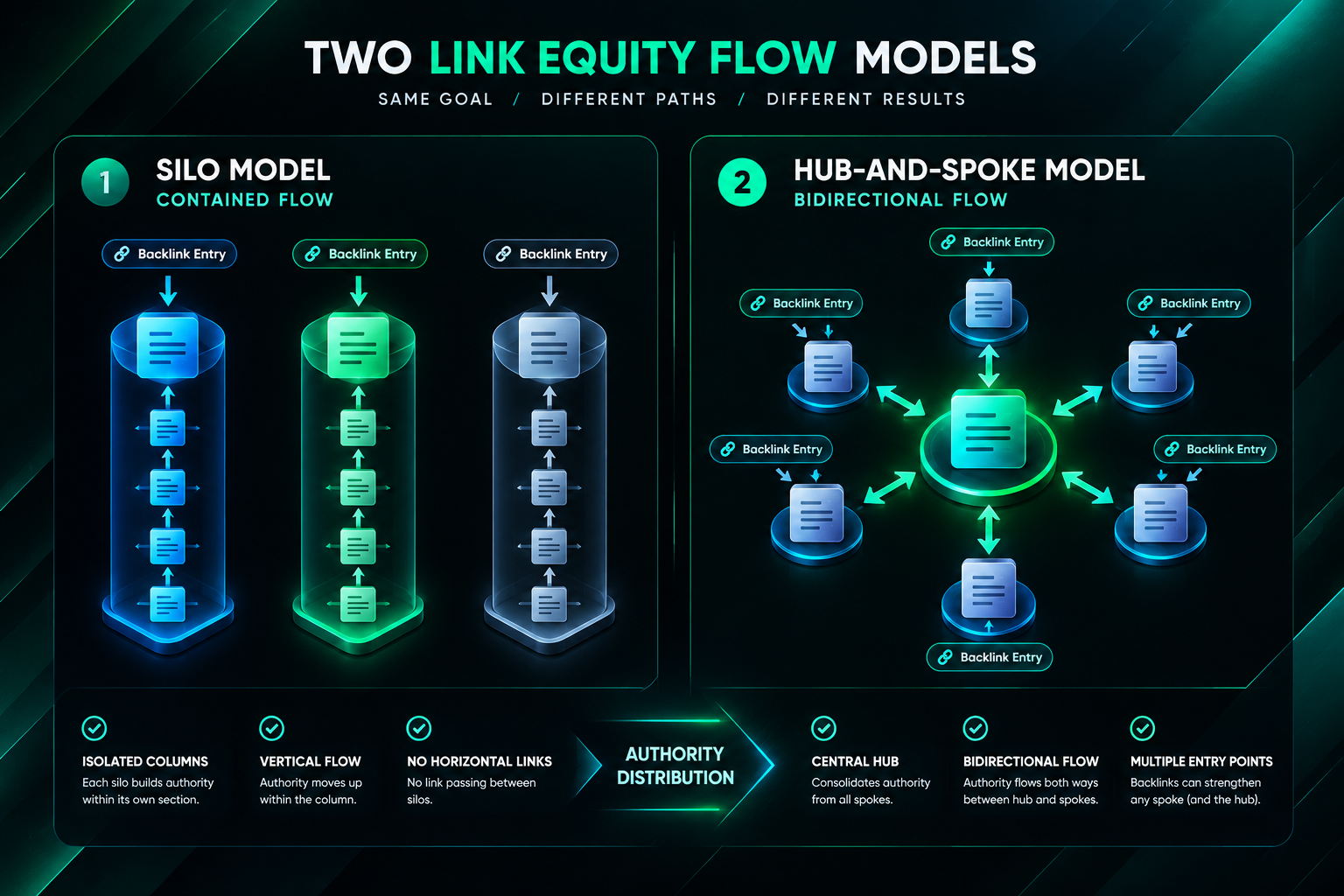
In the hub-and-spoke model, link equity flows more freely between the hub and its spokes. A backlink to the hub page benefits the spoke pages through outbound internal links, and backlinks earned by individual spoke pages can flow back to the hub. This creates a more interconnected authority network that may help the entire cluster perform better for a range of related queries. The trade-off is that the model requires careful planning to avoid diluting authority across too many loosely related pages.
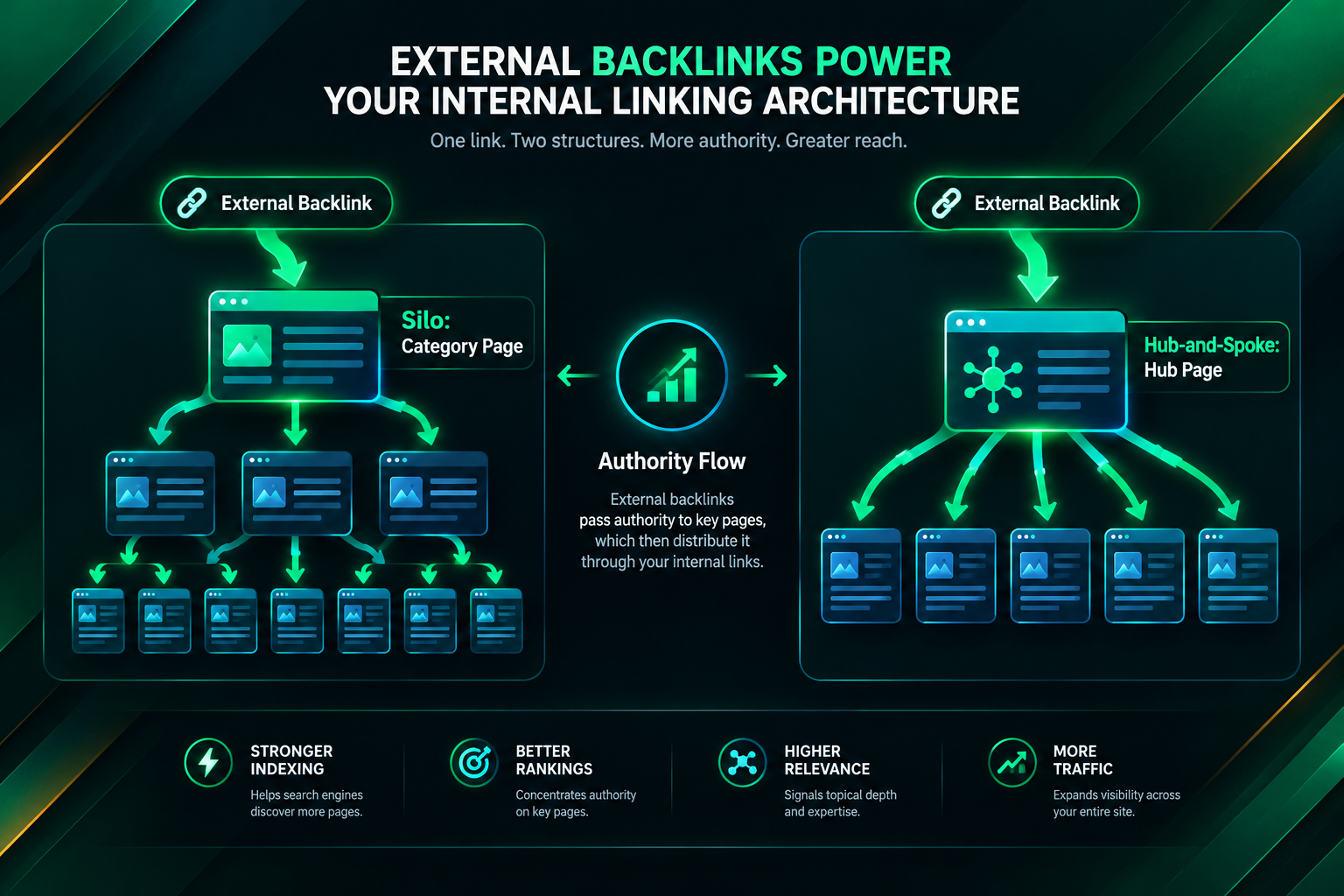
Both models benefit from external link building, but the target pages and the expected flow of authority differ. Silo-based sites often benefit most from backlinks directed at category or pillar pages at the top of each silo. Hub-and-spoke sites benefit from backlinks to hub pages, though well-targeted links to high-quality spoke pages can also strengthen the cluster. Understanding this distinction matters when planning an external link acquisition campaign, because the placement of backlinks affects which pages receive the most direct authority benefit.
Topical Authority and Search Engine Signals
Both the silo structure and the hub-and-spoke model are designed, in part, to communicate topical authority to search engines. Topical authority refers to the degree to which a website is perceived as a credible, comprehensive resource on a given subject. Search engines assess this through a combination of content quality, internal linking patterns, external backlink relevance, and user engagement signals, among other factors.
The silo model signals topical authority by keeping related content tightly grouped and preventing dilution from unrelated topics. When every page within a silo links to and from other pages on the same subject, the cluster of pages collectively reinforces the site’s expertise on that topic. This approach can be particularly effective for large sites covering many distinct subject areas, where clear separation prevents topic confusion.
The hub-and-spoke model signals topical authority through depth and interconnection. The hub page demonstrates broad coverage of a subject, while spoke pages demonstrate depth on specific subtopics. The bidirectional linking pattern signals to search engines that the site has invested in comprehensive coverage of the topic rather than producing isolated pages. Research from content marketing practitioners suggests this model can improve rankings for both the hub page and its associated spoke pages, though outcomes vary considerably depending on content quality, competition, and the relevance of any external links pointing to the cluster.
It is worth noting that neither model guarantees improved rankings on its own. Internal linking architecture is one factor among many. Content quality, page experience, external backlink profile, technical SEO health, and competitive landscape all influence how a site performs in search results. A well-planned internal linking structure supports these other factors but cannot compensate for weak content or a poor backlink profile.
Practical Differences in Implementation
Implementing a silo structure requires significant upfront planning. You need to map your content into clearly defined topic groups before building or restructuring the site. Each silo needs a clear root page, a logical hierarchy of supporting pages, and strict editorial guidelines about which pages can link to which. For existing sites with a large volume of content, retrofitting a silo structure can be time-consuming and may require redirects, URL changes, and a thorough internal link audit.
The hub-and-spoke model is generally more forgiving to implement and maintain. You identify a broad topic, create or designate a hub page, then build or reorganise spoke pages around it. New spoke pages can be added as the content strategy evolves without requiring a restructure of the entire site. Cross-linking between related spoke pages is permitted when contextually appropriate, which reduces the editorial burden of maintaining strict separation.
For sites that are already live and generating traffic, the hub-and-spoke model is often the more practical starting point. It can be applied incrementally, cluster by cluster, without disrupting the existing site architecture. The silo model, by contrast, tends to deliver its strongest benefits when implemented from the ground up or during a significant site restructure.
Which Sites May Benefit from Each Approach
The silo structure may be worth considering for large e-commerce sites with clearly distinct product categories, for financial services or legal sites covering multiple unrelated practice areas, or for any site where topic separation is important for both SEO and user experience. When a site covers subjects that genuinely should not be mixed, such as commercial insurance and personal insurance, strict silo separation can prevent internal competition between pages and keep topical signals clean.
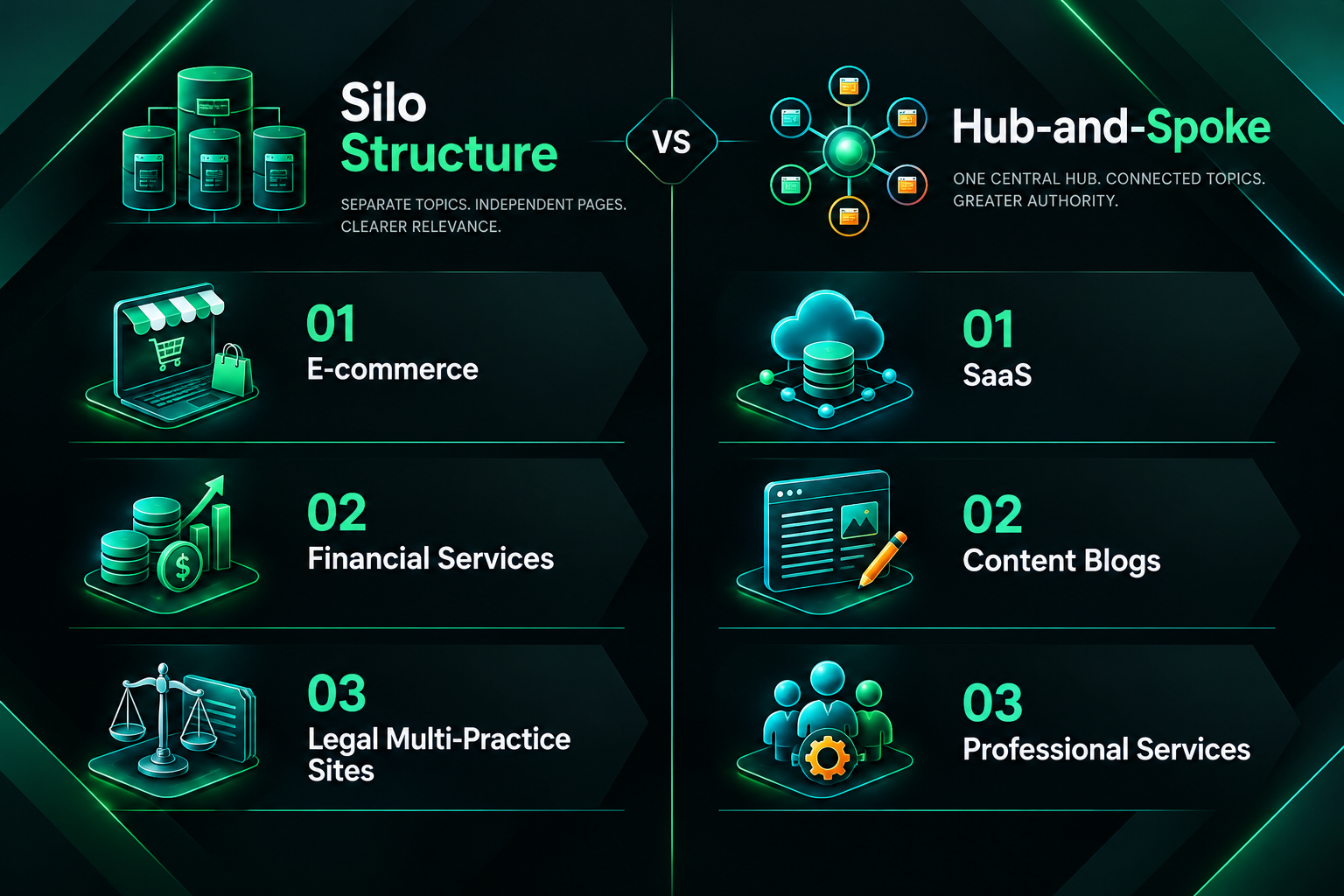
The hub-and-spoke model tends to suit content-heavy sites, SaaS resource centres, professional services blogs, and any site where the goal is to build comprehensive topical authority around a defined set of subjects. It works well when the content strategy involves producing a large volume of related articles, guides, or resource pages that naturally support one another. It is also a practical choice for sites that want to align their internal linking with an external link building campaign, since hub pages make natural targets for backlink acquisition.
Some sites benefit from combining elements of both models. A large site might use silo-style URL architecture and category separation while applying hub-and-spoke linking patterns within each silo. This hybrid approach can provide the topical clarity of the silo model with the flexibility and depth of the hub-and-spoke model. Whether a hybrid approach is appropriate depends on the site’s size, content volume, and the degree of overlap between topic areas.
Internal Linking and External Link Building: How They Work Together
Internal linking architecture and external link acquisition are complementary rather than independent strategies. The way a site is structured internally determines how effectively external backlinks distribute authority across the site. A well-planned internal linking model can amplify the benefit of each external link earned; a poorly structured site may waste much of that benefit through inefficient link equity flow.
When planning an external link building campaign, understanding the site’s internal linking model helps identify the most valuable target pages. For a silo-structured site, backlinks directed at the top of each silo, typically the category or pillar page, will distribute authority most efficiently to the supporting pages within that silo. For a hub-and-spoke site, backlinks to hub pages strengthen the entire cluster, while backlinks to high-quality spoke pages can also contribute meaningfully to the cluster’s overall authority.
Manual outreach campaigns and guest posting services can be aligned with either model by targeting placements that link to the pages most likely to distribute authority where it is needed. For example, if a hub page is underperforming relative to its spoke pages, acquiring backlinks to the hub may help rebalance the authority flow within the cluster. If a specific silo is underperforming, directing link acquisition efforts toward that silo’s root page may be more effective than building links to the site’s homepage.
It is also worth considering that external links to spoke pages or deep silo pages can be valuable, particularly when those pages target competitive commercial queries. A spoke page optimised for a specific long-tail keyword may benefit more from a targeted backlink than from additional internal links alone. The right balance between internal and external link strategy depends on the site’s current authority, the competitiveness of the target keywords, and the quality of the existing content.
Risks and Limitations of Each Model
The silo structure carries a risk of over-restriction. Enforcing strict separation between silos can prevent contextually relevant links that would genuinely help users and signal relevance to search engines. If an editor working on a commercial insurance page cannot link to a related business finance page because it belongs to a different silo, the user experience suffers and a potentially useful topical connection is lost. Overly rigid silo implementation can also make a site feel fragmented, reducing the likelihood that users will explore related content.
The hub-and-spoke model carries a risk of dilution. If a hub page links to too many loosely related spoke pages, or if spoke pages link to one another without clear topical relevance, the authority signal can become diffuse. Creating spoke pages that are too thin or too similar to one another can also lead to keyword cannibalization, where multiple pages compete for the same search queries rather than complementing one another.
Both models require ongoing maintenance. As a site grows, new content must be integrated into the existing architecture rather than published in isolation. Pages that are orphaned, meaning they receive no internal links, will receive little authority from either model and may struggle to rank regardless of their content quality. Regular internal link audits are advisable for any site using either approach, particularly after significant content additions or site restructures.
Neither model eliminates the need for high-quality content. Internal linking architecture can improve how authority flows between pages and how clearly topical relevance is communicated, but it cannot compensate for content that fails to satisfy search intent, lacks depth, or does not meet the quality expectations of the target audience.
Frequently Asked Questions
Can I use both silo structure and hub-and-spoke on the same site?
Yes. Many larger sites use silo-style URL architecture and category separation to organise distinct topic areas, while applying hub-and-spoke internal linking patterns within each silo. This hybrid approach can provide topical clarity at the site level and content depth within each topic cluster. Whether it is appropriate depends on the site’s size, content volume, and the degree of overlap between subject areas.
Does internal linking architecture directly affect Google rankings?
Internal linking is a documented factor in how search engines crawl and index pages and how link equity flows through a site. A well-structured internal linking model may help search engines understand the site’s topical focus and distribute authority more efficiently. However, internal linking is one factor among many, and its effect on rankings depends on content quality, external backlink profile, technical SEO health, and competitive factors.
Which model is better for a new website?
For a new site with a defined content strategy, the hub-and-spoke model is often easier to implement and scale. It allows you to build topical authority incrementally by adding spoke pages as the content library grows. A silo structure may be more appropriate if the site will cover clearly distinct, unrelated topic areas from the outset and the content plan is well defined before launch.
How does external link building fit into a hub-and-spoke strategy?
External backlinks to hub pages can strengthen the authority of the entire cluster, benefiting spoke pages through internal link equity flow. Backlinks to individual spoke pages can also contribute to cluster authority, particularly for spoke pages targeting competitive queries. Aligning external link acquisition with the hub-and-spoke structure, by targeting hub pages or high-priority spoke pages, may improve the efficiency of the campaign.
What is keyword cannibalization and how does it relate to these models?
Keyword cannibalization occurs when multiple pages on the same site compete for the same or very similar search queries, potentially reducing the ranking potential of each individual page. Both the silo and hub-and-spoke models, when implemented carefully, can reduce cannibalization by assigning distinct topics or subtopics to specific pages. However, poorly planned spoke pages that overlap in subject matter can create cannibalization within a cluster.
How often should I audit my internal linking structure?
There is no universal frequency that applies to every site. A practical approach is to review internal linking whenever significant new content is published, after a site restructure, or when target pages show unexpected ranking changes. Sites publishing content frequently may benefit from quarterly audits, while smaller sites with stable content may need less frequent reviews.
Choosing the Right Internal Linking Model for Your SEO Goals
The choice between a silo structure and a hub-and-spoke model is not a decision between a good option and a bad one. Both models can support strong SEO performance when implemented thoughtfully and maintained consistently. The more useful question is which model fits your site’s content volume, topic diversity, and long-term content strategy.
If your site covers clearly distinct, unrelated subject areas and you want to build concentrated topical authority in each area without cross-contamination, a silo structure may be worth the upfront planning investment. If your site is built around a defined set of broad topics that you intend to cover comprehensively through a growing library of related content, the hub-and-spoke model offers a more flexible and scalable framework.
For most content-driven sites, service businesses, and SaaS companies, the hub-and-spoke model tends to be the more practical choice. It aligns naturally with content marketing workflows, supports external link building campaigns by providing clear hub page targets, and can be extended incrementally without requiring a full site restructure. The silo model remains a strong option for large e-commerce sites, multi-practice professional services firms, and any site where strict topic separation is genuinely necessary.
Whichever model you choose, internal linking architecture works best when it is planned alongside content strategy and external link acquisition rather than treated as a separate technical exercise. If you are considering how to align your internal linking model with an external link building campaign, a site-specific assessment from an experienced SEO provider can help identify which pages would benefit most from targeted backlinks and how your current architecture may be affecting authority distribution across the site.