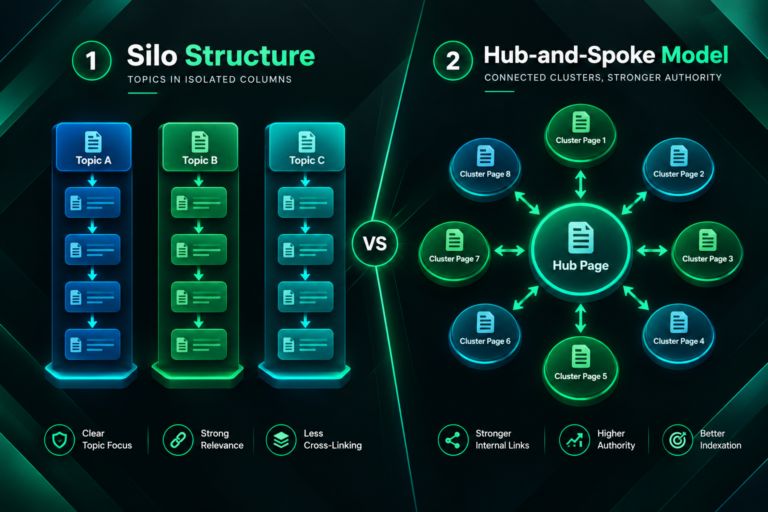
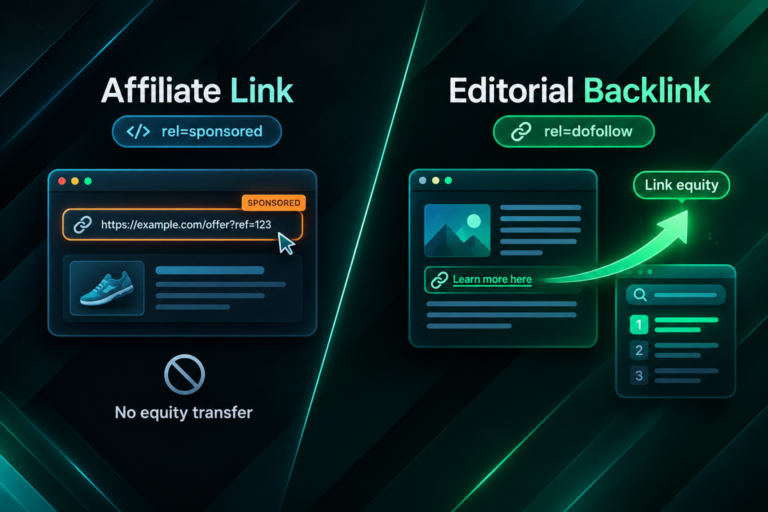
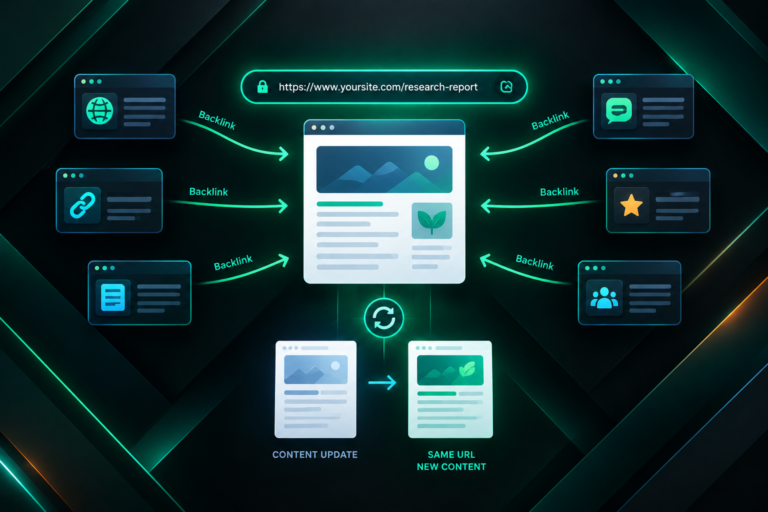
Click depth refers to the number of clicks a user or search engine crawler must take from a website’s homepage to reach a specific page. A page that requires five clicks to reach from the homepage has a click depth of five, while a page reachable in two clicks has a click depth of two. This metric matters because search engines use crawl budget efficiently, and pages buried deep within a site’s architecture may be crawled less frequently, indexed more slowly, or assigned lower priority than pages closer to the root. Understanding click depth helps SEO practitioners and website owners make informed decisions about site structure, internal linking, and where link equity flows within a domain.
Key Takeaways
- Click depth measures how many clicks separate a page from the homepage; lower depth generally means easier discovery by crawlers and users alike.
- Pages with high click depth may be crawled less frequently, which can delay indexing and reduce their visibility in search results.
- Internal linking is the primary tool for reducing click depth, and strategic backlinks to deep pages can also signal their importance to search engines.
- Click depth is one structural factor among many; content quality, relevance, and overall site authority all influence how a page ultimately performs.
- Large websites with thousands of pages benefit most from actively auditing and managing click depth as part of a broader technical SEO strategy.
What Click Depth Means in Practice
Click depth is sometimes called crawl depth or page depth, and the terms are often used interchangeably in SEO discussions. The concept is straightforward: starting from the homepage at depth zero, every additional click required to reach a destination page adds one unit of depth. A category page linked directly from the homepage sits at depth one. A product page linked from that category sits at depth two. A filtered variant of that product page, accessible only through a secondary navigation layer, might sit at depth three, four, or deeper.
Search engines such as Google use automated crawlers to discover and revisit pages. These crawlers follow links, and the number of links they must follow to reach a page influences how often and how reliably that page is crawled. Google’s own documentation has noted that pages very deep in a site’s architecture may receive less crawl attention, particularly on large websites where crawl budget is a practical constraint. For smaller sites with a few hundred pages, click depth is rarely a critical issue because crawlers can typically reach all pages without difficulty. For e-commerce platforms, news publishers, or enterprise websites with tens of thousands of URLs, click depth becomes a meaningful factor in ensuring important pages are discovered and indexed promptly.
It is worth distinguishing click depth from URL depth. URL depth refers to the number of subdirectories in a URL path, such as /category/subcategory/product/. A page can have a short URL path but still require many clicks to reach if the site’s navigation does not link to it efficiently. Conversely, a page with a long URL path might be reachable in a single click if it appears in a prominent navigation menu. Click depth, measured by actual link traversal, is the more operationally relevant concept for crawlability.
How Click Depth Affects Crawling and Indexing
Search engine crawlers operate within resource constraints. Google allocates a crawl budget to each website based on factors including the site’s overall authority, server response times, and the perceived value of its content. When a crawler visits a site, it prioritises pages it can reach quickly and efficiently. Pages at click depth one or two are typically revisited more frequently than pages at depth five or six, all else being equal.
For pages that are not yet indexed, high click depth can delay their initial discovery. If a new product page is added to an e-commerce site but is only reachable through four layers of navigation, a crawler may not encounter it during its next scheduled visit. This delay can mean the page misses ranking opportunities during a commercially important period, such as a product launch or seasonal campaign.
For pages that are already indexed, high click depth can result in less frequent recrawling. If a page’s content changes but the crawler visits it infrequently, the updated version may not appear in search results for an extended period. This is particularly relevant for pages with time-sensitive content such as pricing, availability, or news articles.
It is important to note that click depth alone does not determine whether a page is indexed or how it ranks. A page at depth four on a highly authoritative domain with strong internal linking may be indexed reliably, while a page at depth two on a poorly structured site with thin content may struggle. Click depth is a structural signal that influences crawl efficiency, not a standalone ranking factor with a fixed effect.
The Relationship Between Click Depth and Link Equity
Link equity, sometimes called PageRank or link juice in informal SEO discussions, flows through a website via internal and external links. When an external backlink points to a homepage, some of that equity passes to pages the homepage links to, and then onward through subsequent internal links. Pages closer to the homepage in terms of click depth tend to receive more link equity through this flow, because equity diminishes with each additional link hop.
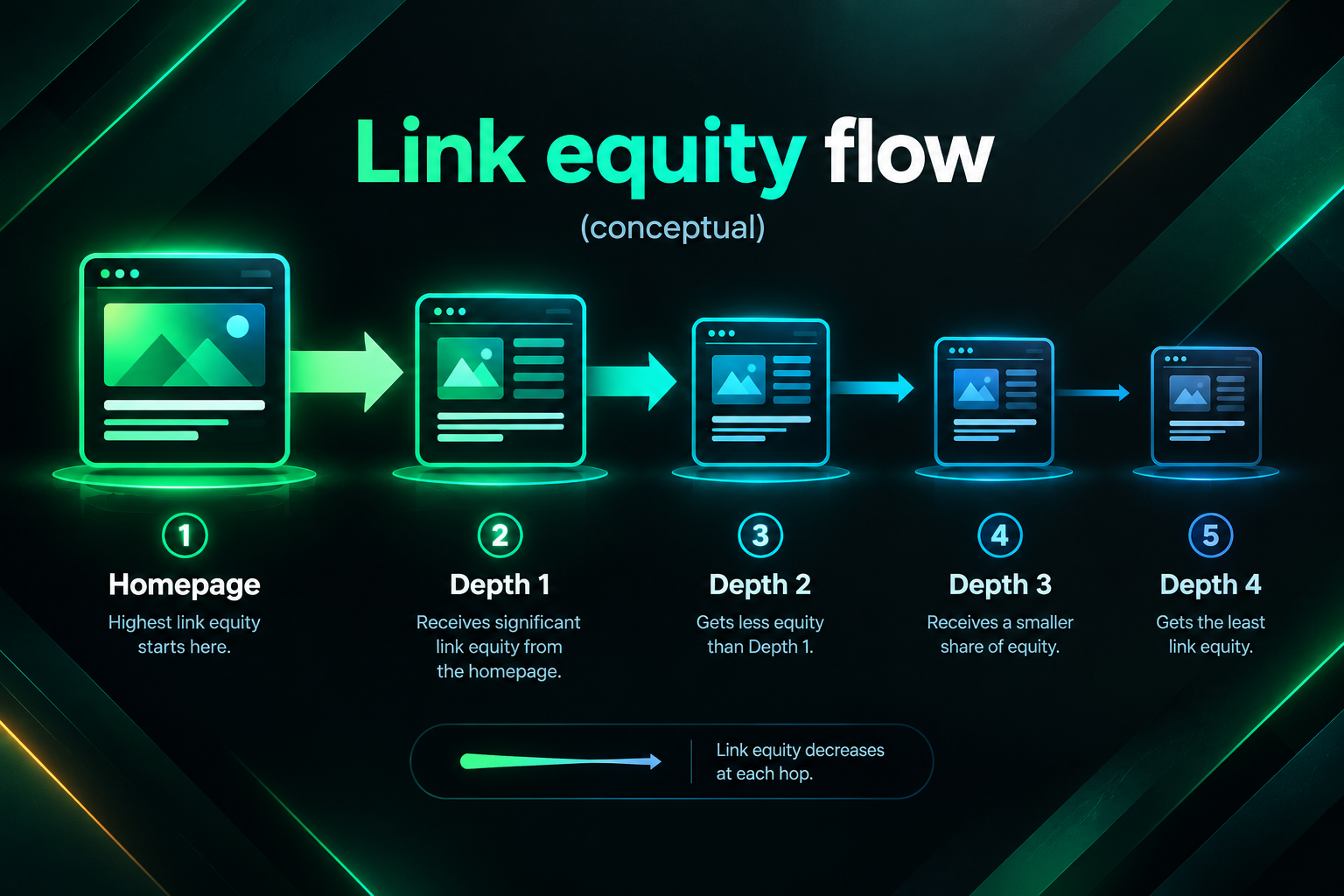
This relationship means that pages with high click depth may receive less internal link equity than pages closer to the root, even if the site has a strong overall backlink profile. A well-linked homepage on a domain with substantial authority may still fail to pass meaningful equity to a product page buried at depth five if the internal linking structure does not create efficient pathways.
Reducing click depth for important pages therefore serves two purposes: it improves crawl efficiency and it increases the amount of link equity those pages can receive. Both effects may contribute to improved rankings for those pages, though the magnitude of the improvement depends on the site’s overall authority, the competitiveness of the target keywords, and the quality of the page’s content.
How to Identify Click Depth Issues
Several SEO tools can help identify pages with high click depth. Screaming Frog SEO Spider crawls a website and reports the click depth of each discovered URL, making it straightforward to identify pages that require many clicks to reach. Ahrefs Site Audit and Semrush Site Audit provide similar functionality and can flag pages that are orphaned (not linked from any other page on the site) or buried deep within the architecture.
Google Search Console can also provide indirect signals. Pages that are submitted in an XML sitemap but show as discovered but not indexed, or that have not been crawled recently, may be experiencing click depth or crawl budget issues. Combining Search Console data with a crawl tool report gives a more complete picture of which pages are affected and how severely.
When auditing click depth, it is useful to prioritise pages by their commercial or strategic importance. Not every page on a large site needs to be at depth one or two, and attempting to flatten the entire architecture is rarely practical or necessary. The goal is to ensure that pages with the highest business value, such as key product pages, service landing pages, or high-traffic blog posts, are reachable within a reasonable number of clicks, typically three or fewer from the homepage.
Strategies for Reducing Click Depth
Internal Linking Improvements
Internal linking is the most direct and controllable method for reducing click depth. Adding links to important deep pages from higher-level pages, such as the homepage, main category pages, or popular blog posts, creates shorter pathways that both users and crawlers can follow. A product page that previously required four clicks to reach might become accessible in two clicks if a relevant category page or a popular article links directly to it.
Contextual internal links within body content are particularly valuable because they pass link equity and provide topical context. Navigation links, breadcrumbs, and footer links also contribute to reducing click depth, though they may carry less contextual weight than in-content links. A combination of these link types, applied consistently across a site, can meaningfully improve the crawlability of deep pages.
When planning internal linking improvements, it helps to map the site’s most important pages and trace the shortest existing path from the homepage to each one. Pages where the shortest path exceeds three clicks are candidates for additional internal links. Prioritising pages with strong keyword targeting, high conversion potential, or significant existing organic traffic ensures that the effort delivers measurable SEO and business value.
Site Architecture Adjustments
For websites where click depth problems are systemic rather than isolated, restructuring the site architecture may be necessary. This typically involves flattening the navigation hierarchy by reducing the number of category and subcategory levels, consolidating thin or duplicate pages, and ensuring that the most important content is accessible from the top levels of the site.
Architecture changes carry more risk than internal linking adjustments because they may involve URL changes, redirects, and alterations to navigation menus that affect user experience. Any significant restructuring should be planned carefully, with proper redirect mapping and monitoring of crawl behaviour and rankings after implementation. For large sites, a phased approach that addresses the most critical pages first is generally more manageable than a wholesale redesign.
XML Sitemaps
An XML sitemap submitted to Google Search Console provides crawlers with a direct list of URLs to discover, which can help ensure that deep pages are found even if the internal linking structure does not create efficient pathways to them. However, a sitemap is not a substitute for good internal linking. Google has indicated that it uses sitemaps as a discovery tool but still evaluates the importance of pages based on how they are linked within the site. A page listed in a sitemap but not linked from any other page on the site may still receive limited crawl attention and link equity.
Backlinks to Deep Pages
External backlinks pointing directly to deep pages can signal their importance to search engines independently of their position in the site’s internal architecture. When a high-quality external site links to a specific product page, blog post, or service page, that link provides both a direct crawl pathway and a relevance signal that may help the page rank more competitively. This is one reason why link building campaigns that target specific deep pages, rather than focusing exclusively on the homepage, can be particularly effective for large websites.
For e-commerce sites, acquiring backlinks to category pages and product pages rather than only to the homepage can help reduce the effective click depth from an external perspective and distribute link equity more broadly across the site. For SaaS businesses, links to feature pages, comparison pages, or use-case landing pages serve a similar function. The key is to align the link acquisition strategy with the pages that have the greatest commercial importance and the most to gain from improved crawl frequency and link equity.
Click Depth, Crawl Budget, and Large Websites
Crawl budget is a concept that becomes practically significant for websites with large numbers of URLs, typically in the tens of thousands or more. Google allocates a crawl rate limit to each site based on server capacity and a crawl demand estimate based on the perceived value and freshness of the site’s content. When a site has more URLs than its crawl budget can efficiently cover, some pages will be crawled less frequently or not at all during a given period.
High click depth exacerbates crawl budget inefficiency. If a crawler must follow many links to reach a page, it consumes more crawl budget per page discovered. Reducing click depth for important pages means the crawler can reach them more efficiently, leaving more budget available for other pages. For very large sites, this efficiency gain can translate into faster indexing of new content and more reliable recrawling of updated pages.
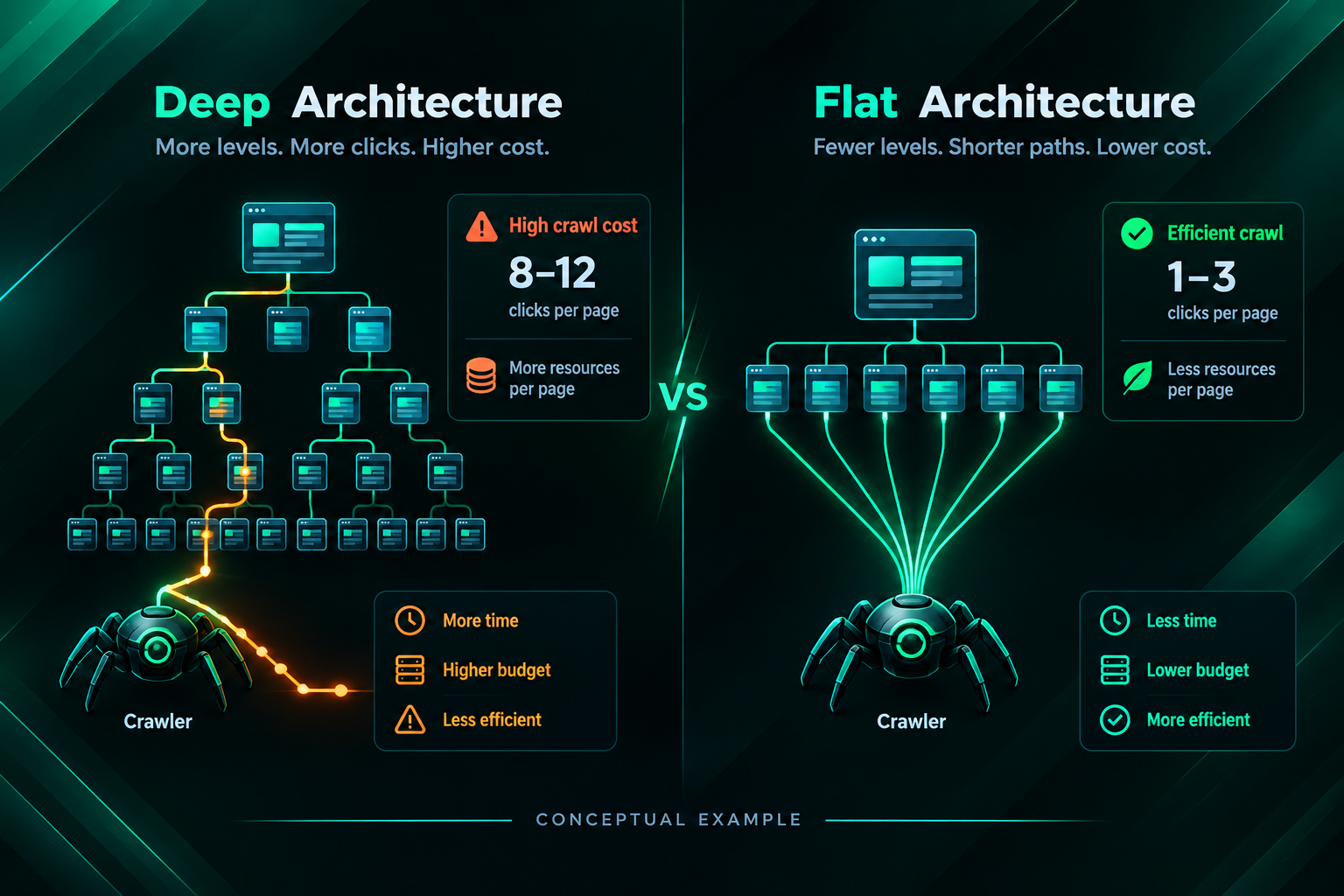
Crawl budget is less likely to be a limiting factor for small to medium-sized websites with a few hundred or a few thousand pages. For these sites, click depth still matters for link equity distribution and user experience, but the crawl efficiency argument is less pressing. The appropriate level of concern about click depth should be calibrated to the site’s size, growth rate, and the proportion of its pages that are commercially important.
Click Depth and User Experience
Click depth is not purely a technical SEO concern. It also affects how easily users can navigate a website and find the content they are looking for. A page that requires five or six clicks to reach from the homepage is likely to receive less organic internal traffic from users browsing the site, which can reduce its engagement metrics and conversion rate. While user experience signals are not direct ranking factors in the same way that links and content relevance are, a site that is difficult to navigate may underperform commercially even if it achieves reasonable search visibility.
Reducing click depth for important pages therefore serves both SEO and usability goals simultaneously. When internal linking improvements make a product page or service page easier to find for crawlers, they typically also make it easier for users to discover through browsing. This alignment of technical and user-facing benefits makes click depth optimisation a worthwhile investment for most websites, particularly those with complex navigation structures or large content libraries.
Limitations and Realistic Expectations
Reducing click depth is a structural improvement that may contribute to better crawling, indexing, and link equity distribution, but it does not guarantee improved rankings or traffic on its own. A page that moves from depth five to depth two will not automatically rank on the first page of search results if its content is thin, its keyword targeting is weak, or its topic faces strong competition from well-established pages. Click depth optimisation is most effective when combined with strong content, relevant backlinks, and sound technical SEO across the site.
It is also worth noting that the relationship between click depth and rankings is not linear or universally documented. Google has not published a specific click depth threshold above which pages are penalised or below which they are rewarded. The practical guidance from Google’s documentation and from observed SEO practice is that pages should be reachable within a reasonable number of clicks, and that very deep pages on large sites may receive less crawl attention. The specific impact on any given page depends on the site’s overall authority, the competitiveness of its target keywords, and the quality of its content.
Finally, click depth improvements take time to produce measurable effects. After internal linking changes are made, crawlers must revisit the affected pages, index any updates, and reassess their relevance signals. Depending on the site’s crawl frequency and the scale of the changes, this process may take weeks or months. Monitoring crawl coverage in Google Search Console and tracking rankings for the affected pages over time provides the most reliable way to assess whether the changes are producing the intended results.
Frequently Asked Questions
What is a good click depth for SEO?
Most SEO practitioners recommend keeping important pages within three clicks of the homepage. Pages at depth one or two are generally crawled most reliably and receive the most internal link equity. For very large sites, some pages will inevitably sit at greater depth, but commercially critical pages such as key product or service pages should be prioritised for shallow placement where possible.
Is click depth the same as URL depth?
No. URL depth refers to the number of subdirectories in a page’s URL path, while click depth refers to the number of clicks required to reach a page from the homepage by following links. A page can have a short URL but high click depth if it is not well linked within the site, and vice versa. Click depth is the more operationally relevant measure for crawlability and link equity.
Does click depth directly affect Google rankings?
Click depth is not a direct ranking factor in the sense that Google has not confirmed a specific depth threshold that triggers a ranking change. However, high click depth can reduce crawl frequency and limit the link equity a page receives, both of which may indirectly affect how well a page ranks. The effect is most pronounced on large sites with crawl budget constraints.
Can backlinks help reduce the impact of high click depth?
Yes. External backlinks pointing directly to deep pages provide crawlers with an alternative discovery pathway and signal the page’s importance independently of its position in the site’s internal architecture. Acquiring relevant, high-quality backlinks to strategically important deep pages is a practical complement to internal linking improvements, particularly for e-commerce and SaaS websites with large page counts.
How do I find pages with high click depth on my site?
Tools such as Screaming Frog SEO Spider, Ahrefs Site Audit, and Semrush Site Audit can crawl your website and report the click depth of each discovered URL. Google Search Console can provide supplementary data on pages that are discovered but not indexed or that have not been crawled recently, which may indicate click depth or crawl budget issues.
Does click depth matter for small websites?
For small websites with a few hundred pages, click depth is rarely a critical issue because crawlers can typically reach all pages without difficulty. However, it still affects link equity distribution and user experience, so keeping important pages within two or three clicks of the homepage remains good practice regardless of site size.
Applying Click Depth Insights to Your SEO Strategy
Click depth is a practical structural concept that connects site architecture, crawl efficiency, internal link equity, and user navigation into a single measurable dimension. For most websites, the actionable implication is straightforward: audit which pages matter most commercially, identify those that require too many clicks to reach, and create more direct internal linking pathways to them. For larger sites, this audit should be a regular part of technical SEO maintenance rather than a one-time exercise, because new content and navigation changes can gradually increase click depth for important pages over time.
Where internal linking alone cannot fully address the issue, particularly for deep pages on large e-commerce or SaaS platforms, a targeted link acquisition strategy that directs external backlinks to those specific pages can complement the structural improvements. This approach treats click depth not as an isolated technical problem but as part of a broader question about how link equity and crawl attention are distributed across a site. Addressing that question systematically, through a combination of architecture review, internal linking, and strategic external link building, gives important pages the best realistic opportunity to be discovered, indexed, and evaluated competitively by search engines.