Broken internal links are one of the more straightforward technical SEO issues to address, yet they are frequently overlooked during routine site maintenance. When a page on your own website links to another page that no longer exists or has moved without a redirect, both search engines and visitors encounter a dead end. Fixing these links is a practical, low-risk improvement that supports crawlability, user experience, and the efficient distribution of link equity across your site.
Key Takeaways
- Broken internal links occur when an internal URL returns a 404 or similar error, preventing crawlers and users from reaching the destination page.
- Regular audits using tools such as Google Search Console, Screaming Frog, Ahrefs, or Semrush are the most reliable way to identify broken internal links at scale.
- The most common fixes are updating the link to the correct live URL, implementing a 301 redirect from the broken URL, or removing the link if the destination page no longer exists.
- Broken internal links can disrupt the flow of internal link equity, which may affect how well target pages are crawled and ranked, though the impact varies by site size and structure.
- Fixing broken internal links is a maintenance task, not a substitute for a broader SEO strategy that includes content quality, external backlinks, and technical health.
What Are Broken Internal Links?
An internal link connects one page on your website to another page on the same domain. A broken internal link is one where the destination URL returns an error response, most commonly a 404 Not Found status, meaning the page does not exist at that address. This can happen when a page is deleted, when a URL structure changes during a site migration, when a CMS slug is edited without updating existing references, or when content is moved to a new location without a redirect in place.
Broken internal links differ from broken external links, which point to pages on other domains. While both types create a poor user experience, broken internal links are entirely within your control and can be corrected without depending on a third party. They also have a more direct effect on how search engine crawlers navigate your site, because crawlers follow internal links to discover and index content. A broken internal link stops that crawl path at the point of the error.
It is worth distinguishing between a broken link and a redirect chain. A redirect chain occurs when a URL redirects to another URL that then redirects again, sometimes multiple times. While not technically broken, long redirect chains can slow crawling and dilute link equity, and they are worth addressing separately during a technical audit.
Why Broken Internal Links Matter for SEO
Search engines such as Google use internal links to understand site structure, discover new content, and assess the relative importance of pages. When a crawler follows an internal link and receives a 404 response, it cannot pass any link equity to the destination, and the crawl path ends there. On large websites with many pages, this can mean that some content is crawled less frequently or not at all, which may affect indexing and visibility in search results.
Internal link equity, sometimes called PageRank flow or link juice in informal SEO discussions, is distributed through the internal linking structure of a site. Pages that receive more internal links from authoritative, well-indexed pages tend to be treated as more important by search engines. When internal links are broken, that equity distribution is interrupted. Fixing broken internal links restores those connections and allows equity to flow to the intended destination pages.
User experience is a separate but related concern. A visitor who clicks an internal link and lands on a 404 page is likely to leave the site, which can increase bounce rates and reduce the chance of conversion. While Google has stated that user experience signals are complex and not directly measured in a simple way, a site that consistently delivers dead ends is unlikely to build the kind of engagement that supports long-term organic performance.
It is important to be realistic about the scale of impact. On a small website with a handful of broken links, fixing them is unlikely to produce a dramatic ranking change on its own. On a large e-commerce site or content-heavy publication with hundreds or thousands of broken internal links, the cumulative effect on crawl efficiency and link equity distribution may be more meaningful. The benefit depends on the site’s size, the number of broken links, and the importance of the affected pages.
How to Find Broken Internal Links
Identifying broken internal links requires either a crawl tool, a server log analysis, or a combination of both. The most practical starting point for most websites is a dedicated crawl tool, which systematically visits every URL on your site and records the HTTP status code returned by each link.
Google Search Console
Google Search Console is a free tool provided by Google that reports crawl errors, including pages that returned a 404 status when Googlebot attempted to access them. The Coverage report and the Pages report within Search Console show URLs that Google could not successfully crawl or index. The tool also provides a list of referring pages for some errors, which helps identify where the broken link originates. Search Console is a useful starting point because it reflects actual Googlebot crawl data, but it may not capture every broken internal link, particularly on pages that are not yet indexed or are blocked by robots.txt.
Screaming Frog SEO Spider
Screaming Frog SEO Spider is a desktop crawl tool that replicates how a search engine crawler navigates a website. Running a full crawl and filtering results by response code 404 produces a list of broken URLs along with the source pages that link to them. The free version of Screaming Frog crawls up to 500 URLs, which is sufficient for smaller sites. Larger sites require a paid licence. The tool also identifies redirect chains and other link-related issues in the same crawl, making it efficient for a comprehensive technical audit.
Ahrefs Site Audit and Semrush Site Audit
Both Ahrefs and Semrush offer cloud-based site audit tools that crawl your website and categorise issues by type and severity. These platforms flag broken internal links as errors and provide the source URL, the broken destination URL, and the anchor text used. Because these tools run in the cloud, they do not require a local installation and can be scheduled to run automatically at regular intervals. They are particularly useful for ongoing monitoring rather than a one-time audit. Both platforms use proprietary metrics such as Domain Rating (Ahrefs) and Authority Score (Semrush) for external link assessment, but their site audit functions focus on technical issues rather than third-party authority scores.
Server Log Analysis
Server logs record every request made to your web server, including requests that returned a 404 status. Analysing server logs can reveal broken internal links that crawl tools miss, particularly those triggered by real user visits or by crawlers other than the one used in your audit tool. Log analysis requires access to raw server log files and either a log analysis tool or technical familiarity with log formats. It is more commonly used by larger sites or those with complex architectures where crawl tool coverage may be incomplete.
How to Fix Broken Internal Links: The Main Methods
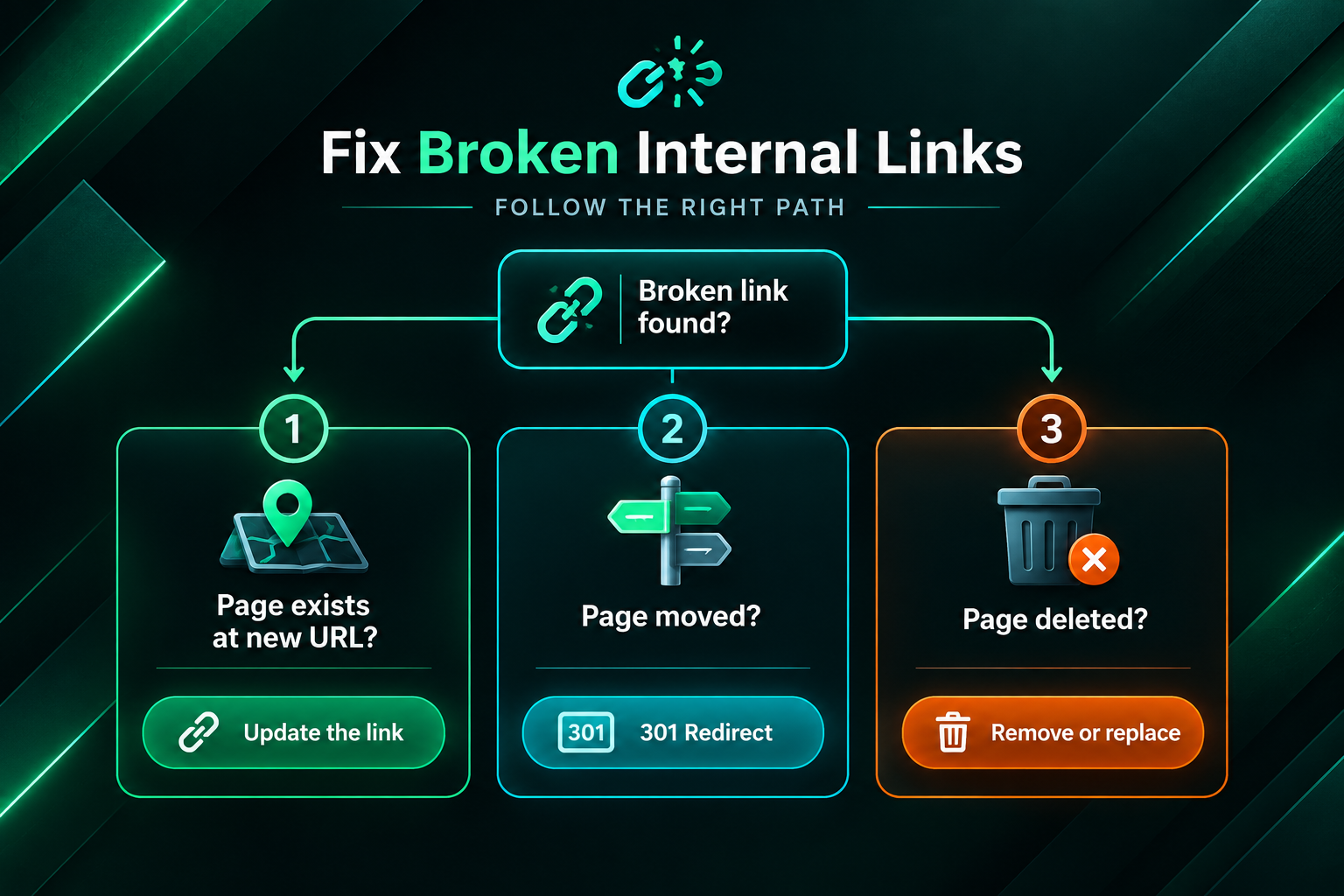
Once you have a list of broken internal links and their source pages, the repair process follows a clear decision tree. The right fix depends on whether the destination page still exists, has moved, or has been permanently removed.
Update the Link to the Correct Live URL
If the destination page still exists but the URL has changed, the simplest fix is to update the internal link on the source page to point to the correct, live URL. This is the preferred solution because it avoids adding an unnecessary redirect and ensures that link equity flows directly to the destination without an intermediate step. In a CMS such as WordPress, this typically involves editing the page or post that contains the broken link and replacing the old URL with the new one. On large sites with many instances of the same broken link, a database search-and-replace tool or a CMS plugin can update multiple occurrences at once, though this should be done carefully to avoid unintended changes.
Implement a 301 Redirect
When a page has permanently moved to a new URL and updating every internal link individually is impractical, implementing a 301 redirect from the old URL to the new one is an efficient solution. A 301 redirect tells search engines that the page has moved permanently and passes most of the link equity from the old URL to the new destination. This approach is particularly useful during and after site migrations, where large numbers of URLs may have changed simultaneously. Redirects can be implemented via the .htaccess file on Apache servers, via Nginx configuration, or through redirect management plugins in a CMS. While a 301 redirect is a practical fix, it is still preferable to update the source links directly where possible, because each redirect adds a small amount of latency to the request and introduces an additional step in the crawl path.
Remove or Replace the Link
If the destination page has been permanently deleted and no suitable replacement exists, the broken link should be removed from the source page. Leaving a link that points to a non-existent page serves no purpose for users or crawlers. If the topic covered by the deleted page is still relevant to the source content, consider whether a different existing page on your site could serve as a useful replacement destination. Replacing a broken link with a link to a relevant, live page is preferable to simply removing it, because it maintains the internal linking structure and provides a useful path for both users and crawlers.
Restore the Missing Page
In some cases, a page that was deleted still has value and should be restored. This is particularly relevant for pages that previously attracted organic traffic, had external backlinks pointing to them, or served an important role in the site’s content structure. Restoring the page at its original URL resolves the broken link without requiring redirects or link updates, and it recovers any external link equity that was pointing to that URL. This option requires more effort than the other fixes but may be the most appropriate choice when the deleted page had meaningful SEO value.
Prioritising Which Broken Links to Fix First
On sites with a large number of broken internal links, it is practical to prioritise repairs based on the potential impact of each fix. Not all broken links carry equal weight, and addressing the most important ones first makes efficient use of available time and resources.
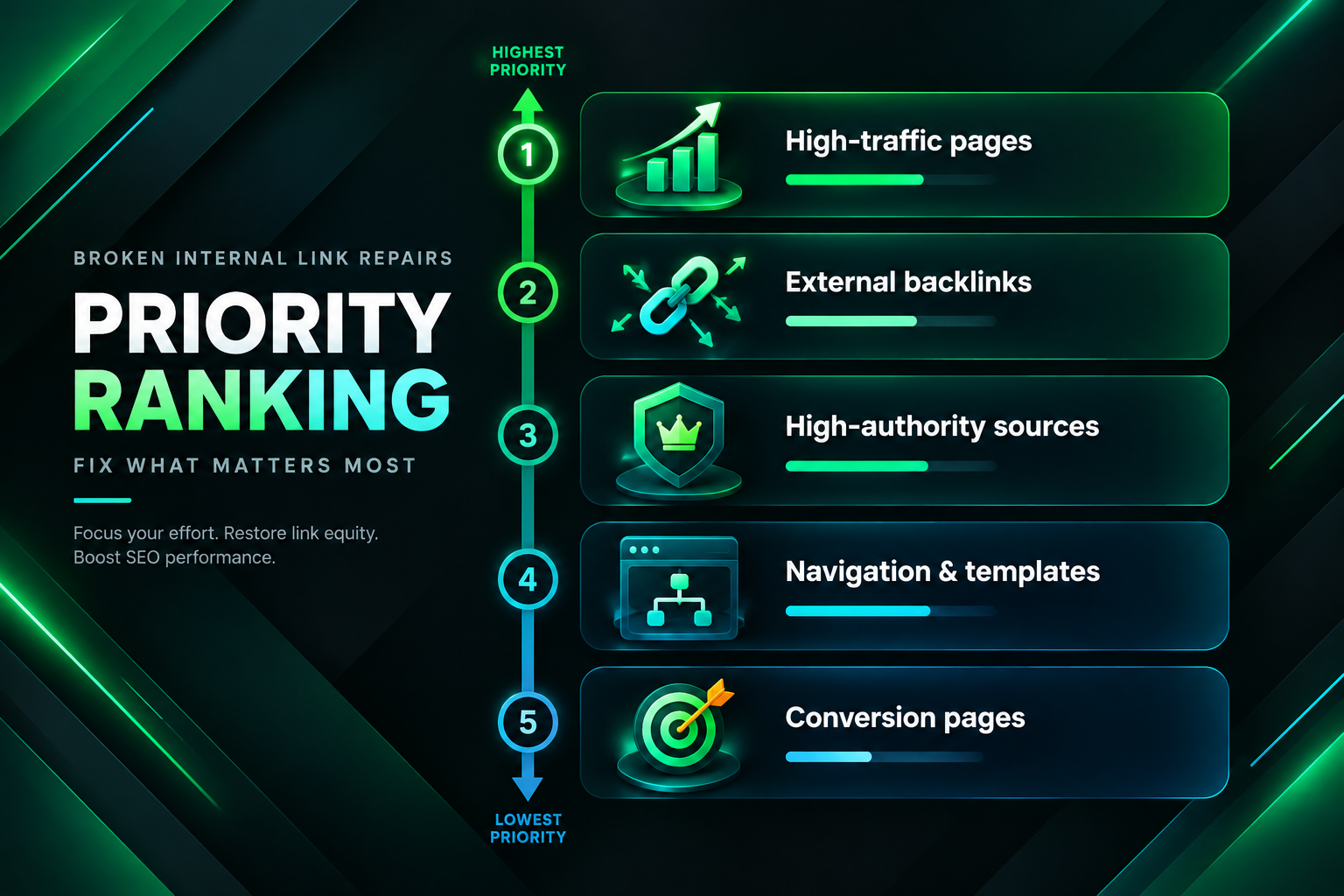
- Pages with high organic traffic or ranking potential: Broken links on or to pages that currently rank or have historically attracted significant organic traffic should be addressed first, as these pages are most likely to benefit from restored link equity and improved crawlability.
- Pages with external backlinks: If a broken internal link points to a page that also has external backlinks from other websites, restoring or redirecting that page recovers both internal and external link equity simultaneously.
- High-authority source pages: Broken links originating from pages that are well-linked internally or externally represent a greater loss of equity flow than broken links on low-authority pages.
- Navigation and template links: Broken links in site-wide elements such as navigation menus, footers, or sidebar templates appear on every page that uses that template, multiplying the crawl and user experience impact. These should be fixed promptly regardless of the individual page’s authority.
- Conversion-critical pages: Broken links on or to pages that support conversions, such as product pages, landing pages, or contact pages, have a direct business impact beyond SEO and should be treated as high priority.
Preventing Broken Internal Links from Recurring
Fixing broken internal links is a reactive task. Preventing them from accumulating in the first place requires a combination of process discipline and ongoing monitoring.
The most common cause of broken internal links is deleting or renaming pages without updating the links that point to them. Establishing a workflow that requires a link audit before any page is deleted or its URL changed reduces the frequency of new broken links. In practice, this means checking which internal pages link to a URL before removing it, and either updating those links or setting up a redirect as part of the deletion process. Most CMS platforms and SEO plugins can show which pages link to a given URL, making this check straightforward.
Scheduled crawl audits, whether monthly or quarterly depending on the rate of content change on the site, catch new broken links before they accumulate. Setting up automated alerts in tools such as Google Search Console or a cloud-based site audit platform means that new 404 errors are flagged promptly rather than discovered months later. For sites that publish or update content frequently, more frequent monitoring is advisable.
During site migrations, which are a common source of large-scale broken internal links, a comprehensive redirect mapping exercise before the migration goes live is essential. This involves documenting every existing URL, mapping it to its new equivalent, and implementing redirects before the old URLs are decommissioned. Post-migration crawl audits should be run immediately after launch to catch any links that were missed in the mapping process.
Broken Internal Links in the Context of a Broader SEO Strategy
Fixing broken internal links is a technical SEO maintenance task, and it is worth understanding where it fits within a broader SEO effort. Technical issues such as broken links, crawl errors, and redirect problems are foundational: they affect how well search engines can access and understand your content. Addressing them creates the conditions for other SEO work to be effective, but it does not replace that work.
Low organic visibility can have many causes beyond broken internal links. Weak or thin content, a mismatch between page content and search intent, insufficient external backlinks from relevant and authoritative sites, strong competition in the target keyword space, and indexing problems unrelated to internal linking can all limit a page’s ability to rank. A site that fixes all its broken internal links but has content that does not satisfy search intent, or that lacks the external link authority needed to compete in its niche, is unlikely to see significant ranking improvements from the technical fix alone.
Internal linking strategy more broadly, which includes how pages are linked to one another, which pages receive the most internal links, and how anchor text is used, is a separate and more strategic topic. Broken link repair is the maintenance layer of internal linking; intentional internal linking architecture is the strategic layer. Both matter, but they address different problems. Once broken links are resolved, reviewing the overall internal linking structure to ensure that important pages receive appropriate internal link support is a worthwhile next step.

External link building, which involves acquiring backlinks from other websites, operates alongside internal linking rather than as a substitute for it. A well-structured internal linking system helps distribute the authority gained from external backlinks to the pages that need it most. Conversely, external backlinks pointing to pages that are poorly connected internally may not deliver their full potential benefit. The two disciplines are complementary, and sites that invest in external link acquisition typically benefit from having a clean, well-structured internal linking environment in place first.
Frequently Asked Questions
How many broken internal links are too many?
There is no universally agreed threshold, and the impact depends on the size of the site and the importance of the affected pages. A handful of broken links on a small site is unlikely to cause significant SEO problems, but hundreds of broken links on a large site can meaningfully disrupt crawl efficiency and link equity distribution. The priority should be to fix broken links on important pages first, then work through lower-priority instances systematically.
Will fixing broken internal links improve my rankings?
Fixing broken internal links may improve rankings for pages that were previously receiving less crawl attention or link equity due to broken link paths, but the effect varies considerably depending on the site, the number of broken links, and the competitiveness of the target keywords. It is a technical improvement that supports other SEO work rather than a standalone ranking solution.
Is a 301 redirect as good as updating the link directly?
Updating the source link to point directly to the correct live URL is generally preferable because it avoids an additional server request and passes link equity without an intermediate step. A 301 redirect is a practical alternative when updating every source link individually is not feasible, such as after a large-scale URL restructure. Where possible, combine both approaches: implement redirects for immediate coverage and update source links over time.
How often should I audit for broken internal links?
The appropriate frequency depends on how actively the site is updated. Sites that publish new content or make structural changes frequently benefit from monthly audits. More stable sites may find quarterly audits sufficient. Setting up automated monitoring in Google Search Console or a site audit tool provides a safety net between scheduled audits by alerting you to new crawl errors as they appear.
Do broken internal links affect external backlinks?
Broken internal links do not directly affect external backlinks pointing to your site, but they can affect how effectively that external link equity is distributed internally. If a page with external backlinks has broken internal links pointing away from it, those broken links interrupt the flow of equity to other pages. If a page that receives internal links is itself broken, any external backlinks pointing to it are also affected. Restoring or redirecting broken pages recovers both internal and external link equity.
Can I use a plugin to fix broken internal links automatically?
Several CMS plugins, particularly for WordPress, can detect and flag broken internal links. Some offer semi-automated repair suggestions. However, automated fixes should be reviewed carefully before being applied, because an incorrect URL substitution can create new problems. Plugins are most useful for detection and monitoring; the actual repair decisions benefit from human review, particularly for important pages.
Broken Internal Link Repair: Where It Fits in Your SEO Maintenance Plan
Broken internal link repair is a practical, well-defined task with a clear process: audit, prioritise, fix, and monitor. The methods available, whether updating source links, implementing 301 redirects, removing obsolete links, or restoring deleted pages, are straightforward to apply once the broken links have been identified. The tools needed, including Google Search Console, Screaming Frog, Ahrefs, and Semrush, are widely accessible and provide enough detail to work through a repair list systematically.
The realistic benefit of fixing broken internal links is a cleaner crawl environment, more efficient distribution of internal link equity, and a better experience for users who follow internal links. On sites where broken links are numerous or affect important pages, the improvement in crawl efficiency may support better indexing and, over time, contribute to improved organic visibility. On smaller sites with few broken links, the impact is more modest but the task is also quicker to complete.
Broken link repair works best as part of a broader technical SEO maintenance routine rather than as an isolated project. Pairing it with a review of redirect chains, crawl depth, page speed, and content quality gives a more complete picture of the site’s technical health. If your site also has gaps in its external backlink profile, addressing those through a structured link building programme alongside technical maintenance may produce more meaningful improvements in competitive search positions than either approach alone. A qualified SEO professional or agency can help assess which combination of technical fixes and link acquisition activity is most appropriate for your specific situation.