Research pages that earn editorial citations share a common quality: their summaries are written in a way that makes it easy for journalists, bloggers, and content teams to reference them accurately and confidently. Writing citation-ready summaries is a practical content skill that sits at the intersection of SEO, digital PR, and link acquisition. This guide explains what makes a summary citation-worthy, how to structure research pages for maximum linkability, and how this approach fits into a broader link building strategy.
Key Takeaways
- Citation-ready summaries present findings in clear, quotable language that reduces the effort required for a third party to reference your research accurately.
- Well-structured research pages with accessible summaries are more likely to attract editorial backlinks from journalists, bloggers, and industry publications.
- The format, specificity, and credibility signals of a summary directly influence whether a page earns organic citations or is overlooked.
- Citation-ready content supports link building campaigns by creating a linkable asset that outreach teams can promote to relevant publishers.
- Effective summaries balance brevity with enough methodological context to allow readers to assess the reliability of the underlying research.
What Is a Citation-Ready Summary?
A citation-ready summary is a concise, accurately worded passage that presents the key findings, methodology, and scope of a piece of research in a format that a third party can reference without misrepresenting the original work. The term is most relevant to research pages — dedicated web pages that present original data, surveys, studies, or curated statistics — where the primary goal is to attract editorial links from other websites.
The distinction between a standard content summary and a citation-ready one is largely practical. A standard summary may explain findings in general terms for a general audience. A citation-ready summary goes further: it uses precise language, qualifies claims appropriately, names the methodology and sample size, and presents a standalone finding that a writer can quote directly without needing to read the full study. This reduces friction for the person citing the work, which increases the likelihood that they will do so.
From a link building perspective, citation-ready summaries are the foundation of a linkable asset strategy. A research page that is difficult to summarise accurately, or that buries its key finding in dense prose, is less likely to earn backlinks even if the underlying data is genuinely valuable. The summary is effectively the interface between your research and the people who might link to it.
Why Research Pages Attract Editorial Backlinks
Editorial backlinks — links placed voluntarily by a publisher because they consider the source genuinely useful — are among the most valuable link types from an SEO perspective. Research pages earn editorial links because they provide something that other content cannot easily replicate: original data, a documented methodology, and a citable source. When a journalist or blogger needs to support a claim with evidence, a well-presented research page reduces their workload and gives their own content more credibility.
The practical implication is that research pages function as linkable assets: pieces of content created specifically because they are likely to attract links over time. Unlike a product page or a service description, a research page has inherent third-party value. However, that value is only realised if the page is structured so that potential citers can quickly identify the key finding, understand the scope of the research, and trust the methodology. A citation-ready summary is the mechanism that makes this possible.
It is worth noting that not every research page earns links automatically. The topic must be relevant to an audience that actively publishes content, the findings must be specific enough to be useful, and the page must be discoverable — either through organic search or through active outreach. A strong summary improves the conversion rate of outreach efforts by giving recipients a clear, quotable passage they can use immediately.
Core Elements of a Citation-Ready Summary
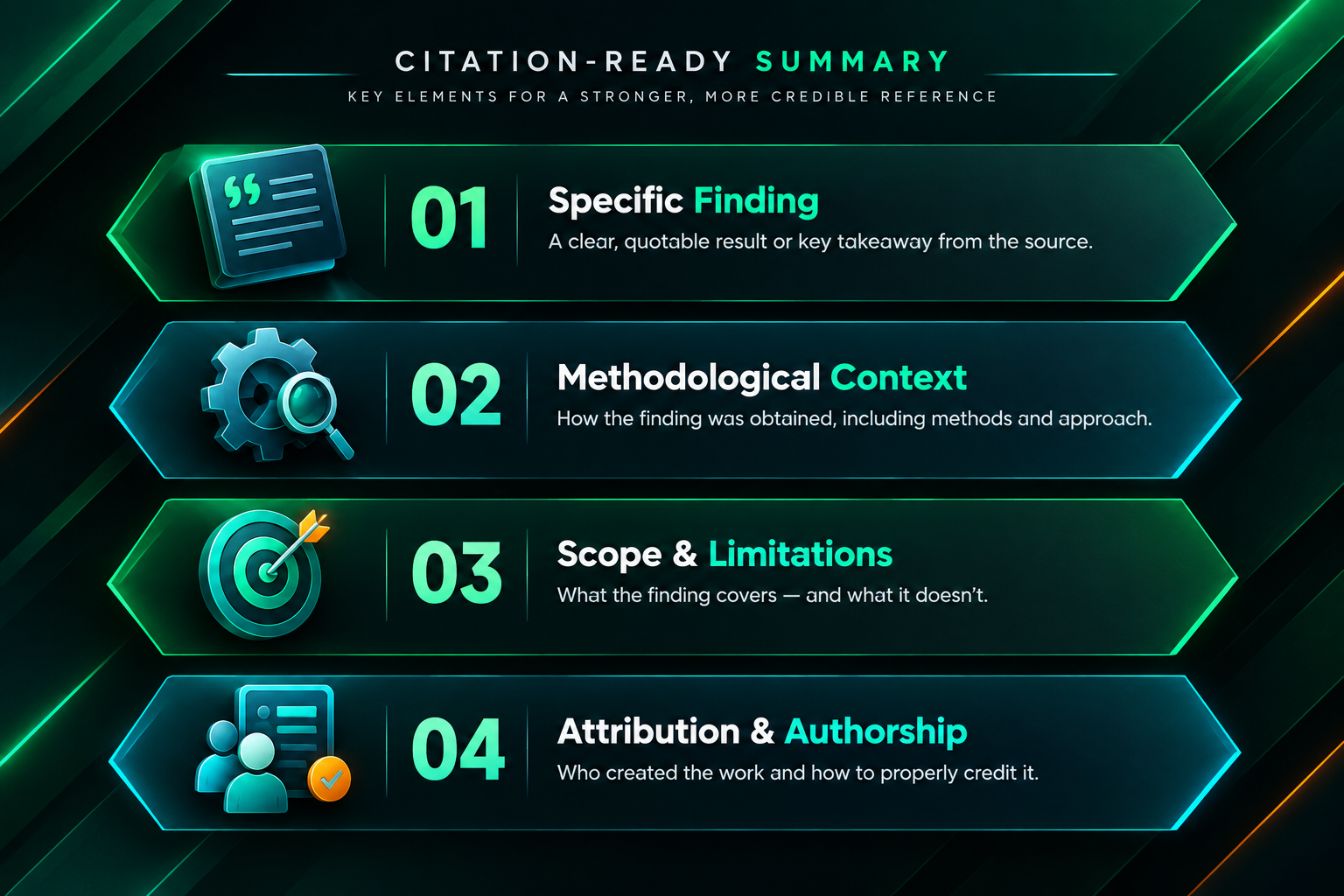
A citation-ready summary typically contains several identifiable components, each serving a specific function for the person who may cite the work.
A Specific, Quotable Finding
The most important element is a precise, standalone finding stated in plain language. Vague conclusions such as “most respondents agreed” are difficult to cite accurately. A specific finding — for example, “62% of respondents reported that they review a vendor’s case studies before making a purchasing decision” — gives a writer an exact figure they can attribute to your research without ambiguity. Specificity also makes the finding more memorable and more likely to be shared.
Avoid overstating findings. If the data shows a correlation or a trend among a specific sample, the summary should reflect that qualification. Overstated claims may attract initial attention but can damage credibility if other researchers or journalists scrutinise the methodology. Accurate, qualified language builds the kind of trust that leads to repeated citations over time.
Methodological Context
A citation-ready summary includes enough methodological information for a reader to assess the reliability of the finding without reading the full methodology section. This typically means stating the sample size, the data collection method, the time period, and any relevant scope limitations. For example: “Based on a survey of 500 UK-based marketing managers conducted in Q1 2024” gives a potential citer the context they need to represent the research accurately.
Methodological transparency also functions as a credibility signal. Research pages that omit sample sizes or data collection methods are harder to cite responsibly, and experienced journalists and researchers may avoid them for that reason. Including this context in the summary — rather than only in a separate methodology section — reduces the effort required to verify the research’s scope.
Clear Scope and Limitations
Stating what the research does not cover is as important as stating what it does. A summary that acknowledges its scope — geographic region, industry sector, time period, or respondent type — helps potential citers use the finding appropriately. It also demonstrates intellectual honesty, which strengthens the credibility of the research page as a whole. Limitations do not weaken a citation-ready summary; they make it more trustworthy and therefore more citable.
Attribution and Authorship Signals
Research pages that clearly identify who conducted the research, when it was conducted, and what organisation or team is responsible for the methodology are more likely to earn citations from publications with editorial standards. Including an author name, a publication date, and an organisational affiliation — where relevant — gives the citing writer the information they need to attribute the work correctly. These signals also contribute to the E-E-A-T (Experience, Expertise, Authoritativeness, Trustworthiness) quality indicators that search engines use to assess content quality.
Structuring a Research Page for Maximum Linkability
The citation-ready summary is most effective when it appears within a well-structured research page. The page structure influences both how easily potential citers can find and use the summary, and how search engines understand and index the content.
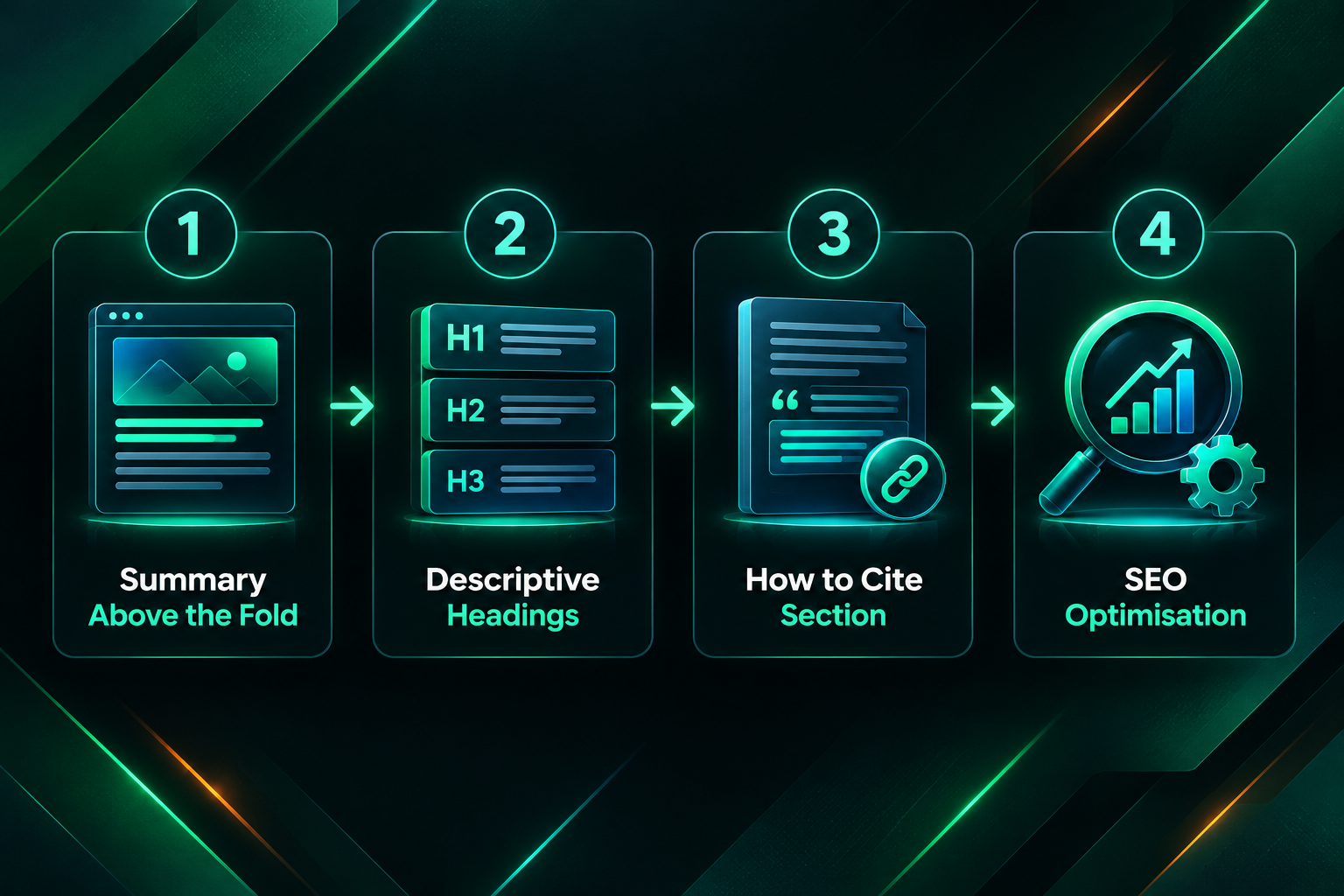
Place the Summary Above the Fold
The key finding and its methodological context should appear near the top of the page, before charts, detailed methodology sections, or extended analysis. Journalists and content writers often scan a page quickly to determine whether it is worth citing. If the most quotable finding is buried several scrolls down, many potential citers will move on. A concise summary block — sometimes called an “executive summary” or “key findings” section — placed prominently at the top of the page significantly improves the usability of the research for third parties.
Use Descriptive Headings and Scannable Formatting
Research pages benefit from clear, descriptive headings that allow a reader to navigate directly to the finding most relevant to their content. If a page covers multiple findings, each should have its own clearly labelled section with a standalone summary. This modular structure means that a writer covering a specific subtopic can find and cite the relevant finding without reading the entire page, which reduces friction and increases the likelihood of a citation.
Include a Dedicated “How to Cite This Research” Section
Some research pages include a short section that provides a suggested citation format, a direct link to the page, and guidance on how to attribute the work. This is particularly useful for academic or semi-academic audiences, but it can also reduce friction for journalists and bloggers who want to reference the research correctly. A pre-formatted citation reduces the effort required to link to the page and signals that the research team expects and welcomes external references.
Optimise the Page for Relevant Search Queries
A research page that ranks for relevant informational queries will attract organic citations over time, in addition to those generated through active outreach. This means the page should target the specific questions that journalists, researchers, and content writers are likely to search when looking for data on the topic. Keyword research focused on data-seeking queries — such as “statistics on”, “percentage of”, “survey results” — can help identify the terms most likely to bring relevant traffic to the page.
Common Mistakes That Reduce Citability
Several avoidable errors reduce the likelihood that a research page will earn editorial citations, even when the underlying data is strong.
- Vague or hedged findings: Summaries that avoid committing to a specific figure or conclusion are difficult to cite accurately and are often passed over in favour of more specific sources.
- Missing sample size or methodology: Without this context, a potential citer cannot assess the reliability of the finding, and responsible publications may decline to reference it.
- Overstated conclusions: Claiming that a finding applies universally when the sample was limited to a specific geography or industry undermines credibility and may lead to corrections or retractions that damage the page’s reputation as a citable source.
- No clear publication date: Undated research is difficult to cite accurately, particularly in fast-moving industries where data becomes outdated quickly. A clear publication date allows citers to represent the recency of the findings correctly.
- Poor page structure: Research buried in long paragraphs without clear headings or a summary section requires significant effort to extract, which reduces the likelihood that a busy writer will cite it.
- Inaccessible language: Highly technical language may be appropriate for academic audiences but reduces citability among journalists and general content writers who need to explain findings to a non-specialist readership.
How Citation-Ready Summaries Support Link Building Campaigns
From a link acquisition perspective, a research page with a well-written citation-ready summary functions as a linkable asset that can be promoted through manual outreach. Outreach campaigns built around original research tend to achieve higher response rates than those promoting commercial pages, because the research offers genuine value to the recipient’s audience rather than asking them to link to a product or service.
When an outreach team contacts a journalist or blogger about a research page, the citation-ready summary does much of the persuasive work. A well-written summary allows the recipient to immediately understand the finding, assess its relevance to their content, and visualise how they would reference it. This reduces the number of follow-up exchanges required and increases the conversion rate of outreach efforts. In practical terms, a research page with a strong summary is easier to pitch and more likely to result in a placed link.
Research-based link building also tends to produce links with stronger editorial context than many other acquisition methods. Because the linking page is referencing a specific finding, the surrounding anchor text and content are typically topically relevant to the research subject, which may contribute positively to the relevance signals associated with the backlink. However, the SEO value of any individual link depends on many factors beyond topical relevance, including the authority and indexing status of the linking page, and results will vary across campaigns and industries.
Adapting Summaries for Different Audiences and Formats
A single research page may need to support citations from multiple types of publishers, each with different audience expectations and content formats. Adapting the summary for different contexts — without changing the underlying finding — can improve the page’s citability across a broader range of publications.
Summaries for Journalists and News Publications
Journalists typically need a finding that is newsworthy, specific, and easy to explain to a general audience. The summary should lead with the most surprising or significant finding, state the figure clearly, and provide just enough methodological context for the journalist to represent the research accurately. Avoid jargon and prioritise clarity over comprehensiveness.
Summaries for Industry Blogs and Trade Publications
Industry publications often have more technically informed audiences and may be interested in nuanced findings or sector-specific data. Summaries for this audience can include more methodological detail and may reference industry-specific terminology, provided it is used accurately. These publications are also more likely to cite research that addresses a specific professional challenge or decision their readers face.
Summaries for Academic and Research Contexts
Academic citers typically require a formal citation format, a clear methodology, and a statement of limitations. If the research page is intended to attract citations from academic or semi-academic sources, the summary should follow conventions closer to those of a structured abstract: background, method, key finding, and limitation. Including a DOI or a permanent URL also supports accurate academic citation.
Integrating Research Pages into a Link Building Strategy
Research pages with citation-ready summaries are most effective when they are integrated into a broader link building strategy rather than treated as standalone assets. This typically involves several coordinated activities.
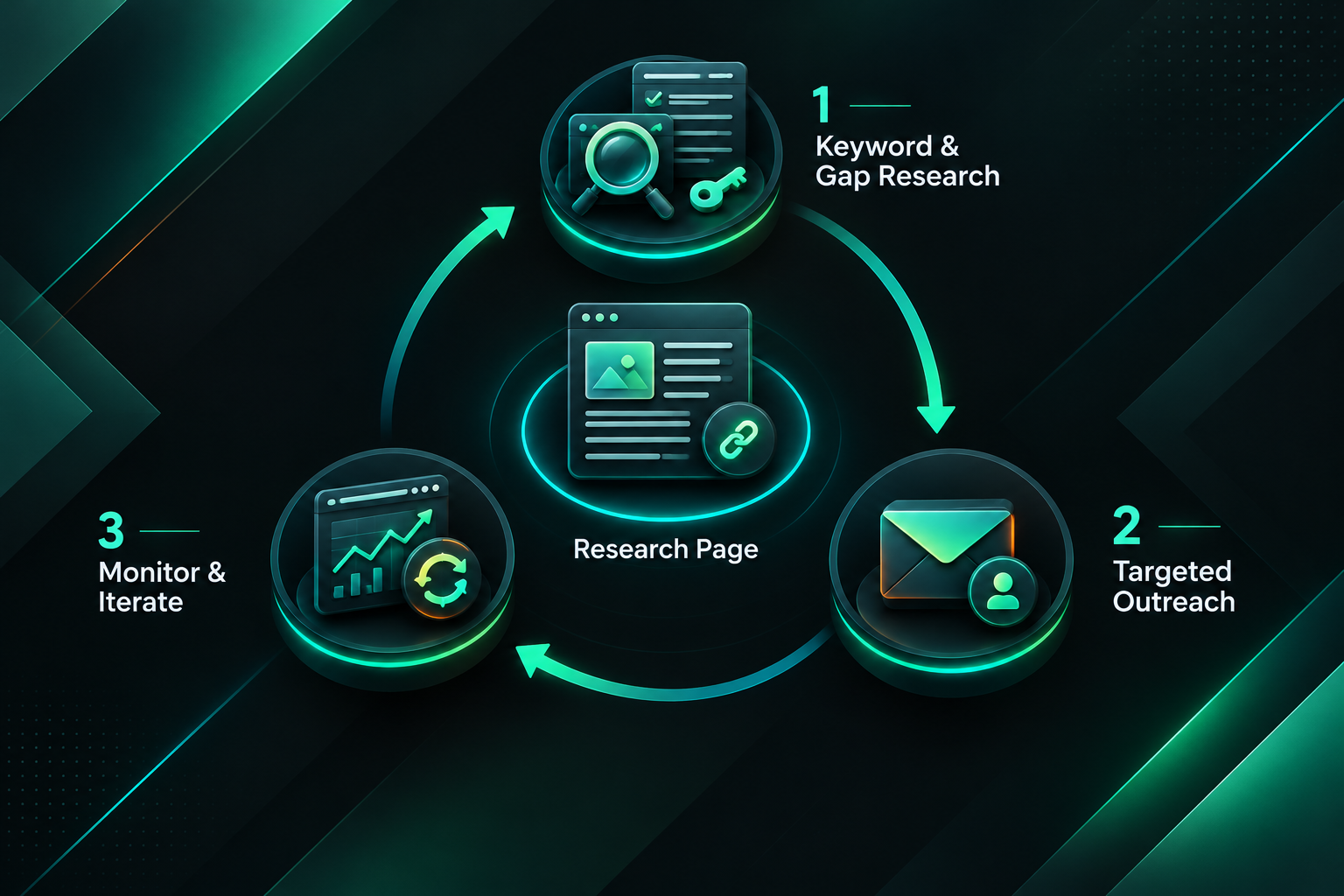
Before publishing, keyword research and competitor analysis can identify the specific data gaps that target publishers are most likely to want to fill. A research page that addresses a question for which no reliable data currently exists is more likely to attract citations than one that duplicates existing research. Understanding what data journalists and content writers in a given industry are currently searching for — and finding inadequate — is a useful starting point for research design.
After publication, active outreach to relevant journalists, bloggers, and industry publications is usually necessary to generate the initial wave of citations. Organic discovery through search may follow over time, but waiting for passive discovery alone is unlikely to maximise the link acquisition potential of the research. Outreach should be targeted, personalised, and focused on the specific relevance of the finding to the recipient’s content and audience.
Monitoring which publications cite the research, and which specific findings they reference, can inform future research design and outreach targeting. If a particular finding consistently attracts citations from a specific type of publication, that signals an opportunity to produce follow-up research on related topics that will appeal to the same audience. This iterative approach builds a research-based link acquisition programme rather than a one-off campaign.
Frequently Asked Questions
How long should a citation-ready summary be?
Most citation-ready summaries work best at between 80 and 200 words. The goal is to include the key finding, the sample size or data source, the time period, and any important scope qualifications — without requiring the reader to parse a long passage. A summary that is too short may omit essential context; one that is too long may bury the key finding. A concise, well-structured paragraph or a short bulleted list of key findings both work well depending on the research format.
Does original research always attract more links than curated statistics pages?
Not necessarily. Curated statistics pages — which aggregate data from multiple sources on a specific topic — can attract significant editorial links if they are comprehensive, well-maintained, and easy to navigate. Original research has the advantage of exclusivity: the finding can only be cited from your page. However, curated pages may attract a broader range of citers because they cover more ground. The most effective approach depends on the topic, the available resources, and the target audience.
Should a research page use nofollow or dofollow links when citing its own sources?
Research pages should link to their primary sources using standard followed links where appropriate, as this supports the credibility of the research and helps readers verify the methodology. The link attribute used on outbound links from a research page does not directly affect the link equity passed to the research page itself by external citers. Focus on accuracy and transparency in source attribution rather than link attribute optimisation on the research page itself.
How can I tell if my research page summary is working?
Useful indicators include the number of referring domains linking to the research page over time, the anchor text and surrounding context of those links, and whether the page is appearing in search results for relevant data-seeking queries. Tools such as Ahrefs, Semrush, or Google Search Console can help monitor referring domain growth and organic visibility. Qualitative signals — such as whether journalists are quoting the specific finding from the summary — are also useful for assessing whether the summary is functioning as intended.
Can a research page summary be too specific?
A finding can be so narrowly scoped that it is only relevant to a very small number of potential citers. For example, research covering a very specific geographic region, a niche industry subsector, or a narrow time window may attract fewer citations simply because fewer publishers cover that topic. The goal is to find the right level of specificity: precise enough to be quotable and credible, but relevant to a broad enough audience to generate meaningful citation volume. This balance is best assessed during the research design phase, before data collection begins.
Is it worth investing in research pages if my website is relatively new?
Research pages can be valuable for newer websites, but their effectiveness depends on several factors beyond the quality of the summary. A new website with limited existing authority may find that outreach response rates are lower than those achieved by established brands, and that organic discovery takes longer. In these cases, combining research-based outreach with other link acquisition methods — such as guest posting or digital PR — may produce more consistent early results. A site-specific assessment is advisable before committing significant resources to research production.
Making Research Pages Work Harder for Link Acquisition
A citation-ready summary is not a guarantee of editorial links, but it is one of the most controllable factors in whether a research page fulfils its link acquisition potential. The quality of the underlying data, the relevance of the topic to active publishers, and the effectiveness of outreach all contribute to outcomes — and results will vary depending on the industry, the competitive landscape, and the existing authority of the publishing domain.
What a well-written summary does is reduce the friction between your research and the people most likely to cite it. It gives journalists and content writers a clear, accurate, quotable passage that they can use with confidence. It signals methodological transparency, which builds the kind of credibility that leads to repeated citations over time. And it makes the outreach process more efficient by giving recipients an immediate sense of the finding’s relevance and usability.
If you are considering research-based link building as part of a broader campaign, it is worth discussing the research design, summary structure, and outreach strategy with an experienced link building team before investing in data collection. The most effective research pages are planned with citation intent from the outset — not retrofitted with a summary after the fact. A qualified SEO or link building provider can help assess whether this approach is well-matched to your current website, target audience, and campaign goals.