

Co-citation is one of those SEO concepts that sits at the intersection of link building, content relevance, and how search engines interpret authority. Unlike a direct backlink, co-citation does not require one website to link to another. Instead, it describes a relationship that may form when two websites are mentioned together, or cited alongside each other, by a third-party source. Understanding what co-citation is, how it may influence search engine perception, and how it connects to practical link building decisions can help you build a more informed SEO strategy.
Key Takeaways
- Co-citation in SEO refers to the practice of two websites being mentioned or cited together by a third-party source, even without a direct hyperlink between them.
- Search engines may use co-citation signals to infer topical relationships and relative authority between websites, though the precise weighting of this signal is not publicly confirmed by Google.
- Co-citation is distinct from co-occurrence, which refers to keywords or entities appearing together in content rather than websites being cited together.
- A strong co-citation profile is generally built through consistent brand mentions, high-quality content, and earning references from authoritative sources in your niche.
- Co-citation is best understood as a complementary signal rather than a replacement for direct backlinks, which remain a well-documented ranking factor.
What Is Co-Citation in SEO?
Co-citation in SEO is the concept that when two websites are referenced together by a third-party source, a search engine may infer a meaningful relationship between those two sites. The term is borrowed from academic citation analysis, where researchers measure how often two papers are cited together to assess their intellectual proximity. Applied to the web, the idea is that if Site A and Site B are both cited by Site C in the same context, a search engine might conclude that Site A and Site B are topically related or occupy similar positions of authority within a subject area.
The important distinction is that co-citation does not require a hyperlink between the two cited websites. Site C might mention both brands in an article, reference both as recommended resources, or include both in a curated list, without linking to either. The mention itself, particularly when it appears alongside a credible co-cited entity, may carry a signal about relevance and authority. This is what separates co-citation from traditional link-based authority signals.
It is worth noting that Google has not publicly confirmed co-citation as a named, weighted ranking factor in the same way that PageRank and backlinks are documented. The concept is largely derived from academic research into information retrieval, patent filings attributed to search engine engineers, and observational SEO analysis. Treating co-citation as a confirmed algorithmic input would overstate the available evidence. However, treating it as entirely irrelevant would ignore a body of credible theoretical and observational work suggesting that search engines may use entity relationships and mention patterns to understand the web beyond hyperlinks alone.
Co-Citation vs Co-Occurrence: Understanding the Difference
Co-citation and co-occurrence are related but distinct concepts, and conflating them leads to imprecise SEO thinking. Co-citation describes a relationship between two websites or entities that are cited together by a third source. Co-occurrence, by contrast, refers to keywords, phrases, or entities that appear together within the same piece of content, without necessarily involving a citation or mention of a separate website.
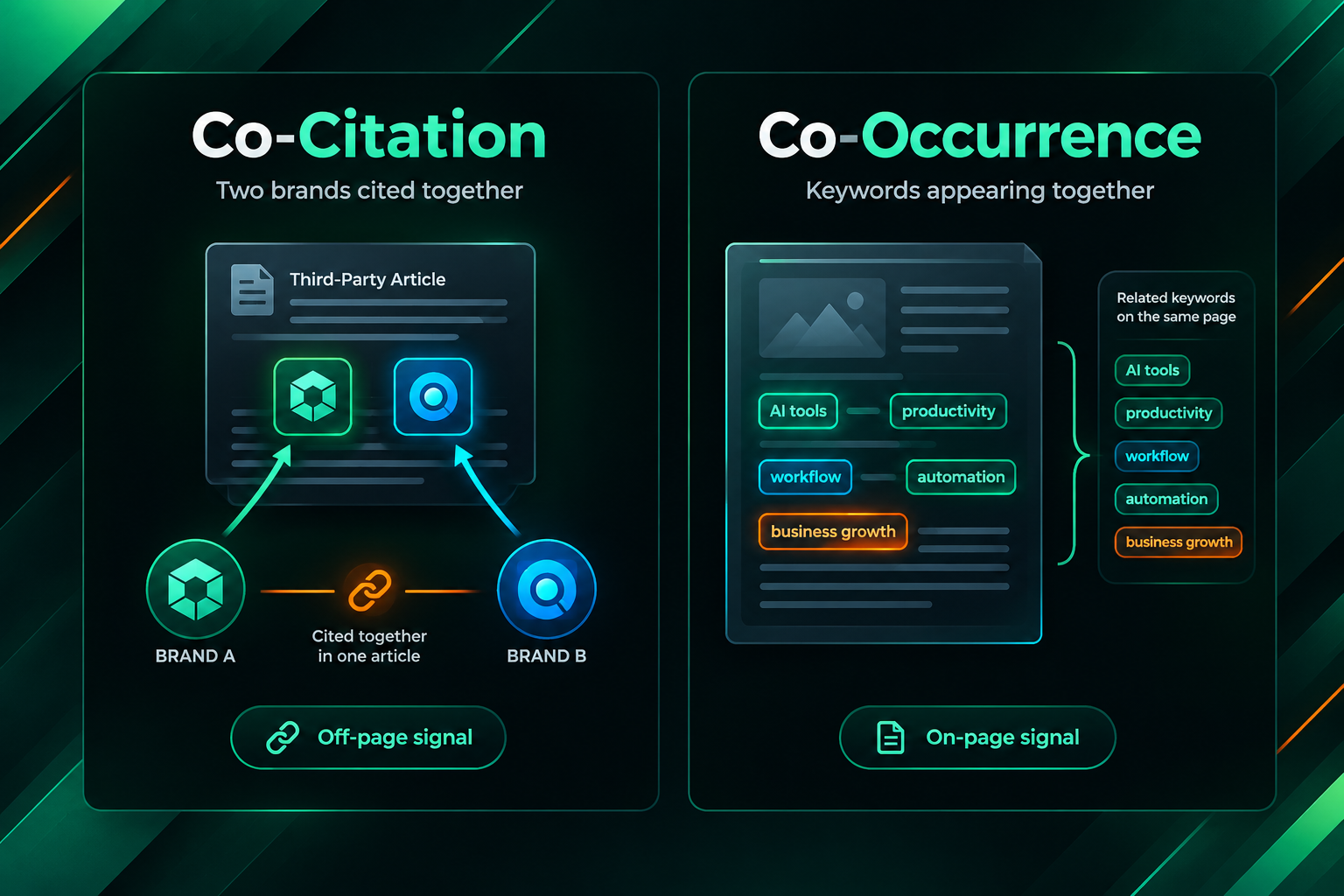
For example, if an article about project management software mentions both Asana and Trello as alternatives, that is co-citation: two brands cited together in the same context. If the same article repeatedly uses the phrases “task management”, “team collaboration”, and “workflow automation” together, those are co-occurring terms that may help a search engine understand the topical context of the page. Both signals may contribute to how a search engine understands relevance, but they operate differently and should not be treated as interchangeable.
In practical SEO terms, co-occurrence is more directly relevant to on-page content optimisation and topical depth, while co-citation is more relevant to off-page authority signals and brand positioning. A well-rounded SEO strategy may benefit from attention to both, though neither replaces the documented importance of earning high-quality backlinks from editorially relevant sources.
How Co-Citation May Influence Search Engine Perception
The theoretical mechanism behind co-citation as an SEO signal draws on how search engines attempt to understand the web as a graph of relationships rather than a simple collection of pages. When a trusted, topically relevant source consistently mentions your brand alongside established authorities in your niche, a search engine processing that content may begin to associate your website with those authorities, even in the absence of a direct link.
This association could influence several aspects of how a search engine evaluates your website. It may contribute to topical authority signals, helping a search engine understand which subject areas your brand is genuinely relevant to. It may also influence entity recognition, particularly as search engines have moved toward understanding named entities, brands, and their relationships rather than relying solely on keyword matching and link graphs. Google’s Knowledge Graph and related entity-based systems are designed to map relationships between real-world entities, and co-citation patterns in content may feed into how those relationships are inferred.
It is important to qualify these claims appropriately. The evidence for co-citation as a direct ranking signal is observational and theoretical rather than experimentally confirmed. SEO practitioners have noted correlations between strong brand mention profiles and improved rankings, but correlation does not establish that co-citation caused the ranking change. Other factors, including content quality, direct backlinks, user engagement signals, and technical SEO health, are simultaneously at work. A website-specific assessment is always required before attributing ranking changes to any single signal.
Co-Citation and Its Relationship to Link Building
Understanding co-citation is practically useful for link building strategy because it reframes how you think about brand visibility and authority. Traditional link building focuses on acquiring hyperlinks from relevant, authoritative websites. Co-citation broadens that perspective by suggesting that being mentioned in the right contexts, even without a link, may contribute to how search engines perceive your brand’s authority and topical relevance.
This has several implications for how link building campaigns are planned and evaluated. First, it reinforces the value of targeting genuinely authoritative, topically relevant publishers rather than simply accumulating links from any available source. When your brand is cited alongside respected names in your industry by credible third-party sources, the co-citation signal, if it functions as theorised, is likely to be stronger than a link from an unrelated or low-quality website. Second, it suggests that unlinked brand mentions, sometimes called implied links, may carry some SEO value, though this value is less certain and less measurable than that of a direct backlink.
For businesses working with a link building service or managing outreach campaigns, co-citation thinking encourages a focus on placement quality and contextual relevance over raw link volume. A guest post on a respected industry publication that mentions your brand alongside other credible sources may deliver both a direct backlink and a co-citation signal. A link from an irrelevant or low-authority site may deliver neither effectively. This is one reason why manual outreach to editorially selective publishers tends to produce more durable authority signals than bulk link acquisition from directories or link networks.
How Co-Citation Profiles Are Built in Practice
Building a strong co-citation profile is not a discrete campaign tactic in the way that guest posting or niche edit outreach is. It is more accurately described as an outcome of consistent brand-building, content quality, and strategic visibility efforts. The following factors tend to contribute to a website developing meaningful co-citation signals over time.
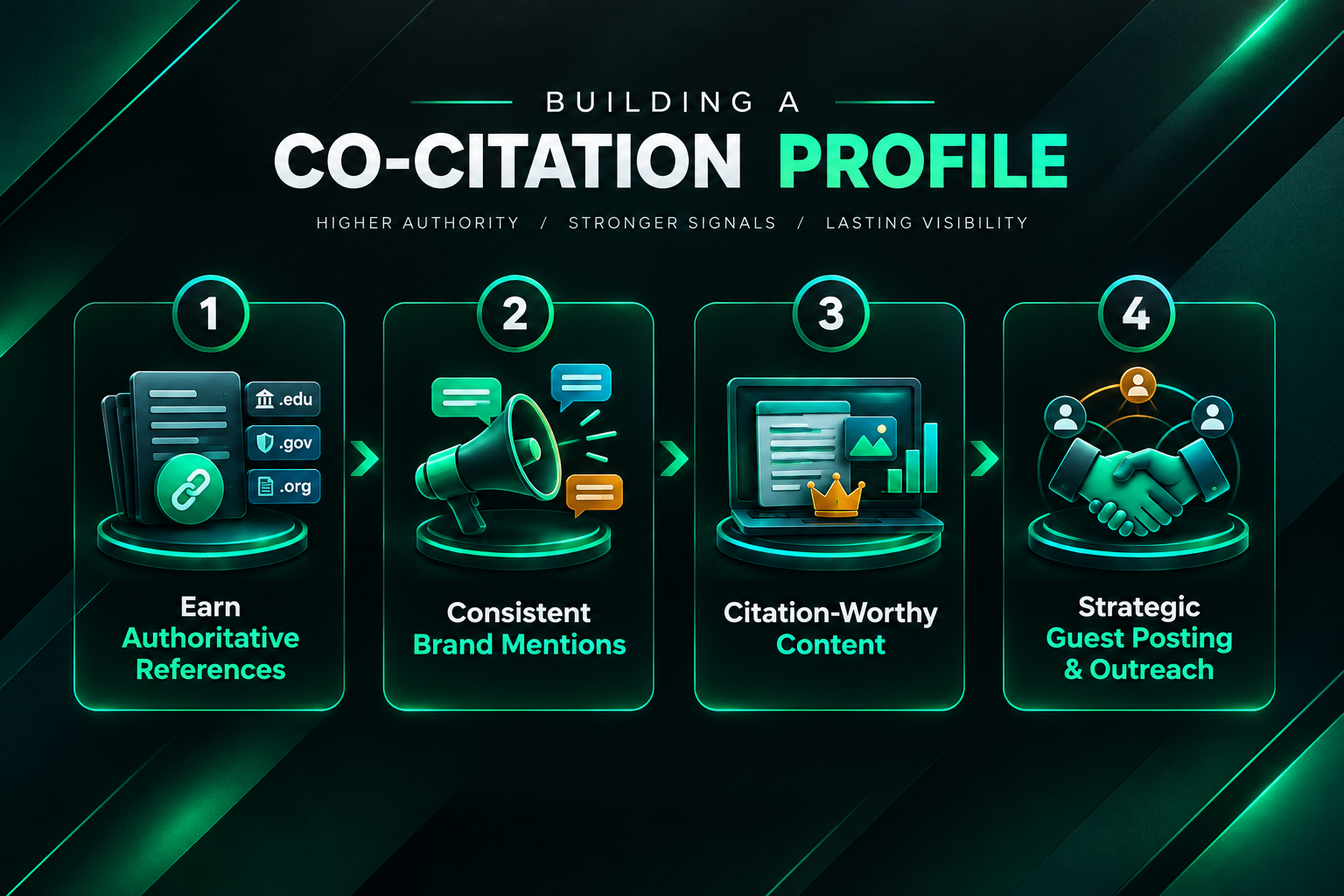
Earning References from Authoritative Sources
When credible publications in your niche reference your brand, product, or content as a resource, they create co-citation opportunities. This is particularly valuable when those publications also reference other established authorities in the same context. Digital PR campaigns, original research publication, and expert commentary in industry media are common methods for earning this type of reference. The goal is to become a brand that authoritative sources naturally mention when discussing your topic area.
Consistent Brand Mention Across Relevant Contexts
Co-citation signals are likely to be stronger when mentions are consistent across topically relevant contexts rather than scattered across unrelated industries or low-quality sources. A cybersecurity company that is consistently mentioned alongside other respected cybersecurity vendors in technology media, analyst reports, and industry forums is building a more coherent co-citation profile than one that appears in unrelated lifestyle content. Topical consistency matters because it reinforces the entity relationship a search engine may infer from the co-citation pattern.
Content That Attracts Natural Citations
Original research, comprehensive guides, data studies, and genuinely useful tools tend to attract citations from other content creators. When your content is cited alongside other credible sources in a well-regarded article, that creates a co-citation relationship between your website and the other cited sources. Investing in content that other writers and publishers want to reference is one of the most sustainable ways to build both direct backlinks and co-citation signals simultaneously.
Strategic Guest Posting and Outreach
Manual outreach campaigns that secure placements on relevant, editorially selective publications contribute to co-citation in two ways. The placement itself may cite your brand alongside other relevant entities in the article, and the publication’s editorial context positions your brand within a specific topical neighbourhood. Over time, consistent placements in the right publications can reinforce the co-citation associations that search engines may use to assess your authority within a subject area.
Measuring and Monitoring Co-Citation Signals
Unlike backlinks, which can be tracked directly through tools such as Ahrefs, Semrush, or Google Search Console, co-citation signals are considerably harder to measure. There is no widely available tool that directly quantifies co-citation strength or maps co-citation relationships in the way that backlink analysis tools map link graphs. This is one of the practical limitations of co-citation as an actionable SEO metric.
What can be monitored is unlinked brand mentions, which represent the raw material of co-citation. Tools such as Ahrefs Content Explorer, Semrush Brand Monitoring, and Google Alerts can surface instances where your brand is mentioned online without a corresponding backlink. Reviewing these mentions allows you to assess the quality and topical relevance of the sources citing your brand, identify opportunities to request a link conversion from an unlinked mention, and understand which contexts your brand is being associated with.
It is worth noting that converting unlinked brand mentions into backlinks is a legitimate and relatively low-friction outreach tactic. When a credible publisher has already mentioned your brand without linking, reaching out to request a link is a natural next step that may improve your direct backlink profile while the co-citation relationship already exists. This tactic is sometimes called unlinked mention outreach or implied link reclamation.
Beyond mention monitoring, assessing your co-citation profile qualitatively involves reviewing which brands and websites tend to appear alongside yours in search results, industry publications, and curated resource lists. If your brand consistently appears in the same contexts as established authorities in your niche, that is a reasonable indicator of a developing co-citation relationship, even if it cannot be precisely quantified.
Limitations and Realistic Expectations
Co-citation is a theoretically interesting concept with a credible basis in information retrieval research, but it comes with meaningful limitations that any honest SEO discussion should address. The most significant limitation is the absence of confirmed, publicly documented evidence that co-citation functions as a direct, weighted ranking factor in Google’s algorithm. Google’s publicly available documentation on ranking signals focuses on content quality, page experience, and links. Co-citation is not named as a confirmed factor.
This does not mean co-citation is irrelevant. It means that building an SEO strategy primarily around co-citation optimisation, at the expense of well-documented factors such as content quality and direct backlink acquisition, would be misaligned with the available evidence. Co-citation is best understood as a complementary signal that may reinforce authority and topical relevance, not as a standalone ranking lever that can be isolated and optimised independently.
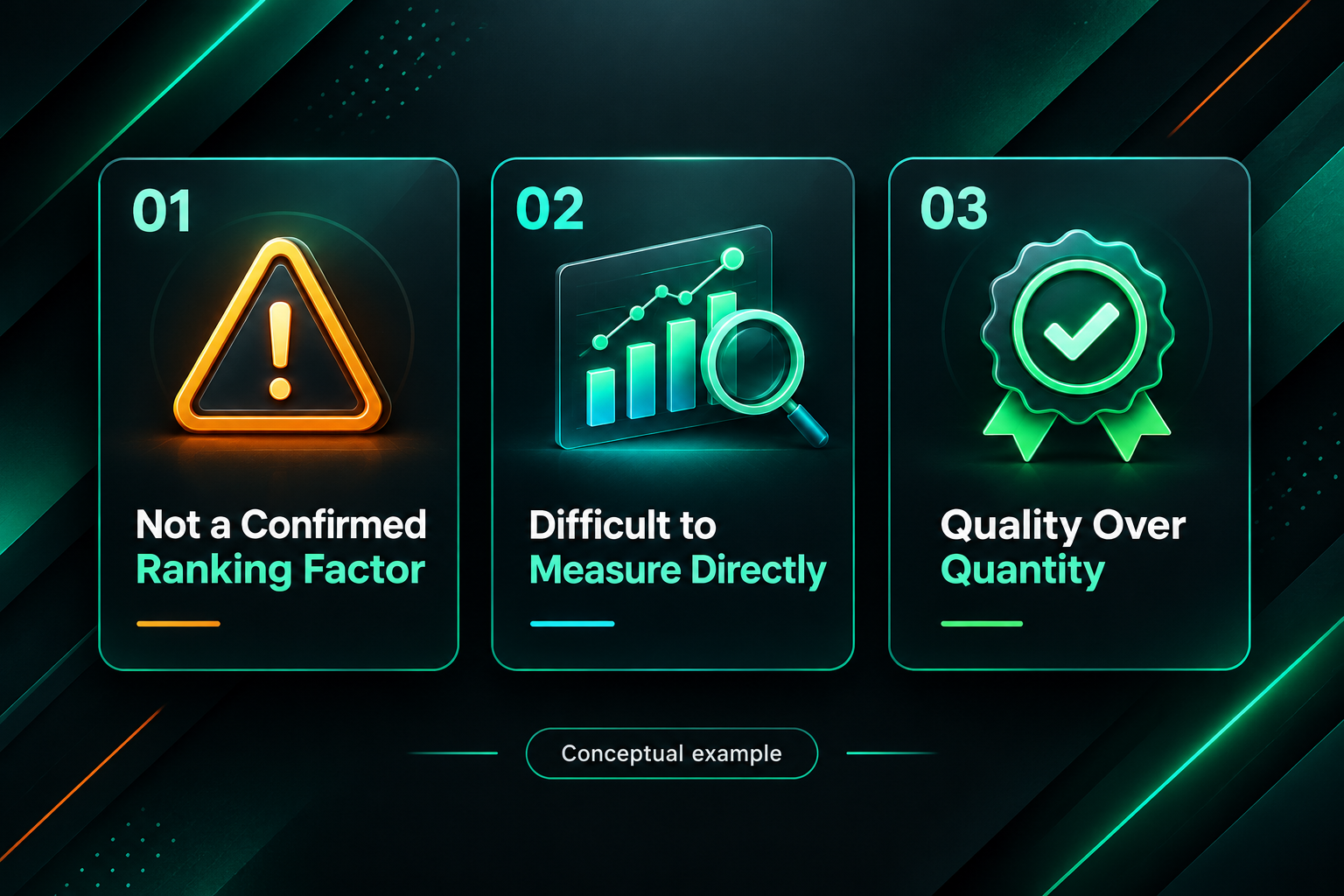
There is also a measurement problem. Because co-citation cannot be directly quantified with available tools, it is difficult to attribute ranking changes to co-citation improvements specifically. Any observed correlation between increased brand mentions and improved rankings could reflect the direct SEO value of the content earning those mentions, the backlinks accompanying some of those mentions, or other concurrent SEO improvements. Isolating co-citation as the causal factor is not currently possible with standard SEO tooling.
Finally, the quality of co-citation matters as much as quantity. Being mentioned alongside low-quality, irrelevant, or spammy websites in poor-quality content is unlikely to produce a positive co-citation signal and may not be neutral either. The same editorial quality standards that apply to direct link acquisition apply to the contexts in which your brand is mentioned.
Co-Citation in the Context of a Broader SEO Strategy
Co-citation thinking is most useful when it informs the overall direction of an SEO and content strategy rather than functioning as a discrete tactic. Businesses that focus on becoming genuinely authoritative, well-referenced brands in their niche tend to accumulate both direct backlinks and co-citation signals as natural byproducts of that authority. The two signals are not in competition; they are complementary.
For businesses working with an outsourced link building provider, co-citation awareness can improve campaign planning in several ways. It reinforces the importance of publisher quality and topical relevance over link volume. It highlights the value of digital PR and original content as link acquisition methods that also generate brand mentions. It encourages monitoring unlinked mentions as a source of outreach opportunities. And it provides a broader framework for understanding how search engines may assess authority beyond the direct link graph.
Businesses in competitive niches, SaaS companies building topical authority, and e-commerce brands seeking to establish category leadership may find co-citation thinking particularly relevant. In these contexts, being consistently associated with respected names in the industry, through editorial mentions, curated lists, comparison articles, and expert roundups, can contribute to a brand’s perceived authority in ways that complement a direct link building campaign.
Frequently Asked Questions
Is co-citation a confirmed Google ranking factor?
Google has not publicly confirmed co-citation as a named, weighted ranking factor. The concept is supported by academic research in information retrieval and observational SEO analysis, but it should not be treated as a confirmed algorithmic input in the same way that backlinks and content quality are documented. It is best understood as a plausible complementary signal rather than a proven direct ranking lever.
Does co-citation replace the need for backlinks?
No. Direct backlinks remain a well-documented ranking factor and the primary focus of most link building strategies. Co-citation may complement backlink signals by reinforcing topical authority and entity relationships, but it is not a substitute for earning high-quality links from relevant, authoritative sources. A strategy that relies solely on brand mentions without pursuing direct backlinks is unlikely to be as effective as one that pursues both.
How is co-citation different from a brand mention?
A brand mention is any reference to your brand online, with or without a link. Co-citation is a specific type of brand mention where your brand is cited alongside another brand or website by a third-party source. The co-citation relationship is defined by the association between the two cited entities, not just the mention of one. All co-citations involve brand mentions, but not all brand mentions constitute co-citations.
Can I actively build co-citation signals?
You cannot directly control which brands you are cited alongside, but you can influence the contexts in which your brand appears. Publishing original research, earning placements in respected industry publications, participating in expert roundups, and building relationships with credible voices in your niche all increase the likelihood that your brand will be mentioned in high-quality, topically relevant contexts alongside other authoritative entities. These efforts tend to build co-citation signals as a byproduct of genuine authority building.
Should I try to convert unlinked brand mentions into backlinks?
Unlinked mention outreach is a legitimate and relatively efficient link building tactic. When a credible publisher has already mentioned your brand without linking, a polite outreach request to add a link is a natural next step. This can improve your direct backlink profile while the co-citation relationship already exists. Prioritise mentions from topically relevant, editorially selective sources rather than pursuing every unlinked mention regardless of quality.
How does co-citation relate to Google’s Knowledge Graph?
Google’s Knowledge Graph maps relationships between real-world entities, including brands, people, and organisations. Co-citation patterns in content may contribute to how Google infers relationships between entities and understands which subject areas a brand is genuinely relevant to. A brand that is consistently mentioned alongside established authorities in a specific field may be more likely to be recognised as a relevant entity within that field, though the precise mechanism is not publicly documented by Google.
What Co-Citation Means for Your Link Building Decisions
Co-citation is a concept worth understanding because it broadens the frame through which you evaluate link building and brand visibility efforts. It suggests that authority on the web is not determined solely by the hyperlinks pointing to your website, but also by the contexts in which your brand is mentioned, the entities you are associated with, and the consistency of your presence in topically relevant, credible sources.
For practical decision-making, this means that link building campaigns focused on editorially selective, topically relevant publishers are likely to deliver more durable authority signals than those focused purely on link volume. It means that digital PR, original content, and expert positioning efforts have SEO value beyond the direct backlinks they generate. And it means that monitoring unlinked brand mentions is a worthwhile part of an ongoing outreach strategy.
If you are evaluating how co-citation thinking might inform your current link building approach, or considering whether your brand’s mention profile is aligned with your target authority positioning, discussing your situation with an experienced SEO or link building specialist can help you identify the most relevant opportunities for your specific website, niche, and competitive context.


