If a link to your website appears on a page that requires users to log in before they can see it, a reasonable question follows: does that backlink actually do anything for your search rankings? The short answer is that backlinks sitting behind a login wall are generally not crawlable by search engine bots, which means they are unlikely to pass any meaningful SEO value. Understanding why this happens, and what the exceptions and alternatives look like, helps you make better decisions about where to invest your link building effort.
Key Takeaways
- Search engine crawlers such as Googlebot cannot log in to access gated content, so backlinks on login-protected pages are typically not crawled or indexed.
- A link that search engines cannot crawl cannot pass PageRank or link equity to the target page, regardless of how authoritative the host domain appears in third-party tools.
- Some platforms partially expose content to crawlers, creating a grey area where a link may occasionally be discovered, but this is inconsistent and should not be relied upon.
- Referral traffic from login-protected communities can still have business value even when the SEO benefit is negligible or absent.
- Publicly accessible editorial placements remain the most reliable way to build a backlink profile that search engines can discover and evaluate.
How Search Engine Crawlers Access Web Pages
Googlebot and other search engine crawlers work by following links from one publicly accessible URL to another. They do not hold user accounts, submit login credentials, or execute the kind of authenticated session that a human visitor would use to access a members-only area. When a crawler requests a URL and receives a login redirect, a 401 authentication challenge, or a page that renders no meaningful content without a session cookie, it cannot proceed further. The content behind that barrier, including any links on it, remains invisible to the crawler.
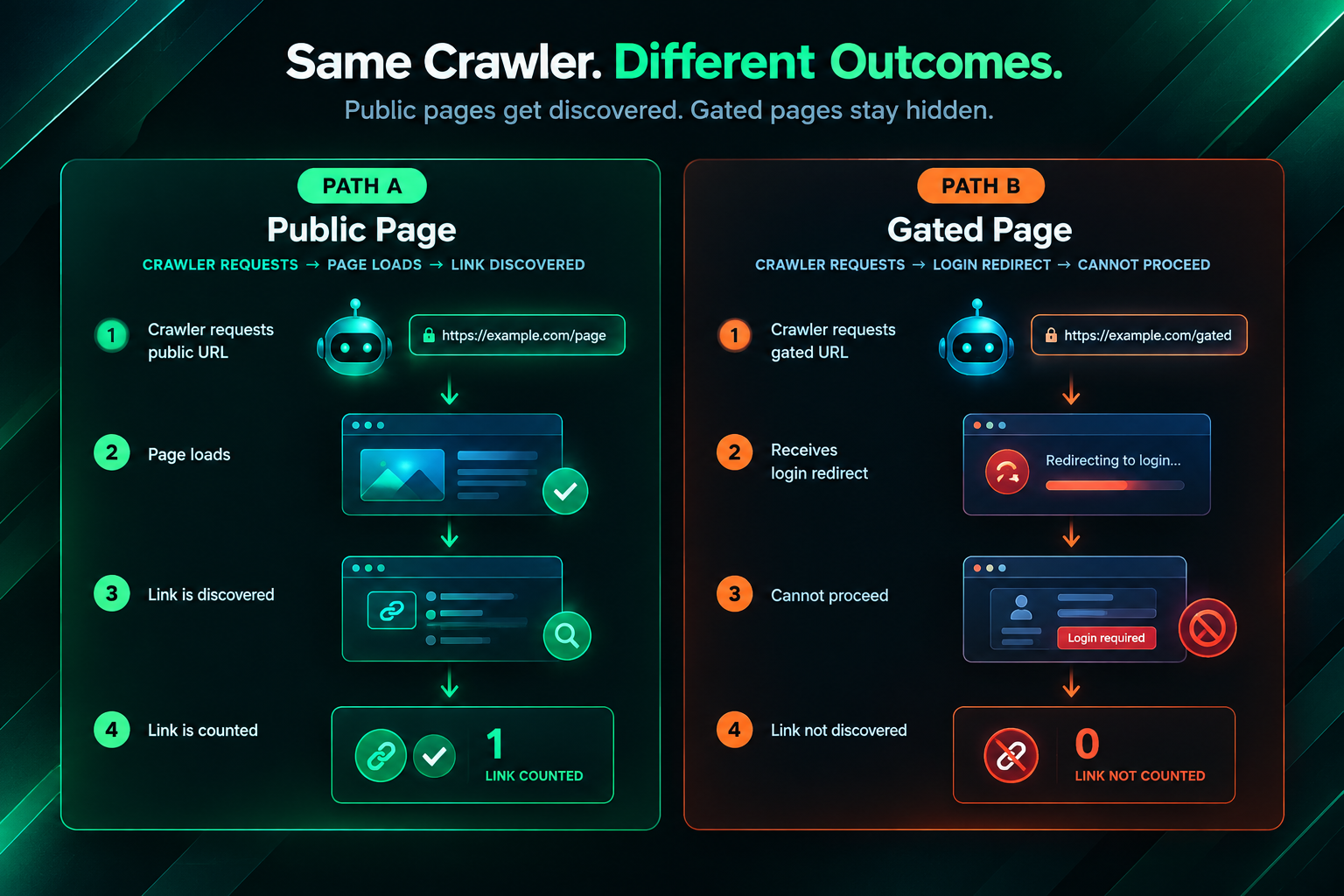
This is not a policy decision by Google about whether gated content deserves to rank. It is a practical consequence of how HTTP authentication and session-based access control work. A page that returns a 200 status code but delivers no useful content to an unauthenticated request is functionally invisible to a crawler in the same way as a page that returns a 403 or redirects to a login form. The result is the same: the backlink on that page is not discovered, not evaluated, and not counted in the target site’s backlink profile as far as search engines are concerned.
What Happens to Link Equity on Gated Pages
Link equity, sometimes called PageRank or link juice in informal SEO discussions, flows through crawlable hyperlinks from one page to another. Google’s documented guidance confirms that links need to be crawlable for PageRank to pass. A link that Googlebot cannot reach cannot transfer any of this equity to the destination URL, regardless of how large or reputable the platform hosting that link might be.
This distinction matters when evaluating backlinks reported by third-party tools such as Ahrefs, Semrush, or Majestic. These tools maintain their own crawl indexes and may have previously crawled a URL before it became gated, or they may have discovered a link through a cached or partially public version of a page. Seeing a backlink appear in one of these tools does not confirm that Googlebot has crawled it or that it is currently passing any value. The tool’s index and Google’s index are separate, and the presence of a link in a third-party database is not evidence that the link is contributing to your rankings.
The Grey Area: Partially Gated and Hybrid Platforms
Not every platform with a login requirement is completely closed to crawlers. Some social networks, forums, and community platforms expose portions of their content publicly while restricting other areas. LinkedIn, for example, shows some profile and post content to unauthenticated visitors and crawlers, while other sections require a logged-in session. Reddit makes most posts and comments publicly accessible. Quora shows content to visitors but may limit how much they can read before prompting a login.
On these hybrid platforms, whether a specific link is crawlable depends on whether the particular page containing it is publicly accessible. A link posted in a public Reddit thread is crawlable. A link shared in a private subreddit or a direct message is not. A link in a LinkedIn post visible to anyone on the web may be crawlable, while a link in a post restricted to connections only is not. The platform’s overall reputation or domain authority score in a third-party tool tells you nothing reliable about whether a specific link on that platform is actually being crawled and counted.
Some membership sites, learning management systems, and SaaS platforms use a hybrid approach where marketing pages, blog content, or resource directories are publicly accessible but the core product is gated. A backlink placed on the public-facing blog of such a platform would be crawlable and could pass value. A link appearing only inside the authenticated dashboard or member forum would not. The distinction is always about whether the specific URL containing the link is accessible to an unauthenticated crawler, not about the platform as a whole.
When Login-Protected Links Still Have Business Value
The absence of SEO value does not mean a link behind a login is worthless in every context. Referral traffic from gated communities can be genuinely valuable depending on the audience. A link shared in a private Slack community of senior marketing professionals, a members-only industry forum, or a paid mastermind group may drive highly qualified visitors to your website even though it contributes nothing to your backlink profile in search engine terms.
This distinction between SEO value and business value is worth keeping clear. If your goal is to improve organic search rankings and domain-level authority metrics, login-protected links are not a useful investment of outreach effort. If your goal is to reach a specific professional audience, generate direct referral traffic, or build brand awareness within a closed community, the same link may be worth pursuing for entirely different reasons. These are separate objectives that call for separate strategies.
It is also worth noting that some gated platforms allow users to share content externally, which can lead to publicly accessible coverage. A discussion in a private community that generates enough interest may result in members writing about the topic on their own public blogs or social profiles, creating crawlable links as a secondary effect. This is an indirect and unpredictable outcome rather than a reliable link building method.
How Third-Party SEO Tools Report These Links
A common source of confusion is discovering a backlink in Ahrefs, Semrush, or a similar tool and assuming it is actively contributing to your SEO. Third-party crawlers operate independently of Google and may have indexed a URL at a time when it was publicly accessible, before a site added authentication. They may also crawl cached versions, sitemaps, or links discovered through other means. The result is that a tool may show a backlink from a domain that is now fully gated, giving the impression of an active link when the link is no longer reachable by Googlebot.
Conversely, a tool may not have crawled a particular gated page at all, meaning a link that was briefly accessible to Googlebot before the page was locked might appear in Google’s index but not in a third-party tool’s database. Neither scenario is reliable as a measure of current SEO impact. The most accurate way to assess whether Google has discovered and evaluated a specific link is to use Google Search Console’s link report, which reflects what Google has actually crawled and attributed to your site, though even this report has known limitations in completeness and update frequency.
Practical Implications for Link Building Campaigns
For businesses and SEO teams planning or evaluating a link building campaign, the key practical implication is straightforward: prioritize placements on publicly accessible, editorially relevant pages. Guest posts on open-access publications, niche edits within existing publicly indexed articles, digital PR coverage on news and industry sites, and resource page inclusions on publicly crawlable domains are all methods that give search engines a clear path to discover and evaluate the link.
When assessing potential link opportunities, it is worth confirming that the target page is actually accessible to an unauthenticated browser session before investing outreach effort. This is a simple check: open the URL in a private or incognito browser window without any cookies or logged-in sessions. If the page loads fully and the link is visible, a crawler can likely reach it. If the page redirects to a login screen or shows a restricted-access message, the link will not be crawlable regardless of the domain’s metrics.
Outreach campaigns that target industry publications, trade media, professional blogs, and topically relevant websites with open access are more likely to produce backlinks that search engines can discover, crawl, and use in their evaluation of your site’s authority and relevance. The topical relevance of the linking page to your target page also matters: a crawlable link from a contextually relevant source is generally considered more useful than a crawlable link from an unrelated domain, though the precise weighting of these factors is not publicly documented by Google.
Nofollow, UGC, and Sponsored Attributes on Accessible Pages
A related but distinct question concerns link attributes on publicly accessible pages. Even when a page is fully crawlable, a link carrying a rel="nofollow", rel="ugc", or rel="sponsored" attribute may be treated differently from an unattributed editorial link. Google has stated that nofollow links are treated as hints rather than directives for crawling and indexing purposes, meaning some nofollow links may still be followed and may pass some value, though this is not guaranteed.
This is a separate issue from login-gated content, but it is worth understanding in context. A publicly accessible page with a nofollow link is still preferable to a login-protected page with a dofollow link, because at least the former gives the crawler a chance to evaluate the link and potentially pass some value. A login-protected page with any link attribute is effectively a non-starter for SEO purposes because the crawler cannot reach the page at all.
Alternatives to Login-Protected Link Placements
If you have been investing time in building links within gated communities or private platforms primarily for SEO reasons, redirecting that effort toward publicly accessible placements is likely to produce better results. Several approaches are worth considering depending on your website’s niche, content quality, and existing backlink profile.
- Manual outreach for guest posts: Identifying topically relevant publications that accept contributor content and pitching original articles that include a contextual link to your target page. The placement is publicly accessible, editorially reviewed, and typically carries a dofollow or nofollow link depending on the publication’s policy.
- Niche edits in existing articles: Reaching out to website owners or editors to request the addition of a link to your content within an already-published, indexed article. When the host article is publicly accessible and topically relevant, this can be an efficient way to acquire a contextual backlink.
- Digital PR and content-led link acquisition: Creating original research, data studies, tools, or resources that journalists and bloggers in your industry are likely to reference and link to from their own publicly accessible content.
- Resource page link building: Identifying publicly accessible resource directories or curated link pages in your niche and requesting inclusion where your content genuinely adds value to the list.
- Unlinked brand mention outreach: Finding instances where your brand or content has been mentioned on publicly accessible pages without a link and requesting that the mention be converted to a hyperlink.
Each of these methods targets publicly crawlable placements, which is the fundamental requirement for a backlink to contribute to your SEO. The suitability of any specific method depends on your website’s niche, the quality and relevance of your content, your existing backlink profile, and the competitive landscape for your target keywords. A site-specific assessment is advisable before committing significant resources to any single approach.
What This Means for Evaluating Your Existing Backlink Profile
If you are auditing your backlink profile and notice links from platforms that require authentication, it is worth investigating whether those specific URLs are publicly accessible. Use the incognito browser test described earlier, and cross-reference with Google Search Console’s links report to see whether Google has attributed those links to your site. Links that appear in third-party tools but not in Search Console and that are confirmed to be behind a login are unlikely to be contributing to your current rankings.
This does not necessarily mean those links are harmful. A login-protected link is generally neutral from a search engine perspective: it is simply not counted. The concern with backlink profiles is usually about links that are actively manipulative, spammy, or violate Google’s spam policies, which is a different category from links that are merely inaccessible. An inaccessible link is not a penalty risk; it is simply a missed opportunity if it was acquired with SEO in mind.
When planning future link acquisition, focusing on the crawlability and topical relevance of potential placements alongside conventional metrics such as domain rating or domain authority scores from third-party tools gives a more complete picture of likely SEO value. Third-party authority metrics are useful as a rough proxy for a domain’s overall link profile strength, but they do not confirm that a specific link on that domain is crawlable, indexed, or passing value to your site.
Frequently Asked Questions
Can Google ever crawl content behind a login?
In limited circumstances, Google can crawl content behind a login if the website owner explicitly configures access for Googlebot, for example through a structured data or paywalled content setup using ClaimReview or similar schema. However, this is a specific technical configuration for paywalled journalism and subscription content, not a general mechanism for community platforms or membership sites. Standard login-protected pages are not crawlable by default.
If a gated platform has a high domain authority score, does that make its links more valuable?
No. Domain authority, domain rating, and similar metrics from third-party tools reflect the overall strength of a domain’s backlink profile as estimated by that tool. They do not determine whether a specific link on that domain is crawlable or passing value. A link on a high-authority domain that is behind a login is still not crawlable and still not contributing to your SEO, regardless of the domain’s metric score.
Does a link in a private Facebook group or LinkedIn group count for SEO?
Links shared in private Facebook groups or private LinkedIn groups are not accessible to unauthenticated crawlers and are therefore not counted for SEO purposes. Links shared in public Facebook pages or public LinkedIn posts may be partially crawlable depending on the platform’s current configuration, but this can change and should not be relied upon as a primary link building strategy.
What about links in email newsletters?
Links in email newsletters are not crawlable by search engines because email content is not publicly accessible via HTTP. They can drive direct referral traffic if recipients click through, but they do not contribute to your backlink profile in any way that search engines can measure.
Can I ask a platform to make a page public so my link gets crawled?
If you have a relationship with the platform owner or administrator, it is technically possible to request that a specific page be made publicly accessible. However, this is rarely practical for community platforms where gating is a core feature. A more efficient use of outreach effort is usually to pursue placements on platforms that are already publicly accessible by design.
Should I disavow backlinks from login-protected pages?
Disavowing links is generally recommended only for links that are spammy, manipulative, or that you believe may be contributing to a manual action or algorithmic penalty. A link that is simply inaccessible because it is behind a login is not a spam signal and does not typically warrant disavowal. If you are uncertain about specific links in your profile, consulting an SEO professional with access to your full backlink data and Search Console account is advisable before submitting a disavow file.
What to Consider Before Investing in Any Link Placement
The question of whether backlinks behind a login count for SEO has a clear technical answer: they generally do not, because search engine crawlers cannot access gated content. The practical implication is that any link building effort motivated primarily by SEO should focus on placements that are publicly accessible, topically relevant, and on pages that search engines are likely to crawl and index.
This does not mean gated communities have no role in a broader marketing strategy. Referral traffic, brand visibility, and audience engagement within closed professional communities can all have genuine business value. The key is to be clear about which goal a particular activity is serving. Conflating SEO link building with community participation or audience development leads to misallocated effort and unrealistic expectations about ranking outcomes.
For businesses and agencies evaluating where to direct link acquisition resources, the most reliable approach remains building relationships with publicly accessible, editorially credible websites in relevant niches. Whether that is through manual outreach, guest posting, digital PR, or other white-hat methods depends on the specific website, its content, its competitive environment, and its existing backlink profile. A qualified SEO provider can help assess which approaches are most likely to be productive for a given site before significant budget is committed.