The reasonable surfer model is a concept from a Google patent that describes how the probability of a user clicking a link may influence how much PageRank that link passes. Rather than treating every link on a page as equally valuable, the model suggests that link placement, context, and visibility all affect how much weight a link carries. Understanding this concept can help SEO practitioners and link builders make more informed decisions about where and how links are placed, rather than simply counting the number of links pointing to a page.
Key Takeaways
- The reasonable surfer model is based on a Google patent that proposes link value may vary depending on how likely a typical user is to click that link.
- Factors such as link placement, anchor text, surrounding content, and page position may all influence how much PageRank a link passes.
- Not all links on a page are treated equally — a prominently placed, contextually relevant link may carry more weight than a footer or sidebar link.
- The model has practical implications for link building strategy, particularly around editorial placement, contextual relevance, and link position within content.
- The reasonable surfer model is a patent-based hypothesis; its precise implementation in Google’s ranking systems is not publicly confirmed.
What Is the Reasonable Surfer Model?
The reasonable surfer model originates from a Google patent filed in 2004 and granted in 2010, titled “Ranking documents based on user behavior and/or feature data.” The patent describes a method for assigning different probabilities to links based on how likely a reasonable, or typical, web user would be to click them. This stands in contrast to the original PageRank model, which distributed link equity more uniformly across all outbound links on a page.
In the original PageRank formulation, a page’s link equity was divided roughly equally among all the links it contained. The reasonable surfer model refines this by proposing that some links are more likely to be clicked than others, and that this click probability should influence how much ranking signal each link passes. A link that a typical user is very likely to click — because it is prominently placed, clearly labeled, and contextually relevant — may pass more value than a link buried in a footer, hidden in a sidebar, or surrounded by unrelated content.
It is important to note that Google patents describe technical approaches that may or may not be implemented in their current form in Google Search. The reasonable surfer model is widely discussed in the SEO community as a useful framework for thinking about link quality, but its precise role in Google’s live ranking systems is not publicly confirmed by Google. Treating it as a confirmed ranking mechanism would be an overstatement; treating it as a useful conceptual model for link quality assessment is more defensible.
How the Reasonable Surfer Model Differs from Classic PageRank
Classic PageRank, as described in the original 1998 paper by Larry Page and Sergey Brin, modeled a hypothetical random surfer who clicks links at random without any preference. Under this model, every outbound link on a page received an equal share of that page’s PageRank. If a page had ten outbound links, each received one-tenth of the available link equity, regardless of where the link appeared or what it said.
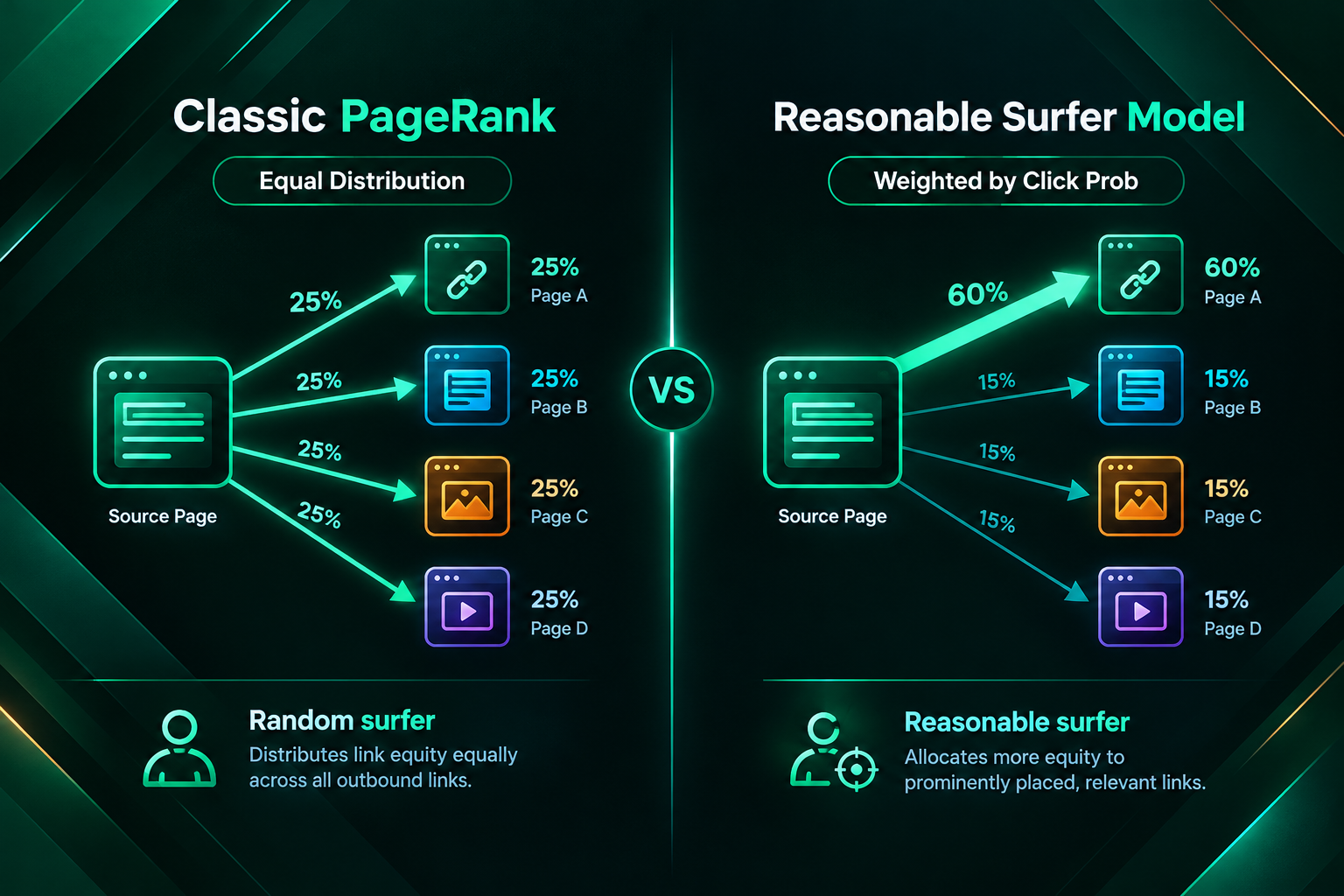
The reasonable surfer model replaces the random surfer with a more realistic one. This hypothetical user makes choices based on visible signals: the anchor text of a link, its position on the page, whether it appears in the main body content or in a navigation element, and whether it is relevant to what the user is already reading. A link with descriptive, relevant anchor text placed within the main editorial content of an article is more likely to be clicked by this reasonable surfer than a generic “click here” link in a page footer. According to the patent’s logic, the more clickable link would therefore pass more PageRank.
This distinction matters for link building because it shifts the focus from link quantity toward link quality and placement. Acquiring a link that appears in a contextually relevant paragraph within a well-structured article may be more valuable than acquiring multiple links in less prominent positions, even if those pages have similar domain-level authority metrics.
Factors That May Influence Link Value Under This Model
Several characteristics of a link and its surrounding environment may affect how a reasonable surfer would interact with it, and therefore how much value that link might pass. These factors are drawn from the patent’s description and from subsequent SEO analysis, and should be understood as informed hypotheses rather than confirmed Google specifications.

Link Position on the Page
Links placed within the main body content of a page — particularly in the upper portion of an article — are generally more visible and more likely to be clicked than links placed in footers, sidebars, or navigation menus. The reasonable surfer model suggests that this positional difference may translate into a difference in the amount of PageRank passed. A link embedded naturally within a paragraph that a reader is actively engaging with is in a stronger position than one appended to a list of unrelated resources at the bottom of a page.
Anchor Text Relevance and Descriptiveness
Anchor text — the visible, clickable words of a link — provides a signal about what the linked page contains. Descriptive, relevant anchor text gives a reasonable surfer a clear reason to click. Generic anchor text such as “read more” or “click here” provides little information and may be less likely to attract a click. Under the reasonable surfer model, this difference in click probability could affect the link’s value. For link builders, this reinforces the importance of natural, descriptive anchor text that accurately reflects the content of the destination page, rather than over-optimized exact-match phrases or meaningless generic labels.
Surrounding Content and Topical Context
A link placed within content that is topically relevant to the destination page is more likely to be clicked by a user who is already interested in that topic. The reasonable surfer model implies that this contextual alignment may increase the link’s value. This is consistent with the broader SEO principle that topical relevance between the linking page and the linked page is a meaningful quality signal. A link to a software product placed within an article about software comparisons is more contextually appropriate than the same link placed within an unrelated lifestyle article.
Number of Links on the Page
Pages with a very large number of outbound links distribute their available link equity across more destinations. Under both classic PageRank and the reasonable surfer model, this dilution effect means that each individual link on a heavily linked page may pass less value. The reasonable surfer model adds nuance here: even on a page with many links, a prominently placed and highly relevant link may retain more value than a less prominent one, because the click probability for that specific link remains higher relative to the others.
Link Visibility and Formatting
Links that are visually distinct, clearly formatted, and easy to identify as links are more likely to be noticed and clicked. Links that are styled to blend into surrounding text, or that appear in low-contrast areas of a page, may attract fewer clicks. The reasonable surfer model’s logic suggests this visibility factor could influence link value, though the degree to which Google’s systems can assess visual rendering is a separate technical question.
Practical Implications for Link Building Strategy
The reasonable surfer model, even as a hypothesis rather than a confirmed system, provides a useful framework for evaluating link quality beyond simple domain-level metrics. Many link building assessments rely heavily on third-party authority scores such as Domain Rating from Ahrefs, Domain Authority from Moz, or Trust Flow from Majestic. These metrics offer a useful starting point, but they do not capture placement quality, contextual relevance, or the likely click probability of a specific link. The reasonable surfer model encourages a more granular assessment.
Editorial Placement Within Body Content
When acquiring links through manual outreach, guest posting, or niche edits, the position of the link within the published content matters. A link placed within the first few paragraphs of a relevant article, surrounded by topically aligned content and using descriptive anchor text, is likely to be assessed more favorably under a reasonable surfer framework than a link added to a resource list at the end of an unrelated post. When evaluating link placement opportunities, it is worth considering not just the domain metrics of the publisher but also where and how the link will appear within the content.
Contextual Relevance Over Volume
The reasonable surfer model supports a quality-over-quantity approach to link acquisition. A smaller number of links placed in genuinely relevant, well-read content may contribute more to a page’s authority signal than a larger number of links in low-engagement, off-topic placements. This does not mean that link volume is irrelevant — a diverse, growing backlink profile from multiple referring domains remains an important signal — but it does suggest that the quality and context of each placement deserves careful attention.
Anchor Text Strategy
The model’s emphasis on anchor text as a click-probability signal reinforces the importance of natural, varied anchor text in a link profile. Over-optimized anchor text — where the same exact-match keyword phrase is used repeatedly across many links — can appear unnatural and may attract scrutiny under Google’s spam policies, regardless of the reasonable surfer model. Descriptive, varied anchor text that reflects the genuine content of the destination page is both more consistent with the reasonable surfer framework and more aligned with Google’s documented link quality guidance.
Assessing Publisher Quality Beyond Domain Metrics
When evaluating potential link placements, the reasonable surfer model encourages looking at the actual page rather than just the domain. A high-authority domain may host a specific page with dozens of outbound links, poor topical relevance, and a footer placement — conditions that would reduce the likely value of a link under this model. Conversely, a moderately authoritative domain may offer a well-placed, contextually relevant link within a focused article that a real audience is likely to read and engage with. Publisher assessment should therefore consider page-level factors alongside domain-level metrics.
Limitations and What the Model Does Not Tell Us
The reasonable surfer model is a useful conceptual tool, but it has important limitations that practitioners should keep in mind.
First, the model is based on a patent, not on confirmed documentation of how Google’s live ranking systems work. Google patents describe technical approaches that may be tested, modified, partially implemented, or not implemented at all. The SEO community has found the reasonable surfer model to be a coherent and useful framework, but this does not confirm that Google applies it in the specific way the patent describes.
Second, the model focuses on one dimension of link value — click probability — and does not address all the factors that influence how a backlink affects rankings. Content quality, technical SEO health, crawling and indexing status, the overall backlink profile of a page, and competitive dynamics all play roles that the reasonable surfer model does not capture. A well-placed link on a relevant page will not compensate for weak content, crawling problems, or a manual action on the target site.
Third, click probability is not directly observable by most SEO practitioners. Assessing it requires judgment about placement, relevance, and context rather than a measurable data point. This means applying the reasonable surfer model in practice involves informed estimation rather than precise calculation.
Fourth, the model does not provide guidance on how much difference in link value exists between a high-click-probability link and a low-click-probability link. Whether the difference is marginal or substantial in practice is not something the patent specifies, and no independent research has reliably quantified this.
The Reasonable Surfer Model and Link Quality Assessment
Despite its limitations, the reasonable surfer model offers a practical lens for link quality assessment that goes beyond domain-level authority scores. When evaluating a potential link placement, considering the following questions is consistent with the model’s logic and with broader link quality principles:
- Is the link placed within the main body content of the page, or in a footer, sidebar, or navigation element?
- Is the anchor text descriptive and relevant to the destination page’s content?
- Is the surrounding content topically related to the destination page?
- How many other outbound links appear on the same page, and how prominent is this specific link relative to them?
- Is the page likely to attract real readers who might genuinely click the link?
- Does the link appear in a natural editorial context, or does it look like it was inserted purely for SEO purposes?
These questions are also relevant to Google’s documented guidance on link quality, which emphasizes that links should be placed because they are genuinely useful to readers rather than primarily to manipulate rankings. A link that a reasonable surfer would be likely to click is, almost by definition, a link that serves a genuine editorial purpose.
How This Applies to Outsourced and Agency Link Building
For businesses and SEO agencies that outsource link acquisition, the reasonable surfer model has practical implications for how campaigns should be structured and evaluated. Link building services that focus on editorial placement within relevant, well-structured content — rather than on volume metrics alone — are more likely to produce placements that align with the model’s quality signals.
When reviewing link building proposals or assessing the quality of delivered placements, it is worth asking whether the links appear in contextually relevant positions within genuine editorial content, rather than in low-engagement areas of a page. A campaign that delivers fewer links but places each one within a relevant, well-read article may produce stronger signals than one that delivers a higher volume of links in less prominent or less relevant positions.
It is also worth noting that the reasonable surfer model’s emphasis on natural, click-worthy links aligns with Google’s documented policies on link schemes. Links that are placed purely for PageRank manipulation, without genuine editorial relevance or user value, carry policy risk regardless of their placement quality. The model’s logic and Google’s spam policies point in the same direction: links that serve real readers in relevant contexts are both more likely to pass value and less likely to attract negative attention.
When working with a link building provider, asking about their approach to placement quality — including where within a page links are placed, how topical relevance is assessed, and how anchor text is selected — can help ensure that the campaign produces placements that hold up to scrutiny under both the reasonable surfer framework and Google’s quality guidelines.

Frequently Asked Questions
Is the reasonable surfer model an official Google ranking factor?
The reasonable surfer model is based on a Google patent, not on official documentation of Google’s ranking systems. Google patents describe technical approaches that may or may not be implemented in their current form. The model is widely used in the SEO community as a framework for thinking about link quality, but it should not be treated as a confirmed, publicly documented ranking factor.
Does link position on a page really affect how much PageRank it passes?
The reasonable surfer model proposes that it does, based on the logic that links more likely to be clicked by a typical user may pass more value. This is a plausible and widely accepted hypothesis in the SEO community, but the precise degree to which Google’s systems differentiate between link positions is not publicly confirmed. Treating prominent, contextually relevant placement as preferable to footer or sidebar placement is a reasonable quality principle regardless of the model’s exact implementation.
How does the reasonable surfer model affect anchor text choices?
The model suggests that descriptive, relevant anchor text increases click probability and may therefore increase the value a link passes. In practice, this supports using natural, varied anchor text that accurately describes the destination page, rather than generic labels or over-optimized exact-match phrases. This approach is also more consistent with Google’s documented guidance on link quality.
Should I prioritize link placement quality over domain authority metrics?
Both matter, but domain-level authority metrics alone do not capture placement quality, contextual relevance, or the likely engagement of a specific link. The reasonable surfer model encourages assessing the specific page and placement, not just the domain. A well-placed, contextually relevant link on a moderately authoritative site may be more valuable than a poorly placed link on a high-authority domain, though a site-specific assessment is needed to evaluate any individual situation.
Does the reasonable surfer model apply to all types of links?
The model’s logic applies broadly to links that pass PageRank. Links with a nofollow or sponsored attribute, or links that are otherwise excluded from PageRank flow, are a separate consideration. For followed editorial links, the model’s principles around placement, relevance, and anchor text are relevant regardless of the specific link type or acquisition method.
Can understanding the reasonable surfer model help me evaluate link building services?
Yes, in a practical sense. The model provides a framework for asking better questions about placement quality: where within a page will the link appear, how relevant is the surrounding content, and how descriptive is the anchor text? These questions can help distinguish link building services that prioritize genuine editorial placement from those that focus primarily on volume or domain metrics.
Using the Reasonable Surfer Model as a Practical Quality Standard
The reasonable surfer model will not tell you exactly how much value any individual link passes, and it should not be treated as a precise formula for link building decisions. What it offers is a coherent, user-centered framework for thinking about link quality that goes beyond domain-level scores and link counts. By asking whether a typical, reasonable user would be likely to click a given link — based on its placement, anchor text, surrounding content, and topical relevance — you can apply a quality standard that is both practically useful and broadly consistent with Google’s documented approach to evaluating links.
For businesses and agencies managing link acquisition campaigns, this framework supports a focus on editorial quality, contextual relevance, and natural placement over volume-driven approaches. Whether you are assessing a link building proposal, reviewing delivered placements, or planning an outreach campaign, the reasonable surfer model provides a useful lens for distinguishing links that are likely to contribute meaningful signals from those that may add little value regardless of the domain metrics attached to them. If you are unsure how to apply these principles to your specific backlink profile or campaign goals, a qualified SEO provider can help assess your situation and recommend an approach suited to your website and competitive context.