

Semrush Authority Score is a proprietary domain-level metric that estimates the overall strength and trustworthiness of a website based on its backlink profile, organic search performance, and traffic data. If you are evaluating potential link prospects, assessing a competitor’s domain, or trying to understand whether a backlink opportunity is worth pursuing, Authority Score is one of the most commonly referenced signals in the process — but it is also one of the most frequently misunderstood.
Key Takeaways
- Semrush Authority Score is a proprietary metric scored from 0 to 100 that reflects a domain’s backlink quality, organic traffic, and spam signals — it is not a Google ranking factor.
- A higher Authority Score generally suggests a stronger, more trusted domain, but the score alone does not guarantee that a backlink from that domain will improve your rankings.
- Authority Score is most useful as a comparative and filtering tool during link prospecting, not as a standalone measure of SEO value.
- The score can be influenced by sudden changes in backlink volume, traffic drops, or spam-like link patterns, so it should always be interpreted alongside other quality signals.
- When building or evaluating a backlink profile, topical relevance, link placement context, and editorial quality matter alongside any numerical domain metric.
What Is Semrush Authority Score?
Semrush Authority Score is a composite metric calculated by Semrush and displayed on a scale of 0 to 100. It is designed to reflect the overall authority and quality of a domain or webpage. The higher the score, the more authoritative Semrush considers the domain to be, based on the data signals it collects and processes. A score of 1 to 10 typically indicates a very new or low-authority domain, while scores above 60 or 70 are generally associated with well-established websites that have accumulated substantial, high-quality backlinks over time.
It is important to understand from the outset that Authority Score is a Semrush-specific metric. It is not provided, endorsed, or used by Google, Bing, or any other search engine as a ranking input. Google has its own internal systems for evaluating link quality and domain trust, none of which are publicly exposed as a single numerical score. Authority Score is a third-party approximation, useful for comparative analysis but not a direct proxy for how Google evaluates a website.
How Is Authority Score Calculated?
Semrush calculates Authority Score using three primary data categories: backlink profile quality, organic search traffic, and spam detection signals. These inputs are combined through a machine-learning model that Semrush has refined over time, and the resulting score is intended to reflect the overall health and influence of a domain.
Backlink Profile Quality
The largest influence on Authority Score comes from the quality and quantity of a domain’s referring domains and backlinks. Semrush evaluates not just how many websites link to a domain, but the Authority Scores of those linking domains themselves. A domain that receives backlinks from many high-authority, editorially relevant websites will typically score higher than one that has accumulated a large volume of links from low-quality or irrelevant sources. The diversity of referring domains — meaning links coming from many distinct websites rather than repeated links from the same source — also contributes positively to the score.
Organic Search Traffic
Semrush incorporates estimated organic search traffic as a secondary signal. Domains that consistently attract meaningful organic traffic from search engines are generally treated as more authoritative than domains with little or no measurable search visibility. This component helps the model distinguish between domains that have genuine audience reach and those that may have accumulated backlinks without corresponding search performance.
Spam and Manipulation Signals
Semrush applies spam detection to identify patterns associated with manipulative or low-quality link building, such as sudden unnatural spikes in backlink volume, links from link farms or private blog networks, or a high proportion of links from domains with very low Authority Scores. When these patterns are detected, they can suppress a domain’s Authority Score even if the raw backlink count appears large. This is why a domain with thousands of backlinks may still carry a low Authority Score if those links originate from poor-quality sources.
Authority Score vs. Other Domain Metrics
Semrush Authority Score is one of several proprietary domain-level metrics used across the SEO industry. Ahrefs uses Domain Rating (DR), Moz uses Domain Authority (DA), and Majestic uses Trust Flow and Citation Flow. Each metric is calculated differently, uses its own link index, and reflects its own methodology. These scores are not interchangeable, and a domain’s score on one platform will often differ from its score on another.
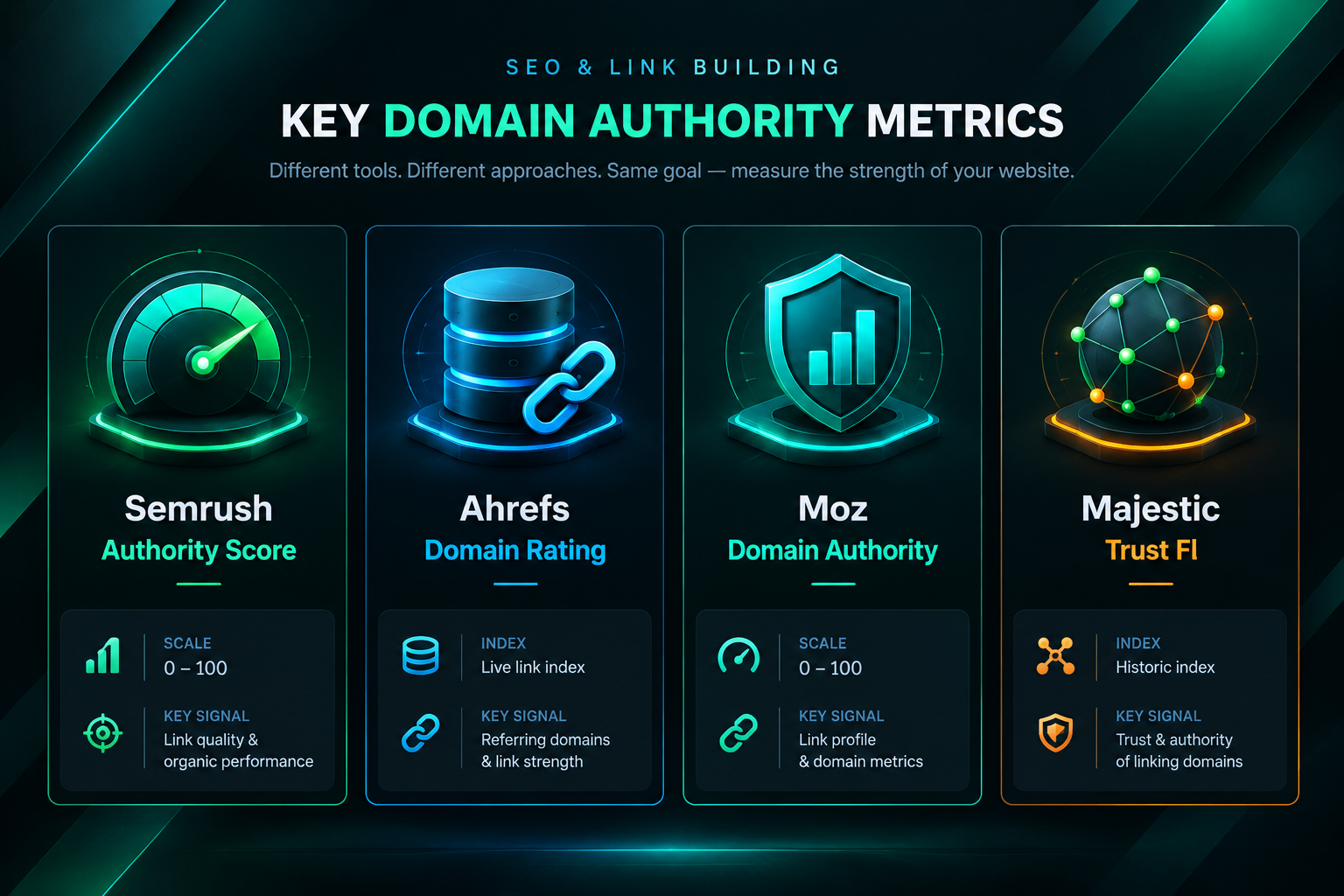
None of these metrics — including Semrush Authority Score — should be treated as a direct measure of Google’s assessment of a domain. Google has confirmed that it does not use third-party authority metrics as ranking signals. What these tools attempt to do is model the relative strength of a backlink profile using observable data, which makes them useful for comparative analysis and link prospecting, but not reliable as absolute predictors of ranking performance.
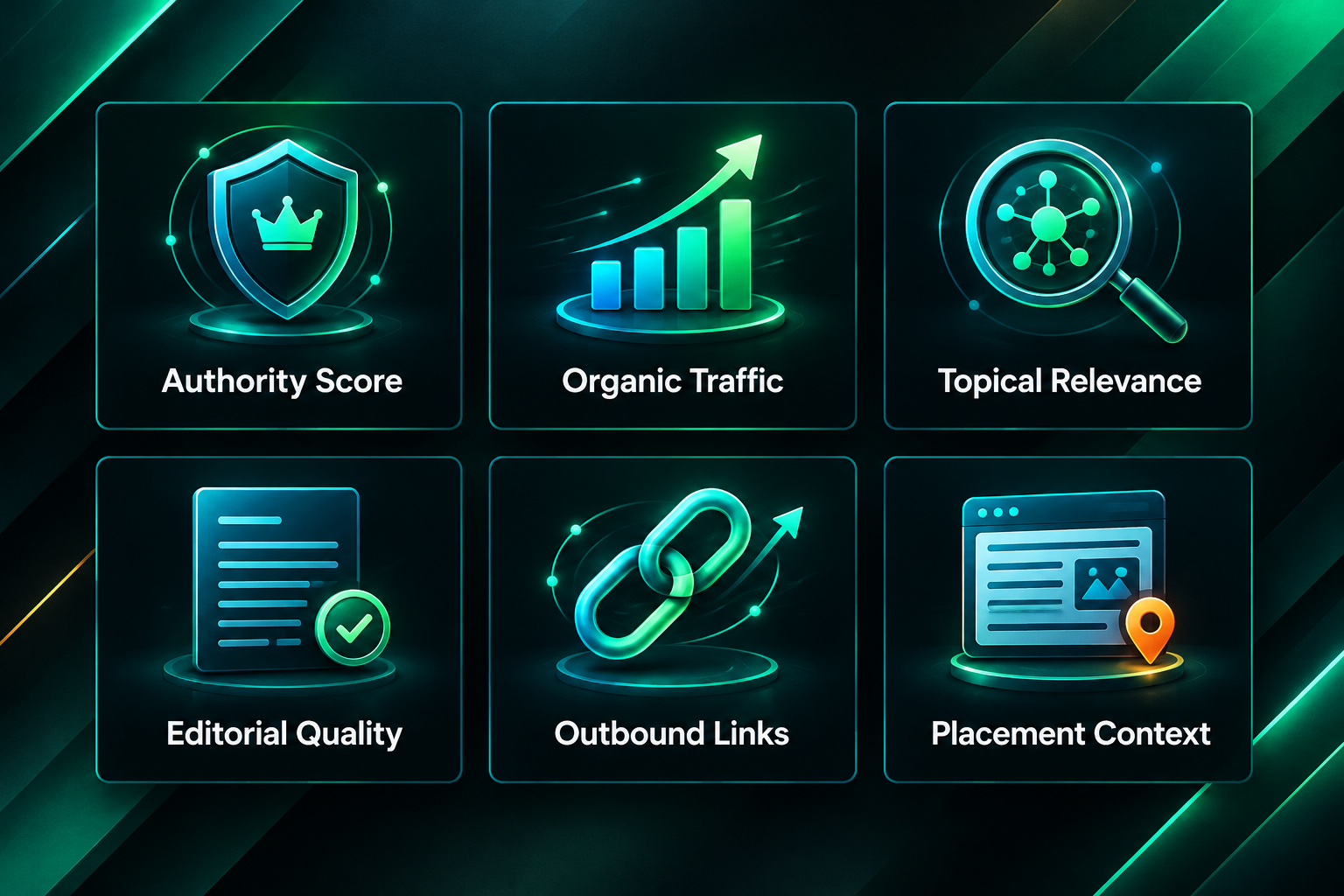
When evaluating a link opportunity, it is generally more informative to look at multiple signals together: the Authority Score or Domain Rating of the referring domain, its estimated organic traffic, the topical relevance of the site to your niche, the placement context of the link, and whether the site demonstrates genuine editorial standards. Relying on a single metric from any one tool introduces blind spots that a more holistic assessment would catch.
What Authority Score Does and Does Not Tell You
Authority Score is most useful as a filtering and comparison tool. When you are prospecting for guest post opportunities, evaluating niche edit placements, or auditing a competitor’s backlink profile, Authority Score gives you a quick signal about the relative strength of a domain. A prospect with an Authority Score of 50 is likely to be a more established and credible domain than one scoring 15, all else being equal.
However, Authority Score does not tell you whether a specific backlink from that domain will improve your rankings. Several factors that matter for link value are not captured by the score alone. Topical relevance — whether the linking site covers subjects closely related to your own — is a meaningful quality signal that Authority Score does not directly measure. The placement of the link within a page, whether it appears in the main editorial body or in a footer or sidebar, also affects its likely value. The anchor text used, whether the link carries a nofollow or sponsored attribute, and whether the linking page itself has meaningful organic visibility are all factors that require separate evaluation.
Authority Score also does not indicate whether a domain is editorially independent. A high-scoring domain that sells links openly, publishes content indiscriminately, or hosts a disproportionate number of outbound links to unrelated websites may carry a strong numerical score while offering limited practical SEO value — and potentially carrying policy risk if the placement is treated as a paid link without appropriate disclosure.
How Authority Score Changes Over Time
Authority Score is not static. It updates as Semrush recrawls the web and refreshes its link index. A domain’s score can increase as it earns more high-quality backlinks and grows its organic search presence. It can also decrease if the domain loses significant referring domains, experiences a major drop in organic traffic, or if Semrush’s spam detection identifies newly problematic link patterns pointing to or from the domain.
Sudden large increases in a domain’s Authority Score are not always a positive signal. A rapid spike in backlinks — particularly from low-quality sources — can temporarily inflate a score before Semrush’s spam filters adjust. Conversely, a domain that has recently lost a significant portion of its backlink profile due to link removals or a Google core update may show a declining score that does not yet reflect any recovery efforts underway. Interpreting score changes requires context, and a single data point in time is rarely sufficient for a meaningful assessment.
Using Authority Score in Link Building Campaigns
In practical link building work, Authority Score is commonly used as one of several filters during the prospecting and qualification stage. When identifying potential guest post targets, niche edit opportunities, or digital PR placements, a minimum Authority Score threshold is often applied to exclude very low-quality domains from outreach lists. This saves time and helps focus effort on domains that are more likely to provide meaningful backlink value.
A typical approach might involve setting a minimum Authority Score — for example, filtering out domains below a certain threshold — while also checking estimated organic traffic, topical relevance, and the quality of existing content on the site. This multi-signal approach is more reliable than using Authority Score as the sole criterion. A domain with a moderate Authority Score but strong topical alignment and genuine editorial content may be a better link prospect than a high-scoring domain with no relevance to your niche.
When running outreach campaigns at scale, Authority Score can also be used to prioritise outreach sequences. Prospects with higher scores and stronger organic visibility may warrant more personalised outreach effort, while lower-scoring domains might be approached with a more streamlined process or deprioritised entirely depending on campaign goals.
Evaluating Competitor Backlink Profiles
Authority Score is also useful when analysing the backlink profiles of competing websites. By reviewing the Authority Scores of domains linking to your competitors, you can identify high-quality link sources that may be worth targeting in your own outreach. If a competitor has earned links from several high-authority, topically relevant domains that you have not yet approached, those represent qualified prospecting opportunities. This type of gap analysis — comparing your backlink profile against competitors — is a common starting point for planning a link acquisition strategy.
Monitoring Your Own Domain’s Score
Tracking your own domain’s Authority Score over time can provide a rough indication of whether your link building efforts are contributing to a stronger backlink profile. If your score increases alongside growth in referring domains from credible sources, that is generally a positive signal. However, an improving Authority Score does not automatically translate into improved rankings or organic traffic. Rankings depend on many factors beyond backlink strength, including content quality, technical SEO health, search intent alignment, and competitive dynamics in your specific market.
Authority Score and Link Quality Assessment
One of the most practical applications of Authority Score is in assessing the quality of individual link opportunities before committing to outreach or placement. When a link building provider or outreach team presents a list of potential placements, reviewing the Authority Score of each domain alongside other quality indicators helps identify which opportunities are worth pursuing and which should be declined.
A useful quality checklist for evaluating a link prospect might include the following considerations:
- Authority Score: Does the domain score above your minimum threshold? Is the score consistent with the site’s apparent age and content volume?
- Organic traffic: Does the domain receive meaningful estimated organic traffic, or does it appear to have little search visibility despite a reasonable score?
- Topical relevance: Does the site cover subjects closely related to your industry, product, or target audience?
- Editorial quality: Does the site publish original, well-written content, or does it appear to exist primarily to host outbound links?
- Outbound link patterns: Does the site link out to a diverse range of credible sources, or does it carry an unusually high number of outbound links to unrelated or low-quality destinations?
- Link attributes: Will the link be followed, nofollowed, or sponsored? Is the attribute appropriate given the nature of the placement?
- Placement context: Will the link appear within the main editorial body of a relevant article, or in a less prominent location such as a footer or author bio?
No single factor on this list is decisive on its own, and Authority Score is just one input among several. A domain that performs well across all of these dimensions is generally a stronger link prospect than one that scores highly on only one or two criteria.
Limitations of Authority Score
Understanding the limitations of Authority Score is as important as knowing how to use it. Several meaningful constraints affect how much weight the metric should carry in any link building or SEO decision.
Authority Score reflects Semrush’s link index, which — like all third-party link indexes — does not capture every backlink on the web. Semrush’s crawl coverage is extensive but not exhaustive, meaning some links pointing to a domain may not be reflected in the score. This can cause the score to underrepresent the true backlink strength of some domains, particularly those in less-crawled niches or geographic markets.
The metric is also susceptible to manipulation in both directions. Domains that have engaged in aggressive low-quality link building may temporarily carry inflated scores before spam filters adjust. Conversely, a domain that has recently cleaned up a toxic backlink profile through a disavow process may show a temporarily suppressed score that does not reflect its current link health. These dynamics mean that Authority Score should be interpreted as a directional signal rather than a precise measurement.
Finally, Authority Score is a domain-level metric by default, which means it reflects the overall strength of an entire website rather than the specific page where your link would appear. A high-scoring domain may have individual pages with very little organic visibility or inbound link equity, which would limit the practical value of a link placed on those pages. Checking page-level metrics — such as the Authority Score and estimated traffic of the specific page where a link would be placed — provides a more accurate picture of likely link value.
Frequently Asked Questions
Is a higher Semrush Authority Score always better for link building?
A higher Authority Score generally indicates a stronger backlink profile and greater organic visibility, which are positive signals when evaluating a link prospect. However, a high score alone does not guarantee that a backlink from that domain will improve your rankings. Topical relevance, editorial quality, placement context, and link attributes all affect the practical value of a placement. A moderately scored domain with strong relevance to your niche may deliver more meaningful SEO benefit than a high-scoring domain with no topical connection to your content.
Does Semrush Authority Score affect Google rankings directly?
No. Semrush Authority Score is a proprietary third-party metric and is not used by Google as a ranking signal. Google uses its own internal systems to evaluate link quality and domain trust, and those systems are not publicly exposed as a single numerical score. Authority Score is useful for comparative analysis and link prospecting, but it does not directly influence how Google ranks your pages.
Why does my Authority Score fluctuate even when I haven’t changed my link building activity?
Authority Score can change for several reasons unrelated to your own actions. If domains that link to you gain or lose authority, that can affect your score. Changes in Semrush’s link index coverage, updates to its spam detection model, or shifts in your estimated organic traffic can all cause score fluctuations. Treat short-term changes as noise unless they are accompanied by a clear pattern in your referring domain count or organic traffic data.
What is a good Authority Score for a link building target?
There is no universal threshold that defines a good Authority Score for link building, because appropriate benchmarks vary by industry, niche, and the competitive landscape of your specific market. In highly competitive sectors, prospects with scores below 30 or 40 may offer limited value. In less competitive niches, a domain scoring 20 to 35 with strong topical relevance and genuine organic traffic may still be a worthwhile target. Setting thresholds should be informed by your own domain’s current Authority Score and the scores of domains already linking to your competitors.
Can I improve my own Authority Score through link building?
Earning high-quality backlinks from credible, topically relevant domains with strong Authority Scores can contribute to an improvement in your own score over time, as the metric is heavily influenced by the quality and quantity of your referring domain profile. However, the relationship is not immediate or guaranteed. Score changes reflect Semrush’s recrawl cycles and model updates, and the timeline for visible improvement varies. Focusing on earning genuinely valuable links is more strategically sound than optimising for the score itself.
How does Authority Score differ from Ahrefs Domain Rating or Moz Domain Authority?
All three metrics attempt to estimate domain-level authority based on backlink profile data, but each uses a different link index, a different calculation methodology, and different weighting for factors such as spam signals and organic traffic. A domain’s score will often differ across these platforms, sometimes significantly. None of the three metrics is more accurate than the others in an absolute sense; they are each useful within their own platform’s ecosystem and should be treated as directional indicators rather than precise measurements.
Using Authority Score Practically Without Over-Relying on It
Semrush Authority Score is a genuinely useful tool when applied with appropriate context. It provides a quick, comparable signal about the relative strength of a domain’s backlink profile and organic presence, which makes it valuable during link prospecting, competitor analysis, and backlink profile auditing. For teams managing link building campaigns — whether in-house or through an outsourced provider — it serves as a practical filter that helps prioritise effort and avoid obviously low-quality placements.
The risk comes from treating Authority Score as a definitive measure of link value or as a proxy for Google’s own assessment of a domain. A link building strategy built around chasing high Authority Score numbers without regard for topical relevance, editorial quality, or placement context is unlikely to produce the organic search improvements that most businesses are actually seeking. The metric is a starting point for evaluation, not a finishing line.
If you are working with a link building provider or planning an outreach campaign, it is worth asking how they use Authority Score alongside other quality signals in their prospecting and qualification process. A provider that relies exclusively on a single metric — from any tool — to assess link quality is applying a narrower evaluation framework than the complexity of link quality assessment typically warrants. Combining Authority Score with organic traffic data, topical relevance assessment, and editorial quality review gives a more complete and reliable picture of whether a link opportunity is worth pursuing.


