

Linkable assets are pieces of content or resources on your website that other publishers, journalists, and bloggers find genuinely useful enough to reference with a backlink. Unlike standard blog posts written primarily for your own audience, linkable assets are created with the explicit goal of earning editorial links from third-party websites. Understanding what makes content link-worthy — and how to build it deliberately — is a foundational skill in any sustainable link acquisition strategy.
Key Takeaways
- A linkable asset is any resource on your website that provides enough standalone value to attract editorial backlinks from other sites without requiring direct payment or reciprocal arrangements.
- Common formats include original research, data studies, comprehensive guides, free tools, visual assets, and curated industry resources — but format alone does not guarantee links.
- The strength of a linkable asset depends on its relevance to a specific audience, the uniqueness of its information or utility, and how easy it is for other publishers to reference and cite.
- Creating a linkable asset is only the first step; active outreach is usually required to generate a meaningful volume of backlinks from it.
- Not every website or niche has equal capacity to produce assets that attract links at scale, and realistic expectations should be set before investing in production.
What Is a Linkable Asset?
A linkable asset is a resource — a page, tool, dataset, visual, or document — that earns backlinks because it offers something genuinely useful, original, or difficult to replicate. The term distinguishes this type of content from standard commercial pages such as product listings or service descriptions, which rarely attract organic editorial links because they serve the site owner’s commercial interests rather than the reader’s informational needs.
The concept is closely tied to the idea of earning links rather than simply building them through outreach alone. When a journalist writing about industry salary trends cites your original survey, or when a blogger links to your free mortgage calculator, those are editorial backlinks driven by the asset’s inherent value. This is different from a guest post link, where the placement is negotiated and the content is written specifically to host the link.
Linkable assets matter in SEO because editorial backlinks — links placed at the discretion of an independent publisher — are generally considered a stronger signal of genuine authority than links acquired through direct negotiation. Google’s publicly available guidance on link quality has consistently emphasized that links should be earned based on merit. While the practical reality of link building involves a mix of strategies, assets that genuinely attract links tend to produce placements with stronger editorial context.
Types of Linkable Assets
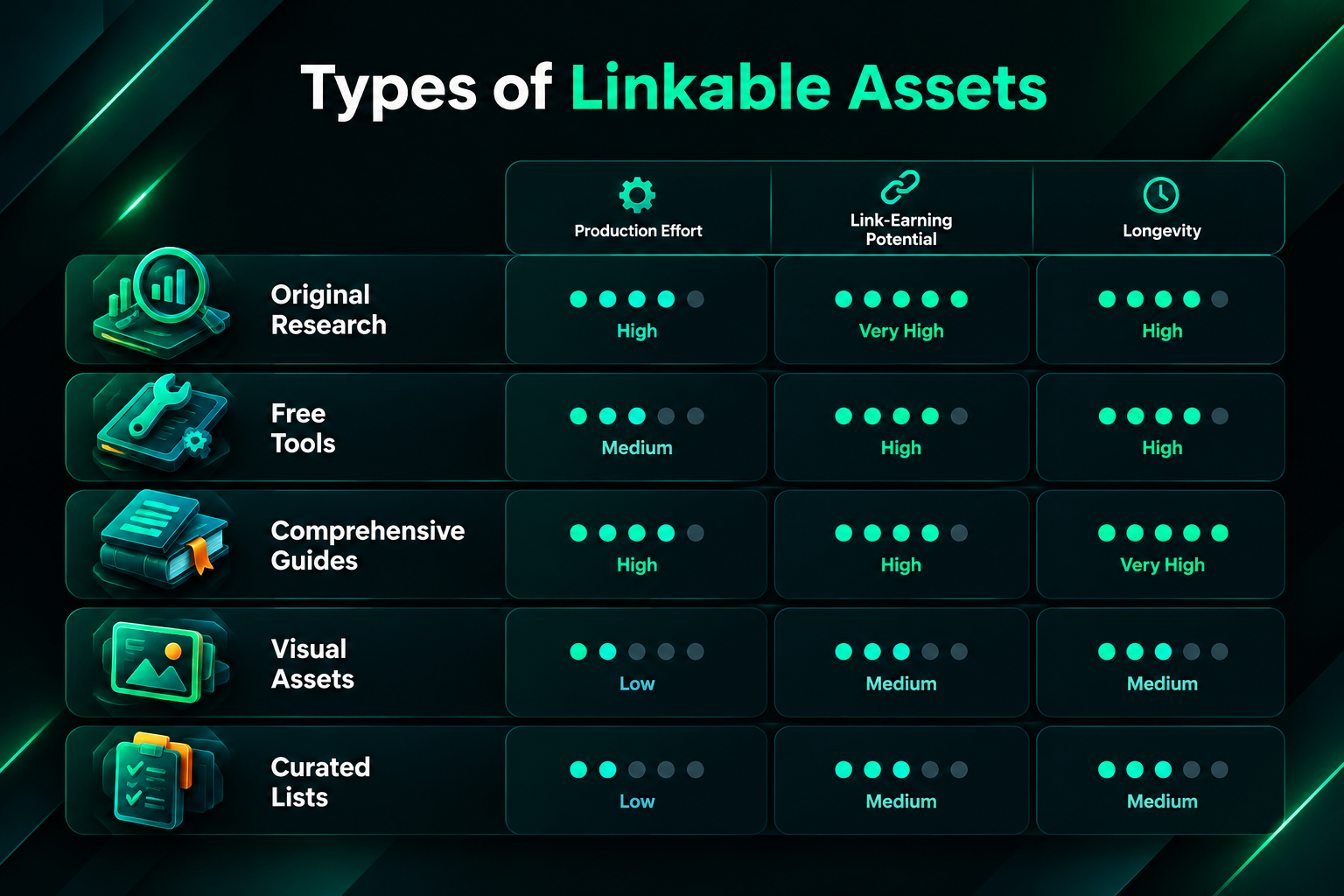
Different asset formats attract links in different ways, and the right choice depends on your industry, audience, and available resources. The following categories represent the most commonly used and documented types.
Original Research and Data Studies
Original research — surveys, proprietary data analyses, industry benchmarks, or aggregated datasets — is one of the most consistently cited linkable asset formats. Publishers and journalists frequently need statistics to support their articles, and when your website is the primary source of a specific data point, you become the natural citation target. The key requirement is that the data must be genuinely original; republishing or summarizing publicly available statistics rarely attracts links because the original source already exists.
Producing original research requires investment in survey design, data collection, and presentation, but the resulting asset can attract links over an extended period if the topic remains relevant. Annual or regularly updated studies tend to accumulate links across multiple publication cycles as publishers return to cite the latest edition.
Comprehensive Guides and Definitive Resources
Long-form guides that cover a topic more thoroughly than existing resources can attract links from publishers who want to point their readers toward a reliable reference. The emphasis here is on genuine comprehensiveness and accuracy rather than length alone. A guide that answers questions other resources leave unanswered, or that organizes complex information more clearly, has a stronger case for earning links than a long article that simply repeats common knowledge.
Comprehensive guides work particularly well in technical, professional, or regulated industries where accurate, well-organized information is genuinely scarce. In highly competitive niches where many detailed guides already exist, differentiation becomes harder and the asset may require more active promotion to generate links.
Free Tools and Calculators
Interactive tools — calculators, generators, assessment frameworks, or diagnostic utilities — attract links because they provide ongoing utility that static content cannot replicate. A financial planning calculator, an SEO audit checklist, or a carbon footprint estimator gives publishers a concrete, functional resource to recommend to their readers. Tools tend to accumulate links steadily over time because they remain useful as long as the underlying need exists.
The main limitation is production cost. A well-built interactive tool requires development resources, ongoing maintenance, and sometimes hosting infrastructure. For businesses without in-house development capacity, this can represent a significant upfront investment relative to other asset types.
Visual Assets: Infographics, Charts, and Diagrams
Visual assets can attract links when they present complex data or processes in a format that is easier to understand than text alone. Infographics summarizing research findings, process diagrams explaining technical workflows, or comparison charts covering industry benchmarks can all serve as embeddable resources that publishers reference with a link.
The effectiveness of infographics as a link acquisition format has become more variable over time. Early adoption of the format produced strong results, but widespread use has made publishers more selective. Visual assets are most likely to attract links when they present genuinely original data or offer a clearer explanation of a complex topic than existing resources, rather than simply presenting common knowledge in a visual format.
Curated Resource Lists and Industry Directories
Carefully curated lists of tools, resources, organizations, or references can attract links from the entities included in the list and from publishers who want to point readers toward a reliable starting point. The value of a curated resource depends on the quality and relevance of its curation rather than its length. A well-maintained list of vetted resources in a specific niche can become a go-to reference, while a generic list of loosely related links is unlikely to attract meaningful attention.
Original Visuals, Templates, and Downloadable Resources
Templates, frameworks, checklists, and downloadable documents can attract links when they save practitioners meaningful time or provide a structured approach to a common task. A content calendar template, a project brief framework, or a compliance checklist for a regulated industry can all serve as linkable assets if they are genuinely useful to the target audience and not easily replicated elsewhere.
What Makes Content Genuinely Link-Worthy?
Format is a starting point, but it does not determine whether an asset will attract links. Several underlying characteristics tend to distinguish assets that earn editorial backlinks from content that does not, regardless of format.
- Originality: The asset presents information, data, or utility that is not readily available elsewhere. Republishing or lightly repackaging existing content rarely provides sufficient reason for another publisher to link to your version rather than the original source.
- Audience specificity: The asset addresses the genuine informational or practical needs of a clearly defined audience. Broadly general content competes with a large volume of existing resources and is harder to position as a preferred reference.
- Citability: The asset contains specific, quotable facts, statistics, or conclusions that a journalist or blogger can reference in a sentence. Assets that are difficult to summarize or cite in a single sentence are harder to link to naturally.
- Credibility: The asset demonstrates methodological transparency, authorial expertise, or institutional credibility that makes publishers comfortable citing it. Unsourced claims or anonymous content are less likely to attract editorial links from quality publishers.
- Longevity or recurrence: Assets that remain accurate and useful over time, or that are updated regularly, continue to attract links after initial publication. Highly time-sensitive content may generate short-term interest but loses link-earning potential quickly.
How Linkable Assets Fit Into a Link Building Campaign
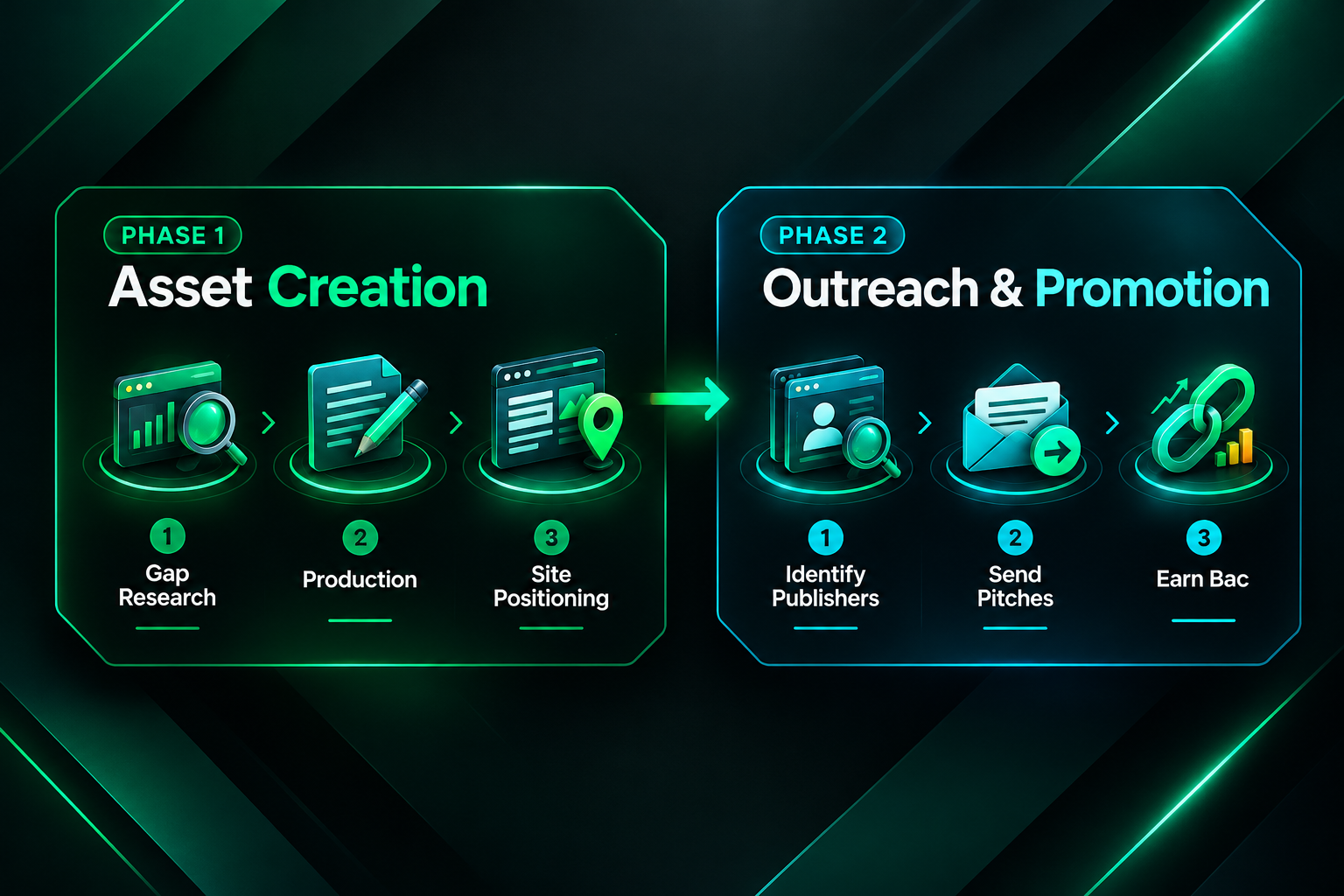
Creating a linkable asset does not automatically generate backlinks. Most assets require active promotion to reach the publishers and audiences most likely to link to them. In practice, linkable asset campaigns typically involve two distinct phases: asset creation and outreach.
Asset Creation and Positioning
Effective asset creation begins with identifying a genuine gap in available resources — a question that existing content does not answer well, a dataset that does not yet exist publicly, or a tool that practitioners in a specific field would find useful. This requires research into what publishers in your target niche are already linking to, what topics generate consistent demand, and where your organization has the credibility or data access to produce something genuinely original.
Positioning the asset correctly on your website also matters. The asset should be hosted on a page that is crawlable, indexable, and clearly associated with your brand or organization. A well-structured landing page that explains the asset’s value and methodology makes it easier for publishers to understand what they are linking to and why it is credible.
Outreach and Promotion
Once an asset is live, targeted outreach to relevant publishers, journalists, bloggers, and industry organizations is typically required to generate an initial volume of links. This outreach involves identifying websites that have previously linked to similar resources, explaining the asset’s value concisely, and making it easy for the recipient to reference or embed the content.
The outreach process for linkable assets differs from standard guest post outreach. Rather than proposing to write content for another site, you are presenting an existing resource that the publisher can reference in their own content. This means the pitch needs to be concise, the asset’s value needs to be immediately apparent, and the relevance to the publisher’s audience needs to be clear.
Outreach volume and targeting quality both affect results. Reaching a large number of loosely relevant publishers is generally less effective than identifying a smaller set of highly relevant sites where the asset genuinely fits the editorial context. Response rates and link conversion rates vary considerably depending on the niche, the asset quality, and the outreach approach.
Combining Linkable Assets With Other Link Building Methods
Linkable assets are rarely the only link building method used in a campaign. They tend to work well alongside guest posting, digital PR, and niche edit outreach. A strong asset can support guest post pitches by giving the author a credible resource to reference within the guest content. It can also support digital PR campaigns by providing journalists with original data or a visual that makes a story more compelling.
For websites that lack the content infrastructure to support a standalone asset campaign, other link acquisition methods may be more immediately practical. The right combination depends on the website’s existing authority, content quality, target pages, and available budget.
Realistic Expectations and Limitations
Linkable asset campaigns can be an effective component of a long-term link acquisition strategy, but several limitations are worth understanding before committing resources to this approach.
Production investment is significant. Original research, interactive tools, and comprehensive guides all require meaningful time and budget to produce well. A poorly executed asset — one that presents inaccurate data, lacks methodological transparency, or covers a topic already well-served by existing resources — is unlikely to attract links regardless of how much outreach is conducted.
Results are not guaranteed or immediate. Even a high-quality asset may take weeks or months to accumulate a meaningful number of backlinks, particularly in competitive niches where publishers receive many outreach requests. The timeline from asset publication to measurable SEO impact can be extended further by the time required for search engines to crawl, index, and process new links.
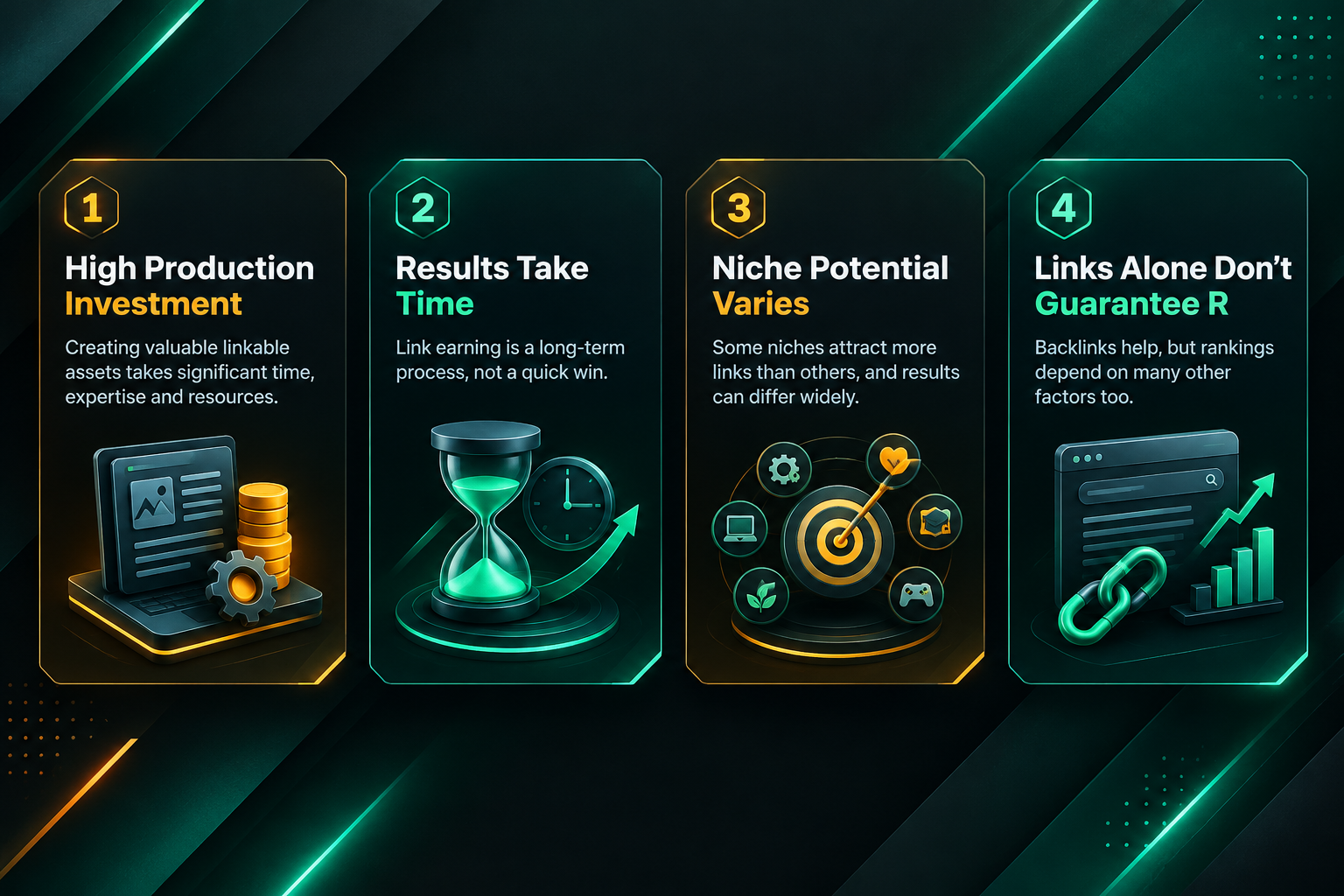
Not all niches have equal link-earning potential. Some industries — technology, finance, health, and marketing — have large ecosystems of publishers actively looking for data and resources to cite. Other niches have fewer active publishers, smaller audiences, and less demand for the type of content that typically attracts links. A realistic assessment of the target niche’s link-earning environment should inform how much investment is allocated to asset creation versus other link building methods.
Links from assets do not automatically translate to ranking improvements. Backlinks are one of many factors that may influence search rankings. A website with significant technical SEO issues, weak on-page content, or a search-intent mismatch on its target pages may not see meaningful ranking improvements from additional backlinks alone. A site-specific assessment is appropriate before attributing ranking changes — or the absence of them — to a link building campaign.
Assessing Whether a Linkable Asset Strategy May Suit Your Website
A linkable asset approach may be worth considering if your website meets several conditions. Your organization should have access to original data, specialized expertise, or development resources that can produce something genuinely differentiated. Your target niche should have an active publishing ecosystem where relevant websites regularly link to external resources. And your existing content and technical SEO should be in reasonable condition, so that new backlinks have a foundation to build on.
Websites that may find this approach less immediately suitable include those in very narrow niches with few active publishers, those without the budget to produce high-quality assets, and those with significant technical or content issues that should be addressed before investing in link acquisition. In these cases, other link building methods — such as targeted guest posting or niche edit outreach — may deliver more predictable results in the near term while the conditions for an asset campaign are developed.
If you are working with an outsourced link building provider, it is worth discussing whether your current content infrastructure supports an asset-led approach or whether a different acquisition method would be more appropriate for your goals and timeline.
Frequently Asked Questions
How is a linkable asset different from a regular blog post?
A regular blog post is typically written to attract and inform your own audience. A linkable asset is created specifically because it offers something — original data, a useful tool, a comprehensive reference — that other publishers will want to cite. The distinction is about the asset’s value to third-party publishers, not just to your own readers. Many blog posts can be made more link-worthy by incorporating original research or unique data, but the intent and execution differ from standard content marketing.
Do linkable assets work for every industry?
Not equally. Industries with large, active publishing ecosystems — technology, finance, health, marketing, and education — tend to offer more opportunities for assets to attract links because there are more publishers actively looking for credible resources to cite. In narrower or more specialized niches, the pool of relevant publishers is smaller, which limits the potential link volume from any single asset. A realistic assessment of your niche’s publishing environment should inform how much you invest in this approach.
How long does it take for a linkable asset to generate backlinks?
Timelines vary considerably. An asset supported by active outreach may begin attracting links within a few weeks of publication. However, the broader SEO impact — measurable changes in rankings or organic traffic — typically takes longer to become apparent, often several months, depending on how quickly search engines crawl and process new links and how competitive the target keywords are. Assets that remain relevant over time can continue attracting links well beyond the initial outreach period.
Can I use a linkable asset to build links to commercial pages?
Directly, this is difficult. Commercial pages — product listings, pricing pages, service descriptions — rarely attract editorial links because they serve the site owner’s interests rather than the reader’s. The more common approach is to host the linkable asset on a dedicated resource page and use internal linking to connect it to relevant commercial pages. This allows the authority from inbound links to flow through the site’s internal link structure toward the pages you want to rank.
What is the difference between a linkable asset and digital PR?
Digital PR typically involves creating a story, campaign, or piece of content designed to attract coverage from journalists and news publishers, often with a focus on high-authority media outlets. Linkable assets are a broader category that includes tools, guides, datasets, and other resources that attract links from a wider range of publishers, not just news media. Original research can serve both purposes simultaneously — functioning as a linkable asset for ongoing outreach and as the basis for a digital PR campaign targeting journalists at the time of publication.
Does the format of a linkable asset matter more than its content?
Content quality and originality matter more than format. An infographic presenting widely available information is unlikely to attract links simply because it is visual. A straightforward text-based data study presenting genuinely original findings can attract significant links without any visual enhancement. Format can make an asset easier to reference or embed, which may support link acquisition, but it does not substitute for the underlying value of the information or utility the asset provides.
Should I create a linkable asset before starting outreach, or can I do both simultaneously?
The asset should be fully live and accessible before outreach begins. Publishers who receive a pitch for a resource that is not yet available, or that is incomplete, are unlikely to link to it. Outreach is most effective when the publisher can immediately evaluate the asset and decide whether it is worth referencing. Planning the outreach strategy in advance — identifying target publishers, preparing pitch messaging, and building a contact list — can happen during asset production, but the outreach itself should follow publication.
Deciding Whether Linkable Assets Belong in Your Link Building Strategy
Linkable assets represent one of the more sustainable approaches to link acquisition because they create resources that can attract editorial backlinks over an extended period rather than requiring a new outreach effort for every individual link. When executed well — with genuine originality, clear audience relevance, and active promotion — they can contribute meaningfully to a website’s backlink profile and support broader SEO goals.
The practical decision comes down to whether your organization has the resources and niche conditions to make asset creation worthwhile. If you have access to original data, specialized expertise, or development capacity, and your target niche has an active publishing ecosystem, an asset-led approach may be a strong complement to other link building methods. If those conditions are not yet in place, other acquisition strategies may deliver more predictable results while you build the content infrastructure needed to support a successful asset campaign.
A qualified link building provider can help assess whether your current website and content situation supports an asset-based approach, or whether a different combination of methods — guest posting, niche edits, digital PR, or targeted outreach — would better serve your goals at this stage. The right strategy depends on your specific website, competitive environment, and objectives rather than on any single format or tactic.


