

An unnatural links manual action is one of the more serious penalties Google can apply to a website. Unlike algorithmic adjustments that happen silently, a manual action is issued by a human reviewer at Google and recorded directly in Google Search Console. It can suppress rankings for specific pages or, in severe cases, for an entire domain. Recovery is possible, but it requires a structured approach: identifying which links triggered the action, removing or disavowing them, demonstrating that the problem has been resolved, and then waiting for Google to review your reconsideration request. This guide explains each stage in practical terms so you can approach the process with realistic expectations.
Key Takeaways
- An unnatural links manual action is issued by a Google reviewer and recorded in Google Search Console under Security & Manual Actions; it is distinct from algorithmic ranking changes.
- Recovery requires a full backlink audit, genuine outreach to remove harmful links where possible, and a disavow file for links that cannot be removed.
- A reconsideration request must explain what you found, what you did, and why the problem will not recur — vague submissions are typically rejected.
- Review timelines vary; Google has stated that reconsideration requests can take several weeks to assess, and ranking recovery after a successful review may take additional time.
- Preventing a recurrence means maintaining a clean link acquisition strategy going forward, which may include auditing any outsourced or agency-managed link building activity.
What an Unnatural Links Manual Action Actually Means
Google’s spam policies prohibit link schemes — practices designed to manipulate PageRank or a site’s ranking in search results. When a manual reviewer determines that a website has participated in such schemes, either by acquiring manipulative links pointing to the site or by selling or distributing links from the site, they can apply a manual action. Google Search Console displays the action under Security & Manual Actions > Manual Actions, and the notification typically describes whether the action is site-wide or partial.
A site-wide manual action affects the entire domain and can cause significant drops across all rankings. A partial match manual action targets specific pages or sections and may be less immediately visible in traffic data, but it still suppresses the affected URLs. Both types require the same core recovery process: audit, remediate, document, and request reconsideration.
It is worth distinguishing a manual action from an algorithmic penalty. If your rankings dropped but Google Search Console shows no manual action, the cause may be an algorithmic update such as a core update or a link-quality signal adjustment rather than a human-issued penalty. The recovery approach for algorithmic issues differs from the formal reconsideration process described here, and conflating the two can lead to wasted effort.
Step 1 — Conduct a Thorough Backlink Audit
Before you can remediate anything, you need a complete picture of your backlink profile. Export your link data from Google Search Console using the Links report, then supplement it with data from third-party tools such as Ahrefs, Semrush, or Majestic. No single source captures every referring domain, so combining at least two data sets reduces the risk of missing problematic links.
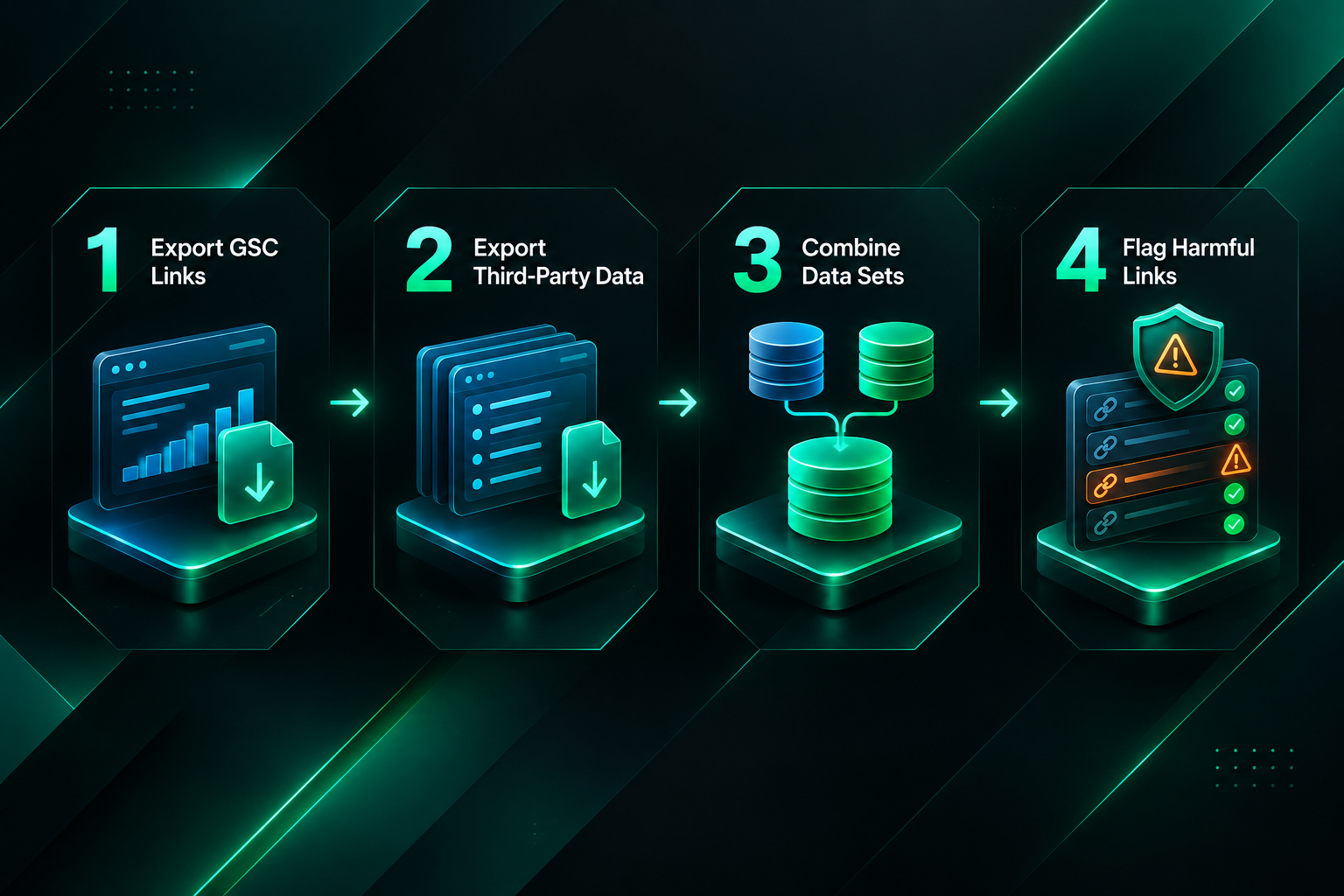
When reviewing the data, look for patterns that are commonly associated with manipulative link schemes:
- Links from sites that exist primarily to sell or exchange links, often identifiable by thin content, unrelated topics, or large numbers of outbound links to unrelated domains.
- Links acquired through private blog networks (PBNs), which typically share hosting, registration details, or templated content across multiple domains.
- Exact-match or keyword-rich anchor text used at an unusual scale, particularly when the anchor text matches commercial target keywords across many different referring domains.
- Links from directories or article submission sites that accepted content without editorial review.
- Reciprocal link exchanges conducted at scale or as part of a formal arrangement.
- Links from sites in unrelated languages or geographies that have no plausible editorial reason to reference your content.
- Paid links that pass PageRank without a rel="sponsored" or rel="nofollow" attribute, which Google’s policies require for compensated placements.
Document each suspicious link with its source URL, target URL on your site, anchor text, and your assessment of why it may be problematic. This documentation becomes the foundation of your reconsideration request. Avoid the temptation to flag every low-authority link as harmful — the goal is to identify links that are genuinely manipulative or policy-violating, not simply links from smaller websites.
Step 2 — Attempt to Remove Links Through Outreach
Google’s reconsideration guidance has historically emphasized that site owners should make a genuine effort to remove harmful links before relying on the disavow tool. While the disavow file is the practical mechanism that carries most of the weight in modern recovery cases, documented outreach demonstrates good faith and strengthens your reconsideration request.
For each domain hosting a problematic link, identify a contact method — typically a contact form, a listed email address, or a WHOIS-registered contact. Send a clear, professional removal request that specifies the exact URL containing the link and the URL on your site it points to. Keep the message factual and avoid language that could be interpreted as threatening or accusatory.
Record every outreach attempt: the date, the contact method used, the message sent, and any response received. If a webmaster does not respond within approximately two weeks, send one follow-up. If there is still no response, or if the webmaster declines to remove the link, note this in your records and proceed to the disavow file. You are not expected to achieve 100% removal; documented attempts that were ignored or refused are accepted as part of the process.
In practice, many of the sites hosting manipulative links are abandoned, have no working contact information, or are operated by parties with no incentive to cooperate. This is why the disavow tool exists — it allows you to signal to Google that you do not want specific links counted, even when removal is not possible.
Step 3 — Build and Submit a Disavow File
The Google disavow tool, accessible through Google Search Console, allows you to upload a plain-text file listing URLs or entire domains that you want Google to ignore when assessing your backlink profile. Google’s own documentation recommends disavowing at the domain level (using the format domain:example.com) when an entire site is problematic, rather than listing individual URLs one by one, which can be incomplete if the same domain hosts multiple harmful links.
Constructing the disavow file carefully matters. Including legitimate, editorially earned links in the disavow file can remove signals that are helping your rankings. Conversely, being too conservative and omitting genuinely harmful links may mean the manual action is not fully addressed. The audit documentation from Step 1 should guide which domains belong in the file.
The disavow file format is straightforward: one entry per line, with domain-level entries prefixed by domain: and comment lines beginning with #. Comments are useful for your own records and for explaining the file’s logic to anyone reviewing it later. Once the file is prepared, upload it through the disavow links tool in Search Console. Google processes the file over time; it does not take effect instantly.
Keep a copy of every version of your disavow file. If you later acquire new links that need to be added, you must upload a complete updated file — the new upload replaces the previous one entirely rather than appending to it.
Step 4 — Write a Credible Reconsideration Request
Once you have completed the audit, attempted outreach, and submitted the disavow file, you can submit a reconsideration request through Google Search Console. The request is reviewed by a human at Google, so the quality and honesty of what you write directly affects the outcome.
A credible reconsideration request typically covers three areas:
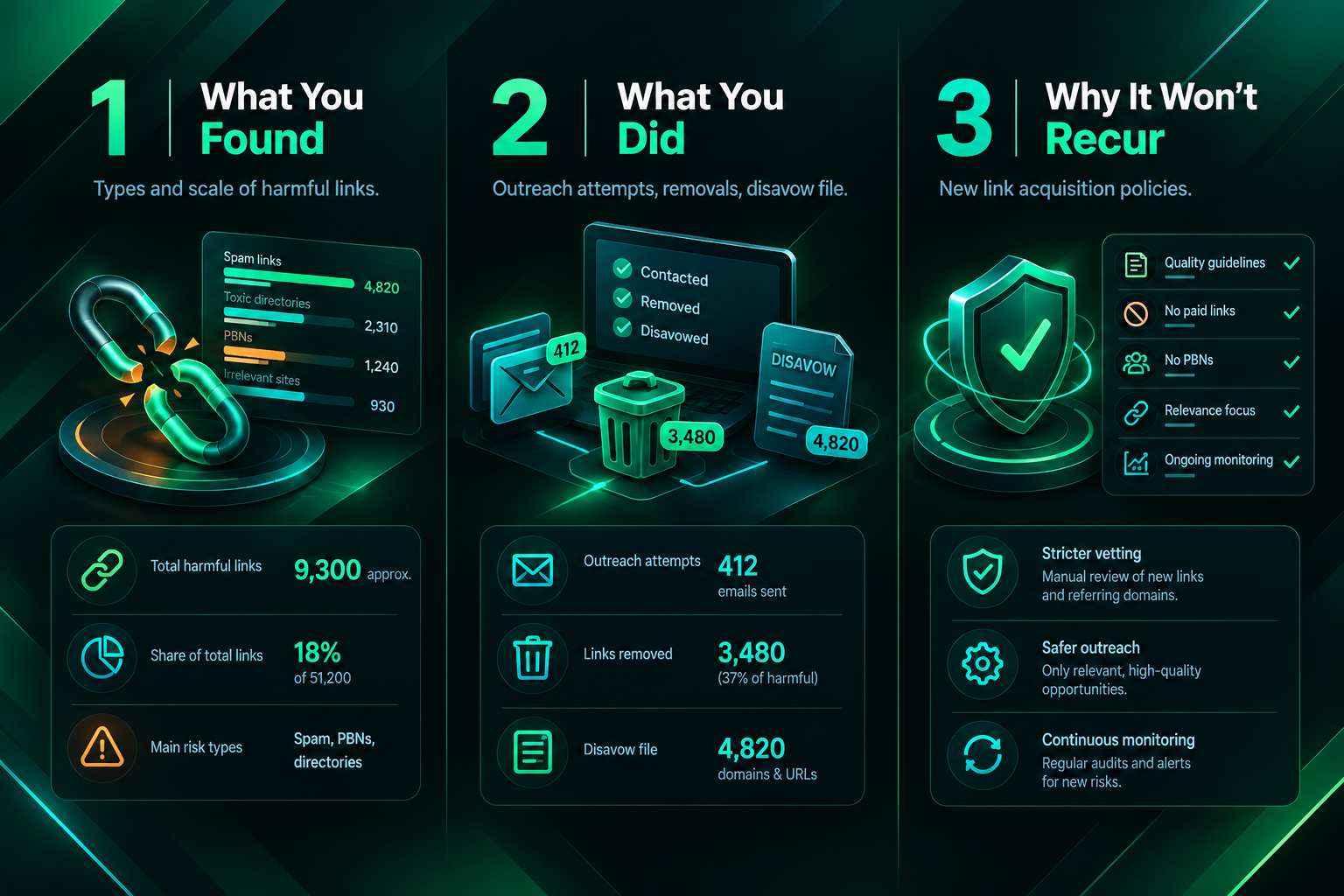
- What you found: Summarize the types of links identified as problematic, the scale of the issue, and how the links were likely acquired — whether through a past agency, an in-house campaign, or a practice that has since been discontinued.
- What you did: Describe the outreach attempts, including the number of domains contacted, the number of links removed, and the number of domains included in the disavow file. Reference your documentation without pasting every detail into the request itself.
- Why it will not happen again: Explain the changes made to your link acquisition practices. This might include ending a relationship with a link vendor, implementing internal review processes for future link building, or committing to editorial-only link acquisition going forward.
Avoid vague language such as "we have cleaned up our links" without specifics, and avoid blaming the problem entirely on a third party without acknowledging any responsibility. Google’s reviewers are experienced; a request that reads as evasive or incomplete is likely to be rejected. If the manual action was genuinely caused by a previous agency or vendor, explain this clearly while also describing the steps taken to prevent recurrence.
Do not submit a reconsideration request before the remediation work is complete. Submitting prematurely and receiving a rejection resets the clock and may complicate subsequent attempts.
What Happens After You Submit
Google has stated that reconsideration requests can take several weeks to process, and in some cases longer depending on the complexity of the backlink profile and the volume of requests being reviewed. You will receive a notification in Google Search Console when the review is complete. The outcome will be one of two results: the manual action is revoked, or Google determines that the issues have not been sufficiently addressed.
If the manual action is revoked, rankings may begin to recover, but this is not immediate. Google needs to recrawl and reindex affected pages, and the time this takes depends on the size of the site, crawl frequency, and how long the manual action was in place. Ranking recovery after a successful reconsideration review can take weeks to months, and the extent of recovery depends on factors beyond the manual action itself, including content quality, technical SEO condition, and the competitive landscape for your target keywords.
If the request is rejected, Google’s notification typically provides some indication of what remains unresolved. Review the feedback carefully, revisit your audit to identify links that may have been missed, update the disavow file if necessary, and resubmit. Multiple submission rounds are not uncommon for sites with large or complex backlink profiles.
Partial Match vs Site-Wide Manual Actions: Does the Approach Differ?
The core recovery process is the same for both partial and site-wide manual actions, but the scope of the audit differs. A partial match action specifies which sections or pages are affected, which can help focus the initial audit. However, it is generally advisable to review the entire backlink profile rather than only the links pointing to the flagged pages, because a comprehensive audit may reveal additional problematic links that could trigger a broader action or complicate future reconsideration requests.
For a site-wide action, the audit necessarily covers all referring domains across the entire domain. This is more time-consuming but unavoidable. Prioritize the highest-volume referring domains and the most obviously manipulative link patterns first, then work through the remainder systematically.
The Role of Link Building Practices in Preventing Recurrence
A manual action recovery is only durable if the link acquisition practices that caused the problem are genuinely changed. Many unnatural links manual actions are connected to past use of link schemes, paid link networks, or low-quality guest posting at scale — practices that were once more common and are now clearly addressed in Google’s spam policies.
Going forward, link acquisition should focus on editorially earned placements: links that exist because a publisher or author found your content genuinely useful or relevant. Manual outreach for guest posting on topically relevant, editorially selective publications, digital PR campaigns that earn coverage through newsworthy content, and link-worthy asset creation are approaches that align with Google’s documented guidelines for link acquisition.
If you work with an external link building provider or agency, the recurrence risk depends significantly on how that provider acquires links. Providers that operate transparent outreach campaigns, disclose their publisher selection criteria, and avoid link networks or guaranteed-placement schemes present a different risk profile than those offering large volumes of links at low cost with no editorial process. After a manual action, scrutinizing any outsourced link building activity is a practical step before resuming campaigns.
It is also worth noting that rel="sponsored" and rel="nofollow" attributes exist precisely to allow compensated or editorially unverified links to be disclosed without violating Google’s policies. Ensuring that any paid placements use the correct link attributes going forward reduces the risk of future policy violations, even if the placement itself is on a legitimate publisher.
Common Mistakes That Delay Recovery
Several avoidable errors can extend the recovery timeline or result in repeated reconsideration rejections:
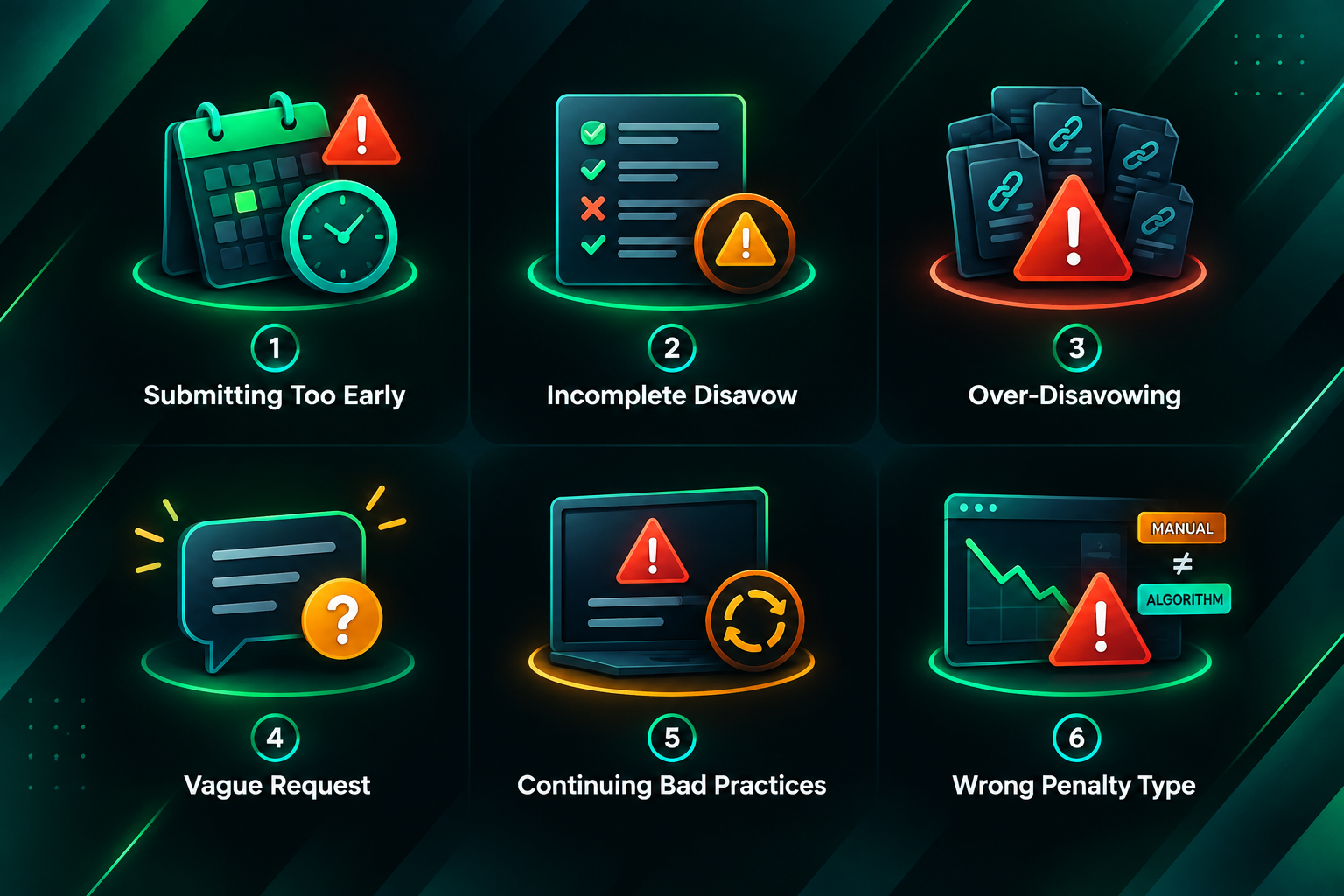
- Submitting the reconsideration request too early, before the disavow file has been uploaded and outreach has been documented. Google’s reviewer will assess the current state of the backlink profile, and if problematic links are still present and not disavowed, the request is likely to fail.
- Using an incomplete disavow file that covers only the most obvious harmful links while leaving others in place. A partial disavow may not be sufficient to satisfy the reviewer that the issue has been addressed.
- Disavowing legitimate links out of excessive caution, which can remove positive ranking signals and make recovery slower even after the manual action is lifted.
- Writing a vague reconsideration request that does not explain the specific links found, the specific actions taken, or the specific changes made to prevent recurrence.
- Continuing to acquire links through the same methods that caused the original action, which can result in a new manual action being issued even after the first is revoked.
- Confusing an algorithmic ranking drop with a manual action and submitting a reconsideration request when no manual action exists. Reconsideration requests are only relevant when a manual action is recorded in Search Console.
Frequently Asked Questions
How long does it take to recover from an unnatural links manual action?
The timeline varies depending on the complexity of the backlink profile, the quality of the reconsideration request, and Google’s current review queue. Google has indicated that reviews can take several weeks. After a successful review, ranking recovery may take additional weeks or months as Google recrawls and reassesses affected pages. There is no fixed timeline, and results depend on many factors beyond the manual action itself.
Do I need to remove every low-quality link, or only the ones that caused the manual action?
The goal is to address links that are genuinely manipulative or policy-violating, not every link from a smaller or lower-authority website. Low-authority links that were editorially placed and are not part of a link scheme do not need to be disavowed. Over-disavowing can remove legitimate ranking signals. Focus the audit on links that match the patterns described in Google’s spam policies.
Can I use the disavow tool without submitting a reconsideration request?
Yes. The disavow tool can be used at any time to signal to Google that you do not want certain links counted. However, if a manual action has been issued, uploading a disavow file alone does not lift the action — you must also submit a reconsideration request and have it approved. The disavow file is a supporting element of the reconsideration process, not a substitute for it.
What if the harmful links were built by a previous SEO agency without my knowledge?
This is a common situation. Google’s reconsideration process does not require that you personally authorized the links — it requires that you identify and address them. Explain clearly in the reconsideration request that the links were acquired by a third party, describe how you discovered this, and document the steps taken to remediate the profile and prevent recurrence. Honesty about the circumstances is more effective than attempting to minimize the issue.
Will my rankings fully return after the manual action is lifted?
Not necessarily, and not immediately. Lifting a manual action removes the penalty, but rankings depend on many other factors including content quality, technical SEO, competition, and the overall backlink profile after disavowal. Some sites recover to pre-penalty levels; others do not, particularly if the disavow file removed a significant portion of the link signals that previously supported rankings. A site-specific SEO assessment after recovery can help identify what additional work may be needed.
Should I pause all link building while recovering from a manual action?
Continuing to acquire links through the same methods that caused the manual action during the recovery period is inadvisable. However, pausing all link building is not necessarily required if you are confident that your current acquisition methods are editorially sound and policy-compliant. The priority during recovery is completing the audit, remediation, and reconsideration process; new link acquisition should be carefully reviewed before resuming.
Deciding Whether to Handle Recovery In-House or Seek Specialist Support
Manual action recovery is a methodical process, but it is time-intensive and requires careful judgment at each stage — particularly during the audit, when distinguishing genuinely harmful links from low-authority but legitimate ones can be difficult without experience. For websites with large backlink profiles, complex link histories, or previous failed reconsideration attempts, working with an SEO professional or a link building specialist who has experience with backlink audits and Google’s reconsideration process may reduce the risk of errors that extend the recovery timeline.
If you do engage external support, look for providers who can demonstrate a clear audit methodology, who are transparent about how they assess link quality, and who can help you build a documented case for the reconsideration request rather than simply uploading a disavow file and submitting a generic message. The quality of the reconsideration request matters as much as the technical remediation work.
After recovery, the link acquisition strategy going forward deserves the same level of scrutiny. Manual outreach campaigns targeting editorially selective publishers, transparent reporting on placement quality, and clear policies on link attributes for any compensated placements are practical measures that reduce the likelihood of a future manual action. If you are considering outsourcing link building after a manual action, discussing your site’s history openly with any prospective provider allows them to assess suitability and recommend an approach that fits your situation.


