

Finding suitable guest posting sites is one of the more time-consuming parts of any link building campaign. The process involves more than running a quick search and sending emails — it requires identifying publishers that are genuinely relevant to your niche, editorially credible, and likely to accept well-written contributions. This guide covers the main discovery methods, how to evaluate the sites you find, common mistakes to avoid, and when it may make sense to delegate the process to a specialist.
Key Takeaways
- Guest posting site discovery combines search operator techniques, competitor backlink research, and outreach tool prospecting — no single method covers every opportunity.
- Publisher quality matters more than volume; a small number of editorially strong placements is generally preferable to many low-quality ones.
- Third-party metrics such as Domain Rating (Ahrefs) or Domain Authority (Moz) are useful filters but are not Google-provided signals and should not be the only quality criteria.
- Manual outreach to real editorial publishers takes time; realistic timelines from prospecting to a live placement often range from several weeks to a few months.
- Outsourcing prospecting and outreach to an experienced provider can reduce internal workload, though the quality of the resulting placements depends heavily on the provider’s vetting process.
What Makes a Guest Posting Site Worth Targeting?
Before exploring discovery methods, it helps to define what a worthwhile guest posting site actually looks like. The goal of guest posting as a link building tactic is to earn a contextually relevant backlink from a publisher that search engines are likely to treat as a credible source. That means the site should have genuine editorial standards, real organic traffic, and content that is topically related to your own website or the page you want to build authority toward.
Several characteristics are worth assessing before you invest time in outreach. Topical relevance is arguably the most important: a link from a site covering your industry or subject area is generally more useful than one from an unrelated general blog. Organic visibility matters too — a site that receives meaningful search traffic is more likely to be indexed regularly and treated as an active, credible publisher. Editorial quality, meaning whether the site publishes original, well-researched content rather than thin or duplicated posts, is another meaningful signal.
Third-party authority metrics — such as Domain Rating from Ahrefs, Domain Authority from Moz, or Authority Score from Semrush — are commonly used as initial filters. These metrics estimate a domain’s link profile strength and can help you prioritise outreach, but they are proprietary calculations, not Google ranking signals. A high Domain Rating does not guarantee that a link from that site will improve your rankings, and a lower-metric site with strong topical relevance and genuine traffic may sometimes be more valuable. Use these metrics as a starting point, not a definitive verdict.
Search Operator Methods for Finding Guest Posting Sites
Search engines remain one of the most accessible starting points for guest posting site discovery. By combining your target topic with phrases that publishers commonly use to signal they accept contributions, you can surface a large initial list of candidates relatively quickly.
Common search operator patterns include combining your niche keyword with phrases such as “write for us”, “contribute an article”, “guest post guidelines”, “submit a guest post”, or “become a contributor”. For example, a marketing agency looking for placements might search for terms like digital marketing “write for us” or content marketing “guest post guidelines”. Varying the phrase helps because different publishers use different terminology on their submission pages.
Quotation marks around the submission phrase help narrow results to pages that contain that exact wording. You can also use the intitle: or inurl: operators to find sites where the submission page appears in the title or URL, which can surface more dedicated contributor portals. These techniques work across Google and Bing, though results will differ between the two.
One limitation of this approach is that it tends to surface the most visible and frequently targeted sites — meaning they may already receive a high volume of outreach and have longer response times or stricter requirements. Sites that do not advertise their guest posting programmes openly may still accept quality contributions but require a more personalised approach. Search operators are a useful starting point, not a complete prospecting strategy on their own.
Competitor Backlink Research
Analysing the backlink profiles of competing websites is one of the most efficient ways to find guest posting sites that are already proven to accept contributions in your niche. If a competitor has earned a guest post link from a particular publisher, that publisher has already demonstrated willingness to work with similar content — which makes it a more qualified prospect than a cold discovery.
Tools such as Ahrefs Site Explorer, Semrush Backlink Analytics, and Moz Link Explorer allow you to enter a competitor’s domain and review its referring domains. Filtering by link type or anchor context can help you identify which links are likely to be guest post placements rather than editorial mentions or directory listings. Looking at the surrounding anchor text and the page the link points to often gives useful context about whether the placement was a contributed article.
Reviewing multiple competitors rather than just one broadens your prospect list and helps you identify publishers that appear across several backlink profiles — a signal that the site is active and genuinely open to contributions. You can also use tools like Ahrefs Content Explorer to search for published articles in your niche and identify which domains are regularly publishing contributed content.
One practical consideration: competitor backlink data reflects past placements, and publisher policies change. A site that accepted guest posts a year ago may have closed its programme or changed its editorial standards. Always verify that a site is still actively publishing contributed content before investing significant outreach effort.
Outreach Platforms and Blogger Databases
Several platforms maintain databases of publishers who have indicated they accept guest contributions, which can speed up the initial prospecting phase. These include tools like BuzzStream, Pitchbox, and Hunter.io, which combine contact discovery with outreach management. Some platforms also include publisher metrics and categorisation by niche, which can help you filter prospects more efficiently.
Link building marketplaces and blogger outreach platforms — such as those that connect content creators with publishers — offer a different model. Rather than cold outreach, these platforms allow you to browse available placements and purchase them directly. The trade-off is that sites listed on open marketplaces are often aware they are being used for link building, which raises questions about editorial independence. Google’s link spam policies distinguish between editorially placed links and paid placements, and links acquired through marketplaces may carry a higher risk of being treated as paid links, particularly if the site does not use appropriate link attributes.
Blogger outreach databases can be a useful time-saving tool for building an initial prospect list, but they work best when combined with manual quality assessment rather than used as a direct purchasing channel. The presence of a site in a database does not confirm its editorial quality, traffic levels, or compliance with search engine guidelines.
Social Media and Community Prospecting
LinkedIn, Twitter (now X), and niche online communities such as industry forums, Slack groups, and Facebook groups can surface guest posting opportunities that do not appear in standard search results. Editors and content managers sometimes post calls for contributors directly in these spaces, and following relevant hashtags or joining industry communities can surface these opportunities in real time.
LinkedIn is particularly useful for identifying editors, content leads, and site owners at publications in your niche. A personalised connection request followed by a thoughtful pitch often performs better than a cold email, particularly for higher-tier publications that receive a large volume of generic outreach. Building a genuine professional presence in your niche — by publishing useful content, engaging with industry discussions, and demonstrating subject matter knowledge — can make outreach more effective over time.
This approach is slower than search operator prospecting but tends to surface higher-quality opportunities and can lead to ongoing contributor relationships rather than one-off placements. It requires consistent effort and is difficult to scale without a dedicated team.
Assessing Publisher Quality Before You Pitch
Identifying a potential guest posting site is only the first step. Before investing time in writing a pitch or a full article, it is worth conducting a basic quality assessment to reduce the risk of wasted effort or, more importantly, acquiring a link that provides little SEO value or carries policy risk.
A practical quality checklist might include the following considerations:
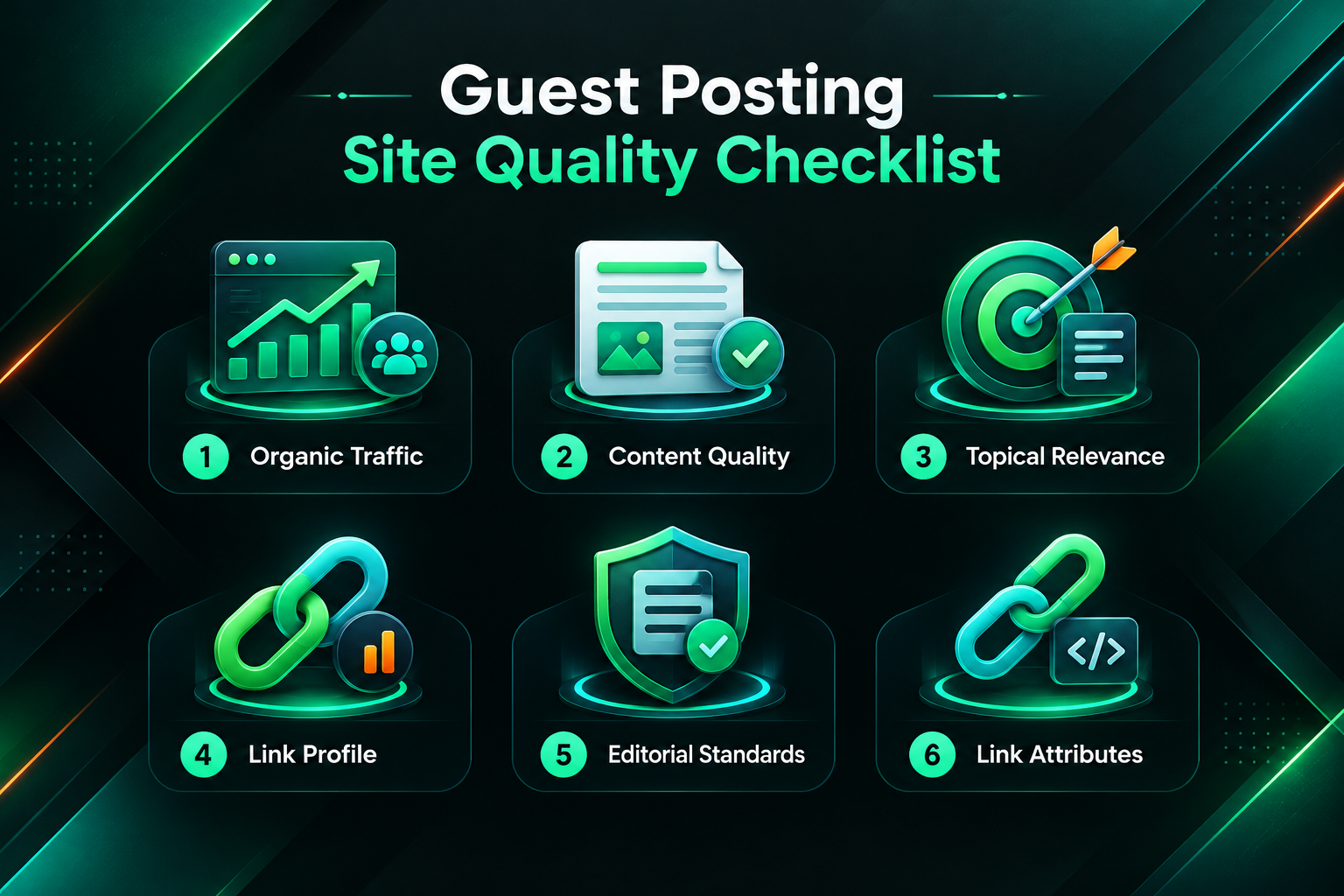
- Organic traffic: Does the site receive meaningful search traffic? Tools like Ahrefs Site Explorer or Semrush Domain Overview can provide estimated traffic figures, though these are approximations. A site with very low or declining organic visibility may not be actively indexed or trusted by search engines.
- Content quality: Is the existing content original, well-written, and genuinely useful? Sites that publish thin, duplicated, or AI-generated content at high volume are generally lower-quality prospects.
- Topical relevance: Does the site’s subject matter align with your niche or the topic of the page you want to build links toward?
- Link profile: Does the site have a natural-looking backlink profile, or does it appear to have been built primarily for link selling? A high ratio of outbound links to thin content, or a large number of links to unrelated commercial pages, can be a warning sign.
- Editorial standards: Does the site have a genuine editorial process, author bios, and identifiable contributors? Or does it publish any submitted content without apparent review?
- Link attributes: Are outbound links in guest posts followed, nofollowed, or sponsored? This affects whether the link passes authority and whether the placement aligns with search engine guidelines for paid or contributed content.
No single factor is definitive, and the right balance of criteria will depend on your campaign goals, niche, and the competitive landscape of your target keywords. A site-specific assessment is more reliable than applying a universal threshold.
Common Mistakes in Guest Posting Site Discovery
Several recurring mistakes reduce the effectiveness of guest posting prospecting and can create risks for a campaign.
Prioritising metric thresholds over relevance. Filtering prospects purely by Domain Rating or Domain Authority and ignoring topical fit often leads to placements that provide limited SEO benefit. A high-metric site in an unrelated niche may be less valuable than a lower-metric site with strong relevance and genuine audience overlap.
Targeting link farms and private blog networks. Some sites that appear in “write for us” searches exist primarily to sell links rather than to serve a genuine audience. These sites often have thin content, a high volume of outbound links to commercial pages, and little organic traffic. Links from such sites carry a higher risk of being discounted or penalised under Google’s link spam policies.
Ignoring publisher guidelines. Many sites that accept guest contributions publish detailed submission guidelines. Ignoring these — by pitching off-topic ideas, submitting articles that do not meet length or formatting requirements, or including excessive self-promotional links — significantly reduces acceptance rates and can damage your outreach reputation with that publisher.
Sending generic outreach at scale. Mass email campaigns with templated pitches tend to generate low response rates, particularly from higher-quality publishers who receive many similar messages. Personalised outreach that demonstrates familiarity with the site’s content and audience generally performs better, even if it takes more time per contact.
Neglecting ongoing monitoring. Guest post links can be removed, nofollowed, or the host page can be deleted after publication. Monitoring your placed links periodically — using tools like Ahrefs Alerts or Google Search Console — helps you identify lost placements and decide whether replacement outreach is warranted.
Scaling Guest Post Prospecting: In-House vs Outsourced
Building a reliable pipeline of guest posting opportunities requires consistent effort across prospecting, quality assessment, personalised outreach, content creation, and follow-up. For many businesses and agencies, this represents a significant internal workload — particularly when campaigns need to run at scale or across multiple client websites simultaneously.
In-house teams have the advantage of deep familiarity with the brand, audience, and content strategy, which can make pitches more authentic. However, prospecting and outreach at meaningful volume typically requires dedicated staff time, access to multiple SEO and outreach tools, and an established publisher network — resources that not every team has available.
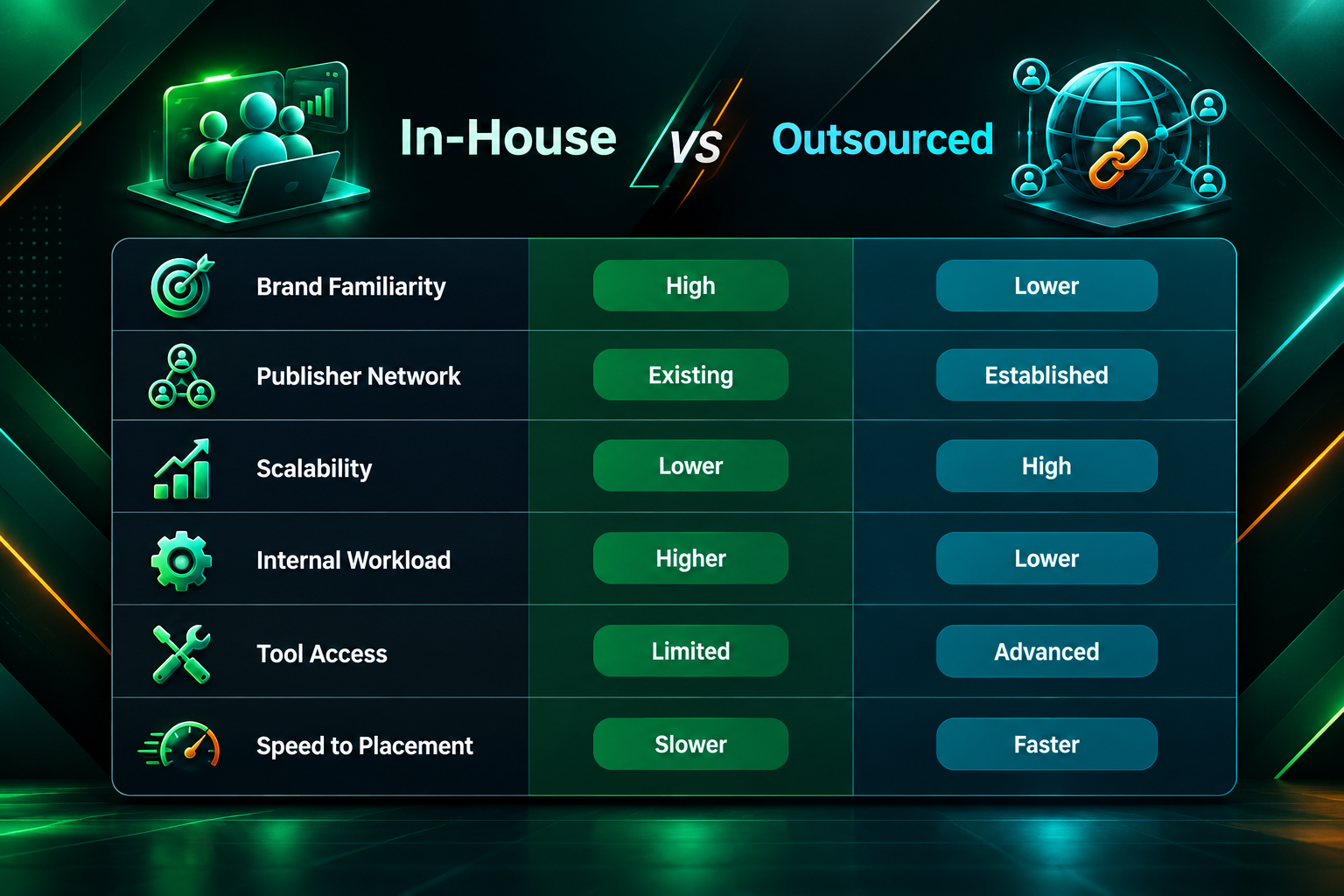
Outsourcing guest posting prospecting and outreach to a specialist provider can reduce internal workload and provide access to an existing publisher network, which may shorten the time from campaign start to live placements. The quality of outsourced campaigns varies considerably between providers, so it is worth understanding how a provider vets publishers, what their editorial standards are, and whether they conduct manual outreach to real sites or rely primarily on link marketplaces.
When evaluating an outsourced link building provider for guest posting campaigns, useful questions include: How do you identify and vet publishers? What is your process for assessing topical relevance and organic traffic? Do you conduct manual outreach or use a marketplace? How do you handle placements that are removed after publication? What reporting do clients receive? The answers to these questions give a clearer picture of whether the provider’s approach aligns with your quality requirements and risk tolerance.
Realistic Timelines and What to Expect
Guest posting campaigns rarely produce immediate results, and it is important to set realistic expectations before starting. The timeline from initial prospecting to a live placement typically involves several stages: building a prospect list, conducting quality assessment, personalising and sending outreach, negotiating with editors, writing and submitting content, and waiting for publication. Each stage takes time, and response rates from cold outreach are often low — particularly for higher-quality publishers.
Once a guest post is published and the link is live, there is a further delay before search engines crawl and index the new link. After indexing, any measurable effect on rankings or organic traffic may take additional weeks or months to become apparent, depending on the competitiveness of the target keywords, the overall strength of the website’s backlink profile, and other SEO factors. Link building is one component of a broader SEO strategy, and its impact is difficult to isolate from content quality, technical SEO, and other ranking factors.
Campaigns that require a meaningful number of placements across multiple target pages will generally need to run over several months rather than as a one-time exercise. Ongoing outreach is typically more effective than a single burst of activity, both because it builds publisher relationships over time and because the SEO benefit of backlinks tends to compound gradually rather than appearing all at once.
Frequently Asked Questions
How many guest posting sites should I target at once?
There is no universal answer. The right number depends on your campaign goals, the competitiveness of your target keywords, your content production capacity, and your outreach resources. Starting with a focused list of well-vetted prospects and expanding based on response rates is generally more effective than sending high-volume generic outreach to a large unfiltered list.
Is it better to find sites manually or use a tool or database?
Both approaches have a role. Manual discovery through search operators and competitor backlink research tends to surface more relevant and editorially credible sites. Outreach databases and platforms can speed up initial prospecting but require careful quality filtering. Using a combination of methods and applying consistent quality criteria to every prospect is usually more effective than relying on a single source.
What Domain Rating or Domain Authority threshold should I use?
There is no threshold that guarantees a link will improve rankings. These metrics are useful for prioritising outreach — a site with a higher Domain Rating has generally accumulated more links from other credible sources — but they are proprietary calculations, not Google signals. Topical relevance, organic traffic, and editorial quality are equally important filters. Applying a minimum metric threshold as a starting filter is reasonable, but it should not be the only criterion.
How do I know if a site is a link farm or a genuine publisher?
Warning signs include very high volumes of outbound links to commercial pages, thin or duplicated content, no identifiable editorial team or author bios, a backlink profile that appears artificially constructed, and very low or no organic traffic. Sites that openly advertise fixed-price guest post packages on their homepage are also worth scrutinising carefully, as this may indicate the site exists primarily to sell links rather than to serve a genuine audience.
Do guest post links need to be nofollowed or labelled as sponsored?
Google’s link spam policies state that links in guest posts that are paid for or exchanged for other consideration should use the rel=”sponsored” or rel=”nofollow” attribute. Purely editorial links — where a publisher independently decides to include a link based on content merit — are treated differently. In practice, the line between paid and editorial placements in guest posting can be blurry, and the appropriate link attribute depends on the specific arrangement. This is an area where understanding current search engine guidelines is important, and the policies may evolve over time.
Can I reuse the same guest post content on multiple sites?
Publishing identical or near-identical content across multiple sites is generally inadvisable. Search engines may treat duplicate content as lower quality, and many publishers explicitly require original, unpublished contributions. Each guest post should be written specifically for the target publication and its audience, which also tends to improve acceptance rates and the quality of the resulting placement.
Building a Guest Posting Strategy That Holds Up Over Time
Finding guest posting sites is a repeatable process, but the quality of the sites you target and the relationships you build with publishers will have a greater long-term impact than the raw number of placements you secure. A focused approach — identifying editorially credible publishers with genuine relevance to your niche, conducting personalised outreach, and contributing genuinely useful content — is more likely to produce durable SEO value than a high-volume approach that prioritises speed over quality.
The methods covered in this guide — search operator prospecting, competitor backlink research, outreach platform filtering, and community-based discovery — each surface different types of opportunities and work best in combination. Applying consistent quality criteria at the assessment stage reduces the risk of wasted outreach effort and helps ensure that the links you do acquire are from publishers that search engines are likely to treat as credible sources.
For businesses and agencies that need to run guest posting campaigns at scale, or that lack the internal resources for sustained prospecting and outreach, working with a specialist link building provider may be worth considering. If you are evaluating that option, asking detailed questions about publisher vetting, outreach methods, and quality standards will help you assess whether a provider’s approach is likely to meet your requirements. A qualified SEO professional can also help determine whether guest posting is the most appropriate link acquisition strategy for your specific website, competitive landscape, and campaign goals.


